
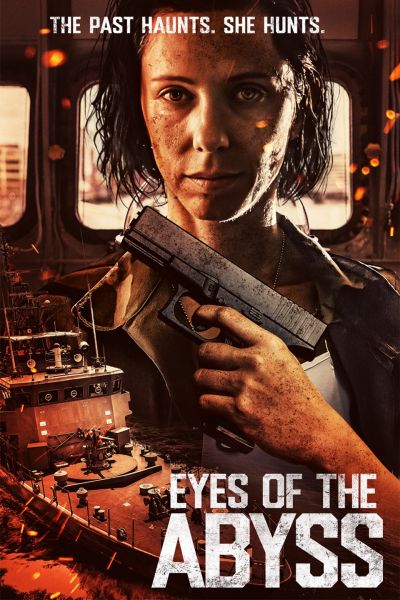
Thanks to Chris for finding this one. Albeit through a clip on a Chinese site under the name “Rescue From the Abyss”. This led to a significant diversion into movies about submarines, before eventually finding the correct, entirely submarine-free movie. No question, this is the hardest hitting film I’ve seen so far in 2026, though once you get past the action, things get more wobbly. Lily Chen (Ladouceur-Nguyen) is an operative for a shadowy government law enforcement group. She just learned about a potential promotion, though husband Jonathan is less enthusiastic and storms out. Before further discussion can occur, she gets a phone-call. The voice (Goad) informs her Jonathan is his hostage, and Lily needs to do exactly what he says.
His subsequent orders involve working her way through the criminal organization belonging to Marcel LaFleur (Moussi). Matters are complicated, as the voice eventually reveals that not everyone in Lily’s organization is as honest as she is. Can she trust even her boss, Director Bass (Berry)? There’s also backstory about a traumatic event in our heroine’s past, though this is largely irrelevant and can safely be ignored. Indeed, I’d say that overall, the scripting is the weakest link. The eventual explanation, while I can’t discuss it in detail due to spoilers, left me with a lot of questions. The supporting cast are a mixed bag too. LaFleur’s mismatched hair and beard colours irritated the hell out of me for some reason, as did his unexplained facial scars.
But when he’s not doing pretentious things like painting in blood or debating Shakespeare… It takes a while to get to the expected Lily vs. Marcel battle. However, it is worth the wait, and is thoroughly convincing, despite the significant size disparity. It’s long, gruelling and brutal. I did have to laugh at the obvious stunt table, which stands out in LaFleur’s apartment like a sore thumb. The best fight might actually be earlier, when Lily has to take on a particularly psychosexual pair of henchmen. Though the opening scene sets bar for savagery quite high as well. Mark’s background in stunts is apparent, though I think I preferred his earlier feature, Control. While its script was imperfect, the flaws were less apparent.
This Canadian production must be out of Quebec, given the significant sprinkling of French here. But, in another in the series of micro-aggressions the film commits, the font used for the subtitles is hard to read. I don’t recall the last time a film got the core element – here, the action – so right, yet appeared entirely dedicated to screwing things up around the edges. I could go on. The whiny nature of Jonathan, who doesn’t appear to realize it is no longer the Victorian era. Occasional forays by the director into shaky-cam. Despite that, there were still enough positives to keep me interested, and I look forward to seeing what both Mark and Ladouceur-Nguyen are able to deliver down the road.
Dir: James Mark Star: Orphée Ladouceur-Nguyen, Alain Moussi, Lisa Berry, Jonathan Goad
And this will cross Ghana off the list of countries for action heroines, in a charming and rather fascinating little glimpse into African culture. After their mother falls ill, Bibi (Mumin) and Kiki (Makafui), have to raise 20,000 cedi that day, to fund her medical treatment. I presume that’s a lot of money in local terms. After failing to do so by legitimate means, they team up with a dubious pal, Padlock (Asante), to hijack and rob a bus as it rolls through the countryside. There are four rules he tells them they must abide by. Keep to the plan; speed is key; don’t get caught; and… Well, he can’t remember the last one, but it probably doesn’t matter, does it?
Of course, it inevitably turns out to be the most crucial of all: “Always have an exit plan.” The lack of planning in this department leaves them stranded in the bush alongside their increasingly aggrieved victims, who are beginning to suspect the guns used on them might not be real. Worse is to follow, when the real robbers who maraud along that section of highway arrive, with weapons which are very definitely not fake. Oh, and the police show up too, leaving the sisters increasingly out of their depth as rookie criminals. Meanwhile, their black sheep and criminal uncle, Bob Pinto (Berko), holds court over his thugs, and complains about.. Just about everything.
This is packed with local colour, though it feels surprisingly accessible to a Western audience. Some things, it appears are universal: when Bibi and Kiki go to their local church to ask for help, the minister apologizes, saying, “The church just bought me the latest Mercedes. That has reduced our finances. But, we stand with you in prayer.” On the bus, in-journey entertainment is provided by a child preacher, Prophet Awukye (Samuel Yaw Dabo, in a scene-stealing performance). He unwittingly encourages the siblings, just when they’re having doubts about their crime, by telling them, “Whatever mission you’re embarking on today, you’ll triumph with ease… If you fail, then, there’s no God.” There’s a generally cynical attitude towards organized religion here, if that isn’t already obvious.
It is kinda loose, in the sense that I expected Uncle Bob to play a bigger part than he does – for example, by having direct ties to the genuine robbers. Similarly, there’s another career criminal on the bus, but he proves rather superfluous to the plot as well. Technically, there are some odd audio dropouts at point, and there were points where the subtitles just give up, translating a multi-sentence rant into a few words. But generally, this looked impressively polished, and I bought into the performances across the board, far more than I expected. I laughed out loud on more than one occasion, and found myself genuinely invested in seeing the sisters succeed. So I’m not going to complain if the way it ended, perhaps felt a little too tidy.
Dir: Kofi Asamoah and Peter Sedufia Star: Salma Mumin, Fella Makafui, Richard Asante, Mikki Osei Berko
Once upon an unspecified time, somewhere in the cosmos, a human-like, space-faring race called the qhal (or Qujal, in a later dialect) stumbled upon, and subsequently greatly extended, a system of high-tech Gates, a relic of a vanished civilization, which permitted instantaneous travel to other planets and other times. Fearing that travel into the past would prove dangerous, the qhal forbade it; but they used the Gates to travel extensively in space and future time, building up an empire that oppressed and exploited the various despised other races they encountered. This gave them much wealth and power (and universal detestation from others) –until somebody eventually tried past time-travel. The resulting cataclysm (only dimly surmised in the theories of the subsequent scientists) reached as far as the Gates themselves reached, and proved to be an apocalyptic warping of space-time that destroyed civilizations and worlds in its path. But the Gates themselves survived. We learn all of this from an omniscient narrator in the first part of the Prologue.
The other parts of the Prologue are excerpts of various (fictional) documents. In the Journal of the “Union Science Bureau,” we learn of the formation of a team charged with traveling through the Gates, for the sole purpose of closing or destroying them permanently on the far side, to prevent a repeat catastrophe. (Since nobody knows how many Gates there are, this may be a multi-generational task until the last one is reached; and it’s surely going to be a lethally dangerous mission.) Written on a low-tech, medieval-like world, a short text in the Book of Embry tells us that on “the height of Ivrel” still stand ill-regarded, rune-marked “Staines” [stones] of Qujalish origin and still imbued with their “sorceries,” which if touched produce “sich fires of witcherie as taken soul and bodie withal.” This place and others such are sought by those with Qujal blood, recognizable by gray eyes and tall stature, who are thought to lack souls, but “by sorceries liven faire and younge more yeares than Men.”
Finally, a longer passage from the Annals of Baien-an recounts how, “In the year 1431 of the Common Reckoning,” five strangers supposedly from the distant south came to the northern realms, one of them a tall, light-colored young woman named Morgaine (who was thought to be Oujal). They persuaded the northern kings to make war on “…the witch-lord Thiye… lord of Ivrel of the Fires;” but near Ivrel, the great northern army of 10,000 men was unaccountably nearly annihilated, and the five were blamed for the disaster. All of them but Morgaine vanished without trace; pursued, she fled south and supposedly died at another place of Qujalish “Stones,” afterwards called Morgaine’s Tomb. “Here it is said she sleeps, waiting until the great Curse be broken and free her.”
Our story proper begins about 98 years after the disaster at Ivrel, when we meet young (about 20, from later clues) Nhi Vanye –the first name is the clan name, the second the personal one. He’s the out-of-wedlock son of a clan chief, grudgingly taken into the latter’s citadel because his mother, a lady from a hostile clan taken in a raid, died giving birth to him; but (as we learn later) he’s been persecuted and bullied by his two half-brothers from childhood on. By the second page, he’s in serious hot water with his father after a sword-practice bout turned deadly, leaving one half-brother dead and the other badly injured. Outlawed, disowned, dishonored and cast out, he no longer has a clan or a livelihood. His one hope is to try to work his way southward (through the territory of his half-brothers’ mother’s clan, whose members will want to kill him on sight) to an area where he has kin.
We skip over the details of that slow trip, but by the second winter of his outlawhood, surviving by hunting (and stealing what he has to) he’s close to the border –but also close to the unchancey vicinity of Morgaine’s Tomb. And when he wounds a deer, and the fleeing animal blunders through the Gate, it opens on the other side. A century before, Morgaine desperately rode into the Gate, and horse and rider have been held in suspended animation, but now, as she rides out from legend into Vanye’s reality, for her it’s as if she’s been gone just for a moment. And (being, as we can guess, part of the Union Science Bureau’s afore-mentioned team) she still has the same goal on her mind. By the following morning (long story, but sex doesn’t play any part in it; there’s no sexual content in the book), due to the complicated mores of his people, Vanye finds himself oath-bound to service as her vassal for a year. (The old kings had given her “lord-right.”) So this is to be a “quest narrative,” and hers is to close however many Gates there are, starting with taking out the Gate of Ivrel. (On this world, that’s the main Gate; the other two depend on it, and can’t survive without it.) The latter goal is now, perforce, Vanye’s as well. And Morgaine’s grimly committed to seeing it through, if it kills them both (which it very well may).
This is a tale of action and adventure, hardship and danger in a rugged land, with escapes, betrayals and subterfuge. Vanye’s a trained warrior, and Morgaine packs some high-tech weapons that she knows very well how to use; that’s fortunate, because there will be plenty of enemies in their path. Thiye’s still alive, and still ruling in the Ivrel area (and with power and domains greatly increased since the debacle a century ago). But there’s also the problem of clan chieftains who hate and fear Morgaine, or who would like to get their own hands on Qujal “magic” (or both); and a surprise enemy waits in the shadows…. It’s also a powerful tale of complex, nuanced characters, facing very high-stakes moral choices as they struggle with conflicting values, obligations and emotions. While Vanye is our viewpoint character and maker of the most significant choices, and it’s his head we’re inside, it’s Morgaine who’s the center of the tale, and her determination that drives it. (We can fairly say that she’s the protagonist; and she makes decisions too, or bears the pain of decisions made.) Cherryh’s world-building is superb, her plotting impeccable, her prose deft and evocative, and she delivers an emotional impact that’s almost breath-taking. I wasn’t even remotely prepared for how rich and rewarding this novel is!
Though this is the opener of a four-book series, there’s no cliff-hanger; the immediate situation here is brought to closure. But though I intended at first to read this as a stand-alone, I’m now in it for the long haul.
Note: Andre Norton’s two-page Introduction to this DAW printing is spoiler-free, and basically just an eloquent appreciation of the author’s literary achievement here. But though the accompanying map was made by Cherryh herself, it’s crudely-drawn, with hard-to-read place names, and hard to refer to due to its small size. And while Michael Whelan is a leading cover artist in the field of speculative fiction, his work here doesn’t reflect any actual scene in the book, and gives the wrong idea about Morgaine’s character; she doesn’t dress at all revealingly under her fur cloak, and doesn’t act like a sex object!
Author: C.J. Cherryh Publisher: DAW, available through Amazon, only as a paperback. There is an e-book available of the whole series. Book 1 of 4 in The Morgaine Cycle.
This is a nasty and grim piece of work, after which you will probably feel like taking a shower. However, I actually mean this in a (grudgingly) complimentary fashion, because it’s clear that director and co-writer Hyett was aiming for exactly that. Well done, I guess. Doesn’t mean I have to like it though, and this is not a film I have any interest in revisiting. It takes place in an unnamed part of the Balkans (though my money is on somewhere in Serbia), during the ethno-religious wars which tore apart the region in the late nineties. All manner of highly unpleasant things went on: here, it’s a brothel in which kidnapped women are forced to service militiamen.
Working for the man who runs it, Viktor (Howarth), is a deaf-mute girl, whom he has named Angel (Day). She was also abducted, and could only watch as Goran (Pertwee) and his men killed the rest of her family. In some small amount of good fortune, Viktor has taken a shine to Angel, and so her duties are of the housekeeping kind, rather than being raped on a daily basis. But the things she sees, as she scurries around the air-ducts of the decrepit building, are the stuff of nightmares. Things come to a head after a platoon show up, assaulting the closest thing to a friend she has, Violeta (Walton), who already had her pelvis broken during a previous session. For the soldiers’ commanding officer is Goran…
This is where, mercifully, the worm turns, with Angel using her secret passages to avoid capture, as she takes out Goran’s men. The first, in particular, is a spectacularly brutal death by pointy object, which feels extremely cathartic. Thereafter, it does a decent job of not having her go toe-to-toe with larger and stronger opponents. The cramped spaces of the air ducts act as a great leveller in this regard, right up until the end. Well, almost the end. Because the final act has her trying to get help from the locals, and is a fraught endeavour in itself. I was reminded in this aspect of a certain other horror movie, though I don’t want to be any more specific there.
The first hour in particular is a little too close to torture porn for my taste. It’s not necessarily especially graphic, though not pulling its punches. However, it still makes for uncomfortable viewing, and the abuse seemed, to me, to go on beyond what was necessary to make its point. A lot of credit to the production designer, who created sets which feel like you can taste the dirt and the sweat. Effective stuff, without question. Again: not to my particular taste, and I would have preferred it if more time had been spent on Angel making Viktor, Goran and the other bastards get their extremely well-deserved just deserts. Instead, I’ll be over in the corner, turning on this fire-hose.
Dir: Paul Hyett Star: Rosie Day, Sean Pertwee, Kevin Howarth, Anna Walton
★★
“Sounds like somebody’s got a case of the Mondays.”
The phrase “blandly competent” comes to mind here. There’s not a great deal to criticize about this, from a technical standpoint. For example, the dialogue is audible, although does vary somewhat in tone, depending on the location. It’s reasonably well-shot, and knows better than to try and go beyond the restrictions of its resources. However, this lack of ambition may be its biggest problem as well, because it’s very intent on colouring strictly within the lines. Smaller-scale films need to push the envelope a bit to stand out, and this instead seems content to go the obvious route at almost every turn. Even the story’s main surprise was not much of one, and provoked little more than a shrug.
The heroine is Nedraphine Ramos (Salgado) – known as Ned by most, for obvious reasons. She and her partner David (Hu), have just pulled off a major jewel robbery in Los Angeles. This netted them ten flawless gems, worth over a million dollars. But the aftermath sees David shot dead, forcing Ned to high-tail it out of California. She heads back to her home town of New York for the first time in years, seeking to fence the loot to a mysterious, little-known individual called the Nubian, before dropping off the grid. She bumps into former high-school sweetheart, former soldier Dale Matthews (Renard). But it quickly becomes clear that someone wants to get their hands on Ned as well as the gems, and will stop at nothing to do so.
I only finished watching the movie a few hours ago, and I’m already struggling to remember many details about this. It does feel in need of both more and better action. There are significant periods which feel more like Ned is driving and/or walking around New York, while listening to a mix tape of slow jams. For example, an extended scene of her driving to a date with Dale, accompanied by one tune, is followed by one of them wandering about together, while another, slightly different song is played. I may have been making “hurry up” gestures at the screen. I could also think of a number of more interesting potential twists: for example, David had faked his own death.
Not sure we ever did discover who was behind the attempted abductions, or what they were trying to achieve with them. There’s only one antagonist, and Ned is looking to arrange a meeting with them anyway, so what was the point? There are fragments where something intriguing does peek through. The notion of a whole, almost John Wick-esque world of thieves and fences, has potential. The best scene might be a simple conversation between Ned and the Nubian – the latter has a calmness about them, which I found highly effective. However, the movie doesn’t appear interested in exploring this in any depth. Not when there’s another song which needs to be levered into proceedings.
Dir: Vaughn Christion Star: Sofia Salgado, Wesley Renard, Crawford Hazelwood, Owen Hu
In sports films is, actors don’t necessarily have to be able to play the game in question. But they should be able to fake it – if not necessarily at a level capable of fooling professionals, at least to get it past the casual viewer. When it comes to ball and cue games, I am certainly a casual. Unfortunately, the two players are the core of proceedings here do not look like pro players. They look considerably closer to me, down the pub, after a few pints. The major difference is, they at least do not look pleasantly surprised when they knock in a ball. But when one half of the “sports drama” equation is unconvincing, it puts a lot of weight on the other.
It fares at least somewhat better there. This is the story of veteran pool hustler, Lizzie Monroe (Madison), who avoids the bright lights of the pro tour circuit. Instead, she hustles players in various bars and other establishments, with the help of manager ‘Grace’ Scott (Krukowski), because “That’s where the real money is.” Admittedly, there’s no particular indication of this being true here, with the money changing hands not exactly life-changing. Anyway, Lizzie meets Jordan ‘J.J.’ Jamison (Grace), a younger and rawer player who uses her sex appeal to help her win, albeit with penny ante rewards. An unimpressed Monroe hustles the hustler, but is eventually convinced to become a mentor to J.J, and show her the proper way to play.
If you’ve seen any films from this genre, you can probably figure out how this is going to go. Eventually, there will be dissension in the ranks, J.J. will go her own way, and the mistress will end up facing off against her student. Give yourself two points, since that’s exactly what happens. To get there, however, you have to sit through an awful lot of pool montages, accompanied by music from mediocre punk(ish) bands – presumably friends of the director, likely sourced from the local scene in Erie, Pennsylvania where this was made. It’s filmed almost glamour style: with many shots of our leads’ cleavages and butts leaning over the pool table. Can’t say I minded, and yet…
Because, cheesecake aside, the pool is probably the least entertaining thing about this. You never get to see much apart from random shots, so there’s absolutely no sense of ebb and flow or contest progression. Rather than the humdrum mechanics of playing the game, what I did find interesting was the psychology of hustling, and the strategy of how you can lure someone in, to take all their money. The best sports films transcend the game they’re about, to tell a story which can resonate, even if you aren’t a fan. Only occasionally does this spend long enough away from the table to be capable of simply engaging the viewer. And inevitably, a few minutes later, you’re back to enduring another montage of unconvincing players making simple shots.
Dir: Paul Gorman Star: Marie Madison, Chexy Grace, Jeremy Krukowski, Shannon Solo
Despite an impressive poster, this is a fairly humdrum action film. If it had been a Western production in the nineties, I would have described it as “straight to video.” I imagine the appropriate comparison here would be “straight to iQIYI”, the streaming service through which I saw this. It’s technically competent, make no mistake. However, there’s not very much to stick in the mind, and it feels like both the script and performances have been carried out with the bare minimum of effort. It’s the kind of thing you could have on in the background, while carrying out light household chores, and it would not impact the level of entertainment value obtained very much.
Mei Jing (Wei) is a cop, who is part of the Thunderbolt Strike Team in Donghai, under Wang Jianing (He). Her all-woman group are often passed over for the most exciting jobs, but they are key in foiling an attempt to free a captive, San Lin Jie, during a prison transfer. The attempt was made by his brother, who goes by the name of Hummingbird (Zhou). However, this helps puts Mei and her father, who was instrumental in the capture of San, on the radar for revenge by Hummingbird and his female sidekick, Nightingale. However, Hummingbird’s dedication to his cause does not sit too well with the other members of his own gang, who would rather just get on with their nefarious activities.
The first effort he makes is to interrupt a stakeout Mei and her colleagues are carrying out downtown. This involves a sniper and some thugs at street level, though quite how this is going to force the authorities to release San is a bit unclear. I also wondered how he know the team were going to be there: I kept expecting there to be a mole in the department or something. Never did turn up. This fails, mostly because the women do fight back, in what’s probably the best bit of action heroine stuff the film has to offer. The opening attack on the transfer convoy isn’t too bad, generating a fair bit of tension while moving the story on. It’s not particularly GWG-ish though.
He then ups the ante, by storming a nursing home and taking the residents hostage. Which at least seems like a semblance of a plan, and might also let him take his vengeance against Mei and her father. However, instead of building to a climax, it feels like the film kinda peters out in a generally disappointing way. While I could see the male lead going up against Hummingbird, surely we would get a nice, long fight between Mei and Nightingale? Sadly, no – this film, thy name is disappointment. Although to be disappointed, I would first need to have had some level of emotional involvement, and I can’t honestly say I did. On the other hand, I did get the washing-up done, so there’s that.
Dir: Xue Wenhua Star: Wei Xiaoxuan, He Meixuan, Zhou Zhiwen, Shen Tai
If there’s absolutely nothing new here, it still manages to do what it does, fairly well. In the main, it’s light and fluffy, to be sure – though it has the capability to switch gears in an instant. For example, while this is by and large a Die Hard knock-off (from the “team edition” subcategory), I’ve not seen many films in that genre where a villain bludgeons a hostage to death with a hammer, because she reminded him of his mother. Just do not ask me to identify any of the players. This is another one of those films with the credits entirely in Chinese, very limited information available online, and subtitles which left a lot to be desired. Coherence, especially.
The basic premise sees two duelling groups of special ops: the all-male Flying Tigers, and the all-female Farewell Flowers. Look, that’s what the subtitles call them. I’m not arguing. There’s a fierce rivalry between the groups. But both are sent to protect renowned Hong Kong businessman Li Xuchang, after a tip-off is received that terrorist group XSA intend to kidnap him at a birthday party he’s giving for his son at his private club. The attack in question does indeed come to pass, though it turns out to be not quite the simple abduction attempt expected. To absolutely nobody’s surprise, the Tigers and the Flowers will have to overcome their differences and work together, to defeat the evil threat posed by XSA.
It is fairly clear that most of the actresses concerned were chosen for their roles on the basis of looks, rather than fighting ability, or even credible musculature. There’s almost as much cheesecake (and some beefcake, too) as fighting. But the action choreographer, cinematographer and editor do a decent job of shooting round the limitations of the cast. You’ll still need to be in a forgiving mood, and I could have done without the obvious attempts at unresolved sexual tension, some of which require stupidity in the extreme. A terrorist letting his hostages tie themselves up? What could possibly go wrong. There are other points where moderate competence on the part of the criminals, would have lead to a very different outcome.
Yet, I was still adequately entertained, and occasionally impressed. The villains have a tendency to pit the hostages against each other in contests, brutally killing the loser (a tactic used in real life by Mexican cartels), so it’s certainly not all fluffy and light. Or there’s the chief evil henchwoman, who strips down in front of the hostages in order to go from evening dress to her battle corset. It’s a striking power move. However, there’s rarely any threat to the main characters: an unpleasant fate for one or two of them would have helped up the tension. But then, we wouldn’t have got a final scene where everyone has apparently forgotten the carnage, laughing and squirting each other with water-pistols, would we?
I suspect the issue here is partly my own expectations. When I read a memoir of somebody who spent more than three decades working for the Central Intelligence Agency, I was half-expecting a life somewhere between Salt and Atomic Blonde (ok, the latter was technically MI-5, but the concept remains valid). This is… not that. It is, of course, perfectly understandable that real life would not be as exciting as a Hollywood film. But given how long the author worked there, I would have expected more entertaining, amusing or even interesting anecdotes. The peak is probably right at the end, with her struggles to pass a lie-detector test when she tried to go back into the Company after 9/11.
It is an an eye-opener, in a couple of ways. Firstly, I kinda thought the CIA simply were not allowed to operate on American soil – that was the territory of the FBI. But based on this book, it appears that’s not the case, with Kirk being based domestically for a number of positions. These mostly involve gathering intelligence from friendly American assets who had foreign connections, and seem to involve being up-front about this being on behalf of the CIA. However, it’s hard to be sure, because a lot of specifics are omitted. This isn’t the author’s fault: an introductory note says, “As a retired CIA employee, I am obligated to present any writing I do to the Prepublication Classification Review Board… Places I served and lengths of time are notably absent per PCRB guidelines.”
This means you’re left with no real sense of place and time, whether she’s serving at home or abroad, and the specific details of what she was working on, are also very limited. In lieu of that you get a lot of complaints about chauvinism and flat-out sexism in the profession. What can I say? It was the sixties. I’m not sure what she thought life would be like, but a degree from Wellesley College might perhaps create certain, unrealistic expectations of life in the outside world. Some of her criticisms do appear justified: there’s no real reason why women couldn’t operate as case officers, just as well as men. But there’s a certain point beyond which I found myself rolling my eyes and quietly mouthing, “We get it”. I mean, she stayed there for thirty years. How bad could it be?
The other thing I took away is how banal and humdrum most intelligence work is – in sharp contrast to every depiction of it in fictional books, movies and television shows. It feels as if Kirk spent more time fighting with bureaucracy than Communism. In this way, it’s no different from any other big business, with the bosses at the top severely disconnected from those on the front lines. I certainly will admit to having learned things here. Those things, however, are just not particularly interesting. I’ll be sticking with the fiction, thank you very much.
Author: Lucy Kirk Publisher: BookBaby, available through Amazon, both as a paperback and an e-book Stand-alone memoir
In the 90s, Warner Brothers’ animated Batman series received a lot of praise for its artful animation and style. Not surprisingly, a lot of studios and channels tried to jump on the bandwagon and create their own dark, classy animated show. Disney gave us Gargoyles, French Canal+ did The Legend of Calamity Jane, and the Vancouver-based Network of Animation (NoA) produced this series. It was shown on Teletoon in Canada and – for a short time, though not the entire series – on Fox Kids in America. What is most interesting, is the back story of the show, largely forgotten by almost everyone. Though thanks to people seeing it at the time and remembering it, Cybersix has become a cult show. It may be due to its rarity, since you couldn’t see it for a very long time. It was not available on DVD until fifteen years after its original broadcast – a similar fate to the animated Calamity Jane show.
Cybersix originally started as a black-and-white strip, written for an Italian comic magazine from 1991 to 1999. Interestingly, it was developed by two Argentinian comic book creators, Carlos Trillo (story) and Carlos Meglia, both now deceased (Trillo died in 2011, Meglia in 2008). They grew up in Argentinian comic book subculture during the dictatorship, where comics very much had a subversive, underground status. Very often these hand-made, self-distributed comics were political, and didn’t hold back in their depictions. I’m no expert on Argentinean comic book history, but I imagine nothing like the American Comic Code Authority existed in South America. Voicing critical opinions under such an oppressive regime was probably very dangerous, and the no-holds barred approach comic artists grew up with, remained after the end of the military dictatorship.
Therefore, it’s not too astonishing the Cybersix comic reflected that attitude, with its wild, very often over-the-top depiction of violence, nudity and sexuality. These comics have still never been translated for the English-speaking world: those interested will have to buy them in French, Italian or Spanish. It should be noted that not all of the series are available in all of these languages. Having read one of the volumes in French years ago, my judgement on it was that, story-wise, it is quite a strange and jumbled mess. There are scenes of gratuitous nudity and sex, and though not the main focus, they’re definitely not recommended reading for teenagers. It lacks a clear goal, with the plot often meandering, and scenes lack cohesion. Also, José, the main antagonist in that volume is an annoying and disgusting teen character. It appeared to my – admittedly very European – eyes, as a bit crude and short on narrative focus. It is neither like an American superhero saga, nor the typical Franco-Belgian fun comics, but something of its own. Of course, that is my judgement based on one single volume. Maybe I just picked the one rotten apple!
I would like to stress that these comics are not “violence-porn”, as I would personally categorize TV series like Game of Thrones. But they are definitely for a more adult readership, albeit with a bit of a juvenile mind. The drawings of a city that definitely reflect Argentina, and Cybersix, clothed in black leather while running and jumping from roof to roof with a parachute-sized cloak that would make comic anti-hero Spawn blush with envy, convey a respectable artistic style. Someone compared the comics and their 90s edginess to the works of Frank Miller (Sin City, 300), and it is not a bad fit. Actually, I’d say the drawings are more elegant and beautiful than Miller’s style.
The idea was born when one of the creators read an article about a couple who had invested in storing their own embryos, before dying in a plane crash. This resulted in the Australian government arguing about what should happen to the embryos. In the end they were destroyed, but the artists wondered what would happen if they were stolen instead. An idea took shape, though changes would naturally occur; originally the main character was supposed to be a police officer, not a superhero. The comic must have enjoyed some popularity in Argentina, since it was made into a very short-lived live-action TV series in 1995, but had such low ratings it was cancelled after only a few episodes. It is believed lost, though you can find at least one episode online. It’s not really cause to mourn, since those who did see it, generally agree how bad it was.
Nevertheless, the comic was lucky enough to get another adaptation in 1999. As Canadian producers were looking for something to turn into an animated show, their attention was drawn to this work. The show was animated by Japanese studio TMS-Kyokuichi, making this essentially a Canadian-Japanese co-produced adaptation, of an Italian comic, written and drawn by two Argentinians. What a culture mix! But sometimes a lot of different influences are not detrimental to the final product. A big influence on the story is the historical German connection to Argentina. Back in the 19th century there were already economical, and later ideological, ties between the two countries. These became stronger after WWII, when both Nazis and Jewish Germans fled to Argentina. This history is rarely addressed in the media, but the historical legacy here, influences and is referred to by the comic, and therefore the animated show.
The story itself: In the fictive city of Meridiana lives superheroine Cybersix, an escaped experiment of Nazi scientist Von Reichter (though this is never directly stated in the animated show). Von Reichter has created his own Frankenstein-like creations for… nefarious purposes, I guess. These beings must obey his orders, and he uses them to hunt Cybersix, the last survivor of a failed project. But he never does his own dirty work, instead having his own cruel teen clone, José, execute his orders via his soulless monsters: tall, ugly and dumb men called Fixed Ideas. While she doesn’t enjoy it, Cybersix relies on killing these man-monsters, as she needs their life-force for sustenance. When she kills one, the body vanishes, leaving only a small test tube containing a green liquid that she consumes.
This is different – as are many other things – from the comic, where she sucks the life-force out of the bodies, Dracula-style. I guess this would have caused quite a stir in a show supposedly for a younger audience. By day, she poses as a friendly school teacher under the name of Adrian Seidelman, working with friendly colleague and possible love interest, Lucas. At night she has to fight the schemes of Von Reichter and his cohorts, supported by her “brother” – another experiment, where the mind of a child was transferred into the body of a black panther. Though she is faced with an existential dilemma. She has to stop Von Reichter, but if she kills him, she will lose all further “sustenance” and can never become a normal human. Her success would also mean her death.
Unsurprisingly, the more controversial elements of the comics fell to the wayside – namely the violence, nudity and sex. The comic was no stranger to the depiction of sexual abuse and rape, and featured teen clone José sleeping with women and showing a sadistic streak. In no way would this ever have been allowed in an animated series for a much younger audience. An interesting sidenote is that LGBTQ-groups try nowadays to claim Cybersix as one of their own, calling her “the first transgender superhero”. I personally disagree, though understand where this comes from. A queer audience can interpret the show as a metaphor for their own situation, especially given that in the ’90s, non-heteronormative lifestyles were not part of the public discussion, as happens today ad nauseam and ad infinitum.
I think this idea was fueled by the fact that Cybersix – very much a beautiful female, who in the comics sleeps with Lucas and gives birth to a child – lives her cover identity as a male teacher. The explanation is not given in the animated show but can be found in the comics – which few read due to the language issues discussed above. While on the run, Cybersix found the identity card of one Adrian Seidelman, who looked similar to her and had died in a car crash. It’s a simpler, more logical explanation than declaring her transgender. Though, if people want to see certain narratives they can see them. She falls in love with school colleague Lucas, a biology teacher and reporter – obviously you need two jobs in Meridiana to make a living. He is good friends with her as Adrian, but she doesn’t dare reveal to him her true identity. Cybersix fears she will never find someone who loves her for what she is – a human experiment with superpowers, depending on a green liquid.
Yes, if you really, really want to, you can find a queer perspective here. But let’s be honest. Isn’t it the same thing Superman/Clark Kent or Batman/Bruce Wayne have done since the dawn of superhero comic books? Also, her Adrian Seidelman persona looks very Clark Kent-ish to me. Though there are several influences in her design. Cybersix’s cape and large hat remind me of classic pulp hero “The Shadow” – but maybe a bit of Carmen Sandiego, too! When she stands on a rooftop overlooking the city, the similarity to images of Batman cannot be denied, and her body costume makes me think of Catwoman.
The show ends on an open note, though nevertheless feels like it achieves some closure. While Von Reichter has been killed by his own monsters, his evil young clone José has survived. At the same time while Cybersix is believed to be dead, Lucas sees a light in her window, indicating that she has survived. Originally, there was a commission for two seasons, but the Canadian and Japanese production studios had different opinions on how to continue the series. The Canadian side wanted it darker, closer to the original comic, while the Japanese side preferred a lighter approach and more humour. Both influences can be found in the show and I dare say that the combination is what makes it appealing for those who like it. I can definitely see a similarity to the Batman animated show. But here, it was a quarrel over the direction the show should take in season two that broke the camel’s back.
It’s a pity, because the potential can be seen and felt throughout the series, though some episodes are weaker than others. Animation-wise the series is well done, and even impressive in the action scenes. Unfortunately, Cybersix was an unknown character, rather than a famous IP like Batman or Superman. So, it’s possible the TV ratings were underwhelming when the show was released. One final point of note: Trillo and Meglio filed a lawsuit against James Cameron – yes, that James Cameron – as they believed his TV show Dark Angel, with Jessica Alba playing a genetically enhanced female super soldier, had plagiarized their show. As they lacked the financial backing to maintain the lawsuit, they had to let it drop. Since both artists are no longer with us, and Cameron will probably not volunteer to talk about this issue, we will never know the truth.
For the show as a whole, I would say it is worth a watch. The basic plot was maybe ahead of its time – but then, considering Dark Angel, maybe not at all that much? The show is entertaining, though it’s mostly a “monster-of-the-week” show, a format at that time already successful in The X-Files. But female superheroes as the main character of an animated show were not common at that time, giving the series a rarity bonus, together with its unusual combination of very different national influences. Overall, it’s a good animated series, and deserves to be rediscovered by a new generation in the same way as Gargoyles or The Legend of Calamity Jane.
Creators: Carlos Meglia and Carlos Trillo Star (voice): Cathy Weseluck, Michael Dobson, Alex Doduk, Janyse Jaud