




★★★
“Part-ially effective.”
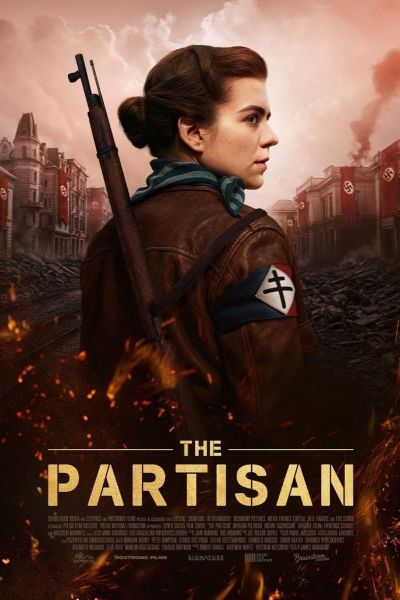 We have written about some of the women who worked behind enemy lines for British intelligence during World War II. Names like Noor Inayat Khan, Virginia Hall and Vera Atkins deserve to be better known that they are. The attempts to tell their stories so far have been laudable attempts, but have left me feeling underwhelmed, with a sense they haven’t done their subjects full justice. This is another which I feel should be filed in the same box. The subject here is Christine Granville (Polanski), born Krystyna Skarbek, a Polish national who originally worked in her native country, organizing a network of spies and couriers, running information to then neutral Budapest. This included early reports foreshadowing Germany’s attack on Russia.
As with so much in the film here, however, the details are left frustratingly vague. The above paragraph tells you more of her time in Poland than the movie, which mentions a microfilm, but seems more concerned with Granville’s efforts to extract her mother out of Warsaw. It does, however, include an incident where she was being questioned by the Nazis, bit her tongue, allowing her to feign coughing up blood and convince the doctor she had TB, leading to her release. Most of the movie, however, is set during her time in southern France, later in the war. There, she worked with the maquis, the local resistance, in preparation for the looming Allied invasion.
The best thing this has going for it is Polanski – yes, she is the daughter of director Roman Polanski, though has more of the luminous looks of her mother, actress Emmanuelle Seigner. Granville had a reputation as a hothead: Atkins called her “very brave, very attractive, but a loner and a law unto herself,” and Polanski’s performance puts all those aspects across very well. There are occasionally scenes which do capture the relentless tension of operating in a scenario like this too, where a single slip could mean death. For example, she tells a Gestapo officer she’s a teacher seeking employment – only for him to show up at the local school, forcing her to improvise during a conversation with the headmistress. More of this would have been welcome.
Instead, for whatever reason, the makers have opted to make their film at least somewhat non-linear, to no readily apparent purpose. There are points where it becomes impossible to tell when or where you are. A straightforward adaptation of her life would have been perfectly fine, including the several occasions on which she was treated badly by her employers. According to Xan Fielding, an operative she had saved from execution, “a few weeks after the armistice she was dismissed with a month’s salary and left in Cairo to fend for herself.” Even more tragically, she was murdered in 1952 by a lover she had rejected. Again, little of this is mentioned here, beyond being whizzed past in a final caption. Once more, this is a heroine who deserves a great biopic, rather than one merely good enough.
Dir: James Marquand
Star: Morgane Polanski, Ingvar Sigurdsson, Frederick Schmidt, Piotr Adamczyk