




★½
“Gouge my eyes out, please.”
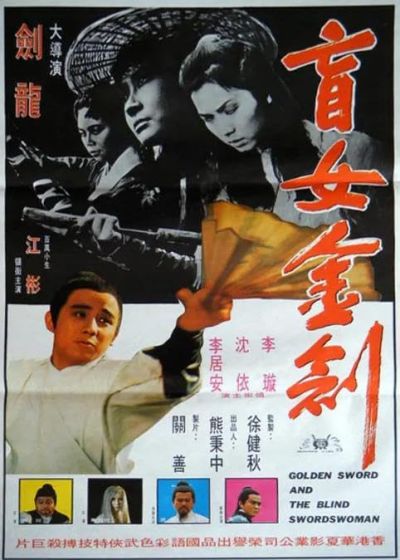 The rating above might actually be a little charitable, and would be for the film as originally released. The only version in which this is now apparently available, is both badly dubbed and pan-and-scanned to a 4:3 ratio. It certainly doesn’t help the film, when there are points at which all you can see of the participants in a conversation is an elbow, sticking in from one side of the screen. It’s close to unwatchable in this format, although I suspect it would barely pass muster, even in its original language and format. It feels like the Taiwanese makers saw Crimson Bat, The Blind Swordswoman, released the previous year and thought, “That looks easy.”
In reality? Not so much. It’s the story of the titular, visually challenged practitioner of the fencing arts (Lee), who is called “Elaine” in the dub. The basic plot sees her out for revenge against the evil Mr. Lee, who appears to be responsible for everything bad in the world, from the murder of her father, to her ocular situation. She isn’t the only one, as there’s another woman, similarly deficient in the eye-chart comprehension department, whose family has also suffered at the hands of Lee. She’s called “Sue-Ann” in the dub, and ends up getting sold off to a whorehouse. I suspect Mr. Lee was probably responsible for this too, if you dig deep enough. There’s another swordsman (Kong), who wanders in and out. In a shocking twist, he can see.
To be blunt, this is the sort of movie which explains why Taiwanese kung-fu films have such a bad reputation. The original Ocean Shores video was titled Zatoichi, the Blind Swordsman: a shameless conceit this version abandoned. As well as being a blatant knock-off (not that Crimson Bat was exactly original, itself being a Zatoichi knock-off of course), it doesn’t feel as if anyone involved in this can do anything more than wave their weapons in the vague direction of each other. This is not helped by the director’s inability to shoot an action sequence: I’m half-convinced he was blind too. The plot is incomprehensibly murky, and there are too many characters, whose purpose often remains frustratingly vague.
Meanwhile, any sense of nuance in the performances is bludgeoned to death by the English language soundtrack. It feels like the voice actors just got fired for incompetence from dubbing porn movies. Or perhaps were homeless people, pulled off the street into the studio at the last minute. Make no mistake though: this does not manage to make it into the “so bad it’s good” category of chop-socky flicks. It’s simply “so bad”. It might be worth trying to track down should you be after a test of cinematic endurance. If you can go longer than any ten minute period in this, without idly scrolling on your phone, you will be doing better than I managed.
Dir: Lung Chien
Star: Lee Shu, Shen Yi, Kong Ban, Yee Yuen
a.k.a. Golden Sword and the Blind Swordswoman
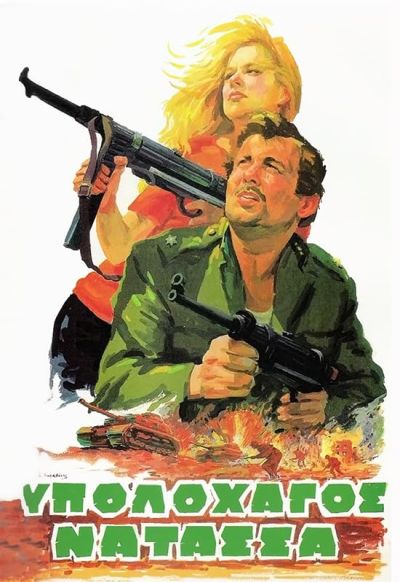 I am reluctant to be overly harsh on this one, because I suspect I didn’t get to see this in its best format. The fact it feels very choppy and disjointed could potentially be a result of the IMDb giving this a running time of 136 minutes, but the only print available ran a good half-hour less. It was also dubbed from Greek into English and pan-and-scanned. Pretty much the holy trinity of cinematic suckage, right there. It’s the story of Natassa Arseni (Vougiouklaki), who lives in Greece when the Nazis invade during World War II. She’s initially largely unconcerned, but gradually becomes involved in the local resistance.
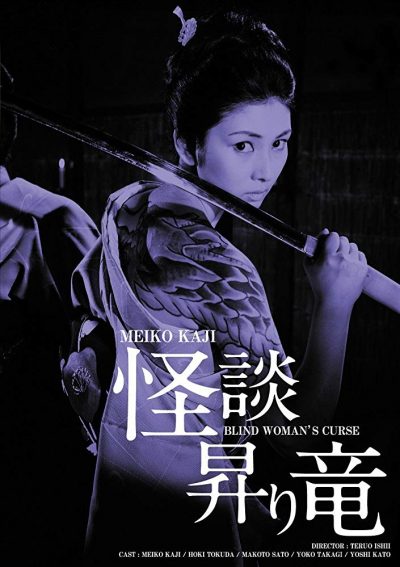 Akemi Tachibana (Kaji) is second in command of her yakuza gang. During a battle with another group, she accidentally blinds Aiko Gouda (Tokuda), the sister of an enemy – an incident Akemi believes leaves her cursed, after a black cat laps up the blood spilled as a result. Following three years in jail, she returns to find the clan on the verge of war against their rivals, the Dobashi group. Various members of the Tachibanas are turning up dead, and with their tattoos flayed off. Turns out that Gouda has joined the Dobashi gang, with the aim of extracting vengeance on the woman who took her sight, even though Akemi has borne the guilt of that event ever since.
 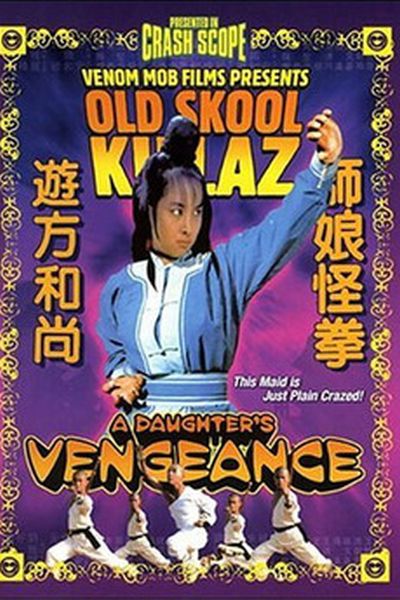 Look, I tried. I really did. When I found my attention had drifted away from watching the film, in good faith, I rewound the film to the point where I’d lost interest, and took up the movie again the following day. After all, maybe it was me. But when I still could barely bring myself to finish this leaden lump of poorly-crafted revenge-fu… No, having gone above and beyond the required effort, it’s really not me. This is lacklustre stuff, to put it mildly, even by the generally low standards of Taiwan.
 This grindhouse obscurity manages to rise above the limitations of its budget, and proves an effectively nasty piece of work. The titular teenage “heroine” (Carpenter) is on the way to see her older lover, but embarks as well on a killing spree that first includes a classmate and the guy who picks them up, then a householder (Michael Findlay) whose swimming pool Janie hijacks, before moving onto a predatory lesbian and finally her lover’s girlfriend (Roberta Findlay), whom she strangles with a belt. This is all told in flashback as she tells the story to her disbelieving bedmate – though the corpse he discovers in the bath-tub rapidly changes his mind. Oh, and did I forget to mention, for extra sleaze points, he is also Janie’s daddy? Damn. All of her exploits are accompanied by narration from what could be seen as an ancestor of Dexter’s “dark passenger”, exhorting Janie to further murderous acts, in a placid and matter-of-fact tone that is actually all the more chilling for its calmness.
 This German 1970’s film is well ahead of its time in some ways, but is postively Neanderthal in others, being basically a scream of fear about women’s liberation. It feels like a far-less subtle version of Neil LaBute’s re-make of The Wicker Man, taking place in a matriarchal town, where women are in charge, with the exception of a couple of incompetent men, to lift heavy things and provide a facade of normality (the police commissioner is an alcoholic, who knows little and cares less about what’s going on). Into this scenario comes Eve (Glas), a stressed-out secretary who has been booked in for a six-week course of treatment at the local spa. It’s not long before she stumbles across the body of a man with a knife embedded in his back, only to discover that no-one believes her, with the clinic’s doctor telling people Eve is suffering from post-tramautic hallicinations. Is that the case, or is there something genuinely unpleasant going on? And what’s this on the dinner menu?
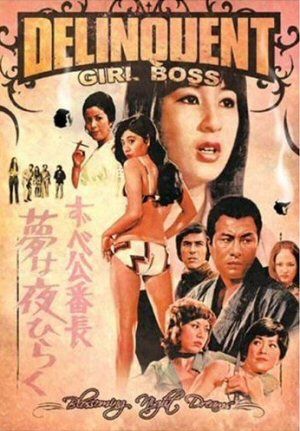 This was my first true vintage “pinky violence” movie, though I had bumped against some fringe entries in the genre before e.g. Female Convict Scorpion: Jailhouse 41, which I enjoyed and really must get round to reviewing for here some time. This one…not so much. It focuses on Rika (Oshida), who gets out of reform school, and gets a job as a ‘companion’ at a bar, where most of the girls have a similarly troubled background. The local Yakuza boss is sniffing around, and his path crosses Rika’s after she (semi-unwittingly) helps a colleague steal some drugs from them. As a result, the house mother/bar owner, is on the hook for three million yen, plus interest.
 Director Ichimura returned for the fourth episode, and despite similar problems as the third installment – most obviously, an apparent doubt that Oichi’s character can hold the viewer’s interest by herself – makes a much better stab at things here. Bounty-hunter Oichi finds out what life is like on the other side of the law, after she helps rescue an unwilling bride from a local magistrate; he slaps a 100 gold-piece reward on her head, which naturally, brings other bounty-hunters on her trail, led by Sankuro (Meguro).