




★★★★
“Turkish delight.”
 Well, “delight” might not quite be the right word. But who am I to let facts get in the way of a good review tagline? It’s more of a Turkish nightmare, probably the most brutal rape-revenge movie I’ve seen since… Well, probably Revenge. The director is best-known for Baskin, generally considered the best horror movie from Turkey. Though, full disclosure, I wasn’t that impressed by it: strong on atmosphere, but short on a coherent storyline. That’s not an accusation which can be levelled at this. However, the level of savagery and bloodshed arguably puts this into the horror genre as well. It’s the story of two Turkmenistan sisters, Sayara (Kocabiyik) and Yonca (Kosar), both of whom are involved, in different ways, with gym owner Bariş Ataberk (Kizilirmak).
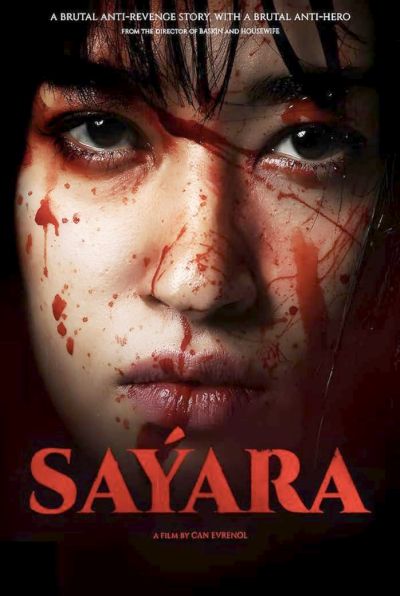 Yonca is having an affair with the married man. But she has been able to leverage this into getting a job at the facility, as a cleaner, for the much quieter Sayara. Bariş offers Sayara a job as a trainer, teaching female clients self-defense, knowing of her skills in this area, but she declines. Worse follows, when Yonca catches Bariş cheating, and threatens to reveal all to his wife. This does not go down well, and ends in Yonca’s death, which is called a suicide officially. It helps that Bariş’s father, Halil Ataberk (Inal), is a senator with a lot of political pull, and can ensure no action is taken against his son.
No official action, anyway. While Sayara may have seemed the quiet and meek sister, we see in flashbacks the relationship she had with her soldier father – now, notably absent. One senses a lot of darkness there. Indeed, he tells his daughter. “I committed many great sins. It doesn’t matter. The darkness in me, is in you too, Sayara. But if someone crosses that line – to you, or your mother, or to your sister – you will go all the way, without blinking. You will go to the bottom of that darkness.” And Sayara does. Boy, does she. Not just against Bariş, but all those involved, even tangentially, and using every weapon at her disposal, from fire to her teeth. The latter provides the film’s most horrific scene.
This establishes its direction early. The first spoken line is “Son of a whore!” and it’s something of a mix of social complaints thereafter. Class, nationality and gender all come into play here in the power dynamics. Though it’s not as one-side as it might seem: Yonca is hardly blameless, and seems to have a fondness for S&M games, as well as no respect for the sanctity of marriage. However, “blurred lines” hardly excuse what happens to her subsequently, and you’ll be firmly behind Sayara on her relentless quest for the bottom of that darkness. You may not find the ending fully satisfying, in the traditional sense. But I’m hard-pushed to deny it’s appropriate, and you will certainly remember it.
Dir: Can Evrenol
Star: Duygu Kocabiyik, Emre Kizilirmak, Özgül Kosar, Levent Inal
 The palpable sense of disappointment I felt when the end credits rolled, was all the more striking, given the decent way this opened. Ayse (Koç) is enjoying a shower after some afternoon delight with her lover, when there’s a thunderous knocking on the door. It’s her thoroughly disgruntled ex-husband. In the resulting fracas, the boyfriend is shot dead, and Ayse has to leap out of a window, and go on the run. Friends and family disown her, as the ancient concept of the honour killing still holds sway in contemporary Turkey. She can’t even go to the authorities, since the ex-husband is a policeman.
  I really must get round to reviewing Wentworth. The Australian women-in-prison drama certainly deserves coverage here, and has provided some of the best television we’ve enjoyed in the 2010’s. I keep intending to do so, but suspect that will now likely have to wait until after the show comes to a conclusion, following its ninth and final season in 2021. In the meantime, however, I do get to review the Turkish remake of the show. If you’ve seen Wentworth, this version is perhaps as unnecessary as any Hollywood remake of a familiar foreign film. Yet there are enough differences – both in story and culture – that I didn’t mind too much.
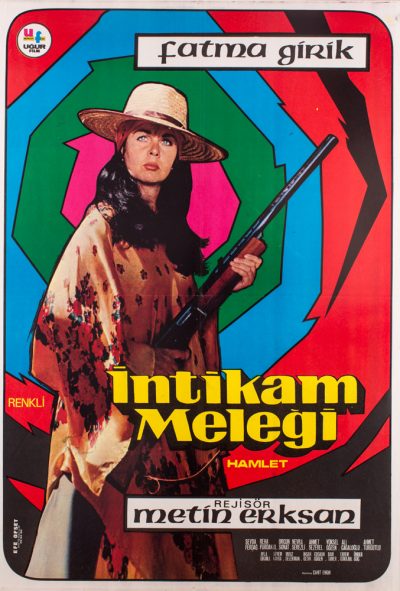 Okay, the above is shamelessly lifted from The Last Action Hero, in which there’s a spoof trailer for Arnold Schwarzenegger as Hamlet. But it applies just as much to this, which is remarkably progressive considering its origins; 1977 Turkey was not exactly in the forefront of women’s liberation. Yet here we are, with a modernized and severely truncated version of Shakespeare’s story. This runs 86 minutes, compared to 242 minutes for, say, Kenneth Branagh’s Hamlet. But it hits the main spots, even if only in passing: for instance, Hamlet’s soliloquy shows up, though “Alas, poor Yorick” gets short shrift.
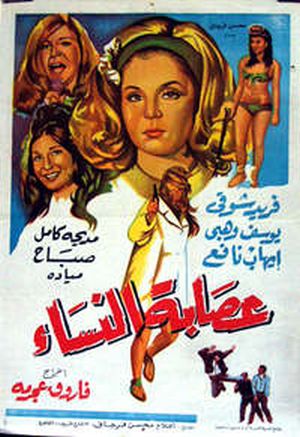
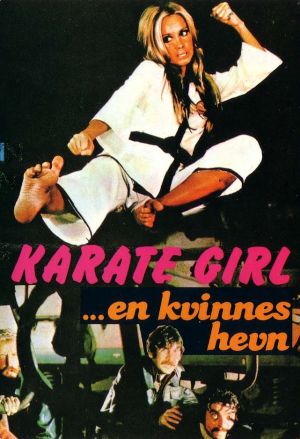 This movie acquired some notoriety last year when a clip of a villain’s death went viral as “Worst death scene ever”, even though it had been edited and had extra audio added for “humourous” effect. Certainly, there’s plenty to mock in this 1974 Turkish revenge flick, which plays like someone heard second-hand descriptions of Thriller: A Cruel Picture and decided the world needed a PG remake. However, while aspects of the execution are without a question shoddy and laughable, it has an interesting story, briskly told, and with a good central character.