Made in 1995, Cutthroat Island was a pirate-themed historical action-adventure movie starring Geena Davis and Matthew Modine. (Before starting my read of this novelization of it, I’d never seen the movie, though I’d long been curious about it; but about 3/4 of the way through the book, after learning that the film could be watched for free on Tubi, I made time to view it so that I could compare it with the book.) The filmmakers didn’t strive for great cinematic art; they didn’t intend to offer anything but undemanding escapist entertainment. But even considering that fact, the widespread negative reaction by both fans and critics, which endures to this day, is remarkable (the film made it into the Guiness Book of World Records — as the worst box office flop in movie history!). I was aware of that going in, but was resolved to make my own assessment. As is sometimes the case, I landed in the minority; I like the movie well enough for what it is
Unlike some people, I don’t view movie novelization as inherently a trashy and illegitimate abuse of the fictional art. To my mind, it can be a perfectly legitimate artistic enterprise, adapting a story told in one medium to the possibilities afforded by a different one, with the intention of producing a retelling that offers genuine rewards to readers. Because it’s an adaptation, I think the adaptor should strive for as much fidelity to the original as possible, just as in the converse situation of novel to film. The novel format, however, offers the possibility of providing more explanation and clarification of areas that may be murky in the film because of the latter’s time (and other) constraints. Unfortunately, I’d have to say that Betancourt didn’t do as well as he could have on either of these points (and this novel generally suffers as a result). Some of its literary flaws and improbabilities, though, are already inherent in the original movie itself.
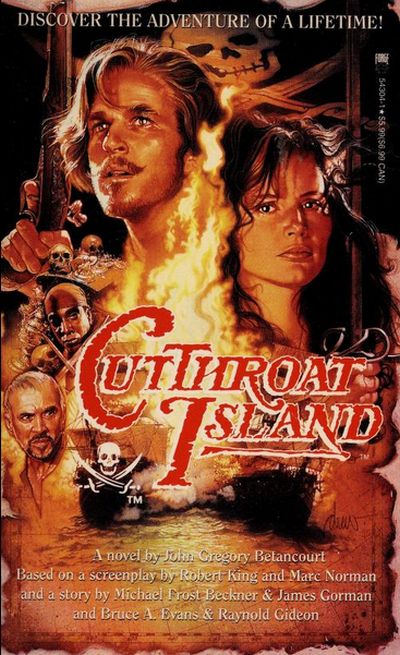 The tale opens in 1688. In the movie, the opening scenes are on, or just off, the coast of Jamaica; in the book, they’re moved inexplicably to Tortuga, off the northern coast of Haiti, and we then move to Jamaica in one day (which I doubt is actually possible for a wind-driven sailing ship). But we soon learn some crucial backstory. In 1619, a pirate captain named “Fingers” Adams captured a Spanish treasure ship loaded with “the richest cargo ever to leave the Americas;” but his ship was subsequently wrecked on the uncharted titular Cutthroat Island, with Adams as the lone survivor. He secreted the treasure there; but after returning to civilization, instead of mounting a retrieval expedition, he contented himself with making a map to the treasure’s location. (Apparently, pirates didn’t steal their booty to do anything like selfishly spend it; they just liked to leave it for posterity.) He divided the map into three parts, bequeathing one piece each to his three in-wedlock sons, all pirate captains in their own right. A fourth son, pirate captain Douglas Brown, nicknamed Dog or Mad Dog (Betancourt always affects the spelling “Dawg,” though that wouldn’t be pronounced any differently) was left out because he was born out of wedlock.
Brown didn’t appreciate this slight, so when our story begins, he’s embarked on a campaign of tracking down and murdering his half-brothers to get their pieces of the map. (This isn’t a close family.) Why he waited until 1688 is never explained. By now, he’s got one piece, and he’s making captured Adams sibling Black Harry “walk the plank” while simultaneously demanding that he reveal the location of the second piece. (Okay, nobody ever said Brown was intelligent.) But Harry’s 20-something daughter Morgan (her exact age is never given), herself raised as a member of his pirate crew, comes to his rescue amid a slew of murky unexplained details and convenient improbabilities, though he’s mortally wounded in the process. Before he dies, he reveals that he had a copy of his part of the map tattooed to his scalp (where he couldn’t possibly refer to it; so no, intelligence doesn’t run in this clan). Morgan’s mission (whether she chooses to accept it or not) is to get herself elected captain in his stead, join up with her surviving uncle, and beat Brown to the treasure, while staying alive in the process. Oh, and find somebody literate in Latin, since that’s the language used on the map. Swashbuckling action-adventure ensues.
There are some significant historical errors here, one already in the movie script itself: in the 17th century, in English law (which applied in Jamaica the same as in England), the punishment for any theft worth more than 12 pence wasn’t being sold into slavery; it was a mandatory sentence to death by hanging. (And it has to be said that main male character William Shaw’s idea of crashing the governor of Jamaica’s ball uninvited, claiming to be a physician when he’s not, swiping jewels off of his dance partners while they’re distracted by his flattery, and transparently lying about what ship brought him to the colony, while having no exit strategy except trying to casually walk out of the building, puts him in the running for the title of most stupid character here, though the competition is fierce.)
And governors of Jamaica did not serve without pay; they were actually paid quite handsomely by 17th-century standards (though the expenses of their station were also steep, and they generally did resort to wangling extra fees and cuts, and sometimes outright corruption). Betancourt also introduces significantly more bad language, nudity and sexual innuendo into this version; the original movie doesn’t have much of any of these, and no real nudity. (It also doesn’t have any reference to Brown having sexually molested Morgan when she was a child, though that claim is made here.) He drops a character arc for one character that’s in the movie, but rather improbable; but he invents two others that are just as improbable compared to their previous behavior.
On the more positive side, the author does develop Morgan’s character better than the filmmakers do, and shows a bit more growth on her part, and more believable development of romantic feelings on the part of the two main characters, than what’s brought out in the movie. He also inserts a short dialogue between Shaw and teenage pirate Bowen (who’s said here to be an orphan taken in by Harry after his parents died) that offers some explanation for how the pirates view their lifestyle; when Shaw points out that Bowen’s a criminal, the latter replies, “We don’t see it that way, since the whole world is crooked, and we’re making the best of it we can.” Morgan’s an interesting, nuanced character, a strong and athletic woman who’s been raised in a rough, kill-or-be-killed milieu (her mother’s never mentioned, in either the movie or the book), who has no qualms about taking human life in combat or in rescuing endangered shipmates, and doesn’t consider reforming and adopting a different career as an attractive possibility. But she’s also capable of kindness and a protective stance, and has a well-developed sense of duty, courage, loyalty, and fairness. (Unlike Brown, she’s not a murderous psychopath; and when she’s pitted against him, she’s not hard to root for.) This read has a lot of action, and there’s never a dull moment.
In terms of content issues, as noted above, there’s more occasional bad language here (in the form of profanity, cuss words and vulgarisms, though not obscenity) than in the movie, but probably far less than we’d have been apt to hear on an actual pirate ship. Violence is pervasive, and Brown is a sadist, but for the most part, neither the movie nor the book make it more graphic than it has to be. (The book is the more graphic of the two, but that’s mostly just in one place, and stops short of being “pornography of violence.”) No sex acts take place in the book itself, though it’s clear that one took place just before it begins. In order to rescue Harry, Morgan’s rousted out of a bed she’s been sharing with a French naval officer who was planning to arrest her after using her; but she’s way ahead of him, and his subsequent discomfiture doesn’t earn him much pity. (She also later poses briefly as a prostitute.) We can infer that she’s honestly been raised with no conception that sex is anything but casual recreation, and she acts accordingly; though there’s an indication at the end of the tale that she might be on the cusp of discovering what it’s actually intended for.)
I actually did like this yarn (though the enjoyment might be characterized as something of a guilty pleasure). It can be recommended to readers who like action-oriented historical adventure, especially with a pirate mystique, and who aren’t put off by the very real flaws noted above.
Author: John Gregory Betancourt
Publisher: Tor Forge; used copy available through Amazon, but only as a printed book. It is available to borrow through the Internet Archive.
A version of this review previously appeared on Goodreads.




 Kiku is an assassin for the Yakuza. Except, it’s complicated, in a whole variety of ways. Her current mission is to track down Alex Harris, who might or might not be the son of Takeo. He’s the head of the Yakuza in the United States, and the son of Kenzo, who is its overall leader. Takeo was also Kiku’s lover in the past. There’s also Jiro, who is Takeo’s half-brother, who is kidnapped by the Russian mob after the son of their boss is gunned down as part of a turf war with the Yakuza, and subsequently rescued by Kiku. Which is why tracking down Alex, before the Russians do, is suddenly of paramount importance.
  Chanda Bajaj is the very epitome of a troubled protagonist. A former soldier, she left the service after she and her comrades took part in the mass murder of “synths” – synthetic humans, and has been plagued by guilt and nightmares ever since. She has become an independent bounty hunter (or “Lancer” – short for “freelancer”), and has just landed on the ferociously hostile mining planet of Reitman, far out in the frontier colonies. The corporation which runs Reitman has an issue, with some of its employees – who are, really, more like indentured serfs – turning them into drug fuelled and violent killers.
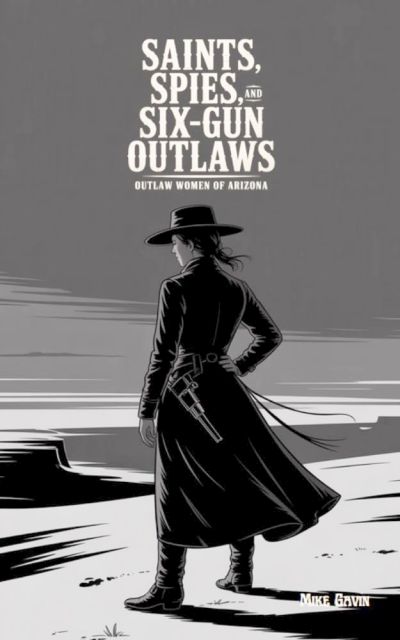 This is a slim little book – more of a booklet, really, coming in at only 74 pages in length. But since it combines both our topic of discussion and local interest, because I live in Arizona, it was an easy decision to pick up a copy, after Dieter brought it to my attention. It does use quite a loose definition of “outlaw” – it is something only really discussed in the book’s epilogue, dividing them into three categories. Most obviously, are the ones Gavin calls “The Breakers of Law”, such as stagecoach robber Pearl Hart, whose exploits were dramatized in
 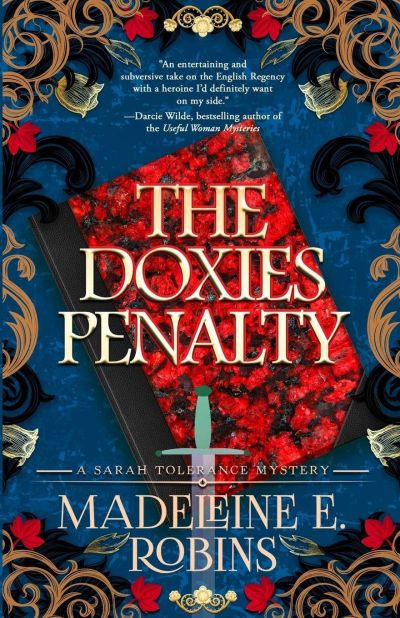 So, for the benefit of readers who haven’t read, or don’t remember, the earlier books or my earlier reviews, Miss Tolerance (born Sarah Brereton) is a scion of a lower-nobility family, which disowned her as a teen when she ran off with her brother’s fencing master. (The pair were in love, and would have married if her father hadn’t forbade it.) After her man died young, Sarah took shelter with the one relative who’d have her, an also-disowned aunt who owns a high-end brothel (fortunately, there’s a small cottage out back); and rather than resort to prostitution like many young women in her situation, she’s created a profession for herself as an “Agent of [discreet] Inquiry.” (She’s smart, inquisitive, able to blend in a variety of social settings and pass as a man if she has to; and since she packs pistols and learned how to fence from her late life-partner, she can handle rough stuff if it’s thrown at her.)
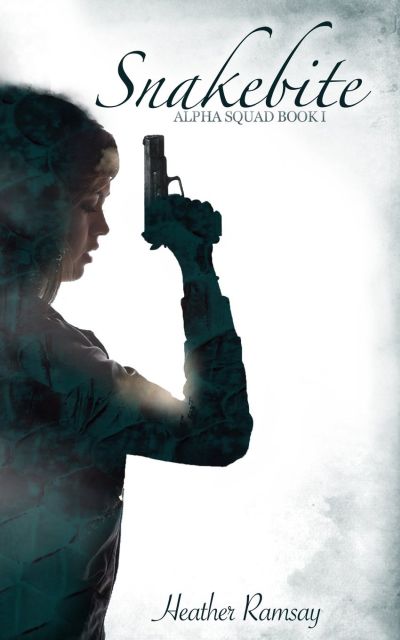 I believe I have previously written disparagingly about “cinematic amnesia”, where a plot revolves around the lead character’s loss of memory. Inevitably, it comes back at exactly the points required for the plot, and to maximize drama. Unless the maker is
 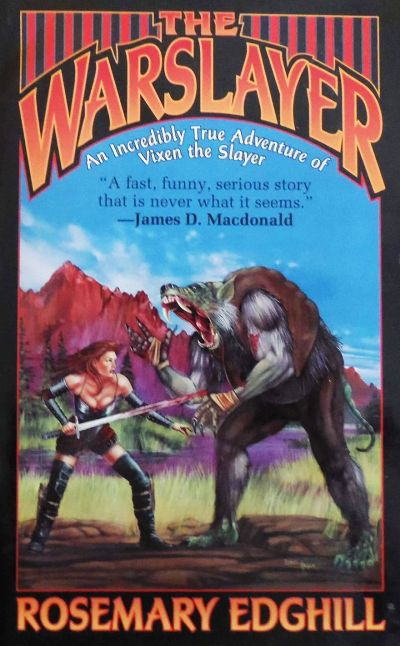 The cover blurb/Goodreads description creates the impression that this is a light exercise in humorous fantasy; and it actually does have a lot of humor (I read it to my wife, and she laughed out loud in several places). Both TITAoVtS and Xena are shows that offer mostly action-oriented entertainment without a lot of serious content, which might also lead readers to expect the same here. However, The Warslayer has its unexpectedly deep and serious side. Glory can deliver a fair amount of wry humor; but we’ll also see her bleed, vomit, and cry. While there’s some intense physical combat going on here at times, the battles aren’t all going to be physical, and the author has some really important things to say. (I’m not going to try to summarize them, because the story is the message, and you need to experience it the way she wrote it.) Her plotting here is not at all predictable. (But it’s deeply satisfying!)
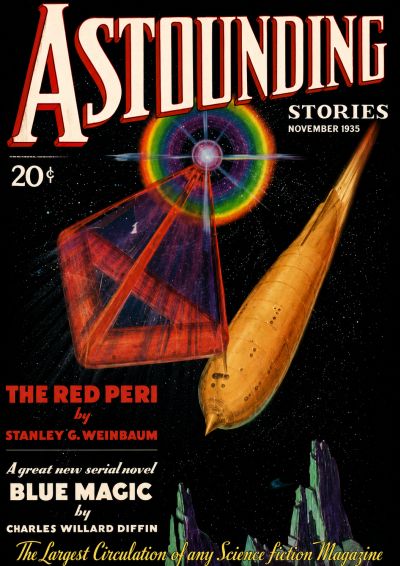 American SF between the World Wars was a sort of literary ghetto, disdained by critics, and found mainly in a handful of small-circulation niche magazines, dominated by editors committed to the genre’s “hard” tradition, in which the speculative element is strictly based on extrapolation from known science and scientific accuracy is a paramount concern. (Literary matters like character development, well-crafted prose, and original plotting, in that era, was sometimes of less concern.) Weinbaum, like many of the genre’s writers in his generation, had the scientific background and interest to write hard SF, but his English literature education/interest also gave him stylistic skills superior to those of a lot of his contemporaries. Both qualities are evidenced in this short work.
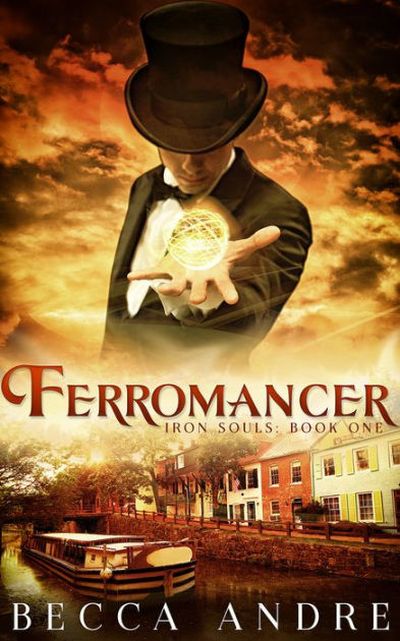 Bridget ‘Briar’ Rose is a rarity: a woman who runs a canal boat, transporting cargo along the waterways which form the Ohio & Erie canal network. However, her livelihood is under threat. The increasing growth of the railway as an alternative method of transportation is increasingly a rival for the jobs she takes, and her cousin, Andrew, is looking to see her barge out from under Briar, so he can invest in the railways instead. However, she suspects he is working with an outlaw: a ferromancer, one of the mages who revolutionized industry in Europe, but who had supposedly been wiped out two decades ago due to the threat they posed.
  I previously reviewed an entry from the middle of this series,
 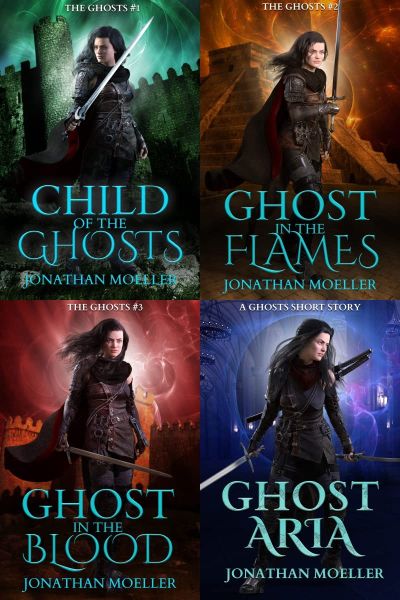 When it begins, the young heroine Caina Amalas is living a somewhat unhappy life, mostly due to her mother being borderline abusive. Eventually, there’s nothing “borderline”, as Mom uses dark magic to turn her husband into a vegetable, and sells his daughter off to sorcerer Maglarion. Caina’s virgin blood is very powerful for his arts, and she is “milked” for all she can provide, kept just this side of death. Fortunately, while the wizard is out, an attack on the facility frees Caina, and she is recruited and trained by the near-mythical group responsible, the Ghosts. These are the Emperor’s spies and assassins, who swear an oath to counter his enemies, by any means necessary.