




★★★
“Annie, forget your gun.”
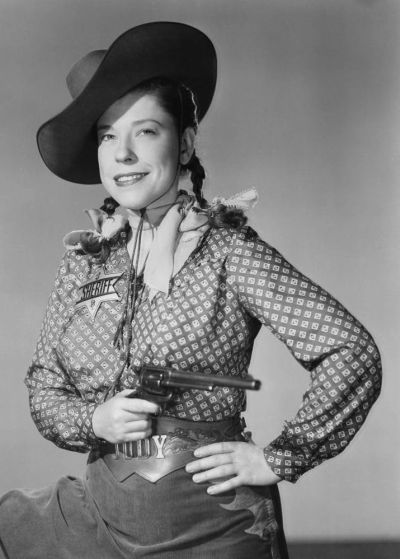 Judy Canova, known as ‘Queen of the Cowgirls’, was a popular star of radio and screen in the forties and fifties. She had a certain schtick: a homely but honest country gal, who stumbled into trouble – often with singing involved. I admit, the mere title of one such entity, Joan of Ozark, made me laugh. Here – despite the title – she plays a character called Judy, as she often did. The film’s name comes from Judy’s grandmother, who had been a much-feared sheriff. According to Judy, “The bad men in these parts were so scared of her, that they either plum reformed, or hung themselves by way of cooperating.” Judy now runs a trading post.
She is deputized by the town’s new sheriff Dan Fraser (Russell), after Judy captures a bank robber, Curt Walker (Barcroft), using her store and its contents in a way which reminded me of Home Alone. But after Fraser heads off to get a judge to try the case, leaving Judy in charge, her lack of relevant experience becomes problematic. She knows her way around a horse: law enforcement, not so much. However, in a remarkably progressive story-line considering the era, she rounds up the women of the town, who then ride off to save the day, and Fraser. I guess that could be considered a spoiler. But if you think a fifties Western was ever going to do anything except have good prevail…
I found myself liking Judy Canova – both the actress and the character – more than I would have expected. If the latter is clearly short on book learnin’, and hardly what you would call a classical beauty, she makes for an appealing heroine, being brave, honest and warm-hearted. I’d like to have seem more of her – and, say, less of the two prospectors who are supporting characters, try to steal her success, and whose comic relief mugging certainly outstayed its welcome. Canova falling for Fraser (and his newfangled auto-mo-beel), causing her pigtails to go independent, is the stuff of classic slapstick. I didn’t even mind the three songs she sings: they are kept brief, and the one where there are four Judys, courtesy of a set of mirrors, harmonising with each other, is genuinely well-done and charming.
Of course, between the light-hearted tone in general, and the fact this is well over seventy years old, you won’t get anything like modern GWG action. But considering these factors, it’s surprisingly ahead of its time. What stood out for me was Canova, who is massively against type of almost any other Western heroine. Maybe heroine in any genre: Melissa McCarthy in Spy might be the closest, though she’s considerably smarter. I could see Canova as a goofy sidekick, not the central character. Yet I undeniably found myself rooting for her, charmed by her innocence and unstoppable good nature. If not something I’d want as a regular diet, it was a refreshing way to clean my palate.
Dir: R. G. Springsteen
Star: Judy Canova, John Russell, Grant Withers, Roy Barcroft
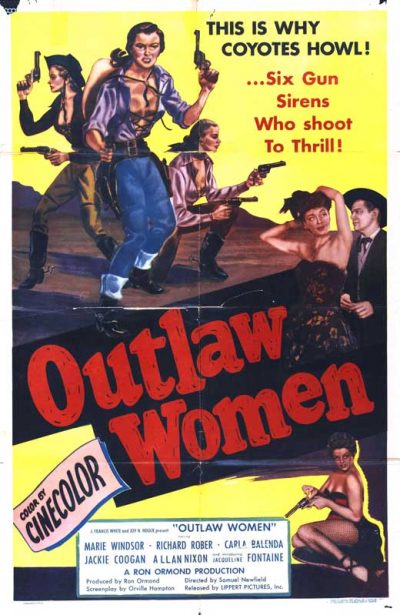 The city of Silver Creek is on the way out, and many of its inhabitants are leaving, including town doctor Bob Ridgeway (Nixon). Originally heading to Kansas City, he is convinced at gunpoint to take up a position instead in “Las Mujeres.” That’s Spanish for “The women,” and is an appropriate name since the place is a gynocratic society, where the ladies are in charge. Top of the heap is Iron Mae McLeod (Windsor), who runs the local saloon and ensures that the the other women in the town are kept safe from exploitation. She does, however, have to navigate the straits between aspirational gambler Woody Callaway (Rober) and outlaw Frank Slater. Ridgeway, meanwhile, because the target of affection for both Beth Larrabee (Balenda), one of Mae’s enforcers, and her big sister and star of the saloon’s show, Ellen. But when all of Mae’s money is about to be transferred out of Silver Creek, and becomes a target for Slater and his gang, romance has to take a back seat.