
Belle Starr’s Daughter

★★½
“Like mother, like daughter.”

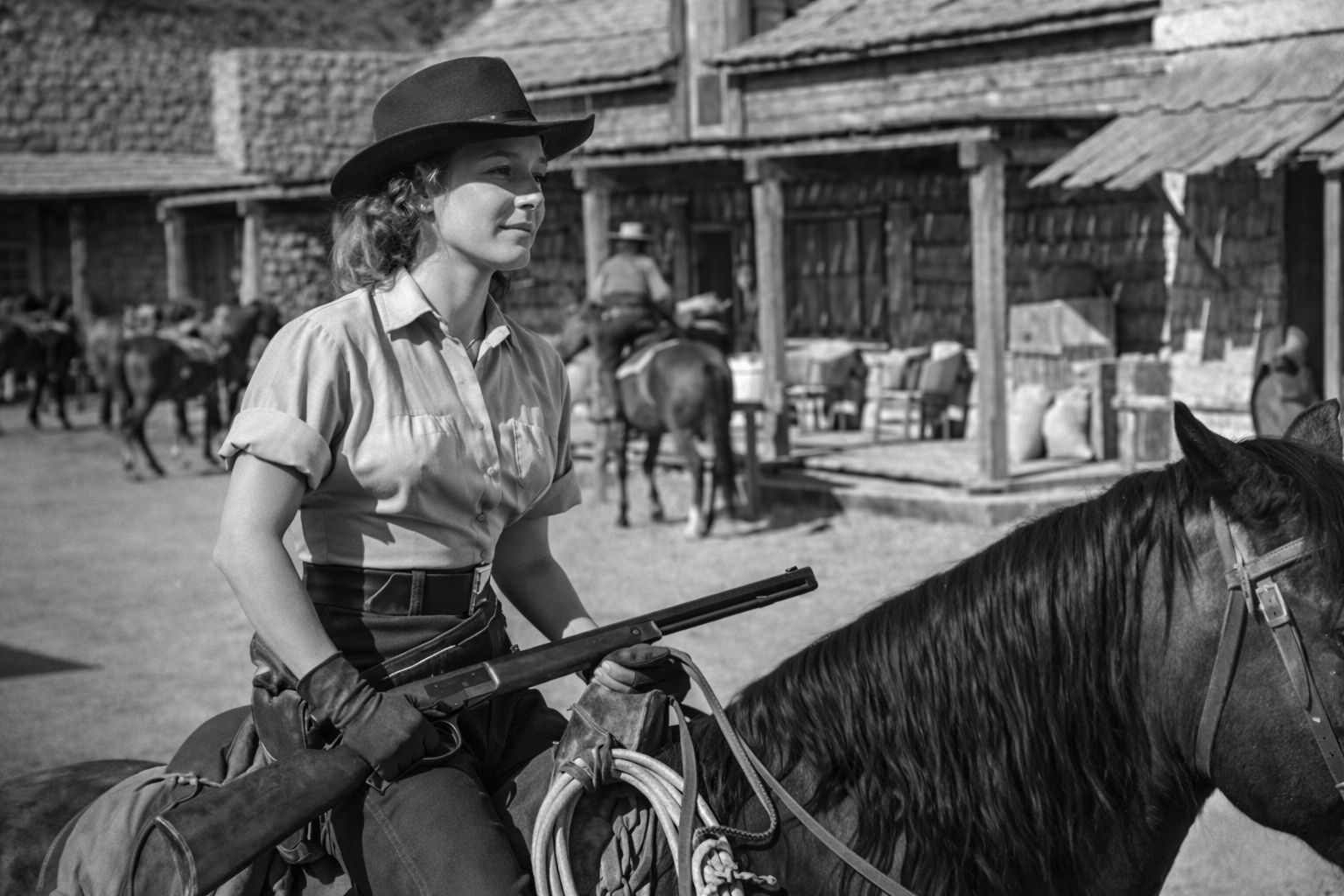
After one of her henchmen kills a local marshal, a posse is sent from Antioch to deal with outlaw Belle Starr, who had previously been in an uneasy truce with the town. However, when they arrive, they find Belle dead, and the gang subsequently scatters. Her daughter, Rose (Roman) mistakenly blames the new marshal, Tom Jackson (Montgomery), for her mother’s death. She apparently takes up honest work as a waitress, and Jackson falls in love with the young woman, initially unaware of her felonious ancestry. But Rose ends up leaving town with Bob Yauntis (Cameron) – he’s a former member of the gang who, unknown to her, was the actual killer of Belle and the previous marshal.

I guess this is something of a follow-up to Belle Starr – or maybe Badman’s Territory, since Isabell Jewell played Belle in both movies. This certainly has a similarly loose approach, taking historical fact as a jumping-off point for fictional adventure. Belle did indeed have a child: however, she was named Pearl Starr. Rather than an outlaw, she became a prostitute and ended up running several bordellos herself, and died in Arizona in 1925 (I’m a little surprised she wasn’t covered in Outlaw Women of Arizona). This appears to be taking another Western wild woman, Cimarron Rose, and making her Belle’s daughter. In reality, that Rose did hang with a criminal nicknamed ‘Bitter Creek’, as Bob is called here. She was supposedly involved in the Battle of Ingalls, an 1893 gunfight between outlaws and law-enforcement. 

Back in the cinematic world, it’s a shame Belle doesn’t survive longer into the movie. Having her, not just be an outlaw, but being the leader of an entire gang, is not something you see much on Westerns, particularly from this era. Obviously, the apple doesn’t fall very far from the tree, but you don’t get the idea Rose is exactly the sharpest tool in the box, letting Bob manipulate her at every step of the way. She refuses to accept the truth, well beyond the point at which any sensible person would be going, “Wait a minute…” While Roman might not be Gene Tierney in Belle Starr, there is something of a resemblance. She passes muster in a “We have Gene Tierney at home” way. 

It is a little disappointing how she ends up sidelined in the middle, in favour of Marshal Jackson hunting after Bitter Creek Yauntis and his gang. Rose just becomes one of the gang, though the way she isn’t treated particularly differently from anyone else, is somewhat refreshing. She does take the lead in trying to help an injured gang member, leaping off her horse to help him when he collapses into a river. Bob’s callous indifference here is what helps turn Rose against him, and she flees (across some very nice scenery), with Bob and his henchmen in pursuit. No prizes for guessing who arrives to save the day: having a woman who could save herself was still a little too advanced for Hollywood.

Dir: Lesley Selander
Star: Ruth Roman, George Montgomery, Rod Cameron, Wallace Ford

Barbaric Acts

★★★½
“Revenge has never been so… messy.”

This begins with a caption detailing the horrendous number of gun deaths annually in Brazil, including several thousand per year in police actions. Given the synopsis, I wondered how the film was going to reconcile this with its own subject – would the answer to gun violence be… more gun violence? The answer is, the film doesn’t really bother to try, instead embracing the contradictions in a way that permits no logical conclusion. Indeed, it fails to offer one. The original title translates as Barbaric Times – Act I: Revenge Therapy, hinting at more to come – this explains, if not excuses, the abrupt and unfinished ending.
Carla (Abreu) is a happily married attorney, until her daughter is shot during a botched street robbery. This sends her spiralling down into an increasingly dark place, as it becomes clear there will be no conventional closure, the case simply being one of too many for the authorities. A self-help group doesn’t, and nor does mercenary vigilante justice, the operative in question believing one dead thug is as good as any other. Her husband (Mello) leaves Carla as she won’t let go, and her spiral culminates in an attempt to shoot herself in the same spot as her daughter. Yet this proves a potential turning point, Carla realizing only one person can take revenge for her. But how far up the chain should her quest for vengeance take Carla?

It certainly gets you into the head of its heroine, on her descent into psychological hell. The refusal to take a stance regarding the morality of her position is admirable, and I found myself pulled first one way, then the other. I particularly enjoyed Carla yanking the rug out from under the pacifist proclamations of the self-help group’s leader (Lemmertz), by offering her the murderer of her parents on a plate. I suspect it’s this kind of moral equivalency which led to some of the more sniffy critical opinions in the film’s home country. Me? I acknowledge and respect the position that, yes, sometimes violence is the solution, thank you very much.

Aside from the abrupt ending, it does feel stretched quite thin, and the pacing is a little weird, with the narrative bouncing around in time. It surges with a pulse-pounding chase sequence through the streets after Carla encounters the criminal responsible. Then it circles with a notable lack of aim or purpose for extended periods, before reeling you back in with a change of direction. The overall impact is positive, and occasionally shocking, such as the discovery that in Brazil, buying a car involves casually deciding the degree of bullet-proofing you want. Bernstein intends it to be the first in a trilogy about violence in Brazilian society. On the strength of this, I hope he gets the chance to make further installments, despite clearly being more interested in asking hard questions than providing difficult answers. 

Dir: Marcos Bernstein
Star: Cláudia Abreu, César Mello, Júlia Lemmertz, Alexandre Borges
a.k.a. Tempos de Barbárie – Ato I: Terapia da Vingança

The Bitter Taste

★★½
“Olympic-level self indulgence.”

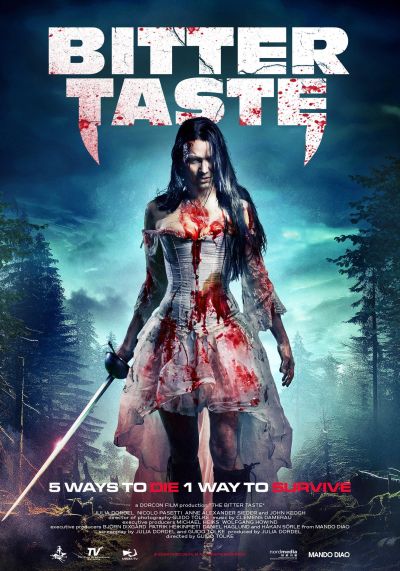
I have to give this credit for being something different. A vampire sports movie? Not a genre cross I’ve seen before. Especially when the sport is… um, modern pentathlon, the least-watched member of the modern Olympics. It’s a five-discipline event, based on the skills needed by a cavalry officer: running, shooting, fencing, swimming and horse-riding. All five play their part here, mostly in the form of Marcia Lorenz (Dordel), a former pentathlete, who is now a hunting guide. Well, was. She just got fired, and has absconded with valuable antique documents belonging to the customer who was responsible. Driving through remote woods, she stops to help a woman by the road, and that’s where things kick off. 
Turns out the woods belong to the Countess Badesky (Wolf), a Bathory knockoff who escaped execution with her four henchmen, but have been locked in their estate for centuries courtesy of a magic spell. They’re not happy about it, but maintain their eternal youth by drinking the blood of penathletes, who are considered the ultimate warriors. It’s unclear what they did before the sport was invented in 1912. Kinda lucky Marcia was an expert in the sport, before injury ended her career. And what are the odds? Those documents she lifted are key to lifting the occult lockdown and letting the Countess roam free. Only Marcia, plus possibly plucky fisherman Josh (Paseti) and local cop George Balough (Alexander-Sieder), stand in her way. 

There is actually more going on, as you would expect in a film running one hundred and thirty-one minutes. Logic is not its strong suit, stuff happening simply because the makers think it looks good. Marcia donning a wedding dress she finds in the castle is one such conceit. Not only does it fit perfectly (okay, it may be a little small in the bust, if you know what I mean and I think you do), she keeps it on while swimming. This kind of thing will eventually elicit derisive snorts, but is perhaps inevitable, with Tolke and Dordel having written, directed, produced, starred, edited and shot the whole thing between them. The film desperately needed an outside perspective to say, “Hang on – that’s a bit much, isn’t it?” 

Dordel was previously in Mission NinetyTwo, which also seems to have been inspired by her real-life activities. There, it was a background in forest science; here, it’s Dordel actually being a fairly adept pentathlete. Her skill-set is spun off in this case, into a batshit crazy film which wears a grab-bag of horror influences on its sleeve. from the hedge maze of The Shining through to blatantly lifting Evil Dead II‘s “Swallow this!” line. Sometimes it works, but it is in desperate need of editing down. A streamlined version of this – with less jerky editing – might have had cult potential, along the lines of Bloody Mallory. Instead, it comes over too often as bloated and self-indulgent, when it needs to be lean and mean. 

Dir: Guido Tölke
Star: Julia Dordel, Rita Wolf, Nicolo Pasetti, Anne Alexander-Sieder

The Blind Swordswoman

★½
“Gouge my eyes out, please.”

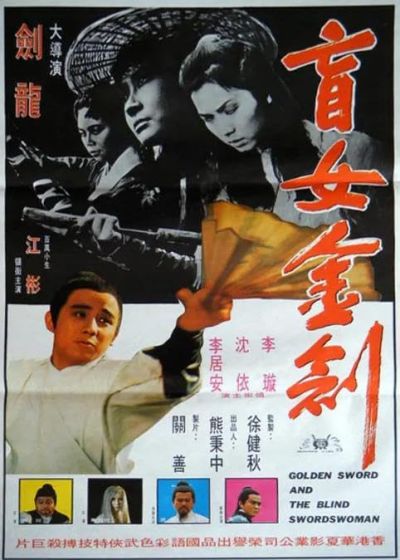
The rating above might actually be a little charitable, and would be for the film as originally released. The only version in which this is now apparently available, is both badly dubbed and pan-and-scanned to a 4:3 ratio. It certainly doesn’t help the film, when there are points at which all you can see of the participants in a conversation is an elbow, sticking in from one side of the screen. It’s close to unwatchable in this format, although I suspect it would barely pass muster, even in its original language and format. It feels like the Taiwanese makers saw Crimson Bat, The Blind Swordswoman, released the previous year and thought, “That looks easy.” 

In reality? Not so much. It’s the story of the titular, visually challenged practitioner of the fencing arts (Lee), who is called “Elaine” in the dub. The basic plot sees her out for revenge against the evil Mr. Lee, who appears to be responsible for everything bad in the world, from the murder of her father, to her ocular situation. She isn’t the only one, as there’s another woman, similarly deficient in the eye-chart comprehension department, whose family has also suffered at the hands of Lee. She’s called “Sue-Ann” in the dub, and ends up getting sold off to a whorehouse. I suspect Mr. Lee was probably responsible for this too, if you dig deep enough. There’s another swordsman (Kong), who wanders in and out. In a shocking twist, he can see. 

To be blunt, this is the sort of movie which explains why Taiwanese kung-fu films have such a bad reputation. The original Ocean Shores video was titled Zatoichi, the Blind Swordsman: a shameless conceit this version abandoned. As well as being a blatant knock-off (not that Crimson Bat was exactly original, itself being a Zatoichi knock-off of course), it doesn’t feel as if anyone involved in this can do anything more than wave their weapons in the vague direction of each other. This is not helped by the director’s inability to shoot an action sequence: I’m half-convinced he was blind too. The plot is incomprehensibly murky, and there are too many characters, whose purpose often remains frustratingly vague.

Meanwhile, any sense of nuance in the performances is bludgeoned to death by the English language soundtrack. It feels like the voice actors just got fired for incompetence from dubbing porn movies. Or perhaps were homeless people, pulled off the street into the studio at the last minute. Make no mistake though: this does not manage to make it into the “so bad it’s good” category of chop-socky flicks. It’s simply “so bad”. It might be worth trying to track down should you be after a test of cinematic endurance. If you can go longer than any ten minute period in this, without idly scrolling on your phone, you will be doing better than I managed.

Dir: Lung Chien
Star: Lee Shu, Shen Yi, Kong Ban, Yee Yuen
a.k.a. Golden Sword and the Blind Swordswoman

Burner

★★½
“Crime does pay…”

Kiki (Owens) was in a detrimental relationship with drug dealer Axar (Wheatley), until an arrest and subsequent jail time acted as a wake-up call. She cleaned up her act while inside, got out on probation, and has just succeeded in winning back custody of her teenage daughter, Lola Ray (Wylie). However, Axar – who slid out from charges on a technicality involving mishandled evidence – comes crawling out of the woodwork, wanting to resume their relationship, and offering one last score which will set the family up for life. This goes badly and violently wrong (of course!), but Kiki ends up in control of a cryptocurrency wallet containing close to a million dollars. Naturally, that’s not where the story ends. 

Indeed, the early going goes bouncing about in time like a rubber ball, beginning with Kiki being hauled out of a van by a masked man, in the middle of the desert. We then kick back to see the various events which led up to that point, as outlined above. I’m not sure this approach necessarily adds much, beyond offering an immediate hook at the start. It always feels like the use of this gimmick indicates film-makers are unsure about the overall strength of their narrative, having to cherry-pick an incident to lure people in. That is somewhat the case here, with a story that doesn’t have much to offer which wasn’t familiar.

For example, the mother prepared to go to dodgy lengths for her child is rather clichéd, and the supposed twist provided by the reveal at the end, of what actually happened, is nowhere near as much a surprise as the makers think. However, there are enough positives in other elements to make this a tolerable watch. Owens’s performance gives Kiki a commitment which helps paper over the cracks, and there are a couple of excellent supporting actors. Veteran Lew Temple only has one scene, as the detective investigating the shootout, but almost steals the film with his probing interrogation of Kiki. He knows for sure something is up; he just can’t prove it, given Kiki’s stonewalling. Similarly, Jolene Andersen is great in her single scene as very bad cop Stanikov.

However, these moments only highlight the rest of the film, which is nothing special at all. I didn’t feel Kiki was particularly sympathetic, not least because she jumps back in with Axar far too easily for my tastes. Certain subsequent events – part of the reveal – also suggest she’s hardly a good person or a fit mother. Indeed, you could credibly argue she’s worse than Axar, and certainly little worse than Stanikov. Again, this feels like a misstep by the makers, who seem to like their lead character more than they give the viewer reason to do so. Having a kid feels very much a lazy and insufficient excuse for her actions. While it’s understandable, this does leave the film touting a questionable moral, albeit unintentionally.

Dir: Robert Orr
Star: Kacy Owens, James Oliver Wheatley, Akina Wylie, Robert Laenen

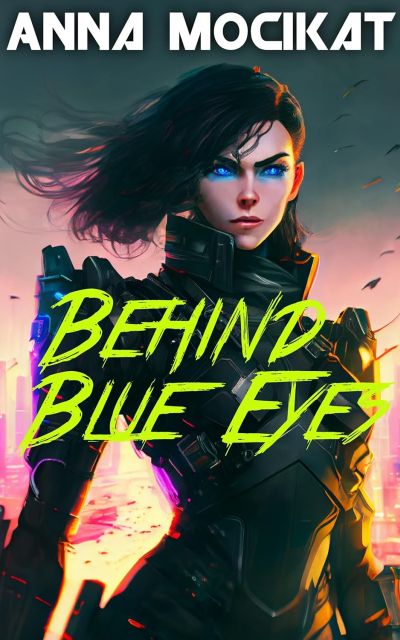
Behind Blue Eyes, by Anna Mocikat

Literary rating: ★★★
Kick-butt quotient: ☆☆☆½

The set-up here is an interesting one. The world is now entirely ruled by three corporations. The Olympias Conglomerate governs the Americas; TogbuaXiang controls Asia; and Rosprom holds sway over Europe. Certainly under Olympias, life is not terrible, with the company providing for all your needs. However, the cost is a total lack of freedom, with any attempt to live outside the control of Olympias brutally suppressed. In charge of doing that are its feared Guardian Angels, who are trained from birth to be ruthless killers, augmented by cybernetic implants to be faster and stronger than any human, and absolutely obedient to their commanding officer, Metatron.
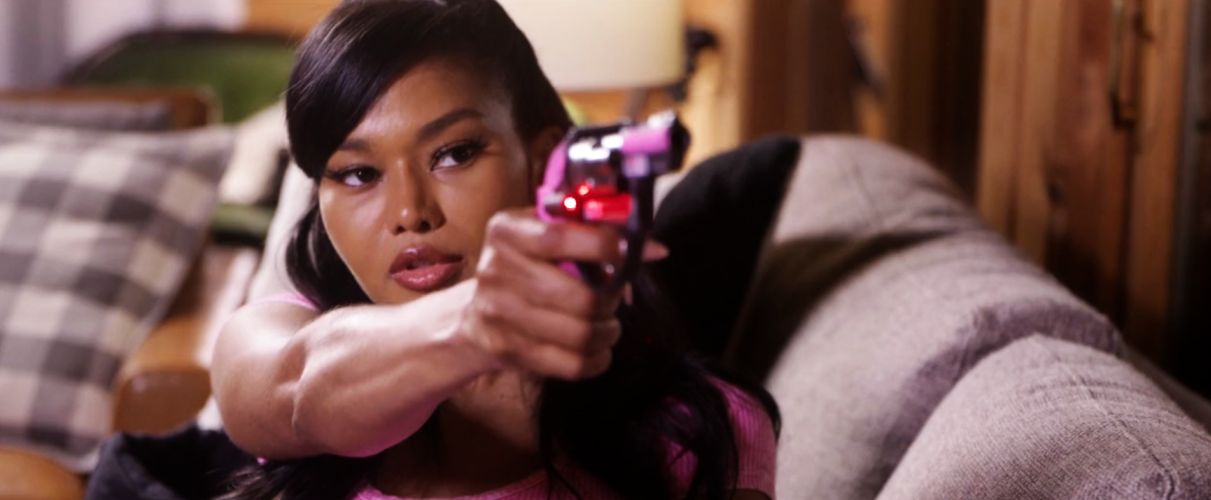
Or not. Because where would the fun and dramatic conflict be in that? Specifically, Nephilim, who is being groomed by Metatron to become one of his inner cabal, the Archangels. Except, after a mission to exterminate a dissident encampment, her programming seems to be breaking down, and she is having increasing doubts about which side she is on. She’s even “dreaming”, something unheard of for Angels. A friendly tech (who basically has a crush on Nephilim) implants her with a device which allows some autonomy from the perpetual surveillance under which Guardian Angels operate. While on her nightly excursions, she meets Jake, who opens her eyes to the realities of what she is doing. Nephilim decides to rebel again Metatron and everything she has done her whole life. 

It feels as if Mocikat was a big fan of Equilbrium, the similarly dystopian film in which a highly-skilled and savage enforcer (played by Christian Bale) rebelled against his conditioning, after having his eyes opened to the totalitarian regime for which he works. This is fine, because I’m a big fan of it as well. But it does bring a certain predictability to proceedings, almost from the start. I’d have been more impressed if Nephilim had not rediscovered her individuality – or had done so, and instead remained enthusiastically carrying out the orders of Metatron and Olympias. The only real wrinkle here is that Jake has secrets of his own, and even these are not particularly significant in the final analysis. 

However, while it’s not hard to work out the final destination, the journey to get there still made for a decent read. The world here is developed nicely, and you are left wondering how much liberty people would be willing to give up, in exchange for security and comfort [the answer, I suspect, is a great deal] Nephilim certainly proves capable of taking on just about anything thrown at her, with her 60% artificial body, and the action scenes are crisp and well-described. At almost five hundred pages, it does cram a lot in, but never felt particularly padded. The ending feels like it may push the author into less predictable territory, and I would say that’s likely for the best. Moderately curious as to where it might go.  

Author: Anna Mocikat
Publisher: Self published, available through Amazon, both as a paperback and an e-book
Book 1 of 7 in the Behind Blue Eyes series.

Born Again Baddie

★★½
“God told me to do it.”

With a running time of 155 minutes, this may be the Gone With the Wind of low-budget urban cinema. To be fair, it didn’t feel that long. To be honest, this might have been partly because it was watched in five separate chunks, over the course of about a week. However, in comparison to some entries I’ve seen, this is technically competent. Director Freddie (whose last name appears to have been abandoned) knows where to point the camera, and he has assembled a decent enough cast of actors, presumably found in the Charlotte, North Carolina area where the story unfolds. Though in this genre, “decent enough” is code for “does not generate physical pain with their performances.” 

It opens with a quote from the Bible – Jeremiah 29:11, to be precise. This will become relevant, although not for another two hours or more. Instead, we are into what is probably trope #1 for the genre: the rise-and-fall story. In this case, the heroine is Nia (Evans), whom we first meet in prison. New inmate Sheba (Abell) realizes that Nia used to be her idol, when Nia was on the outside and called ‘Baddie Bedina’. Her reputation had her dead or on the run. In reality, she’s been inside for a decade, with ten more to serve, and tells her life story to Sheba. This begins with her as a young girl, struggling to take care of her disabled father, a situation which eventually forces her into prostitution. 

She’s good enough at that to become one of the top escorts in the city, the #1 girl at the agency for whom she works, the subtly-named “Harlots”. One of her most regular and richest customers is businessman JP (Tillman), who falls for Baddie. She discovers his business is crime, and saves his life (top) when his enemies attack them at his house. After he goes to prison, for assaulting a slumlord, she takes over and expands the territory under their control – with surprising ease, it has to be said). This comes at a price, and the eventual reprisals force Baddie on the run. She hides out in a remote cabin which her father built with his friend Arthur (Massey).

Trouble follows: unsurprisingly, because she blabs her location to the head of Harlots, after about 30 seconds of chit-chat. Considering they didn’t exactly part on good company, this is incredibly dumb of her. However, she has an ally because Harold is… No, I can’t even. Let’s just say, I did not see his identity coming, and that Bible verse becomes increasingly relevant. It’s certainly unique among GWG films: whether it’s good or not is likely a sharp matter of both personal opinion, and religious conviction. Nia speaks about taking the consequences for her actions, yet there’s a (literal) get out of jail free card here. Credit to Freddie for taking a different route – I just can’t say it’s one that worked for me.

Dir: Freddie
Star: August Evans, Torri J. Tillman, Carlos Massey, Destiny Abell

The Bluff

★★★
“Back from Davy Jones’s locker.”

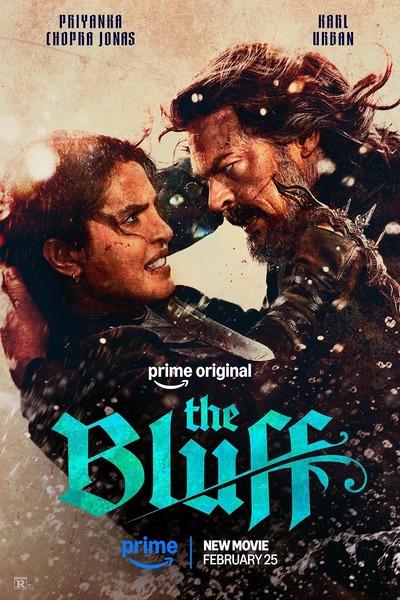
Are women pirates in vogue again? It’s safe to say that the startling failure of Cutthroat Island holed that subgenre of action heroine movies below the water. That was over thirty years ago now, and this may well be the first time Hollywood has returned to it since. [I found an indie film about Irish pirate Grainne Uaile which wrapped shooting in February 2014, and still hasn’t received a release] Though even here, there isn’t much high seas action here. Outside of the opening scene, where Captain Connor (Urban) boards a ship run by Captain Bodden (Córdova) and finds gold stamped with Connor’s hallmark, this takes place almost entirely on land, specifically the island of Cayman Brac.

Connor heads there, that being where Bodden’s ship came from, in search of the rest of the gold. This was taken from him years previously by then piratical associate Bloody Mary (Chopra Jonas) , who stabbed Connor in the chest and left him for dead. She is now Mrs. Ercell Bodden, having abandoned the nautical life, and started a family. The arrival of her ex-lover upends her domestic bliss, and forces her back into the violent way of life. It’s all kinda like The Long Kiss Goodnight, without the amnesia thing. She has to protect her crippled son Isaac and rather flighty sister-in-law Lizzie (Oakley-Green), while figuring out how to rescue her husband from Connor’s clutches.

The two leads are probably the best things about thus. Chopra Jonas has been ramping up her action chops since her co-starring role in Citadel – also an Amazon product – and does a good job throughout. Urban makes for a great villain, despite being solidly into his mid-fifties. He still commands a fine screen presence, almost thirty years after playing Julius Caesar on Xena. However, the other elements aren’t quite as impressive – or, at least, not consistently so. Flowers doesn’t have a lot of directorial experience, especially in the action genre, and sometimes that shows. There are some good sequences, such as where Ercell fends off buccaneers in her own home. But others, such as a battle in a cave complex, come over as dark and muddled.

The same lack of consistency hampers the rest of the film. For every cool moment – such as the discovery that there are caimans on Cayman Brac – there are elements that don’t work, like Ercell’s relationship with Lizzie. Another issue is that since the days of Cutthroat Island, the genre has been redefined by the Pirates of the Caribbean franchise. Any pirate movie will inevitably be compared to it, and any hero(ine) to Jack Sparrow. It’s an awkward situation, and it feels as if The Bluff is torn between pandering to this, and being its own thing. Whatever Cutthroat‘s issues – and they were numerous – that wasn’t one. But if this can prove the viability of female pirates again, it’ll have been worth the effort. 

Dir: Frank E. Flowers
Star: Priyanka Chopra Jonas, Karl Urban, Safia Oakley-Green, Ismael Cruz Córdova

Billie the Kid

★½
“Sadly, they’re not kid-ding.”

I’m inclined to look kindly on this, because I suspect it was a local production, filmed here in Arizona. While the end credits are silent on the topic, there are enough saguaro cacti about, to make it likely the faux Western town and other locations used, were somewhere near me. I recognize an actor or two as well. Unfortunately, it’s not exactly a film I would hold up as a shining example of quality Arizona cinema. While clearly set in the Old West, the movie is stuffed with anachronisms, from haircuts through a terrible British accent to glasses. It consequently never succeeds in establishing a convincing sense of period. This is a bit of a shame, since the Western horror action heroine isn’t one we see often. 

In this case, it’s vampires which provide the darker elements – though these can daywalk, probably because it’s harder to film at night. A small clan are seeking the location of Drakul, a senior bloodsucker who can grant a blessing to his chosen one. Emphasis on “one”, leading to dissent in the ranks. Meanwhile, the bodies they left behind causes local Sheriff Jack Barton (Prell) to assemble a posse. Included is Billie (Hsu), who was languishing in Barton’s jail, but is allowed out due to her tracking skills. There’s also a Van Helsing type, in the shape of black “British” guy – did I mention the accent? – James Underhill (Monroe), who seems to know a lot about them. One might say a suspicious amount.

A simple approach would have worked better here, pitting cowboys against vampires in a straightforward action adventure. But the film diverts too much time and energy into uninteresting areas. For example, it tries repeatedly to generate romantic tension between Billie and Jack. However, when this relies on lines like, “I’m plenty good – and I’m good at plenty”, it’s a struggle which is more uphill than the side of El Capitan. Similarly, one of the vampires (Conran) has taken up with a prospector (did I mention the haircut?), a thread which occupies running-time and little else. The same goes for Billie’s back story, involving sexual abuse and revenge. Couldn’t she just be a gunslinger without a tragic past?

Things grind to a particular halt in the middle, freeing me up to consider whether or not this was better than the infamous and similarly themed 1966 B-movie, Billy the Kid Versus Dracula. Given John Carradine called the latter the worst of the 343 feature films in which he appeared, the competition is tough. This probably isn’t quite as bad: Hsu does what she can with dialogue which is often spectacularly terrible. But much like its predecessor, this fails badly as a Western, and likely even more so as a horror film. I was left with a greater understanding of precisely why the two genres have largely gone their own way. Though the general ineptness in this production certainly doesn’t help.

Dir: Paul Tomborello
Star: Olivia Hsu, Frank Prell, Zion Monroe, Veronica Conran

The Broken Sword, by Jonathan Posner

Literary rating: ★★★
Kick-butt quotient: ☆☆☆½

I’m not sure I’ve read a book with a 16th-century action heroine before, so the setting here certainly appears a fresh one. Things take place during the reign of King Henry the Eighth of England, when Mary Fox had been brought up alongside her three older brothers. From them she had secretly learned how to wield a sword and ride a horse, among other unladylike skills. But having now reached adulthood, her father is intent on marrying her off, to the particularly repellent Sir Reginald de Courtney. Mary is having none of that, so packs her bags and leaves the family home.

On the road, she saves Sir John Fitzwilliam and his son, Robert, from a brigand. She then agrees to help on their quest, returning a precious heirloom, the titular weapon, to their family home. However, Sir Reginald is not taking the loss of his bride-to-be lightly, and is in pursuit, with the intention to put Mary back under his control. For at this point in history, a woman had very little independence in the eyes of the law, being little more than property, first of her father, and then her husband. I repeat: Mary is having none of that, and most of the book is basically an extended chase, first back to Sir John’s estates, and then continuing, as Mary heads off on her own.

It makes for a breezy romp, one which won’t challenge the reader, yet definitely kept me wanting to read on. I will say, Mary does not exactly seem like she comes from the middle ages, feeling more like a modern gal transplanted back in time. Apart from odd epithets like “God’s wounds”, the dialogue similarly feels largely contemporary. It’s not Shakespeare, put it that way, although to be fair, most films set in the era play similarly fast and loose with historical accuracy in their speech. We also get the “woman pretends to be a man” trope, as often seen in Chinese films, and looking at the cover, it seems about as plausible here. Which would be “not very”!

On the plus side, romance is very heavily back-burnered. While Mary does eventually grow to respect Robert, after initially referring to him in her mind as “Weed,” she decides not to remain with the Fitzwilliams, instead choosing admirably to carve out her own path. This does cause problems, not least her decision to stick around the very same inn, where she had just escaped from Sir Reginald’s clutches. [I’ve rarely come closer to yelling at my Kindle!] But it does also lead to the opportunity which will be covered in the second volume. I suspect more cross-dressing is going to be in her future there, and I have questions about that too, e.g. You want someone to imitate a boy… why use a girl? All criticism aside, the bottom line is: I was entertained by this, and can see myself investing in the sequel down the road. 

Author: Jonathan Posner
Publisher: Winter & Drew Publishing, available through Amazon, both as a paperback and an e-book
Book 1 of 2 in the Mary Fox Adventures series.