




★★★
“High-quality torture porn”
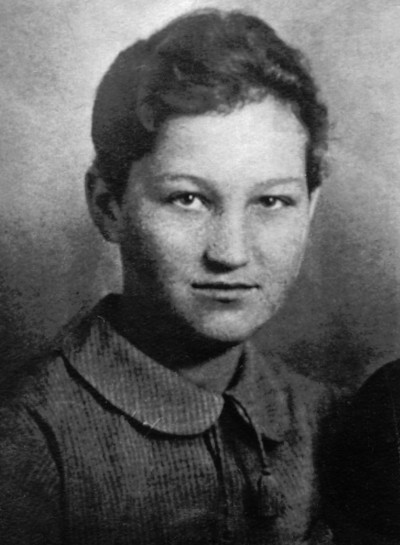 This was originally made under the working title of The Passion of Zoya, and the Joan of Arc reference is on point. Both were young warriors fighting against the occupation of their native land, captured by the enemy and tortured before being executed. But they became a rallying point for their country as it succeeded in expelling the invaders, and are now revered as national heroines. The real Zoya Kosmodemyanskaya (pictured) was an 18-year-old teenager in 1941, who signed up to be dropped behind the front-line as the Germans invaded Russia, and carry out missions of sabotage intended to make life difficult for the Nazi army. It did not end well, but she became the first woman Hero of the Soviet Union in WW2, less than three months after her death.
Unsurprisingly, the facts are a bit murky, with the regime at the time intent on making a heroine of her, who could be used for propaganda purposes. [There was another film of the same name made in 1944, to that end. It’s on YouTube; I need to find subtitles before I can review it] This was criticized on its release for historical inaccuracies, but most of the events match the Wikipedia page, at least. There is perhaps artistic license over her motivation, signing up after her fiancé was killed in action. Whether her capture was triggered by the betrayal of a colleague in the sabotage cell, Vasily Klubkov (Kologrivy), or the betrayal was after her capture, as depicted here, I don’t know.
As ever, I’m here for the cinematic experience, not a documentary. As such, it’s well made, though concentrates to such an extent on her post-capture experience that it seemed to border on the exploitative. The lengthy sequence where Zoya is stripped and whipped, is the most obvious example, and her stoicism as she refuses to give up any useful information makes things worse. Perhaps the most interesting character beside Zoya is Hauptmann Erich Sommer (Cerny), who seems to feel for his captive, explicitly ordering the troops under his command to refrain from abuse. Not that they necessarily obey. I likely was more impressed by the earlier stages, depicting Zoya’s training and her activities behind enemy lines, which are tense and well-assembled.
There’s no doubt she was being positioned as a heroine, from the first reports of her death in state newspaper Pravda [which included a gnarly, NSFW photo of her corpse]. This feels like it’s trying to do the same thing, right up to her defiant speech on the scaffold: “Comrades, beat the Nazis. Burn them! Poison them! There’s 200 million of us, you can’t hang us all.” I imagine that would have had the intended effect in 1942, of inflaming patriotic anger and willingness to fight. But I can’t say I was particularly moved, with my main reaction to Zoya’s death being relief that her torment was over. More depth and less torture would have been preferable, I’d say.
Dir: Maksim Brius + Leonid Plyaskin
Star: Anastasia Mishina, Nikita Kologrivy, Wolfgang Cerny, Darya Jurgens
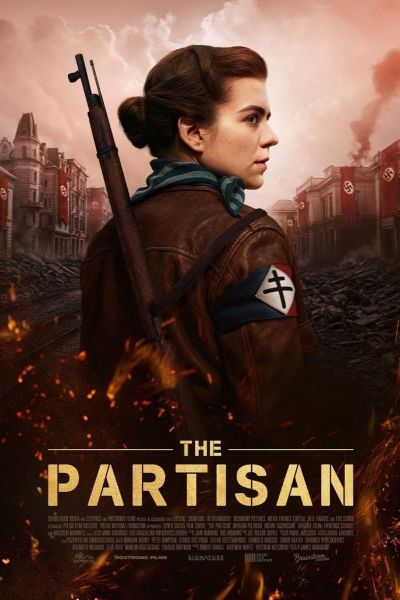 We have written about some of the women who worked behind enemy lines for British intelligence during World War II. Names like
 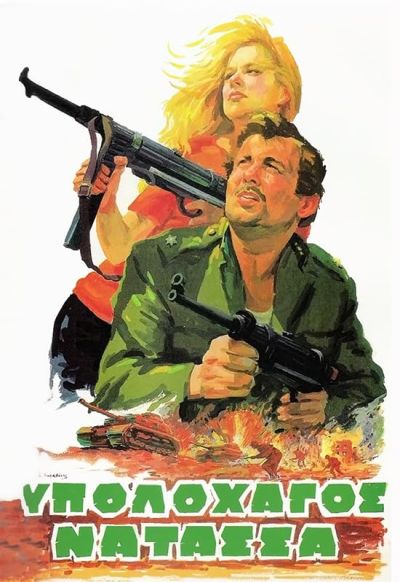 I am reluctant to be overly harsh on this one, because I suspect I didn’t get to see this in its best format. The fact it feels very choppy and disjointed could potentially be a result of the IMDb giving this a running time of 136 minutes, but the only print available ran a good half-hour less. It was also dubbed from Greek into English and pan-and-scanned. Pretty much the holy trinity of cinematic suckage, right there. It’s the story of Natassa Arseni (Vougiouklaki), who lives in Greece when the Nazis invade during World War II. She’s initially largely unconcerned, but gradually becomes involved in the local resistance.
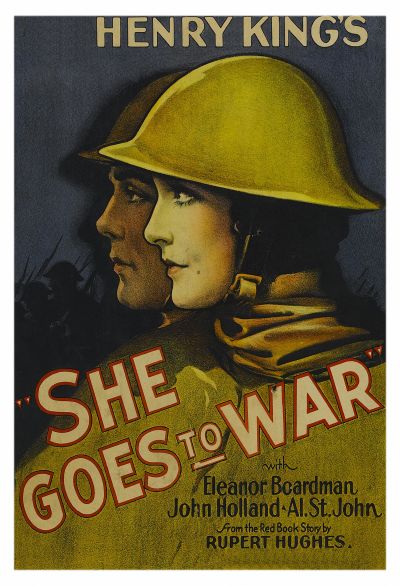 . Albeit for reasons that are largely not the makers’ fault, because this film only partially survives. Originally released in 1929 with a running-time of 87 minutes, the only version that remains is one re-released about a decade later, which has been chopped down to under fifty minutes, including new opening captions which comment on the looming second global conflict. What remains still packs quite the wallop, as an anti-war movie which doesn’t shy from the brutal nature of World War I. It’s a part-talkie, with sounds for some of the music and dialogue, and it’s very effective when used.
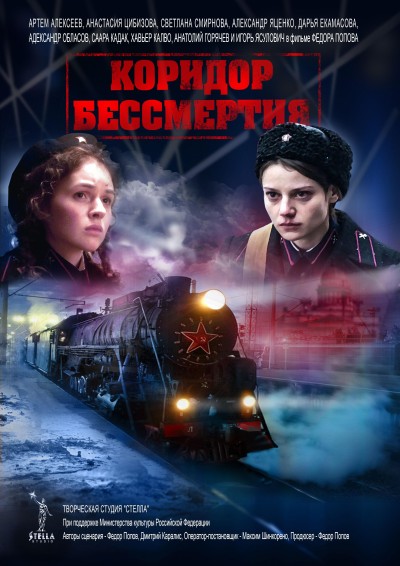 I guess this is a slightly different take on the typically heroic stories to come out of Russia concerning their battles against Germany in World War II. Rather than focusing on members of the military, it’s the story of civilians – many with little or no previous experience – who were brought in to keep the railway supply line to Leningrad open. These wee crucial to the city’s survival, as the Nazi blockade threatened to starve the city into submission, being responsible for thee-quarters of the resources going into the city. Naturally, the German forces wanted to cut this off, so subjected the tracks and trains to a relentless bombardment, from artillery, mortars and planes, placing those operating the trains in near-constant danger.
 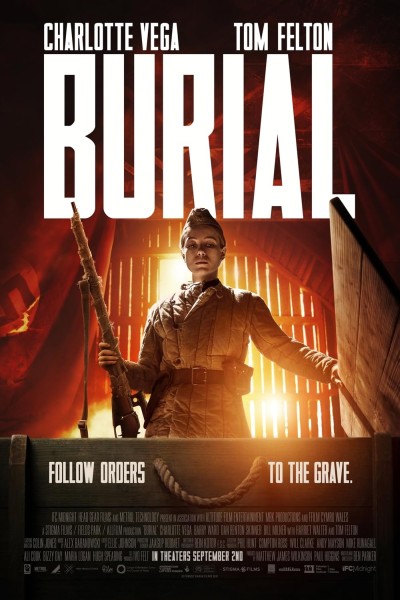 There’s an interesting idea here, which somewhat works. But it’s perhaps a little too grounded for its own good. It starts in a London flat, where senior citizen Anna Marshall (Walter) ambushes an intruder, handcuffing him to a radiator. Turns out he’s not just a burglar. He knows about her past, and wants the truth. So she tells him a story… At the very end of World War II, her identity was Brana Brodskaya (Vega). She was one member in a small group of Russian soldiers, who have been given a very important task: transport a box back from Berlin to Moscow. Oh, and bury it every night. Inevitably, their curiosity overcomes them, and the box is opened, to reveal Hitler’s corpse inside.
  The Texas Chainsaw Massacre was fairly notorious in Britain in the eighties and nineties, being famously banned on video. Naturally, this meant I had to see it, and… I was initially underwhelmed. However, I’ve gradually come to appreciate its raw intensity over the years. If I ever doubted its merits, watching this largely shameless knockoff should act as a reminder. Because it shows how flat and uninteresting the premise can be, when executed poorly. This relocate things from seventies Texas to Germany in the last days of World War II. A medevac team is trying to get injured and grumpy officer, Colonel Franklin (Christian) to a hospital before his leg falls off from sepsis.
 I’m very cautiously giving this one our middest of mid-tier ratings, which I reserve the right to change in future. Because this one showed up on one of the… “less official”, let’s say Chinese movie channels on YouTube. While the likes of Youku and iQiyi make the effort to deliver subtitles which are typically at least intelligible, I’d say the subs here reached such a level, only about one line in five. Then I still had to figure out cultural context for this period piece, which also seemed to reference local folklore. I guess I should be grateful the soundtrack here was intact. The previous night, I’d watched another film on the same channel which, I kid you not, had random bursts of musak injected, presumably to avoid YouTube’s automated copyright system.
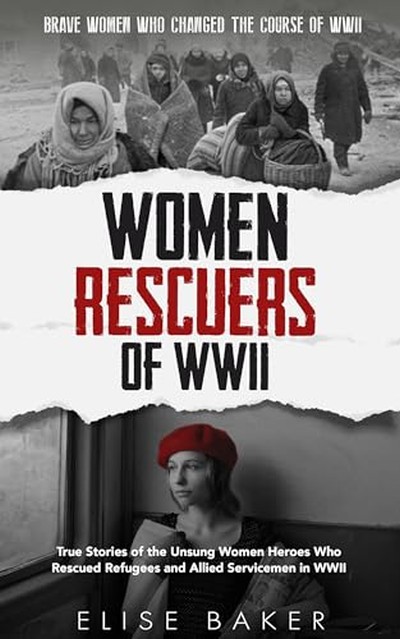 With the somewhat accurate and rather clunky sub-title of “True stories of the unsung women heroes who rescued refugees and Allied servicemen in WWII”, this is a book whose idea I liked rather more than the execution. The core is six chapters, each devoted to a woman or pair of women, who operated before and around World War II, mostly helping refugees to escape the Nazi regime as it swept across Europe. Every chapter has the same structure. Each begins with ‘The Threshold’, describing how they came to take on that role; then ‘The Move’, covering their heroic activities; and finally, ‘The Close’, detailing what happened to them afterward.
 This is the story of Syrian sisters Yusra Mardini and her sister Sarah, played by real-life sisters Nathalie and Manal Issa. Growing up, they were trained by their father, a professional swimmer himself, and had the goal of reaching the Olympics for their country. The (still ongoing) Syrian Civil War led to the sisters leaving their homeland, and this is mostly the story of their journey, through Turkey, across the Mediterranean in a