 ★★★½
★★★½
“We never sleep.”
When we think of the tough women in the old West, the first ones that come to mind are usually, the criminals. Let’s face it, most people we celebrate as “legends of the old West” today were not really heroes. More often, they were people who broke the law, or highly questionable personalities such as Calamity Jane, Belle Starr, Pearl Hart or Etta Place. But we should not forget there is also the other side of the law! Though women were present in quite a number of job areas and were vital in the development of the country, very often history writing has focused rather on the achievements of men, overlooking the women’s part of the success story. But now and again, an interesting yet forgotten character is rediscovered and attracts new attention.
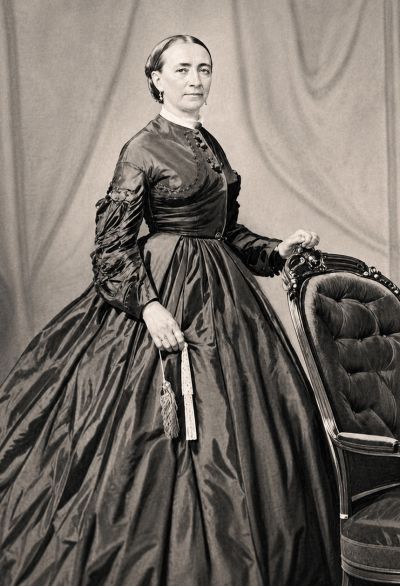
One of these characters is Kate Warne (sometimes spelled Warn), born in 1833 in New York. Coming from a poor background, life turned even more challenging after she became a widow at just 23 years old. She was working as a cleaning woman when she saw an advertisement in a newspaper. Allan Pinkerton, head of Pinkerton’s detective agency, was looking for new employees, interested in working for him. The agency were involved in quite a number of fascinating cases, such as the “Molly Maguires”. Those events were referenced in the Sherlock Holmes novel The Valley of Fear, and subsequently became the basis for a 1970 movie with Sean Connery and Richard Harris. Warne was able to convince Pinkerton to employ a female, arguing that women have an eye for details and are excellent observers. Indeed, it seems that Pinkerton grew quite fond of her as he spoke highly of her after her death.
Warne was active in solving crime cases and is said to have played an essential role in discovering a plot to kill Abraham Lincoln in 1861. She guarded him when his train passed locations where an attack was planned. (Unfortunately, she wasn’t around in 1865.) For the whole story I refer you to Warne’s Wikipedia page. But I especially like the following sentence there: “It is believed that Pinkerton came up with the slogan to his agency “we never sleep” as a result of Warne’s guard of Lincoln that night.” How much of that is true is difficult to say. Pinkerton himself was rumored to invent his own stories. He was definitely a man who knew how to blow his own trumpet. Though he had successes which prove the quality of his agency, and for a long time the Pinkertons were the most well-known and respectable detective agency.
The real Kate Warne
Kate had become the head of the female detectives department at Pinkerton’s, but died young, at just 35 years old in Chicago, of pneumonia. The Great Fire of 1871 there destroyed a lot of the company’s records, so not so much is known about Warne, apart from what Pinkerton himself reported about her and the cases in which she was involved. But in recent years this highly interesting character has had a resurgence in popular media. Among others, there have been a couple of children’s books, a novel, a non-fiction book about the female detectives at Pinkertons, a comic book and a low-budget movie on Amazon Prime, Pinkerton, in which she appears. She also played a very small role in the three-part TV series about Lincoln on the History Channel, and there has been talk of a big-budget Amazon MGM film, with Emily Blunt playing her and Jaume Collet-Serra directing.
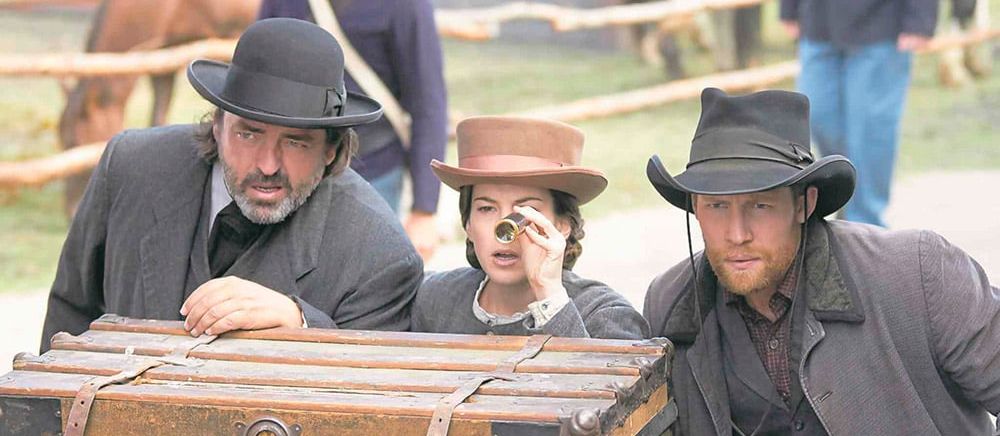
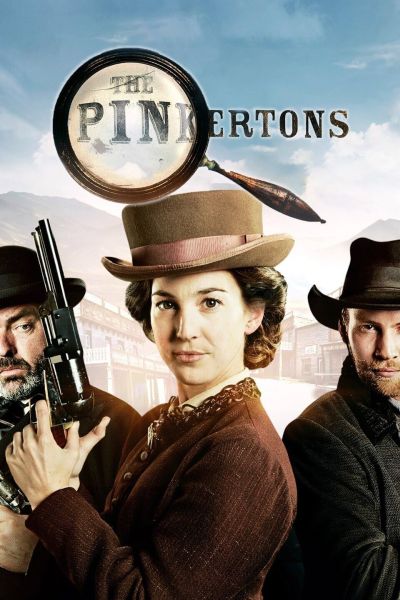
I’m not quite sure when and why this new interest in Warne arose. But I wouldn’t be surprised if it started with this small, Canadian TV series from 2014, that ran until the following May. The Pinkertons was made by Rosetta Media and Buffalo Gal Pictures, in partnership with Channel Zero. Only one season with 22 episodes was produced, and obviously, it was not successful enough to get a second season. Which is, actually, kind of a pity, as the show ended with a cliffhanger. It’s a Western show, yes. But it is also a detective show, making it a very unusual hybrid. We are not used to seeing cowboys and detectives in the same series, and it is a smart way to cater to two different potential audiences: Western and crime fans.
It must be said, the budget was not very high: over the course of the series, we get to see the same sets again and again. The farm where Kate (Martha MacIsaac) lives for the time being, working for the elder Pinkerton, Allan (Angus MacFadyen). The local saloon in which she and young William Pinkerton (Jacob Blair) regularly meet. And the Sheriff’s office where suspects are imprisoned. Also, a lot of episodes take place in the woods or large fields, with single buildings housing the perpetrators or victims. The whole series is set in Kansas City, Missouri in 1865. Pinkerton Sr. thinks a lot of shady things happen here, which is why he insists that his son and new employee Kate stay there and work “undercover”. The Lincoln story discussed above is mentioned, but doesn’t play any role here.
The cases themselves are well-thought out. Not so complicated as to become ridiculous, nor easily and quickly figured out by viewers. They cover a wide range from murder and identity theft, to the killing of a dog. The three main characters are generally given equal attention, for this was before female characters in modern media started to become the center of everything (mostly by showing how inadequate or ridiculous men are, in the opinion of modern TV/film executives). There’s no such need here; while Will is initially not very happy about Kate, especially because his father makes her his superior, he quite quickly acknowledges her expertise and knowledge. They subsequently form a good team and work well together.
The pairing makes it possible for them to investigate different places and witnesses at the same time. Luckily, they also keep tabs on each other, with episodes where one would have been killed if the other hadn’t been around. Allan himself pops up now and again in the show, before he vanishes off to do something else. Other regulars include AnnaLee Webb (Jennifer Pudavick) who owns the saloon and the brothel in it; a black worker on Kate’s farm, John Bell; local sheriff Lawrence Logan; and Kenji Harada, a Japanese man who is initially a client, before becoming a Pinkerton apprentice. MacIsaac plays Kate Warne as a sophisticated young woman without attitude. She is neither a bombshell nor a spinstery type. She is always polite, well-dressed and appears a bit out of place in this typically Western town, as if she does belong more in the big city.
 Meanwhile, Will is a bit of a rascal and wants to prove his worth as a detective to his grumpy but sympathetic father. But he and Kate get along well, developing a friendly working relationship. She doesn’t reveal much about her background. I wonder if screenwriters maybe wanted to set up something along the lines of the Benedict Cumberbatch version of Sherlock Holmes, without the extremes. She definitely has a scientific mind, quoting facts that indicate she is well-read, and uses what could be called early forensic investigative methods. But she is not set up as a genius and doesn’t solve the cases alone: this is genuine team work. In the beginning, I wondered if Kate really belonged in the “girls with guns” genre, since an investigator is not necessarily someone involved in much action. But I shouldn’t have worried: there’s enough to confirm her action heroine status!
Regrettably, the show had an open ending. Billy the Kid turns up with a new experimental rifle to take revenge on old Pinkerton, finally challenging young Will to a duel. They have a shoot-out but the outcome has to stay a mystery, as this is where the show ended. It was, of course, a gamble of the producers, in the hope that a second season would be ordered. Unfortunately it didn’t pay off, and we are left with an unfinished story. I do understand why it might not have been a big ratings success. For a Western fan, there might not be enough gun-fighting; and for a crime series fan, the Western tropes might be largely uninteresting. But I did like the mixture. All in all, this is a nice little show.
I did sometimes think there could have been better set design: in the interior of houses, everything looked a bit spartan. Also, I wondered if the way the three main characters were such a good team and got along so well, might have made the show too humdrum for many. Some stronger emotional conflicts or personal problems in their relationships with each other, could have made the whole thing a bit more interesting. But you don’t always need that. Sometimes it’s nice just to have a team that does its work, has a good relationship with each other, and that’s it. This is a well-done detective show that might have helped to reintroduce Kate Warne to the modern public. I liked it well enough, and am indeed curious what a big movie about her might offer, if the proposed production with Emily Blunt should indeed become a reality.
Creators: Kevin Abrams and Adam Moore
Star: Martha MacIsaac, Jacob Blair, Angus Macfadyen, Jennifer Pudavick



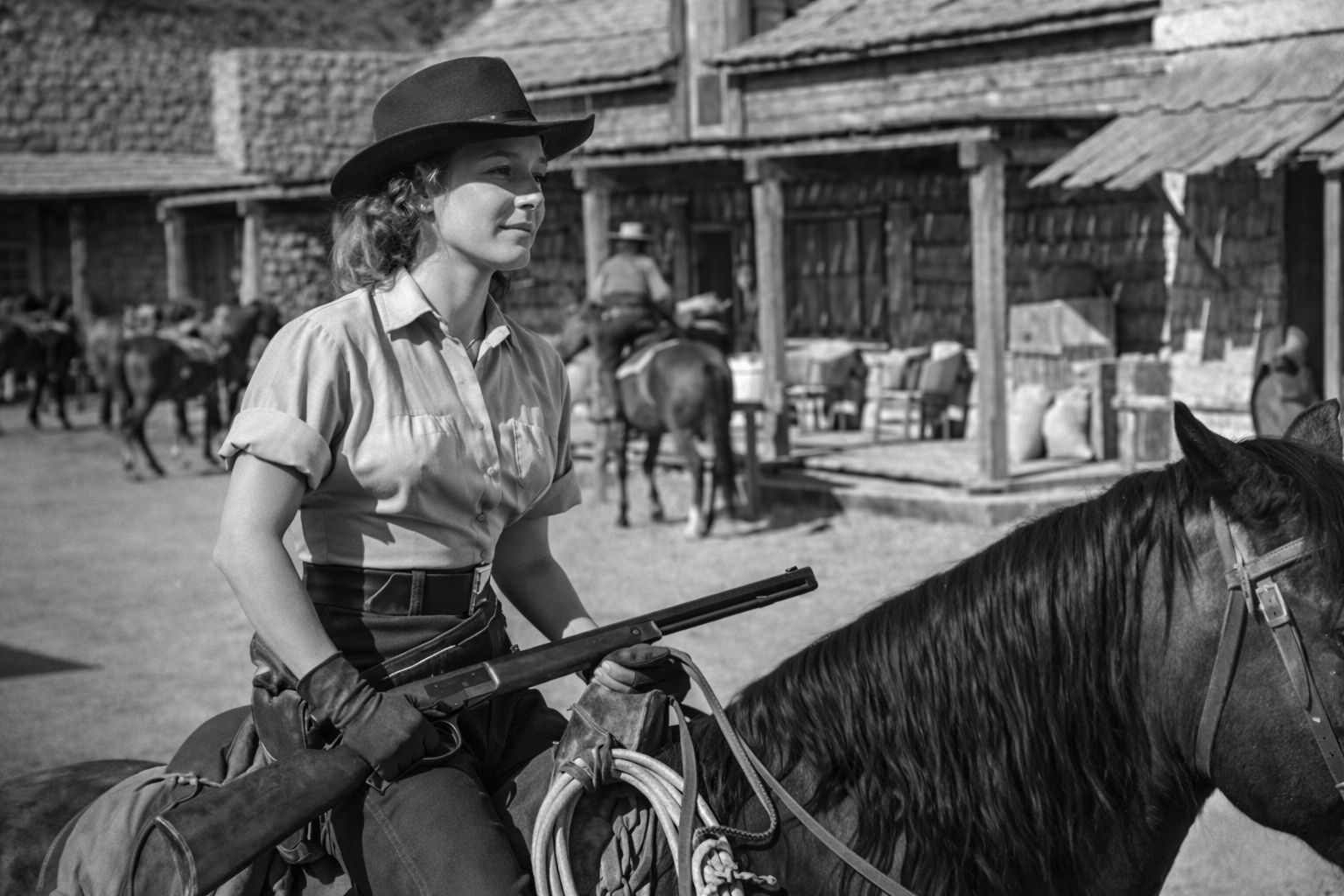 ★★½
★★½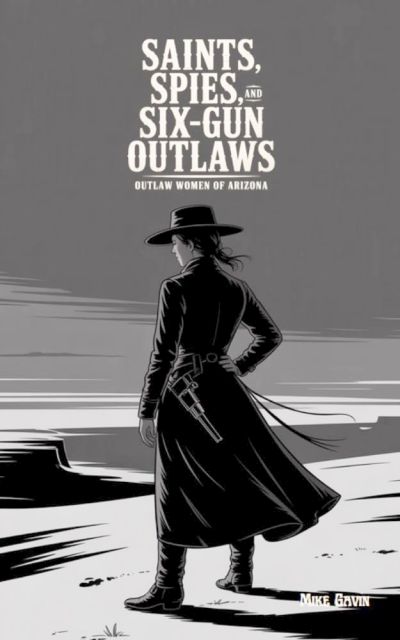 This is a slim little book – more of a booklet, really, coming in at only 74 pages in length. But since it combines both our topic of discussion and local interest, because I live in Arizona, it was an easy decision to pick up a copy, after Dieter brought it to my attention. It does use quite a loose definition of “outlaw” – it is something only really discussed in the book’s epilogue, dividing them into three categories. Most obviously, are the ones Gavin calls “The Breakers of Law”, such as stagecoach robber Pearl Hart, whose exploits were dramatized in
 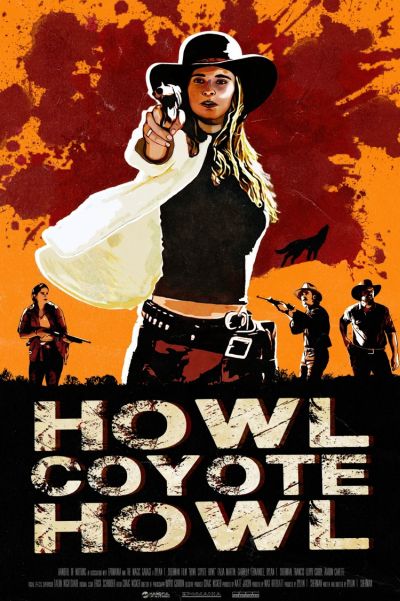 I dunno. Maybe I’m getting less patient in my old age. Or maybe social media has shot my attention span to pieces. But I’ve noticed of late that my tolerance for underwhelming movies has worn precariously thin. I definitely feel like the average rating I’ve handed out on this side in the past year has gone down, as film after film has failed to capture my interest. This is the latest such: the best thing I can say about it is, the creators did a good job of keeping within their means. This means a cast in single digits, and everything shot where film-making is cheap, in the great outdoors.
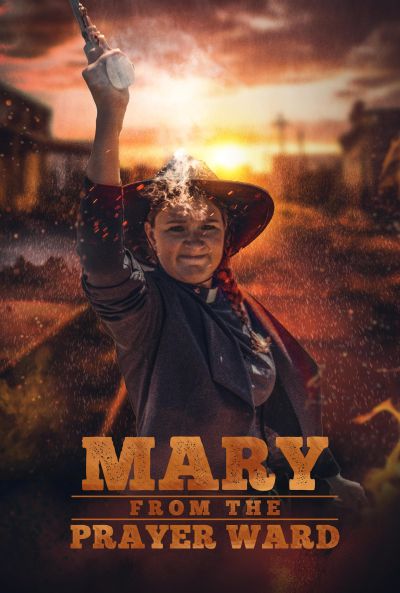 I mean: Stetson wearin’, six-gun shootin’ country gal, on a mission to slay demons, vampires and things that go bump in the West? Yeah, it’s like that. Mind you, there’s a rough start to this, with three minutes of what is likely a top contender for the worst acting of 2026. I guess it’s good to get it out of the way early, and it does make the rest of the cast look like Oscar candidates in comparison. To be fair, Jones is decent enough in the title role. Even when lumbered with some pretty clunky globs of exposition about a 17th-century Satanic cult, she is generally tolerable, and occasionally above that.
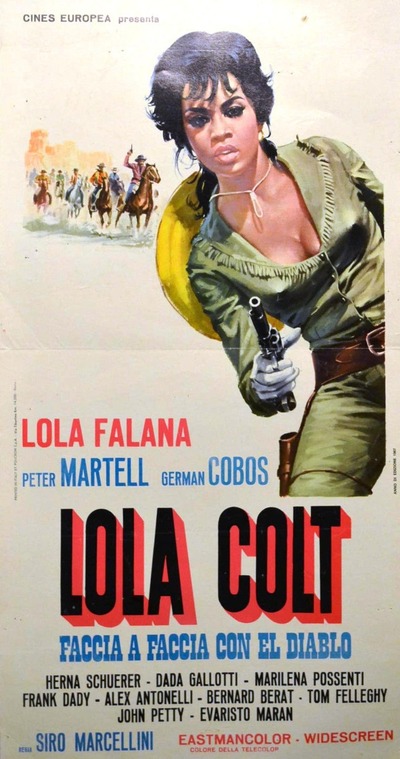 This spaghetti Western sees Lola (Falana) arrive in the town of Santa Ana with her troupe of dancing girls, after one of them falls ill. They need to stay there while she recuperates, under the care of the local not-quite-a-doctor-yet, Rod Strater (Martell). The town has bigger problems, being ruthlessly squeezed for every penny by El Diablo (Cobos). Lola lost her family to a not dissimilar band of outlaws, and is peeved that the menfolk are utterly cowed by El Diablo, even after Rod explains that the villains has taken hostages and is using them to compel the town’s good behaviour. But after a particularly tragic death, Lola has had enough, and rouses the town folk to action.
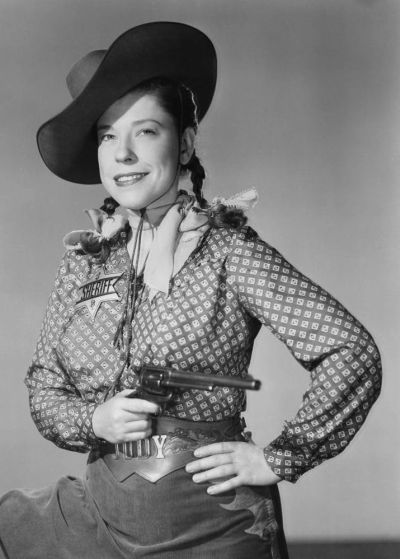 Judy Canova, known as ‘Queen of the Cowgirls’, was a popular star of radio and screen in the forties and fifties. She had a certain schtick: a homely but honest country gal, who stumbled into trouble – often with singing involved. I admit, the mere title of one such entity, Joan of Ozark, made me laugh. Here – despite the title – she plays a character called Judy, as she often did. The film’s name comes from Judy’s grandmother, who had been a much-feared sheriff. According to Judy, “The bad men in these parts were so scared of her, that they either plum reformed, or hung themselves by way of cooperating.” Judy now runs a trading post.
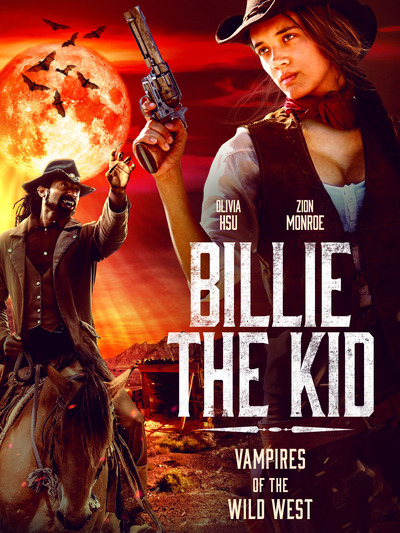 I’m inclined to look kindly on this, because I suspect it was a local production, filmed here in Arizona. While the end credits are silent on the topic, there are enough saguaro cacti about, to make it likely the faux Western town and other locations used, were somewhere near me. I recognize an actor or two as well. Unfortunately, it’s not exactly a film I would hold up as a shining example of quality Arizona cinema. While clearly set in the Old West, the movie is stuffed with anachronisms, from haircuts through a terrible British accent to glasses. It consequently never succeeds in establishing a convincing sense of period. This is a bit of a shame, since the Western horror action heroine isn’t one we see often.
 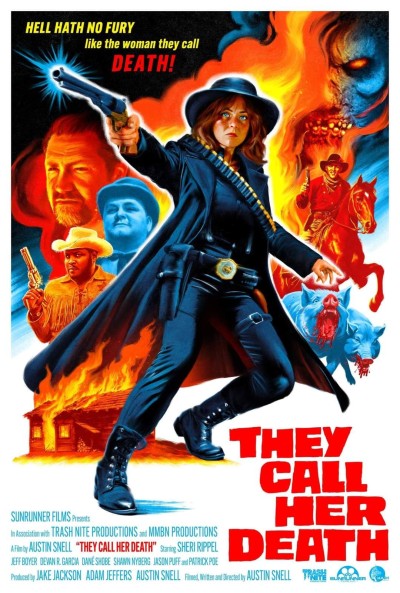 It’s clear what Snell is going for here. This is a throwback to the spaghetti Westerns of the seventies, along with Italian exploitation films from around the same time. I certainly admire the effort which went into this: for example, rather than shooting digitally and applying effects to imitate film, Snell actually shot on Kodak 16mm stock. I did not know that was still a thing, to be honest. Some of the other elements, like the music, also do a good job of reproducing the era – the movie poster is another one. I’ve seen enough of this kind of movie (mostly through
 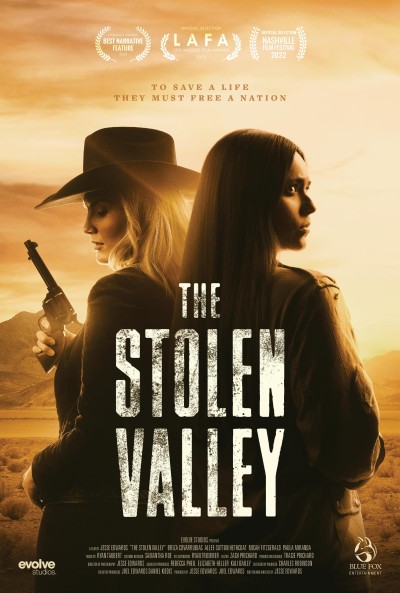 This feels like a modern Western. I think it was shot up on the borders of Utah and Arizona, since I recognized scenes shot at the Buckskin Tavern, in that area. While contemporary, with relatively minor tweaks, it could easily take place a century or more ago, back when robber land barons were a thing in the Old West. Lupe (Covarrubias) is in desperate straits, with her mother Adamina (Miranda) in need of money to pay for medical treatment she can’t afford. There’s another shock: the father, Carl (Fitzgerald), who Lupe long believed dead, is actually alive, and might be the last chance of getting the necessary funds. So she decides to make the journey to see him.