



★★★
“From stage to stage.”
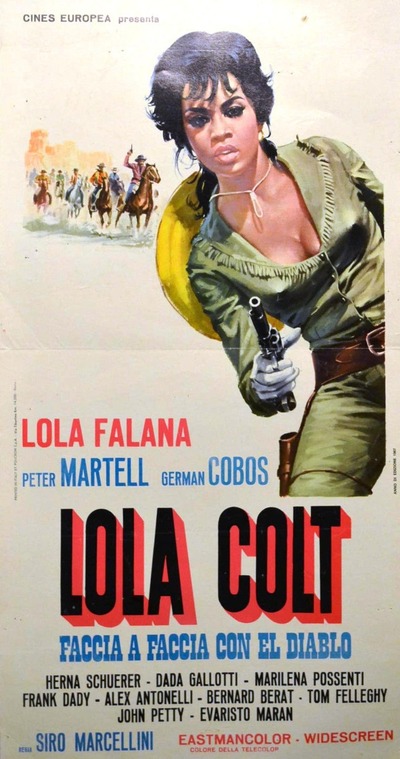 This spaghetti Western sees Lola (Falana) arrive in the town of Santa Ana with her troupe of dancing girls, after one of them falls ill. They need to stay there while she recuperates, under the care of the local not-quite-a-doctor-yet, Rod Strater (Martell). The town has bigger problems, being ruthlessly squeezed for every penny by El Diablo (Cobos). Lola lost her family to a not dissimilar band of outlaws, and is peeved that the menfolk are utterly cowed by El Diablo, even after Rod explains that the villains has taken hostages and is using them to compel the town’s good behaviour. But after a particularly tragic death, Lola has had enough, and rouses the town folk to action.
In many ways, this is a standard Western, with the lone good guy taking on the villains: hence its subtitle, “Face to face with the devil”. Except, of course, in this case, the guy is a gal. Oh, and Lola is black. I have just mentioned this fact more in the review, than the film ever does, being refreshingly colour-blind. It’s especially remarkable given the era, a good few years before Pam Grier would become a trailblazer back in Hollywood. It’s tempting to read race into Lola being greeted with, “We don’t need your kind around here,” when she steps off the coach. Subsequent events show it’s just the local morality police, who are severely unimpressed with her profession, rather than the shade of her skin.
In another twist, the villain’s real name is actually Larry Stern, which sounds more like an advertising executive. He’s a businessman who got peeved when his plans for a railroad fell through because the locals wouldn’t sell him their land, and decided to take revenge on them. Falana, though born in New Jersey, was already a star on Italian TV, and also performs a few musical numbers here. Though I did wonder where the music, a full-on jazzy production, was coming from in the town’s saloon, where there are no musicians at all. She certainly brings it with her moves, which are much more Vegas than Old West. And she would indeed go on to become the highest-paid performer in Sin City.
Until the final assault on El Diablo’s compound, where she demonstrates she does know her way around both ends of a firearm, Lola is more a figurehead to the town’s resistance, encouraging them to break free of their fears. The physical side of things is mostly left to Rod, who gets a couple of lengthy fist-fights, including one with El Diablo, when he’s not dealing with jealous girlfriend Rose (Schürer). It is this middle section where the film struggles a little, being particularly generic in its elements. But Falana is always compelling to watch, and it’s a shame she wasn’t given many further opportunities in our genre: 1975’s Lady Cocoa was perhaps the closest she came, although it doesn’t quite qualify for inclusion here.
Dir: Siro Marcellini
Star: Lola Falana, Peter Martell, Germán Cobos, Erna Schürer
a.k.a. Black Tigress
 The appeal of K-Pop in the West baffles me. I mean, I have a fairly low tolerance for pop in general. So the appeal of a foreign version, born from a culture to which you have no connection… Yeah. Fortunately, you need no knowledge to be entertained by this Netflix animated movie. It’s also tongue in cheek enough to work for non-fans, poking self-deprecating fun at the obsessive nature of K-Pop fandom. The title alone is so direct as to indicate the attitude. It’s accurate though. Pop trio Huntr/x are also demon hunters. They are the latest generation, tasked with keeping the forces of darkness and their ruler Gwi-Ma, out of our world through a barrier called the Honmoon.
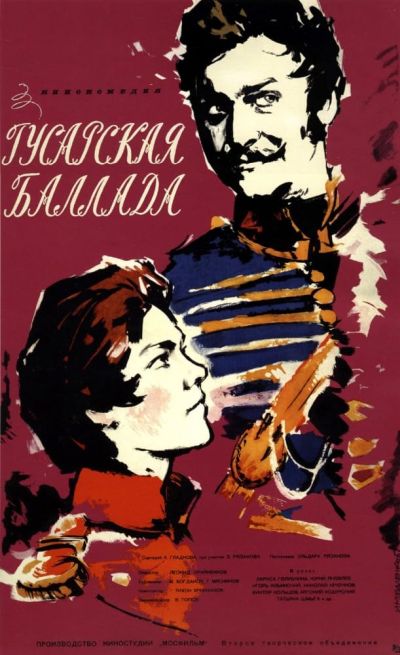 This is an adaptation of a Russian play A Long Time Ago by Alexander Gladkov, but was inspired by the real-life exploits of Nadezhda Durova. She was a woman who basically pulled a Mulan, concealing her gender in order to defend her homeland in the Napoleonic and other wars of the early 19th century. Durova joined the army on her 23rd birthday and served honourably for a decade, even after her true gender was discovered. Tsar Alexander I was impressed when he heard about Durova, giving her a promotion after summoning the soldier to his palace in St. Petersburg. Wounded by a cannonball at the Battle of Borodino, she eventually retired in 1816, with the rank equivalent to captain-lieutenant.
 I initially intended to review this and its sequel, Jeanme, by Dumont as one entity, for a couple of reasons. They really only work as a single item. This confused the hell out me, because the second film turned up on a streaming service by itself. Five minutes in, I was so confused, I started searching the Internet, only to find I had, in effect, joined a movie already two hours in progress. Also, I suspected I would be hard-pushed to deliver 500 words on
  I probably should have done a bit more research before adding this to the list of versions for review here. I saw a sixties movie made by Shaw Brothers with that title, and presumed there would be kung-fu. Boy, was I wrong. There’s about one significant scene, which pits Mulan (Po) and some of her new army colleagues against each other. And that’s it. Oh, there is a battle between Imperial and invading forces. This might have contained some action, but was so poorly photographed – mostly due to incredibly bad lighting – that it was impossible to tell. What there was, instead, was singing.
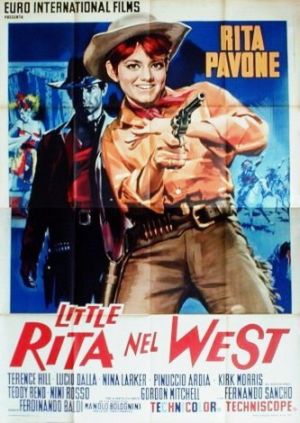 I came into this almost entirely blind, watching it based on the title and the first three minutes off YouTube. You can understand my surprise, after Rita (Pavone) and her German sidekick (Dalla) take out a gang of stagecoach robbers, finishing off by gunning one down in the back, as he lies dazed on the ground, when they… burst into song? Yep, what I didn’t know was, this is actually a musical, designed around the talents of Ms. Pavone, who was apparently a huge pop-star in Italy in the sixties. Hence the songs. Okay, that makes a bit more sense. But it’s still an extremely odd beast, swinging from obvious spoof to apparent seriousness at the drop of a catchy tune.