 ★★
★★
“Entertainment: Impossible”
The Great 2023 Void of Action Heroines continues on. The closest thing we’ve seen to one as a mainstream hit in the cinemas is… um, Barbie. Yeah. Not going there. I was looking at the box-office chart for the year, and excluding movies which were actually released in 2022 e.g. Everything Everywhere All at Once, there is only one single film in the top two hundred we have covered here. Polite Society sits outside the top hundred, at $1,.5m [We will get round to The Wrath of Becky in a bit. It’s #181, with a gross of $168,109.] Last year, we had Everything and The Woman King in the top thirty. 2021 gave us Black Widow; 2020, Birds of Prey and Wonder Woman 1984. The complete lack of tentpole heroines this year is disconcerting.
There has been no shortage of female supporting characters who have kicked butt. We already wrote about the The Women of Mission: Impossible, while John Wick 4 also delivered in this category, among quite a few other successful movies. But if you want to see a GWG take centre-stage, you will not find it in the movies. In some ways, it’s more convenient, to be able to sit at home, in your own comfy chair, with a choice of reasonably-priced snacks, and simply push a button on your remote control. But, it has to be said: quality wise, there’s often a good reason most of these films have gone straight to a streaming service. We’ve already covered a number here. The Mother. Furies. Mercy Falls. True Spirit. Some were decent. Yet none have achieved a seal of approval.
 This one certainly won’t, barely reaching the level of acceptable entertainment, and sadly, continuing Gal Gadot’s streak of swings and misses. She blazed onto the scene in Wonder Woman back in 2017, and seemed set to take over the mantle as one of the top action actresses in Hollywood. But she has singularly failed to build on that foundation. She lost a lot of public goodwill for her tone-deaf Imagine video in the pandemic. WW84 was a flop, Red Notice was a quickly-forgotten Netflix Original, and her turn in Death on the Nile was widely-panned, becoming a meme. This, however, was a chance to correct course, putting her front and centre in a movie which, it was clearly hoped, would kick-start a franchise and become the female version of Mission: Impossible.
Ain’t gonna happen.
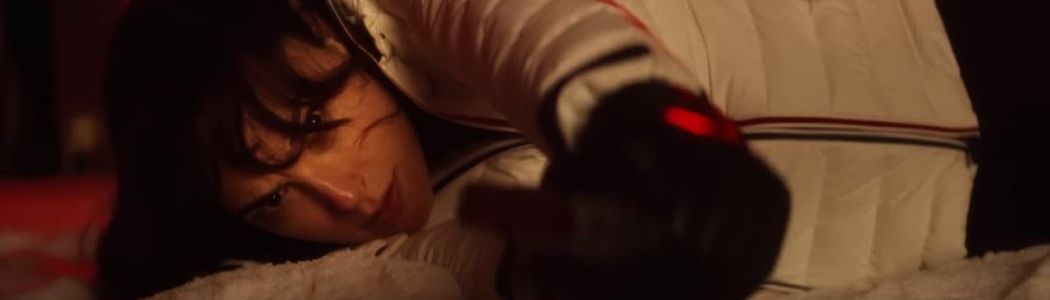
Two minutes in, Chris turned to me and said, “Is this a movie or a TV series?” and I can see her point. Having watched this just a couple of weeks after the undeniably cinematic Mission: Impossible – Dead Reckoning Part One, the difference is obvious. Harper directed The Aeronauts, which was decent enough, but it seems he is incapable of scaling things up from a balloon basket, to the much larger scope needed here. Part of the problem with the action sequences in particular, is the VR enhancement gimmick the heroine wears, allowing her to get real-time updates from her handler. This too often leaves everything looking like it’s a video-game, and it rubs off on other sequences, such as her parachute jump, which feels thoroughly unconvincing.
The plot is perhaps an even greater weakness, a confusing and unengaging mess. Rachel Stone (Gadot) works for a group called Charter, who use hi-tech surveillance for good (yeah… about that…). She’s embedded as an agent in MI-5, for reasons that are never made clear. Wouldn’t you know it, one of the people on her team, Parker (Dornan), turns out to be plotting to steal The Heart, the super-computer on which Charter relies for their surveillance – and use it, presumably, not for good. He has teamed up with talented young hacker Keya Dhawan (Bhatt) to this end, and only Stone can stop them, recover The Heart, and save her colleagues at Charter, including Stone’s boss Nomad (Okenedo).
 Dear god, I almost lost consciousness merely typing the previous paragraph. Reviewing the previous work of writers Greg Rucka and Allison Schroeder, what stands out is an almost complete lack of action movies. Rucka has worked mostly in comics (including the one which became The Old Guard), while Schroeder did, um, Christopher Robin and Hidden Figures. The lack of experience shows. Never mind not having written an action movie, it feels as if neither of them had seen an action movie. If so, they might have realized Stone’s handler flicking VR screen around by gesture, was done twenty years ago in Minority Report. The good ideas here are all like that, things you’ve seen elsewhere, and done better, while the ones the movie can call its own are uninspired in concept and/or execution.
It doesn’t help that the supporting cast are mostly bland. If Gadot does still have reasonable charisma, Dornan is completely forgettable. Bhatt is a thoroughly unconvincing hacker – I might trust her to reset my account password, and apologize for the inconvenience. That’s about it. The most irritating character though, is probably her handler. I get what they were going for, but almost every time he’s involved, it leaves the heroine feeling not much more than a meat-puppet, removing a significant degree of agency from her. I will say, some of the action set-pieces aren’t too bad. There’s a good car-chase through Lisbon, for example. But any secret organization which fills its airship with hydrogen, is certainly not going to remain secret for very long. That’s the level of idiocy we are dealing with in the writing here.
Long before the end, I had mentally checked out, as the film globe-trotted manically from [checks notes] the Alps to London to Portugal to Senegal to Iceland. There’s no denying there was a significant amount of resources expended on this production, though Netflix is notoriously tight-lipped on specific budgets. However, the film doesn’t so much jump the shark, as use it for a 3000-metre steeplechase, when the MI-5 spies have a dance break. Read the sentence again. Roll it around your brain. That it’s to a Lizzo song – unfortunate timing, that – makes it considerably worse. Everything thereafter feels like a waste of those resources, as well as the variable talents of those involved.
Dir: Tom Harper
Star: Gal Gadot, Jamie Dornan, Alia Bhatt, Sophie Okonedo



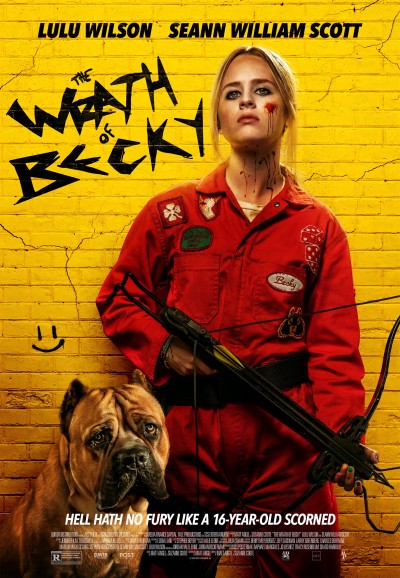 Don’t mess with someone else’s dog. This is a good rule of thumb in most cases, but especially so when the owner is an unhinged teenage psychopath, with the both the talent and desire to inflict carnage in retribution. The last time we saw Becky (Wilson), she had disposed of a gang of neo-Nazis who had invaded her house in search of a key, and killed her father in the process. Now, a couple of years later, she is a waitress in a diner, and renting a room from Elena (Burse). Three more individuals with, um, alternative political opinions enter the diner. This is not going to end well.
 Somebody
  You may have noticed that I’ve been on a bit of a spree with these Taiwanese fantasy-fu flicks of late. However, I think I’m feeling a bit sated with them at this point, and the law of diminishing returns seems to be setting in. There are only so many unconvincing male impersonators, bad effects (both optical and practical) and almost illegible and/or illiterate subtitles a man can take, and I think I’ve reached my capacity in almost of these categories. Fortunately, my queue of such things seems to be nearing an end, with just a couple more to go. Still, after this delirious experience, I feel in need of a week or two’s break from the madness.
 Yeah, if the above line of subtitled dialogue makes sense, this film then ups the ante, with white subs on a frequently white background, and which frequently appear to be making a bid to escape from the bottom of the picture. It’s safe to say that a decent presentation of this, perhaps with a print which doesn’t look like it was left in someone’s pocket when their suit went to the cleaners, might merit a half-star more. A few more fight sequences would help too: the ones there are, don’t lack in quality. There’s just a bit too much farcical comedy for my taste.
 If 2023 has been underwhelming on the theatrical front (to put it mildly), the various streaming services have certainly had no shortage of entries to keep us occupied here. This one comes to us from Paramount+, and stars Saldaña – already known around these parts, most likely for
  Not to be confused with
 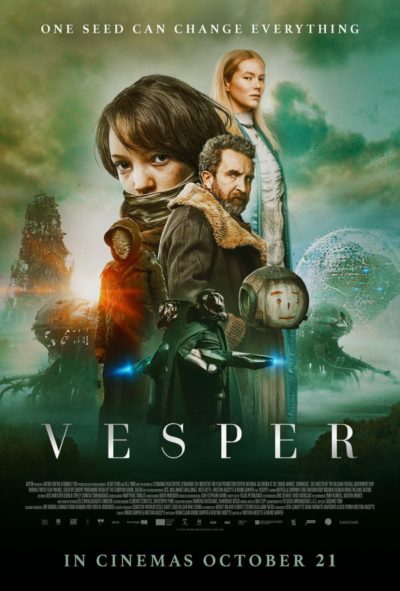 As the above suggests, I was getting a strong manga influence, in particular from the works of Hayao Miyazaki: it feels like the script could have been something he’d have written on a gloomy Wednesday in January. Feisty teenage heroine? Check? Ecological message? Check. For this takes place after some kind of change in the world, which has left the bulk of the population clinging on to existence by their grubby fingernails, in a world now owned by bizarre flora. Vesper (Chapman) is one such, tending to her paralyzed father (Brake) whose consciousness has been transferred into a drone. She trades with her uncle, Jonas (Marsan), swapping blood for the seeds they need to survive.
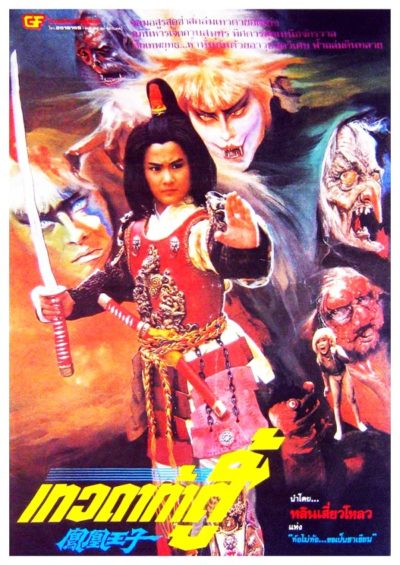 I am going to be entirely upfront, and state that any factual statements regarding the plot here will be entirely cribbed from other sources. Because, on my own, I have close to no clue as to the details of what was going. I got that some girl dressed as a guy, Little Flying Dragon (Lin, inevitably) was trying to protect Golden Boy (Chan) from a bunch of very strangely dressed weirdos with even more bizarre powers. They want Golden Boy for some nefarious purpose on behalf of an evil sorcerer type, who laughs maniacally. A lot. Everyone involved wears wigs which look like they were bought in bulk from Hair Metal R Us. There’s an acid pit, into which Golden Boy’s father is unceremoniously dropped. His mother is called “Evil Lady” in the subtitles, though she isn’t really. At one point, there’s a song whose lyrics according to the subs go, “Little Flying Dragon, Little Flying Dragon, change all the time, power breads everything.”
 Much though I love the streaming service, even I have to admit that “Tubi Originals” are a bit of a mixed bag, to put it mildly. For every