




★★★
“Hell hath no fury?”
 This had a fair number of decent and well-done elements. However, it very much feels like these are balanced by the aspects which fall short of adequate. How you react to this will likely be determined by your ability to overlook the latter, and appreciate the former. The basic idea is lean and mean. Sisters Jas (Purvis) and Laura (Pauley) are on a country weekend, when they encounter a car-load of men led by the particularly sleazy Randy (North). This leads to a home-invasion, a dead Laura, and Jas going on a rampage of revenge through everyone Randy can throw at her. Fair enough there, with enough brutal violence to leave the most blood-thirsty satisfied.
But I have questions. So many questions. Why does one sister have an American accent? Why are the villains so utterly incompetent? I mean, they can’t even tie Jas up for ten seconds – never mind taking advantage of the many, many opportunities to dispose of her entirely. Don’t even get me started on the gas canister scene: hello, throw it through the window? How does Jas, who has never been in the area, magically know the location of their headquarters, and so can head straight for it? Where did she acquire that very particular set of skills? All we get is a passing reference to her having taken a self-defense class – all I can say is, these lessons must have been given by John Wick.
Because Jas goes from zero to stabbing someone in the neck, in about thirty seconds after finding the body of her sister, and takes more damage than a crash-test dummy, without flinching. As for calling the authorities? It’s vastly over-rated. This really leaves her character with nowhere to go for the rest of the film: a slower escalation would probably have been more satisfying. None of the above flaws are necessarily show-stoppers by themselves. The damage criticism, for example, could equally be levelled at the heroine in Revenge. However, they all combine to chip away at this film’s overall entertainment value, in effect leaving it doing the Hokey-Pokey: one step forward, one step back.
This is before we get to specific elements, like the performances. These are similarly over the place, particularly among the villains. Fortunately, North – who likely has most acting to do, since Purvis’s performance mostly requires screaming – makes for a pleasantly hateable bad guy. There’s some spectacularly bad CGI fire; the practical stuff is fine, with energetic blood spatter, and everyone selling each bit of damage with the enthusiasm of someone auditioning for the WWE. This momentum is sufficient to paper over some of the flaws, though it would be optimistic to say it covers them all, or anywhere close to that. But I am a simple man, with simple needs. Consequently, I’ll always look somewhat kindly on a movie which possesses zero pretensions and a large bucket of red-coloured corn syrup.
Dir: Rebecca J Matthews and Michael Hoad
Star: Megan Purvis, Aaron-Jon North, Hannah Pauley
 I actually ended up watching this one twice. The first time, on Tubi, was one of the worst prints I have ever seen. It was cropped and the color was so washed-out I could barely tell it wasn’t in black and white. However, the film itself was decent enough to get me hunting for a better copy. YouTube for the win: I found on there a glorious ‘scope version, with tints that fairly pop off the screen (
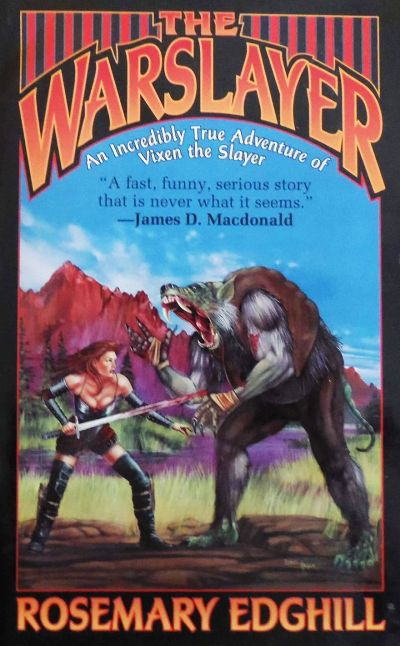 The cover blurb/Goodreads description creates the impression that this is a light exercise in humorous fantasy; and it actually does have a lot of humor (I read it to my wife, and she laughed out loud in several places). Both TITAoVtS and Xena are shows that offer mostly action-oriented entertainment without a lot of serious content, which might also lead readers to expect the same here. However, The Warslayer has its unexpectedly deep and serious side. Glory can deliver a fair amount of wry humor; but we’ll also see her bleed, vomit, and cry. While there’s some intense physical combat going on here at times, the battles aren’t all going to be physical, and the author has some really important things to say. (I’m not going to try to summarize them, because the story is the message, and you need to experience it the way she wrote it.) Her plotting here is not at all predictable. (But it’s deeply satisfying!)
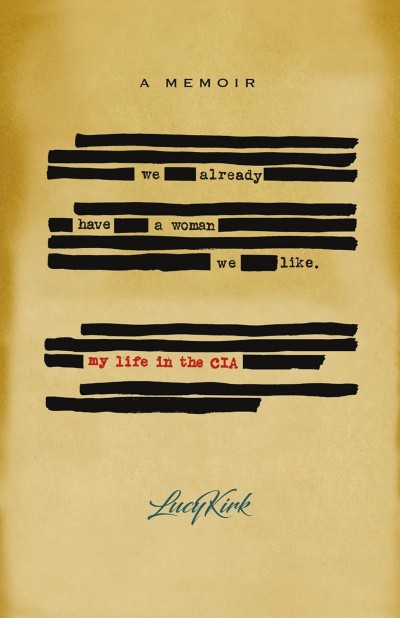 I suspect the issue here is partly my own expectations. When I read a memoir of somebody who spent more than three decades working for the Central Intelligence Agency, I was half-expecting a life somewhere between
 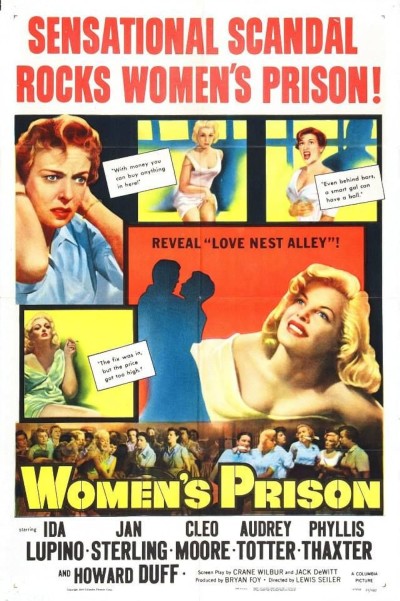 It’s always interesting to watch these early entries in the women-in-prison genre, and see the elements which are still staples of the genre, close to seventy years later. Well,
  I was quite startled to read some of the scathing reviews this received. For I genuinely enjoyed it, to the point it likely came one element (which I’ll get to) from a seal of approval. Sure, it’s nothing particularly new overall. However, I found it consistently enjoyable, to the level I felt no desire to look at my phone at any point. These days, that’s high praise indeed. It takes place in a slightly alternate London, where gang bosses Frasier Mahoney (Charles Dance) and Mrs. Christina Vine (Krige) are on the edge of a war for control of the city. There’s also a rogue element, in the Mushka Gang, who have turned an East End estate into a no-go area.
 This was a real and pleasant surprise. I wasn’t even sure if this would qualify for the site, or if it would end simply being too gentle. Whole it’s not going to get any awards for hard-core action, it does fit in here. More impressively, it managed to make my empathize with someone whose views are ones I’d generally disagree with. It takes place in Iceland, where Halla (Geirharðsdóttir) is a middle-aged, single woman, waging a near one-person campaign of sabotage against heavy industry, mostly by disabling the power-lines which supply electricity to it, disfiguring the landscape and exacerbating climate change. It’s a game of cat and mouse, with the authorities keen to stop the eco-terrorist from dissuading foreign investors.
 However, Halla has issues of her own, beyond the net closing in on her property destruction. A long-dormant adoption request is suddenly approved, and she can’t risk further criminal acts, as a conviction would bar her from proceeding. She intends to go out with a declaration of her manifesto, literally flung from the Reykjavik roof-tops, and a final act, stealing Semtex to blow up a key electricity pylon. Her accomplice, government employee Baldvin (Ragnarsson) is increasingly concerned about the “one last job” trope, and twin sister Ása (also Geirharðsdóttir), a yoga teacher, threatens to put a spoke in the adoption process too, by vanishing off to India for two years to live with her guru.
 I would have sworn I had seen every example of Hong Kong girls-with-guns movies from the eighties. But this one had managed to escape my attention completely for 35 years, until accidentally stumbling across it on YouTube. It’s perhaps partly because it never seems to have received any kind of post-VHS release, being unavailable on DVD or streaming sites. Which is a little surprising since it combines two genres that have been quite popular in the West: not just GWG, but also hopping vampires, as in the Mr. Vampire franchise. It’s a rather awkward combo, and there’s definitely significant potential wasted. Yet I’m fairly certain it’s going to be unlike anything you’ve seen before.
 With the somewhat accurate and rather clunky sub-title of “True stories of the unsung women heroes who rescued refugees and Allied servicemen in WWII”, this is a book whose idea I liked rather more than the execution. The core is six chapters, each devoted to a woman or pair of women, who operated before and around World War II, mostly helping refugees to escape the Nazi regime as it swept across Europe. Every chapter has the same structure. Each begins with ‘The Threshold’, describing how they came to take on that role; then ‘The Move’, covering their heroic activities; and finally, ‘The Close’, detailing what happened to them afterward.
 It generally makes sense for a film to escalate over its duration. The problem here is, what escalated was my annoyance. It began as irritation, but by the end I was deeply peeved, because the stupidity is strong in this one. It begins with two different strands. In one, former desperado Lee Hughes is visited in his mountain resort by ex-colleague Jimmy Montague (Fafard) and his minions. They want to know the location of two million in proceeds from a previous crime Lee and Jimmy pulled. In the other, lesbian couple Lane (Newton) and Megan (McClay) are busy being lesbionic with each other, because they’re lesbians. Did I mention they are a same-sex couple?