




★★★
“Red Nose Day?”
Dir: Yôichi Sai
Star: Miho Tsumiki, Yôko Kikuchi, Kumiko Takeda, Mikari
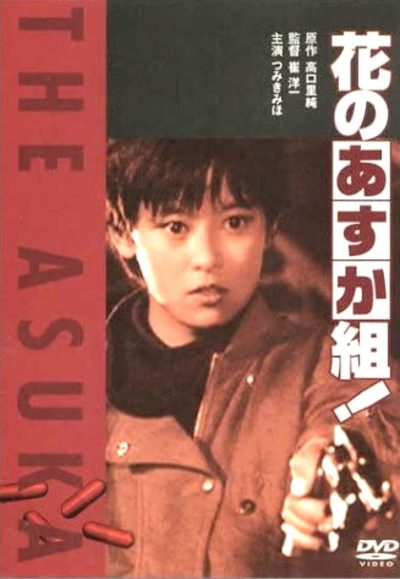 This is based on a 34-volume manga series by Satosumi Takaguchi, which began publication in 1985. It is far from the only adaptation. There have also been two OVAs, a live-action drama series, a different feature version made in 2009, and even a pair of drama CDs. This feature, however, is the only one available in the West to date with subtitles. It takes place at an indeterminate point in the future – the year is given as 199X – when “the streets are overflowing with drugs and violence”. There’s a battle for control, which conveniently seems to be along gender lines. The unfortunately naned male “Red Nose Gods”, under boss Toki Masamune, are going up against the all-girl Hibari Group. They are named after their leader (Mikari), who speaks only through her lieutenant, or with the aid of an artificial voice-box.
Out heroine, Asuka (Tsumiki), has just peeled off from Hibari, along with her best friend Miko (Kikuchi), seeking to make their own way on the streets. They quickly gain the enmity of the Red Nose Gods, but more troubling, is that Hibari has ordered Yoko (Takeda) to kill them both. For Yoko is Miko’s sister. This is established quite quickly, and the rest of the movie is various shenanigans as the two groups struggle for power, while the local corrupt police run interference on their own agenda. Will there be betrayal, plotting and heavy use of a Rolling Stones song? The answer is yes, to all three elements.
This feels like it ought to be a straight-to-video title, of which there was no shortage around the time this came out (1988). But the production values are considerably better than normally present in that kind of thing. The cost of merely licensing the Stones’s Satisfaction would have exceeded the entire budget of many V-cinema entries. There are also some quite spectacular sets built to represent “New Kabuki Town”, after the apparent near-collapse of normal society, and the photography is positively theatrical in quality. If you’d told me this was a Japanese remake of Streets of Fire, I would have believed you. Elements like Hibari’s voice-box indicate there was a decent amount of thought put into the various elements too.
So why is it… kinda dull? Or at least, it seems like it should be considerably more exciting. While there are occasional upticks in energy, it feels considerably more chatty than I wanted. Yoko, in particular, seems to act in ways that defy any kind of internal logic, yet are necessary to propel the narrative forward. What is her motivation? What, indeed, is anyone trying to accomplish? For a time, it looks as if Asuka is seeking to take over from Hibari, or replace Toki. This all goes away quite quickly, left by the wayside, and leaving a vacuum in terms of character goals. It ends instead in a straightforward duel between Asuka and Yoko, and there’s a definite sense that, once the dust settles, nothing much will have changed. Maybe that’s the point.
 The above is said by an Arab character, passing on advice from her father. By the end of it, despite this being an Israeli-produced movie, you may be inclined to agree with them. Mind you, on the basis of this, you should also never trust, the Arabs, Americans or Germans either. This dive into the world of intelligence, counter-intelligence and realpolitik is so morally murky, it should come with a head-lamp, to assist viewers peering into the darkness. Naomi (Riskin) is a Mossad agent, who has been out of the game for two years, since her husband, a fellow spy, was killed in a terrorist attack. She has now been tasked with what should be a simple job, guarding Hezbollah informant Mona (Farahani).
 It is possible to do Lovecraft on a low-budget and make it work. Earlier this year, I was introduced to the delightful films of Lars Henriks, who did
  Not to be confused with the clearly different
  Well, this is certainly the first film I’ve reviewed here which drops both into the “women in prison”
  This is a fairly classic “rise from nowhere” story, yet is well-executed and done in a world which is interesting for its differences. The heroine is – surprise! – Marilia, whom we first meet on the battlefield, about to face an opponent of superior numbers. We then flash back to her childhood, growing up in a Tyracian brothel. Her mother was one of the “painted ladies,” but after she dies, Marilia and her brother Annuweth are on increasingly thin ice. Their effort to run away is unsuccessful, yet does bring them a chance at a new life. While it’s here that Marilia discovers her tactical savvy through board games, it’s not without its downside, the siblings being split up after Marilia enters an arranged marriage in another territory.
 This is a prequel of sorts to
  This is definitely an interesting idea, and potentially the most meta action heroine film I’ve seen. Cha Yeon-hee (Ahn) has wanted to be a movie heroine ever since she was a child, though it’s an ambition which has always eluded her – in part because of her refusal to work her way up in the industry. She eventually and grudgingly accepts a stunt double position in a historical swordplay film, and shows up on the set for her first day. However, due to circumstances involving a magical clapperboard (hence the title) and an inconvenient portal, she finds herself transported to a parallel dimension. It’s kinda like modern Korea in clothes and speech, but run by warlords and their sword-carrying minions.
 Made on a shoestring in Ireland, the nicest thing you can say is probably, this doesn’t look as cheap as it was. If only you could say the same for the script, which seems to be trying to be Guy Ritchie, only to end up nearer to Guy Fieri. It’s not a terrible idea, if rather stretching belief. Katelin Ballantine (Doherty) is a film producer, trying to raise funds for her latest movie. To that end, she is hanging out, unwillingly, with sleazeball businessman, Felim Shaw. What she doesn’t know, is he is deep in debt to local mob-boss Edmund Murren (Fleming). He kidnaps them both, forces Katelin to kill her potential investor, then threatens her family to make her continue in her new career as his assassin, alongside former friend and now Murren associate, Henry Furey (Kealy).