



★★★
“Tubi or not Tubi? NOT Tubi.”
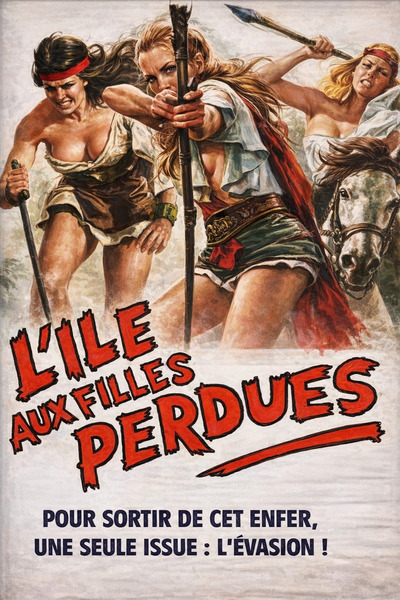 I actually ended up watching this one twice. The first time, on Tubi, was one of the worst prints I have ever seen. It was cropped and the color was so washed-out I could barely tell it wasn’t in black and white. However, the film itself was decent enough to get me hunting for a better copy. YouTube for the win: I found on there a glorious ‘scope version, with tints that fairly pop off the screen (compare and contrast) – and fifteen minutes longer, too. It’s a genuinely good-looking movie, and I don’t mean the copious quantities of attractive continental actresses. Well, not just them, anyway. This Italian-French co-production is an early example of the European women in prison genre, here with a historical bent.
An opening caption tell us this takes place at the end of the 17th century. Though that doesn’t quite fit with other elements, which seem around the French Revolution. Regardless, the government ship off their female prisoners to an island near French Guiana. There, they pan for gold, indulge in community sing-alongs and get eaten by alligators. The latest arrivals include Martine Foucher (Mercier), a noblewoman imprisoned for political reasons. There, she’s reunited with her sister, Jeanette (Ranchi), although she has assumed the identity of another, deceased prisoner. It’s a rough life. The only respite is if you sleep with the sleazy governor, Lefèvre (Muller), or his guards. Martine gets involved in an escape attempt, plotting to take some of the gold with them. It does not go well.
However, things look up with the arrival of new prison boss, Henri Vallière (Madison), who is much more compassionate towards the inmates, telling the staff, “They are not here to be tortured”. However, he is an impostor, not actually the naval officer he’s pretending to be. For Henri is a pirate, planning to stage a heist and steal all the gold. So he doesn’t truly care for the prisoners initially, though proves to be a dab hand at wrestling large reptiles. Key word: initially. Naturally, he develops feelings for Martine. This still leaves the inmates unsure of whether to turn Henri in, or throw their lot in with him.
They eventually decide to fight alongside Henri and his men, in exchange for a shot at winning their freedom. To be fair, this does only occupy a few minutes towards the very end of the film. After Henri’s plan gets revealed, the brisk and entertaining pace the movie had maintained to this point slows considerably. Instead, there’s a bit too much relationship shenanigans: I much preferred the earlier sections, where the women were actively engaged and had agency. For obvious reasons, given this was the early sixties, don’t expect nudity, although there is cleavage, and I concur with another reviewer who noted the similarity of Margaret Rose Kiel to Brigitte Bardot. Better than expected, providing you can find the decent print.
Dir: Domenico Paolella
Star: Michèle Mercier, Guy Madison, Paul Muller, Federica Ranchi
The good YouTube print is embedded below.
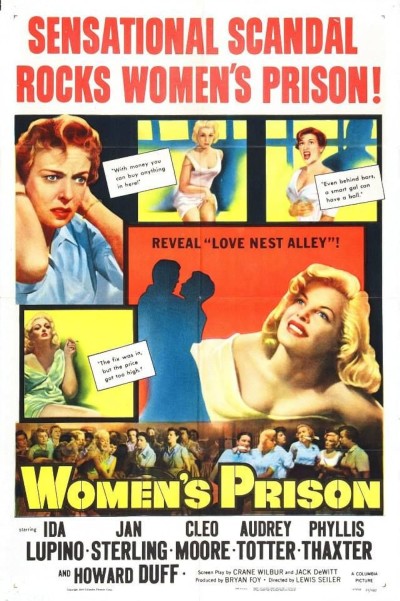 It’s always interesting to watch these early entries in the women-in-prison genre, and see the elements which are still staples of the genre, close to seventy years later. Well,
  This came out the same year as
  With that title, you’ll understand why it’s one I opted not to make part of family movie night. I mean, you can’t argue with the forthrightness, though I’ve little doubt it’s as “true” as most films which make that claim i.e. barely at all. However, the bigger problem is that it’s fairly borderline “pinky violence”, being considerably more interested in the pink than the violence: it’s arguably more of a roman porno. It’s as if someone presented a checklist of cliches from the woman in prison genre, and asked the director to cross them off as rapidly as possible. The resulting speed-run lasts barely more than seventy minutes, especially impressive considering the amount of time devoted to soft-core sex couplings, in various combinations.
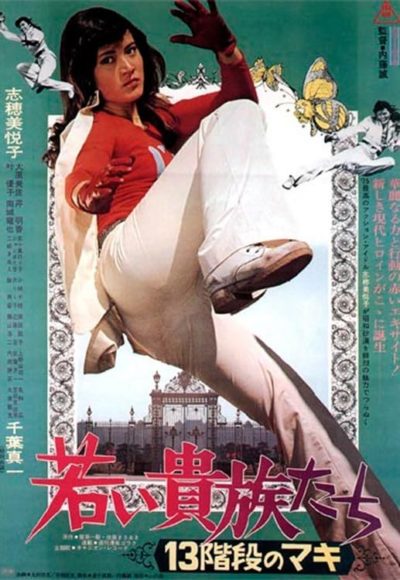 Made by Toei, this is very much a straightforward “pinky violence” film in concept, telling the story of the Wildcats and, in particular, their leader Maki Hyuga. What separates this – in ways both good and bad – from the pack is that Maki is played by Sue Shiomi, best known for her roles in the
  This feels almost like a throwback to the silent era, and ‘white slave’ films with titles like Traffic in Souls, combined with a significant fear of ‘the other’. As such, it’s both painfully simplistic, and endlessly fascinating in the layers of interpretation which can be read into it, should you be so inclined. On the most basic level, it’s your everyday tale of “good” girls, kidnapped for sale to the highest bidder, who need to fight to retain their modesty and virtue. [Though let the record show, at no point is there any bikini-wearing wielding of automatic weapons, despite what the poster clearly wants you to think. The heroines here prefer weapons of the blunt and/or pointy variety]
 I think it has been a long time since a film has so completely yanked the carpet out from under me. We might have to go back all the way to David Lynch’s Lost Highway, and that was 1997. So it has been a while. I’m not sure if it works here. It did in Highway; I’m just uncertain whether Khalili is as good a film-maker as Lynch. It’d likely require a second viewing to decide, and I wasn’t that impressed elsewhere to justify a repeat. I will remember it though, and that’s more than can be said for many of the films I review here. So it was not a complete waste of time.
 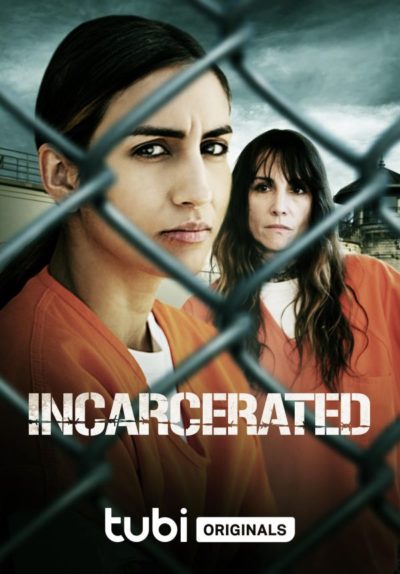 There’s an interesting idea here, at least. As a young child, Elena (Ayala) has to watch as her mother and brother are killed by crime boss babe Maeve (McComb), after her father (Pardo) made the ill-advised decision to try and steal from her. It’s particularly awkward, since Maeve made him choose which of his two children should live… then killed the one he picked, his son. This Sophie-like choice has, understandably, left the father-daughter relationship somewhat strained, to put it mildly. 15 years later, Elena is a druggie, who robs a liquor store and gets sent to jail as a result. Except, this incarceration is entirely deliberate, because it’s the facility in which Maeve is now serving time, giving Elena her long-awaited chance for revenge.
 Zombies and jail aren’t quite as new an idea as you might think. The Walking Dead had a major arc which took place at a prison, the facility’s fences now more useful for keeping things out than in. And back in 2005, The Asylum released the (surprisingly decent)
  I can’t recall seeing an action heroine movie with