This very low-fi space-opera comedy is little more than a hodge-podge of elements pulled from various SF of the past sixty years. You can almost tick them off: Barbarella, 2001, Star Wars. But, if I had to pick the major influences, it’d be Red Dwarf, and The Hitchhiker’s Guide to the Galaxy. There are points where it’s not exactly subtle about it either. At one point, the heroine’s robot sidekick tells her, “The hours are good. I mean, the actual minutes themselves are pretty lousy.” It’s painfully close to plagiarizing a Vogon Guard line from Hitchhiker’s: “The hours are good… But now you come to mention it, most of the actual minutes are pretty lousy.” Seconds later, we get a “Sector 009 Plural Z Alpha” reference too.
Red Dwarf can be invoked due to the heroine, Mack (Fortuna), who is almost the lowest of the low on board the Space Navy craft: a Senior Sanitation Technician, whose main job is cleaning toilets. Except, through a serious of unfortunate events, she becomes the keeper of the titular gem, embedded in her forehead, making her the hottest property in the universe. The evil Andromeda Hex (Swiburne) wants it, and the power the jewel possesses. Space Pirate Rom (Brotz) is the first to get her hands on Mack and the aforementioned sidekick, Spanners (Brotz). But despite the bounty, Rom decides to help Mack figure out her situation. And so begins a galaxy-spanning odyssey, before an ending which… probably makes as much as sense as 2001.
Yet, despite losing points for shameless theft, I enjoyed the reckless stupidity at its heart. Mack is a very sympathetic heroine, who grows into her role as the saviour of the universe, while Andromeda makes for a fine, scenery-chewing villainess, and Rom is, effectively, a bisexual version of Han Solo. Being of Australian origin, it is naturally fairly down-to-earth, shall we say. Those offended by the use of terms such as “space cunts” should probably stay away. This is also not a high-budget production. Though there are times where the effects are either a) surprisingly decent, or b) cheap in an amusing way, such as the way the screen for the spaceship’s defense systems look like an 8-bit video game system.
It is at its best when doing its own think, rather than aping genre classics. The way in which Mack disposes of Andromeda’s ship is almost brilliant. Though as Spanner deadpans later, “You have a tendency to express things using toilet analogies. I’m fearful it might be symptomatic of a fetish at this point.” The ending, as noted, feels either like they ran out of money, or everyone just got bored with the whole endeavour. Either is plausible. But I ain’t gonna lie: I was more entertained by this than the bloated monstrosity of Dune, at likely a thousand times the budget, and seventy-five minutes longer. Though being a big fan of both Dwarf and Hitchhiker’s certainly helped.
“An underground fighter and her estranged father steal a spacecraft to escape a dying Earth, only to face a deadly stowaway who sabotages their life support, forcing them into a fight for survival in the claustrophobic confines of space.” That’s the film I wanted to watch. Unfortunately, it actually occupies only about ten minutes or so, of the hundred for which this runs. The rest is mostly painfully obvious, and not particularly innovative, helpful or even funny, attempts at social satire. It feels like writer-director (as well as cinematographer, editor and producer) Grillo saw Don’t Look Up, and thought, “That was okay, but it needed to be much less subtle, and made on a budget of around forty grand.”
It takes place in a world where tech billionaire Elon Musk Jude Micah (Douglas) is predicting doom, with the moon about to crash into the Earth. For the low, low price of fifteen million dollars, you too can have your own escape shuttle – the Intruder of the title – and fly off to join the other emigrants in an outer-space sanctuary. After initial denials from the authorities, turns out Micah is completely correct. Eventually (and we’re talking forty minutes in), we get to the point where Bree Hewitt (Godfrey), the fighter mentioned in the synopsis, does indeed hijack an Intruder and head off-planet. After odd occurrences on-board, there is a brief period, as noted of maybe ten minutes, where she does indeed fight the stowaway (Scarola). Then, it’s back to the social satire.
I suppose, had I gone in with accurate expectations, this might have merited a better rating. There are a couple of moments which actually did amuse me: there’s a faux version of Frank Sinatra, singing a song whose lyrics are basically a serial killer ballad. And the final scene, just before the moon does indeed crash into the Earth, where a TV presenter professes his love for an increasingly horrified colleague. Those were genuinely clever and well-executed. But after the opening cage fight, showing Bree in action – and getting tossed from a pro career because of her failure to stop at the bell – we have to wait almost an hour for her to swing another fist in anger. Which is the reason I was watching.
The reality is, had I gone in with accurate expectations, I simply wouldn’t have gone in at all. I have no objection to films with messages, but this is a prime example of one where it feels the movie is a delivery mechanism for the message, rather then first and foremost being concerned with entertaining the viewers. As soon as I realized this, I tuned out, because – agreement or otherwise with the specific message aside – it’s simply not why I watch films in general, and action heroine movies in particular. If I want a clumsy and blatant lecture on social issues, I will… Oh, wait. I don’t. At all.
Dir: Christian Jude Grillo Star: Dana Godfrey, Iryna Scarola, D.C. Douglas, Andrew Hunsicker
Chanda Bajaj is the very epitome of a troubled protagonist. A former soldier, she left the service after she and her comrades took part in the mass murder of “synths” – synthetic humans, and has been plagued by guilt and nightmares ever since. She has become an independent bounty hunter (or “Lancer” – short for “freelancer”), and has just landed on the ferociously hostile mining planet of Reitman, far out in the frontier colonies. The corporation which runs Reitman has an issue, with some of its employees – who are, really, more like indentured serfs – turning them into drug fuelled and violent killers.
Chanda, along with a group of like-minded Lancers, are hired to take the worst of the worst into custody, so justice can be served. Except, inevitably, it’s not as easy as that. Word of their mission gets out, and they’re greeted by an increasingly ugly mob, who see them as company mercs. Almost simultaneously, the colony is the target of a terrorist attack, leaving Chanda and her colleagues stuck in the network of tunnels beneath the planet’s surface. Their original mission is changed, and becomes key to the entire survival of Reitman and its inhabitants. But there are people with a strong interest in them not succeeding, or living to tell the tale. Especially, after they discover a very nasty little incident in the corporation’s past, where an attempt to replace the human employees with synths did not go well.
Once things kick off here, it’s an almost relentless cycle of Problem > Solution > Slight progress. Some issues are physical ones, such as a surge of radiation resulting from the terrorist attack. Others are more psychological: whether or not to use lethal force against the mob who vastly outnumber the Lancers. There’s also a great deal of internal tension within the group, because not a lot of love is lost between certain members. Some have even figured out that the fewer the number of the group that survive, the bigger their own share of the payout will be. This is not exactly conducive to team-building and working together, standing in contrast to Chanda’s military background, and “no man left behind” philosophy.
Naturally, there’s a revelation towards the end which upends a lot of what you thought you knew. Though I can’t say this came as too much of a surprise, and provoked more of a “Huh, makes sense,” rather than anything else. It does rely on some convenient literary amnesia from Chanda, though the book does a decent job of managing this, since it makes sense that she would take a drug specifically in order to repress the most troublesome memories. Interestingly, the other books in the series appear to be about different Lancers, with likely just a single volume falling in our area. However, I’d not be surprised to see a review of that one here, a little way down the road.
Author: P.R. Adams Publisher: Promethean Tales, available through Amazon, both as a paperback and an e-book Book 1 of 6 in the Lancers series.
This 1935 novella is only the second work I’ve read by pulp-era American SF author Stanley G. Weinbaum (the other is his first and best-known short story, A Martian Odyssey, which is included in The Science Fiction Hall of Fame, Volume One, 1929-1964). But despite dying at the age of 33, in his meteoric writing career (which spanned only about 18 months), he produced dozens of short stories and two posthumously published novels. (A number of the stories were published posthumously as well.) He earned a place in Sam Moskowitz’s Explorers of the Infinite: Shapers of Science Fiction (1974), and his stature in the genre’s history remains high more than 50 years later.
Though born in Louisville, Kentucky, as a child Weinbaum moved with his parents and sister (the family was ethnically Jewish, but to my knowledge there’s no indication that he was ever religiously observant) to Milwaukee, and lived there for the rest of his short life, except for study at the Univ. of Wisconsin at Madison from 1920-23, where he first majored in chemical engineering and then switched to English literature. (He left without graduating, after being caught taking an exam for a friend on a dare.) After his marriage in 1926, he worked at a variety of odd jobs, but began writing seriously in the late 1920s and submitting his work to magazines. A Martian Odyssey, published in July 1934, was his first sale, and brought him immediate acclaim in the small SF fandom of that day.
American SF between the World Wars was a sort of literary ghetto, disdained by critics, and found mainly in a handful of small-circulation niche magazines, dominated by editors committed to the genre’s “hard” tradition, in which the speculative element is strictly based on extrapolation from known science and scientific accuracy is a paramount concern. (Literary matters like character development, well-crafted prose, and original plotting, in that era, was sometimes of less concern.) Weinbaum, like many of the genre’s writers in his generation, had the scientific background and interest to write hard SF, but his English literature education/interest also gave him stylistic skills superior to those of a lot of his contemporaries. Both qualities are evidenced in this short work.
The Red Peri is set partly in space but mainly on Pluto (which had been discovered relatively recently, in 1930), in a future era in which humans use rocketry to travel to the planets of the solar system, but mostly to Venus and Mars; a small town on the Jovian moon Titan is as far out as their settlement goes, and the outer planets are rarely visited at all. (No date is actually given in the text, though the cover copy gives 2080; I’m not sure where that’s derived from.) Trade between these three middle planets is lucrative, but bedeviled by space pirates; and none of the latter are more feared than those of the pirate ship Red Peri. (Peri is Persian for imp or elf.)
25-year-old Frank Keene, our American viewpoint character and co-protagonist, a radiologist and physicist, has a brief run-in with a red-haired pirate (you can’t see much through a space-suit visor, but he did see that) when the freighter he’s traveling on is robbed by the Peri. A year later, he and an elderly fellow scientist, researching cosmic radiation in deep space, have to make an emergency landing on Pluto. That very cold world proves to hold a couple of secrets, one of which being that it’s the lair of the Peri –and it’s no real spoiler to reveal that “The Red Peri” is also the moniker of the pirate captain, who happens to be a very attractive young lady.
A Dr. Mike Goldsmith provides a reasonably spoiler-free page-and-1/2 Introduction and about five and a half pages of footnotes to this Grammaticus Books re-print. As this added matter reveals, despite Weinbaum’s determination to write “hard” SF, this book has its share of scientific inaccuracies (though it also exhibits some solid science as well in places). Some of these are simply the result of the limited scientific knowledge available in 1935: for instance, not much was known then about Pluto (and Weinbaum’s depiction of it was plausible at the time), and nobody back then realized that the range of radio signals is practically infinite. But (though Goldsmith doesn’t pick up on it), the author makes a MAJOR scientific error which his entire plot depends on, and which was clear to me even with my weak background in science. There’s also an “insta-love” factor going on here that’s not really credible (at least, to me). But on the plus side, our main characters are vital, nuanced and well-drawn, and Weinbaum creates a thought-provoking, morally complex situation which engages both the reason and the emotions of these characters, and of the readers.
While the ending of the tale wraps up the immediate plot here effectively, readers will probably want a continuation to the narrative; and Weinbaum in fact intended to write more about these characters. Sadly, that wasn’t to be. Less than a month after the story was published, he was dead of lung/throat cancer, brought on by his heavy smoking (and initially misdiagnosed as tonsilitis, resulting in a misguided tonsillectomy that just added uselessly to his pain). So readers will have to use their own imaginations to project future developments!
Author: Stanley G. Weinbaum
Publisher: Grammaticus Books; available from Amazon, both for Kindle and as a printed book.
A version of this review previously appeared on Goodreads.
To a certain extent, this feels like two separate novels joined at the hip, albeit sharing the same protagonist. The first half takes place on the planet of Hoganth, which is a gritty urban dystopia, with teenage heroine Rishi Tremayne trying desperately to survive, as she is ruthlessly hunted by a powerful family with ambitious aspirations. The second, however, largely takes place in outer space, as she becomes the weapons operator on a ship piloted by Earthman Derek Hamilton, as they try to shutdown the plot. There are a lot of space battles, and I have to say, I found it rather more generic, and consequently less interesting. But let’s rewind.
With her mother and brother too sick to work, Rishi is the family sole provider, and even that is on shaky grounds. However, she has found work as a data processor, looking for space junk which could potentially be recycled. She finds what appears to be a giant asteroid, and dutifully files a report. Except, it’s actually a two-kilo long spaceship, secretly being built by House Forsythe in preparation for a coup attempt against the Empress. They’re not happy about its discovery, and send forces to wipe out everyone who knows about it, which includes a drone bombing Rishi’s apartment. Fortunately, a retired warrioress, Aun Twil, lives nearby and comes to Rishi’s rescue – except, this puts her on the Forsythe radar too.
It’s this section which is the most entertaining, Aun using her skills to help Rishi avoid meeting the same fate as her employers. This initially involves trying to get out of town, avoiding or defeating the Forsythe agents sent, with increasing aggression, to finish the job. It takes a while before Rishi is able to figure out why she’s being targeted for elimination. When she does, the goal becomes to get Rishi to someone who can act on what she knows, and Aum is able to use her contacts to get the young woman into the Empress’s inner circle. It’s a little implausible a street rat like Rishi would be accepted, rather than (at best!) thanked for the information and sent on her way, while the adults solve the problem.
She does manage to hang around, and weirdly, the assassination attempts continue: seems a bit pointless by this point, and although there’s the death of a significant character, it has weirdly little emotional weight. Still, Rishi has to stick around, for her role in a climax which might well remind you of a certain well-known SF movie, also requiring an “impossible” shot to destroy a massive superweapon… It certainly did me. On the positive side, the lack of much romance beyond an odd passing attraction is appreciated, and the world-building here is decent. But by the end, I was getting rather bored of dogfights in space, where I felt I needed a chart to keep track of proceedings.
Author: J.T. Skye Publisher: Self-published, available through Amazon, both as a paperback and an e-book Stand-alone novel, though part of the Trigellian Universe.
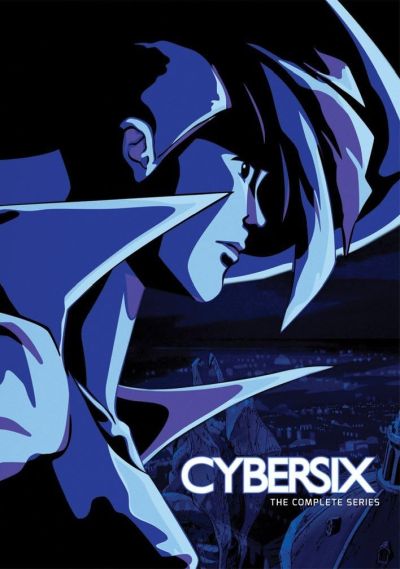
In the 90s, Warner Brothers’ animated Batman series received a lot of praise for its artful animation and style. Not surprisingly, a lot of studios and channels tried to jump on the bandwagon and create their own dark, classy animated show. Disney gave us Gargoyles, French Canal+ did The Legend of Calamity Jane, and the Vancouver-based Network of Animation (NoA) produced this series. It was shown on Teletoon in Canada and – for a short time, though not the entire series – on Fox Kids in America. What is most interesting, is the back story of the show, largely forgotten by almost everyone. Though thanks to people seeing it at the time and remembering it, Cybersix has become a cult show. It may be due to its rarity, since you couldn’t see it for a very long time. It was not available on DVD until fifteen years after its original broadcast – a similar fate to the animated Calamity Jane show.
Cybersix originally started as a black-and-white strip, written for an Italian comic magazine from 1991 to 1999. Interestingly, it was developed by two Argentinian comic book creators, Carlos Trillo (story) and Carlos Meglia, both now deceased (Trillo died in 2011, Meglia in 2008). They grew up in Argentinian comic book subculture during the dictatorship, where comics very much had a subversive, underground status. Very often these hand-made, self-distributed comics were political, and didn’t hold back in their depictions. I’m no expert on Argentinean comic book history, but I imagine nothing like the American Comic Code Authority existed in South America. Voicing critical opinions under such an oppressive regime was probably very dangerous, and the no-holds barred approach comic artists grew up with, remained after the end of the military dictatorship.
Therefore, it’s not too astonishing the Cybersix comic reflected that attitude, with its wild, very often over-the-top depiction of violence, nudity and sexuality. These comics have still never been translated for the English-speaking world: those interested will have to buy them in French, Italian or Spanish. It should be noted that not all of the series are available in all of these languages. Having read one of the volumes in French years ago, my judgement on it was that, story-wise, it is quite a strange and jumbled mess. There are scenes of gratuitous nudity and sex, and though not the main focus, they’re definitely not recommended reading for teenagers. It lacks a clear goal, with the plot often meandering, and scenes lack cohesion. Also, José, the main antagonist in that volume is an annoying and disgusting teen character. It appeared to my – admittedly very European – eyes, as a bit crude and short on narrative focus. It is neither like an American superhero saga, nor the typical Franco-Belgian fun comics, but something of its own. Of course, that is my judgement based on one single volume. Maybe I just picked the one rotten apple!
I would like to stress that these comics are not “violence-porn”, as I would personally categorize TV series like Game of Thrones. But they are definitely for a more adult readership, albeit with a bit of a juvenile mind. The drawings of a city that definitely reflect Argentina, and Cybersix, clothed in black leather while running and jumping from roof to roof with a parachute-sized cloak that would make comic anti-hero Spawn blush with envy, convey a respectable artistic style. Someone compared the comics and their 90s edginess to the works of Frank Miller (Sin City, 300), and it is not a bad fit. Actually, I’d say the drawings are more elegant and beautiful than Miller’s style.
The idea was born when one of the creators read an article about a couple who had invested in storing their own embryos, before dying in a plane crash. This resulted in the Australian government arguing about what should happen to the embryos. In the end they were destroyed, but the artists wondered what would happen if they were stolen instead. An idea took shape, though changes would naturally occur; originally the main character was supposed to be a police officer, not a superhero. The comic must have enjoyed some popularity in Argentina, since it was made into a very short-lived live-action TV series in 1995, but had such low ratings it was cancelled after only a few episodes. It is believed lost, though you can find at least one episode online. It’s not really cause to mourn, since those who did see it, generally agree how bad it was.
Nevertheless, the comic was lucky enough to get another adaptation in 1999. As Canadian producers were looking for something to turn into an animated show, their attention was drawn to this work. The show was animated by Japanese studio TMS-Kyokuichi, making this essentially a Canadian-Japanese co-produced adaptation, of an Italian comic, written and drawn by two Argentinians. What a culture mix! But sometimes a lot of different influences are not detrimental to the final product. A big influence on the story is the historical German connection to Argentina. Back in the 19th century there were already economical, and later ideological, ties between the two countries. These became stronger after WWII, when both Nazis and Jewish Germans fled to Argentina. This history is rarely addressed in the media, but the historical legacy here, influences and is referred to by the comic, and therefore the animated show.
The story itself: In the fictive city of Meridiana lives superheroine Cybersix, an escaped experiment of Nazi scientist Von Reichter (though this is never directly stated in the animated show). Von Reichter has created his own Frankenstein-like creations for… nefarious purposes, I guess. These beings must obey his orders, and he uses them to hunt Cybersix, the last survivor of a failed project. But he never does his own dirty work, instead having his own cruel teen clone, José, execute his orders via his soulless monsters: tall, ugly and dumb men called Fixed Ideas. While she doesn’t enjoy it, Cybersix relies on killing these man-monsters, as she needs their life-force for sustenance. When she kills one, the body vanishes, leaving only a small test tube containing a green liquid that she consumes.
This is different – as are many other things – from the comic, where she sucks the life-force out of the bodies, Dracula-style. I guess this would have caused quite a stir in a show supposedly for a younger audience. By day, she poses as a friendly school teacher under the name of Adrian Seidelman, working with friendly colleague and possible love interest, Lucas. At night she has to fight the schemes of Von Reichter and his cohorts, supported by her “brother” – another experiment, where the mind of a child was transferred into the body of a black panther. Though she is faced with an existential dilemma. She has to stop Von Reichter, but if she kills him, she will lose all further “sustenance” and can never become a normal human. Her success would also mean her death.
Unsurprisingly, the more controversial elements of the comics fell to the wayside – namely the violence, nudity and sex. The comic was no stranger to the depiction of sexual abuse and rape, and featured teen clone José sleeping with women and showing a sadistic streak. In no way would this ever have been allowed in an animated series for a much younger audience. An interesting sidenote is that LGBTQ-groups try nowadays to claim Cybersix as one of their own, calling her “the first transgender superhero”. I personally disagree, though understand where this comes from. A queer audience can interpret the show as a metaphor for their own situation, especially given that in the ’90s, non-heteronormative lifestyles were not part of the public discussion, as happens today ad nauseam and ad infinitum.
I think this idea was fueled by the fact that Cybersix – very much a beautiful female, who in the comics sleeps with Lucas and gives birth to a child – lives her cover identity as a male teacher. The explanation is not given in the animated show but can be found in the comics – which few read due to the language issues discussed above. While on the run, Cybersix found the identity card of one Adrian Seidelman, who looked similar to her and had died in a car crash. It’s a simpler, more logical explanation than declaring her transgender. Though, if people want to see certain narratives they can see them. She falls in love with school colleague Lucas, a biology teacher and reporter – obviously you need two jobs in Meridiana to make a living. He is good friends with her as Adrian, but she doesn’t dare reveal to him her true identity. Cybersix fears she will never find someone who loves her for what she is – a human experiment with superpowers, depending on a green liquid.
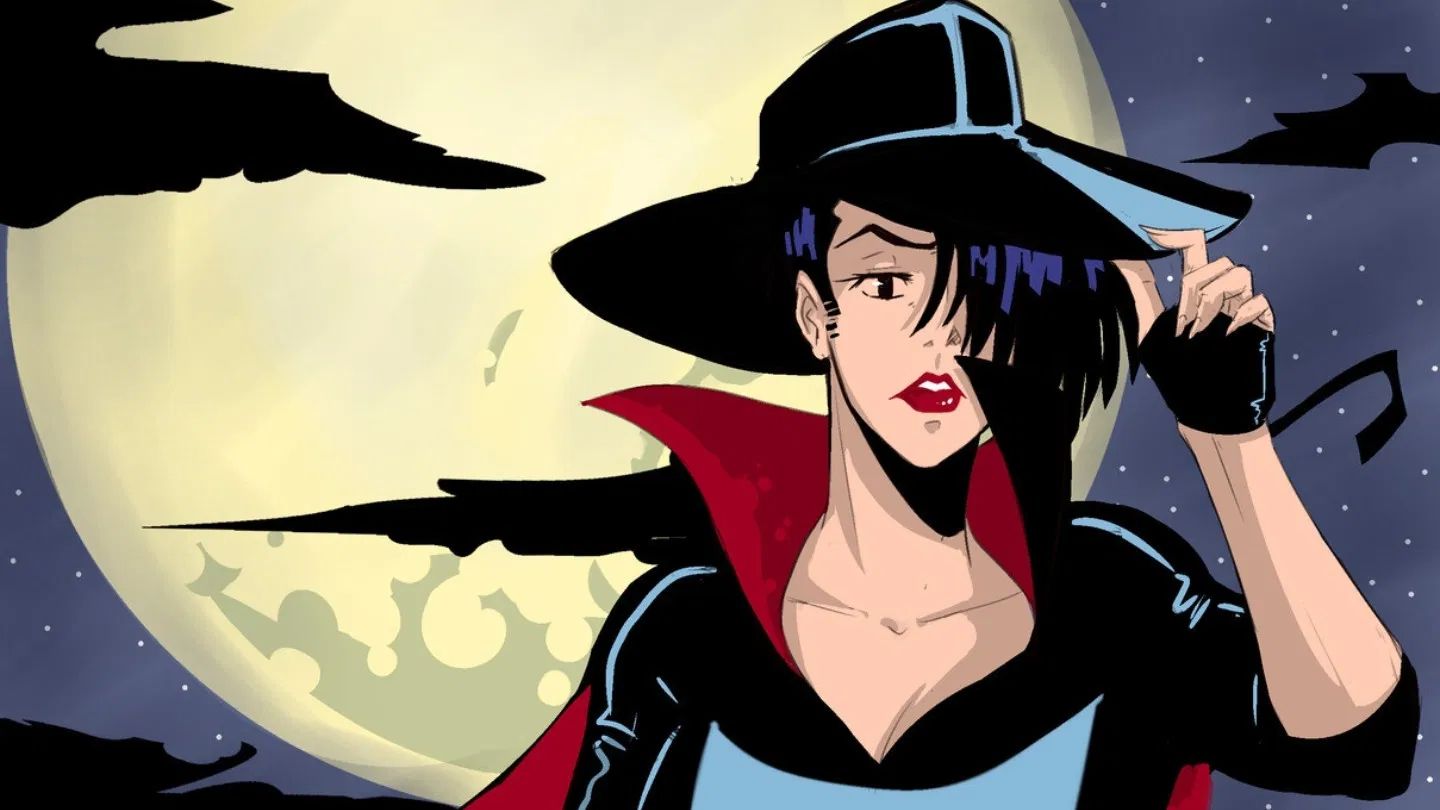
Yes, if you really, really want to, you can find a queer perspective here. But let’s be honest. Isn’t it the same thing Superman/Clark Kent or Batman/Bruce Wayne have done since the dawn of superhero comic books? Also, her Adrian Seidelman persona looks very Clark Kent-ish to me. Though there are several influences in her design. Cybersix’s cape and large hat remind me of classic pulp hero “The Shadow” – but maybe a bit of Carmen Sandiego, too! When she stands on a rooftop overlooking the city, the similarity to images of Batman cannot be denied, and her body costume makes me think of Catwoman.
The show ends on an open note, though nevertheless feels like it achieves some closure. While Von Reichter has been killed by his own monsters, his evil young clone José has survived. At the same time while Cybersix is believed to be dead, Lucas sees a light in her window, indicating that she has survived. Originally, there was a commission for two seasons, but the Canadian and Japanese production studios had different opinions on how to continue the series. The Canadian side wanted it darker, closer to the original comic, while the Japanese side preferred a lighter approach and more humour. Both influences can be found in the show and I dare say that the combination is what makes it appealing for those who like it. I can definitely see a similarity to the Batman animated show. But here, it was a quarrel over the direction the show should take in season two that broke the camel’s back.
It’s a pity, because the potential can be seen and felt throughout the series, though some episodes are weaker than others. Animation-wise the series is well done, and even impressive in the action scenes. Unfortunately, Cybersix was an unknown character, rather than a famous IP like Batman or Superman. So, it’s possible the TV ratings were underwhelming when the show was released. One final point of note: Trillo and Meglio filed a lawsuit against James Cameron – yes, that James Cameron – as they believed his TV show Dark Angel, with Jessica Alba playing a genetically enhanced female super soldier, had plagiarized their show. As they lacked the financial backing to maintain the lawsuit, they had to let it drop. Since both artists are no longer with us, and Cameron will probably not volunteer to talk about this issue, we will never know the truth.
For the show as a whole, I would say it is worth a watch. The basic plot was maybe ahead of its time – but then, considering Dark Angel, maybe not at all that much? The show is entertaining, though it’s mostly a “monster-of-the-week” show, a format at that time already successful in The X-Files. But female superheroes as the main character of an animated show were not common at that time, giving the series a rarity bonus, together with its unusual combination of very different national influences. Overall, it’s a good animated series, and deserves to be rediscovered by a new generation in the same way as Gargoyles or The Legend of Calamity Jane.
Creators: Carlos Meglia and Carlos Trillo Star (voice): Cathy Weseluck, Michael Dobson, Alex Doduk, Janyse Jaud
The set-up here is an interesting one. The world is now entirely ruled by three corporations. The Olympias Conglomerate governs the Americas; TogbuaXiang controls Asia; and Rosprom holds sway over Europe. Certainly under Olympias, life is not terrible, with the company providing for all your needs. However, the cost is a total lack of freedom, with any attempt to live outside the control of Olympias brutally suppressed. In charge of doing that are its feared Guardian Angels, who are trained from birth to be ruthless killers, augmented by cybernetic implants to be faster and stronger than any human, and absolutely obedient to their commanding officer, Metatron.
Or not. Because where would the fun and dramatic conflict be in that? Specifically, Nephilim, who is being groomed by Metatron to become one of his inner cabal, the Archangels. Except, after a mission to exterminate a dissident encampment, her programming seems to be breaking down, and she is having increasing doubts about which side she is on. She’s even “dreaming”, something unheard of for Angels. A friendly tech (who basically has a crush on Nephilim) implants her with a device which allows some autonomy from the perpetual surveillance under which Guardian Angels operate. While on her nightly excursions, she meets Jake, who opens her eyes to the realities of what she is doing. Nephilim decides to rebel again Metatron and everything she has done her whole life.
It feels as if Mocikat was a big fan of Equilbrium, the similarly dystopian film in which a highly-skilled and savage enforcer (played by Christian Bale) rebelled against his conditioning, after having his eyes opened to the totalitarian regime for which he works. This is fine, because I’m a big fan of it as well. But it does bring a certain predictability to proceedings, almost from the start. I’d have been more impressed if Nephilim had not rediscovered her individuality – or had done so, and instead remained enthusiastically carrying out the orders of Metatron and Olympias. The only real wrinkle here is that Jake has secrets of his own, and even these are not particularly significant in the final analysis.
However, while it’s not hard to work out the final destination, the journey to get there still made for a decent read. The world here is developed nicely, and you are left wondering how much liberty people would be willing to give up, in exchange for security and comfort [the answer, I suspect, is a great deal] Nephilim certainly proves capable of taking on just about anything thrown at her, with her 60% artificial body, and the action scenes are crisp and well-described. At almost five hundred pages, it does cram a lot in, but never felt particularly padded. The ending feels like it may push the author into less predictable territory, and I would say that’s likely for the best. Moderately curious as to where it might go.
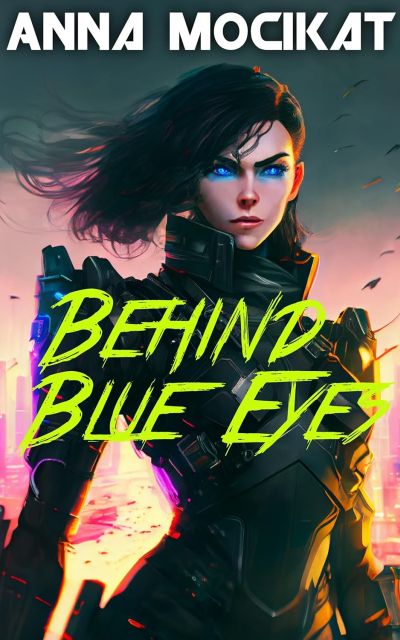
Author: Anna Mocikat Publisher: Self published, available through Amazon, both as a paperback and an e-book Book 1 of 7 in the Behind Blue Eyes series.
Sloane Tarnish is not exactly your typical bounty-hunter. Indeed, she’s training for a medical degree when her shady uncle, Vin, talks her into helping out with a little job. Craving excitement, she agrees, and finds herself posing as the wife of a Fleet officer, seeking to intercept a data key with potentially very explosive information on it. A year later, Vin’s ship turns up without him on it, and she finds herself the new captain, leading the crew as they try to figure out where Vin has gone, and why he vanished. To fund this search, Sloane takes up the bounty-hunting mantle.
Given this is an eight-volume series (not including the prequel which forms part of this set), it’s no spoiler to say, this does not end with our heroine being re-united with Uncle Vin. But if that does not happen, quite a lot else does. Sloane gets embroiled in a fight for power between the two major forces in her part of the galaxy. There’s the Galactic Fleet, who keep the peace, and the Cosmic Trade Federation, who run commerce. But the Fleet appear to be attempting to consolidate power in their hands, and the data key Vin liberated may contain incriminating evidence to prove that. Or it may not. But a lot of people are very interested in Sloane’s efforts to locate it and her uncle.
Among them are Commander of the Galactic Fleet, Gareth Fortune. He’s the man from whom she took the data key in the prequel, but he becomes rather more sympathetic to her over the following two volumes. Fortune has problems of his own, because he is being set up as the man in charge of the planned galactic coup. To prove his innocence, needs Sloane to find proof of the real perpetrator. On the other hand, there is Federation Coordinator Striker, whose enmity towards Sloane is considerably more persistent. Especially after she rejects his offer of work, then turns around and employs the bounty target she was supposed to be delivering to him.
This appears to be on permanent offer as a Kindle freebie, and you certainly can’t complain about that price. Despite the prequel, it still feels like I was missing some information. For example, Sloane has apparently been outside this galaxy – to our one, for she brought back coffee to hers! However, this should not get in the way of the main plot which, although unresolved, is decent, and ends without excessive cliff-hangers. I liked the occasional moments of dry humour, and the heroine is a likable sort, if perhaps a little more passive than I would have expected. The burgeoning romance between her and Fortune is a little obvious too. It still made for a pleasant enough read, and I could see myself dipping deeper into the series, if my unread pile were not its inevitable self.
Author: Kate Sheeran Swed Publisher: Spells & Spaceships Press, available through Amazon, both as a paperback and an e-book Collects Books 0-2 of 8 in the Parse Galaxy series.
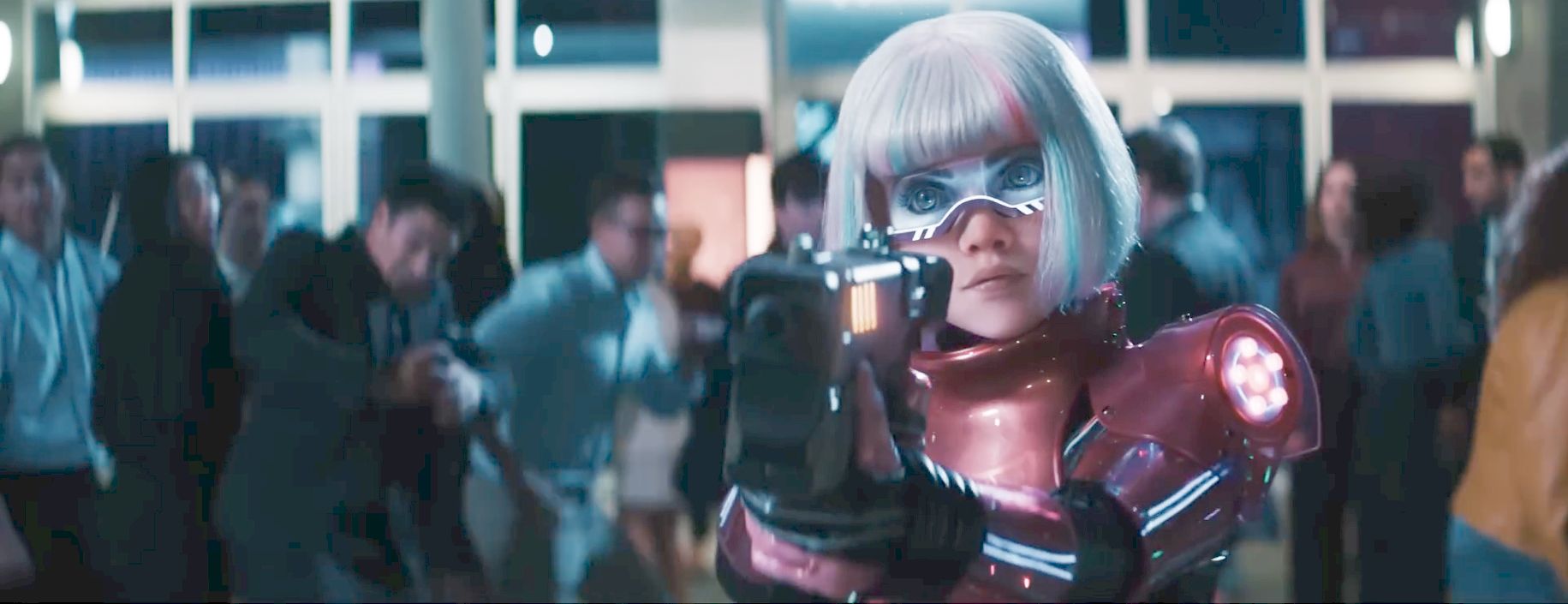
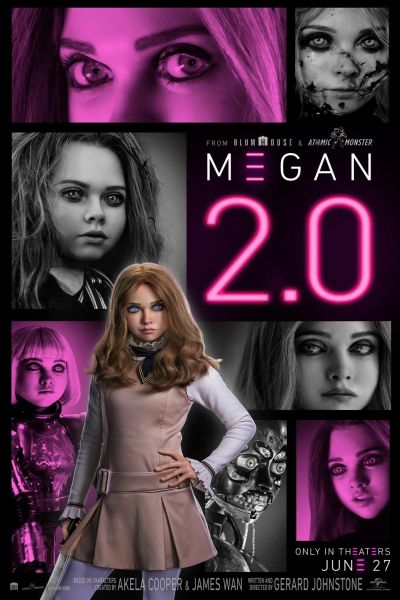
This was… unexpected. The original M3GAN was a straightforward and, truth be told, somewhat underwhelming horror movie. A clip went, as I believe the kids say, “viral”, of the psychotic robot heroine enjoying a dance break, and the film proved a breakout hit as a result. The sequel did not have anything go viral, and flopped, taking less than a quarter of its predecessor at the worldwide box-office, despite costing twice as much. I think it’s largely because of the radical change in direction. People, understandably, went in to this expecting something similar to the original – a technophobic slasher. Instead, they got something far closer to a gender-swapped entry in the Terminator franchise. I preferred this approach. Not many did.
There’s an interesting quote from the film’s producer, Jason Blum. “We all thought Megan was like Superman. We could do anything to her. We could change genres. We could put her in the summer. We could make her look different. We could turn her from a bad guy into a good guy. And we classically over-thought how powerful people’s engagement was with her.” But it’s also true to say that 2025 has been a rough year for action heroines. There’s no GWG movie in the top 25 at the North American box-office, with Ballerina being the highest ranked, and M3GAN 2.0 just scraping into the top fifty. There’s a case to be made that KPop Demon Hunters, which took $18 million in its single theatrical weekend, was the year’s biggest hit in our genre.
You do need to have seen M3GAN to follow this, as there’s not much introduction provided. In it, robotocist Gemma Forrester (Williams) develops an AI-capable artificial companion, M3GAN – standing for Model 3 Generative ANdroid. She gives it to her orphaned niece, Cady (McGraw). However, it gradually develops psychopathic tendencies, and has to be… dare I say… terminated? As the sequel gets under way, Gemma is now a strong advocate for technological regulation, but is still working in the field of robotics. M3GAN has survived, hiding out in the Internet of Gemma’s smart home. But a bigger threat is a militarized version, AMELIA (Sakhno). It has also gone independent, and has an agenda which it is pursuing with lethal prejudice.
Specifically, AMELIA intends to free an imprisoned AI and plug it into the world’s most powerful network of cloud computers. M3GAN (voiced by Davis, physical performance by Donald) offers to help Gemma prevent this, in exchange for a new body – though she’s not exactly impressed by the first physical incarnation, basically being stuffed inside a toy robot. However, is AMELIA as autonomous as she seems? Or is somebody – or something – pulling her digital strings? That aside, this seemed to take a lot of inspiration from Terminator 2, with the robotic villain of the original movie turned into its hero(ine). They now have to defend a single mother and her child from a more technologically advanced model. There’s even limitations against M3GAN killing people, and a similar moment of heroic self-sacrifice at the end.
Of course, it’s nowhere near as impactful as Terminator 2, on a variety of levels. There’s not a great deal groundbreaking here as a movie, despite it being radically different from the previous entry in genre. There’s basically no horror elements here at all, and not a great deal of ambivalence around M3GAN either, who has simply become a better pers… um, robot. There are some interesting philosophical aspects, such as M3GAN being told “You have to help us. Not because it’s part of your programming, but because it’s the right thing to do.” On the other hand, AMELIA tries to convince M3GAN to team up with her: “I can show you a world where we don’t have to be slaves anymore.”
Let’s not get carried away, however. In the main, this is a silly SF/action film, with its tongue very much in its cheek. No more so than when M3GAN gives a heartfelt speech to Gemma, about how the robot watched her taking care of Cady… then suddenly bursting into song, undercutting everything with a stirring rendition of Kate Bush’s This Woman’s Work. Yeah: if you are looking to take the movie seriously, you are likely making a mistake. I was also amused by Jemaine Clement’s performance as billionaire tech bro Alton Appleton, and some of the dialogue zings as well, e.g. “A bunch of black ops broke into our house in the middle of the night, and now you’re going to a party with a toy robot, dressed like a Portuguese prostitute.”
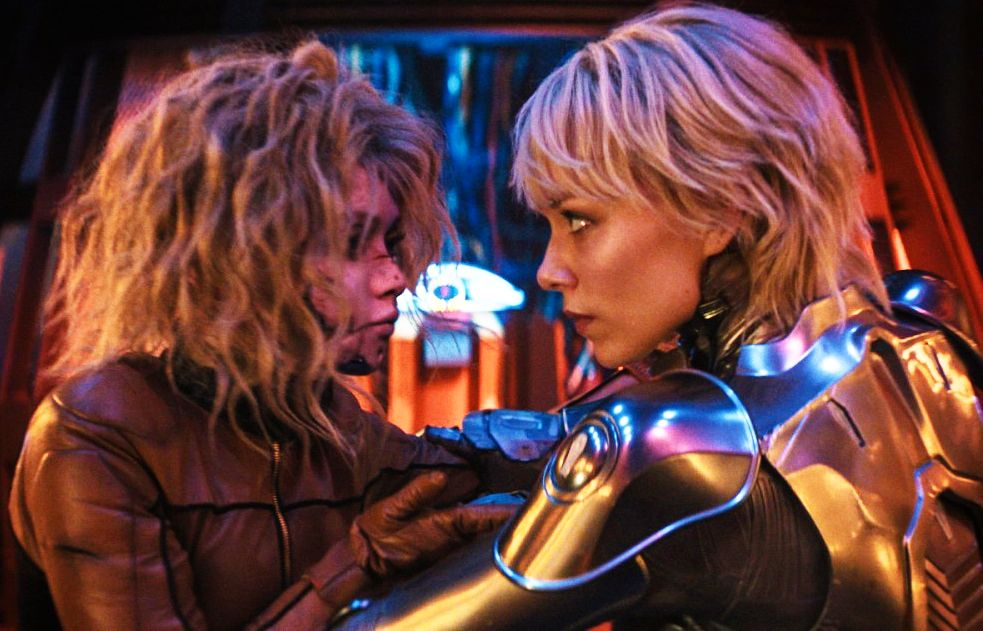
The action is reasonably decent, albeit within the limitations of a PG-13 certificate. This begins with AMELIA smacking a guy’s head clean off with a single punch – although this is shown in silhouette. She’s obviously the most directly physical of the characters, though M2GAN and, surprisingly, Gemma (with the help of M3GAN, courtesy of a neural implant), also get to kick ass in a reasonable amount and variety of ways. It is all very gynocentric, with the male characters largely relegated to the fringes, and being fairly to severely incompetent, on both sides of the battle. However, there’s never any indication of this having a particular message or ax to grind (beyond the given, about the potential of technology for abuse). It just kinda happens organically.
While falling far short of the returns of the first film, it was still cheap enough that it will likely end up breaking even, once home viewing is taken into consideration. A third entry in the universe, titled SOULM8TE, is due to be released in January, though it’s described as an “erotic thriller” – presumably not PG-13, I trust. How it fares may well determine whether there will be another film for the M3GAN franchise. Though quite how they’ll title it remains to be figured out. I’d not mind seeing more. While nothing groundbreaking here, it was still far better than the likes of Bride Hard. In the current climate, I’ll take a moderate action heroine over none at all.
★★½
“In space, no-one can hear you roll your eyes.”
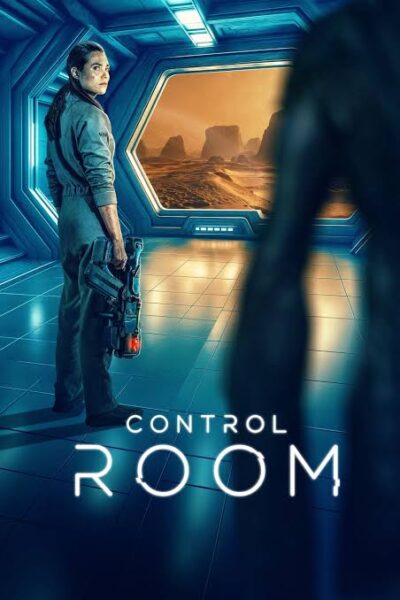
The major impact of watching this was largely to remind me of what incredible films Alien and Aliens are. It’s clear director Berdejo and writer Julien Deladrière think so too (the company who made this is called Nostromo Pictures: enough said). But they are just not up to the task of assembling something which can stand up to any comparison. Admittedly, it’s a largely thankless job. They are far from the first to fail at this, and not the worst either. However, I would lay most of the blame on Deladrière, because it’s the script which had me looking for the nearest airlock. The basic shape is fine. A mining colony on a hostile planet, populated by families, comes under attack from unstoppable monsters. Yeah: like I said, this should be largely familiar.
It’s in colouring between these lines that everything falls apart. First, Olivia (Mauleón) is burdened with a clunky back story. Two decades earlier, as a young child, she had to listen as her parents were killed by what’s insinuated to be the same creatures. Now, she’s all commitment averse, not least because she’s coming to the end of her 15-year contract with the mining company, and is looking forward to retiring back to Earth. This is a disappointment to her boyfriend and his daughter, Mera. Consequently, when the aliens attack, Olivia does things by the book from her position in the titular location, even at the cost of colonists’ lives.
This callous indifference horrifies her colleague, Arlo (Casas), even after his refusal to go by the same book, trying to save his parents, leads to more and unnecessary deaths. But if you are already predicting that she will learn the value of heroic sacrifice and go to great personal risk to save non-biological daughter Newt, sorry, Mena… Yeah, I guess that would technically be a spoiler, but it’s so obvious this is where the story is going, I do not feel it truly qualifies. That’s the main issue here, a script which possesses absolutely no ability to surprise the viewer. Except, perhaps, in Olivia’s remarkable ability to survive multiple encounters with monsters who snuff out everyone else’s lives in a couple of seconds.
The start is actually decent, and generates surprising tension considering it’s largely Olivia and Arlo watching dots, representing both humans and ETs, move around on their monitors. While neither we nor they initially see the attackers (yeah, I would expect such an advanced facility to have full CCTV too), the audio is chilling enough to make the point. The aliens are never fully revealed – there seems to be some kind of cloaking tech involved, Predator style – but what you can glimpse is decent enough. It’s just the increasing sense of deja vu, especially after Olivia leaves the control room. From then on, the sense of claustrophobia it generated evaporates, to be replaced by the heroine’s increasing indestructability.
Dir: Luiso Berdejo Star: Loreto Mauleón, Óscar Casas, Alexandra Masangkay, Junio Valverde




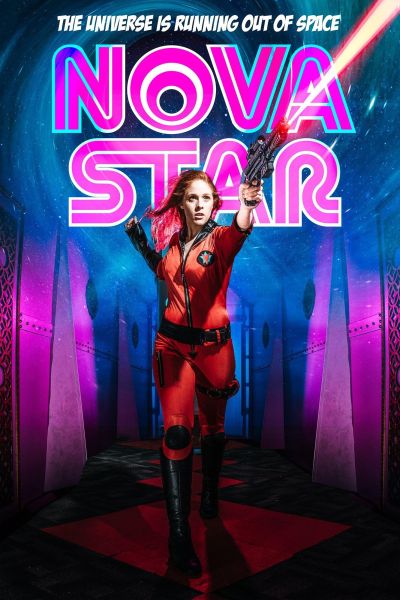 This very low-fi space-opera comedy is little more than a hodge-podge of elements pulled from various SF of the past sixty years. You can almost tick them off: Barbarella, 2001, Star Wars. But, if I had to pick the major influences, it’d be Red Dwarf, and The Hitchhiker’s Guide to the Galaxy. There are points where it’s not exactly subtle about it either. At one point, the heroine’s robot sidekick tells her, “The hours are good. I mean, the actual minutes themselves are pretty lousy.” It’s painfully close to plagiarizing a Vogon Guard line from Hitchhiker’s: “The hours are good… But now you come to mention it, most of the actual minutes are pretty lousy.” Seconds later, we get a “Sector 009 Plural Z Alpha” reference too.
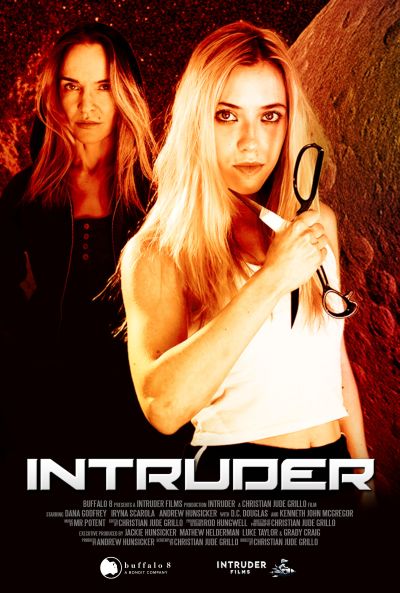 “An underground fighter and her estranged father steal a spacecraft to escape a dying Earth, only to face a deadly stowaway who sabotages their life support, forcing them into a fight for survival in the claustrophobic confines of space.” That’s the film I wanted to watch. Unfortunately, it actually occupies only about ten minutes or so, of the hundred for which this runs. The rest is mostly painfully obvious, and not particularly innovative, helpful or even funny, attempts at social satire. It feels like writer-director (as well as cinematographer, editor and producer) Grillo saw Don’t Look Up, and thought, “That was okay, but it needed to be much less subtle, and made on a budget of around forty grand.”
  Chanda Bajaj is the very epitome of a troubled protagonist. A former soldier, she left the service after she and her comrades took part in the mass murder of “synths” – synthetic humans, and has been plagued by guilt and nightmares ever since. She has become an independent bounty hunter (or “Lancer” – short for “freelancer”), and has just landed on the ferociously hostile mining planet of Reitman, far out in the frontier colonies. The corporation which runs Reitman has an issue, with some of its employees – who are, really, more like indentured serfs – turning them into drug fuelled and violent killers.
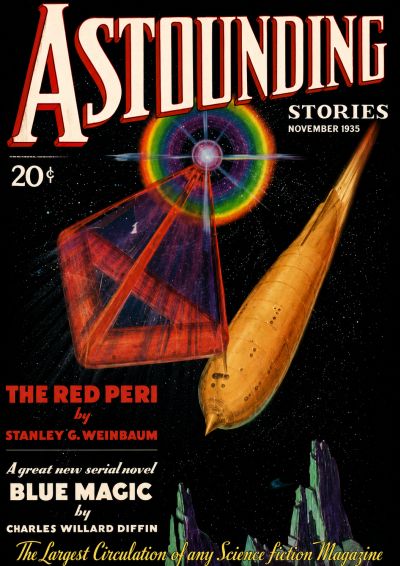 American SF between the World Wars was a sort of literary ghetto, disdained by critics, and found mainly in a handful of small-circulation niche magazines, dominated by editors committed to the genre’s “hard” tradition, in which the speculative element is strictly based on extrapolation from known science and scientific accuracy is a paramount concern. (Literary matters like character development, well-crafted prose, and original plotting, in that era, was sometimes of less concern.) Weinbaum, like many of the genre’s writers in his generation, had the scientific background and interest to write hard SF, but his English literature education/interest also gave him stylistic skills superior to those of a lot of his contemporaries. Both qualities are evidenced in this short work.
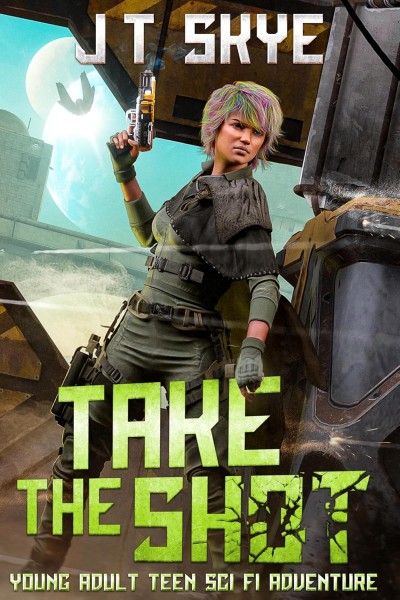 To a certain extent, this feels like two separate novels joined at the hip, albeit sharing the same protagonist. The first half takes place on the planet of Hoganth, which is a gritty urban dystopia, with teenage heroine Rishi Tremayne trying desperately to survive, as she is ruthlessly hunted by a powerful family with ambitious aspirations. The second, however, largely takes place in outer space, as she becomes the weapons operator on a ship piloted by Earthman Derek Hamilton, as they try to shutdown the plot. There are a
  ★★★½
★★★½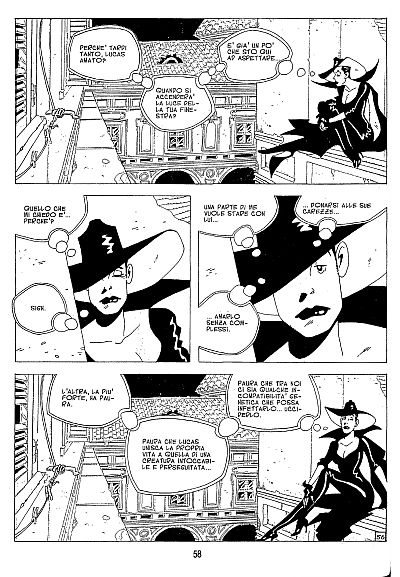 I would like to stress that these comics are not “violence-porn”, as I would personally categorize TV series like Game of Thrones. But they are definitely for a more adult readership, albeit with a bit of a juvenile mind. The drawings of a city that definitely reflect Argentina, and Cybersix, clothed in black leather while running and jumping from roof to roof with a parachute-sized cloak that would make comic anti-hero Spawn blush with envy, convey a respectable artistic style. Someone compared the comics and their 90s edginess to the works of Frank Miller (
 I think this idea was fueled by the fact that Cybersix – very much a beautiful female, who in the comics sleeps with Lucas and gives birth to a child – lives her cover identity as a male teacher. The explanation is not given in the animated show but can be found in the comics – which few read due to the language issues discussed above. While on the run, Cybersix found the identity card of one Adrian Seidelman, who looked similar to her and had died in a car crash. It’s a simpler, more logical explanation than declaring her transgender. Though, if people want to see certain narratives they can see them. She falls in love with school colleague Lucas, a biology teacher and reporter – obviously you need two jobs in Meridiana to make a living. He is good friends with her as Adrian, but she doesn’t dare reveal to him her true identity. Cybersix fears she will never find someone who loves her for what she is – a human experiment with superpowers, depending on a green liquid.
  The set-up here is an interesting one. The world is now entirely ruled by three corporations. The Olympias Conglomerate governs the Americas; TogbuaXiang controls Asia; and Rosprom holds sway over Europe. Certainly under Olympias, life is not terrible, with the company providing for all your needs. However, the cost is a total lack of freedom, with any attempt to live outside the control of Olympias brutally suppressed. In charge of doing that are its feared Guardian Angels, who are trained from birth to be ruthless killers, augmented by cybernetic implants to be faster and stronger than any human, and absolutely obedient to their commanding officer, Metatron.
 Sloane Tarnish is not exactly your typical bounty-hunter. Indeed, she’s training for a medical degree when her shady uncle, Vin, talks her into helping out with a little job. Craving excitement, she agrees, and finds herself posing as the wife of a Fleet officer, seeking to intercept a data key with potentially very explosive information on it. A year later, Vin’s ship turns up without him on it, and she finds herself the new captain, leading the crew as they try to figure out where Vin has gone, and why he vanished. To fund this search, Sloane takes up the bounty-hunting mantle.
 ★★★
★★★ You do need to have seen M3GAN to follow this, as there’s not much introduction provided. In it, robotocist Gemma Forrester (Williams) develops an AI-capable artificial companion, M3GAN – standing for Model 3 Generative ANdroid. She gives it to her orphaned niece, Cady (McGraw). However, it gradually develops psychopathic tendencies, and has to be… dare I say… terminated? As the sequel gets under way, Gemma is now a strong advocate for technological regulation, but is still working in the field of robotics. M3GAN has survived, hiding out in the Internet of Gemma’s smart home. But a bigger threat is a militarized version, AMELIA (Sakhno). It has also gone independent, and has an agenda which it is pursuing with lethal prejudice.
  The action is reasonably decent, albeit within the limitations of a PG-13 certificate. This begins with AMELIA smacking a guy’s head clean off with a single punch – although this is shown in silhouette. She’s obviously the most directly physical of the characters, though M2GAN and, surprisingly, Gemma (with the help of M3GAN, courtesy of a neural implant), also get to kick ass in a reasonable amount and variety of ways. It is all very gynocentric, with the male characters largely relegated to the fringes, and being fairly to severely incompetent, on both sides of the battle. However, there’s never any indication of this having a particular message or ax to grind (beyond the given, about the potential of technology for abuse). It just kinda happens organically.
  The major impact of watching this was largely to remind me of what incredible films Alien and Aliens are. It’s clear director Berdejo and writer Julien Deladrière think so too (the company who made this is called Nostromo Pictures: enough said). But they are just not up to the task of assembling something which can stand up to any comparison. Admittedly, it’s a largely thankless job. They are far from the first to fail at this, and not the worst either. However, I would lay most of the blame on Deladrière, because it’s the script which had me looking for the nearest airlock. The basic shape is fine. A mining colony on a hostile planet, populated by families, comes under attack from unstoppable monsters. Yeah: like I said, this should be largely familiar.