



★★★★
“Just the facts, ma’am.”
 We’ve written about Griselda Blanco before. In particular, we reviewed telenovela La Viuda Negra, which was loosely based on her life and compared it to the facts. We also covered Cocaine Godmother, in which Catherine Zeta-Jones took on the role of Blanco in a bio-more-or-less-pic. She remains a fascinating character, so you won’t be surprised that when I heard about a new documentary concerning her life, it went straight to near the top of my watch-list. I was a little concerned, since it came out as a “Tubi Original”. I’ve been burned by some of these before, and so was expecting a lurid, shallow TMZ-style expose which played fast and loose with the truth.
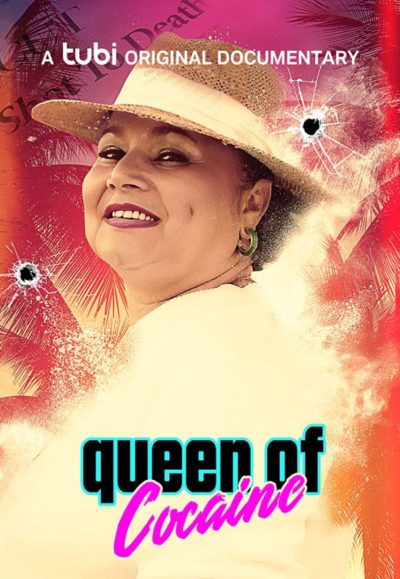 To my pleasant surprise, that’s not the case at all. Obviously, there’s a certain allure here, but it doesn’t needlessly glamourize or condemn its subject, and instead manages to do a good job of painting both sides, and depicting Griselda as a surprisingly complex character. This is particularly clear at the end, when her youngest son – named, amusingly, Michael Corleone – says of his mother, “Yes, it’s a legacy of violence. But she was a woman that had to become savage in a world that wasn’t made for her.” Then Detective Diaz, who headed the Miami task force charged with bringing her down, counters, “We have this bitch from hell who decides she wants to be meaner and more powerful than anybody else… Violence. Arrogance. Greed. That is her legacy.” Take your pick!
It covers Blanco’s entire career, from growing up poor in Cartagena, through her (illegal) emigration into America, where she got into the drug business, and built an empire which brought her a fortune estimated (likely conservatively) in hundreds of millions of dollars. With this came enemies on both sides of the law, but Blanco almost seemed to feel she was invulnerable, and continued acting with impunity, until first the authorities and then her foes, eventually caught up with her. They’ve got some very good interview subjects, with Michael in particular standing out. His description of how he witnessed his father being gunned down on a Colombian street is chilling.
Cops, journalists and even other criminals also chip in, and it’s edited skilfully together to tell a complex story with clarity. Another interesting character I’m going to have to look into is Jemeker Thompson-Hairston, the “Queen of crack” who served time alongside Blanco in federal prison. One of the key players in the eighties crack epidemic, she’s now an evangelist, and came over as very well-spoken and thoughtful. I do have to say, something about narrator Elena Hurst’s voice kinda grated on me. Perhaps it was the way she’d apparently adopt an outrageous Spanish accent, any time she said the subject’s name: “Greez-hel-dahh”. Overall though, this manages to be both informative and entertaining, even if it is perhaps helped by having a story it would be difficult to screw up.
Dir: Victoria Duley
Star: Michael Corleone Blanco, Bob Palombo, Raul Diaz, Dr. Amy Shlosberg
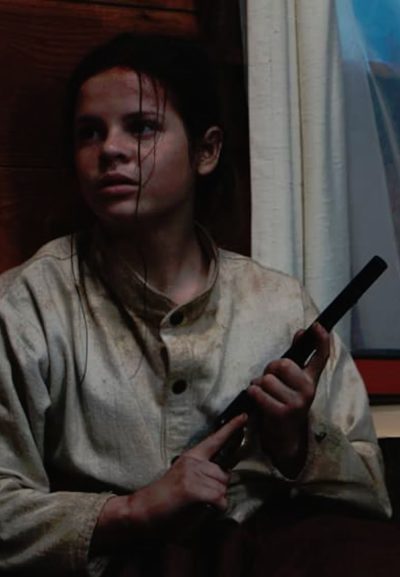 This one does take a while to reach the necessary threshold: probably only truly qualifies for the final twenty minutes or so, though it does talk a good game until that point. Also, it’s a decent enough combination of Western and home-invasion genres to that point, to pass muster. Nothing special, mind you. It just knows its limitations and is careful enough to work within them. It takes place in the Old West. whee Beth (Bernadette) and her twin children, Brian and Irene (Betsy) now live with her new husband, Robert (Krause). The trio appear to have escaped an abusive relationship, and it’s not long after a railroad surveyor pays a visit, before Irene is cheerfully telling him, she’s going to go back and kill her father some day.
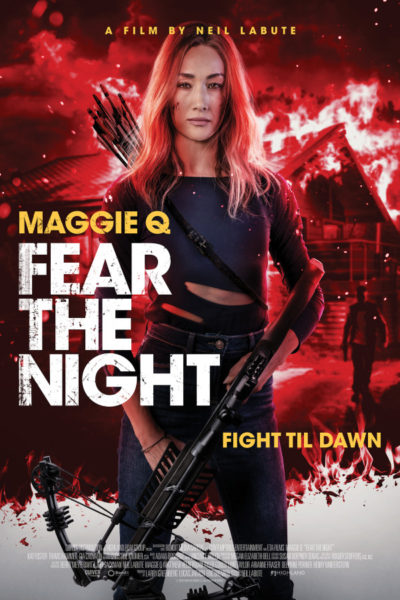 Director LaBute is best known around these parts for his ill-conceived remake of classic horror The Wicker Man, which is generally regarded as spectacularly bad, and is probably best-known for spawning memes involving Nicolas Cage and bees. So expectations going into this were… not high, shall we say. On that basis, the three-star rating is something of a pleasant surprise, though most of the credit for this should got to its star, rather than the director. Tess (Q) is a veteran of the war in Iraq, who is struggling to reconnect to her two sisters. Rose is getting married, and is nice enough that Tess is willing to attend her bachelorette party at the family cabin, deep in the country. But Beth (Foster) is a straight-up bitch.
 By coincidence, I watched this not longer after the not very good
 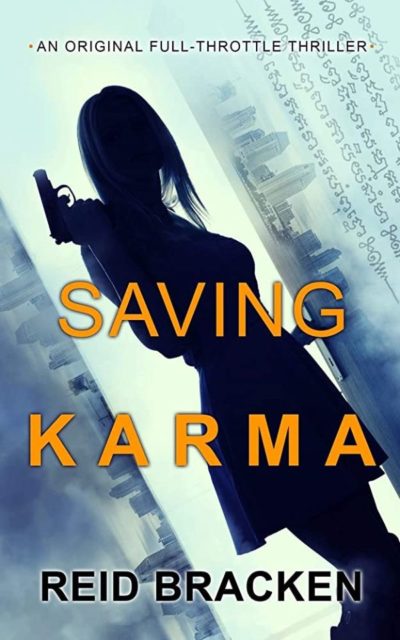 On Amazon, this is subtitled, “A full-throttle Thailand thriller,” but that’s a little bit of a misleading label. The bulk of the story – at least, the bits that matter – actually take place in China. The book itself goes with “A full-throttle thriller throughout Asia,” Except it starts off in the not-exactly Asian setting of San Bernardino, California, where Bree Thomas is just about to graduate. This is despite the problems of her adopted family, who she was sent to live with after her parents were killed in Thailand. She gets a chance to escape it all, in the form of an apprentice program with the Meng Foundation, a charitable group who help refugees around the world.
 To be honest, I enjoyed this a good bit more than the rating above would indicate – probably another star or so. But I have a particular tolerance for cinema with rough edges, which I know not everyone will share. This is such an entity. I can’t really recommend it, since most people won’t be able to get past the micro-budget anesthetics, which the film rarely bothers even to try and hide. But I could appreciate the obvious passion that went into this. Put it this way, if I had twenty quid with which to make a movie, it could end up looking something like this. Probably not with such a kick-ass poster though.
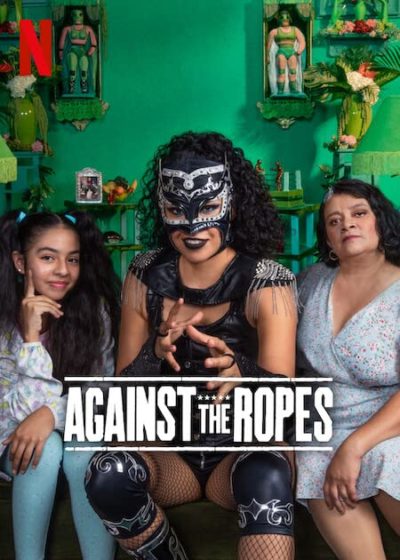 In one of the odder remakes I’ve seen in a while, this is a repurposing of the French 2013 film, Les reines du ring, which translates as “Queens of the Ring”. The core concept is retained, but the location is changed from France to Mexico, and the idea is expanded to a ten-part series. These changes make for a bit of a mixed blessing. Pro wrestling is certainly a more well-established part of the cultural landscape in Mexico, where lucha libre is extremely popular. On the other hand, the multiplication of the running time a factor of about four, leads to the necessary injection of superfluous storylines, which definitely reduced the entertainment value as far as I was concerned. It’s less a wrestling soap-opera, than a soap-opera with wrestling in it.
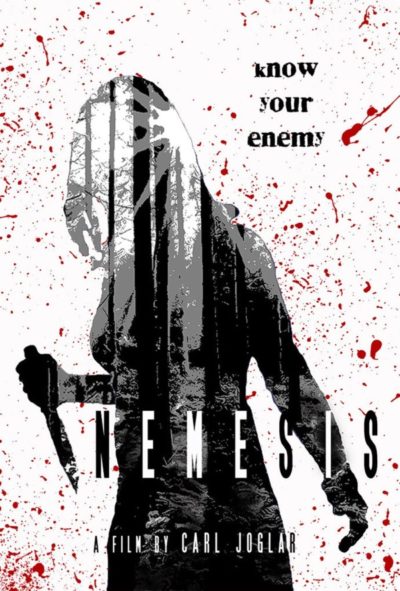 I was going to go with “Tree’s company” as the tagline, before I realized I’ve actually used that in three separate, forest-set movies. So I decided to adjust it slightly, and what’s above is indeed very apt. There is a cast of three (3) and the entire thing unfolds in the woods. There isn’t a single set or interior shot in the whole film. Indeed, if you’d asked me, I’d have said this had all the hallmarks of a COVID-era project, designed to be shot with a small cast and in a nicely sanitary, outdoor location. Not so, even though Tubi dates it as 2020. There was a screening in April 2019, well before anyone had heard of Wuhan, and the IMDb gives it a year of 2017.
 I had quite forgotten that Rose was part of John Wick: Chapter 2 in 2017. That
  I think I can point almost to the exact point where this one jumped the shark. It had started well enough. Jamie Austen works for the CIA, taking down human traffickers across the world, in conjunction with a non-governmental organization called Save the Girls. Now, I have questions here: why exactly would the CIA