 ★★★
★★★
“The original Barbie”
The subtitle is not a joke. Lilli began her life as a comic – just a single drawing, with a line of her saying something funny – in the German newspaper Bild. Drawn by German artist Reinhard Beuthien, it ran from 1952-1961. With her child-like face, perfect slim figure, and long blond hair that she carried as a ponytail, Lilli was an attractive young woman. Also, she was saucy, sexy, independent and single: not at all as you would imagine young women to be in 1950’s Germany. It’s unsurprising that “Bild-Lilli” had her fans, and that dolls in her image would be produced from 1955 on. Though these were originally meant not as toys, but for marketing purposes.
When Mattel co-founder Ruth Handler went to Germany on holiday in 1956, she discovered the dolls and wanted to bring them to the American market. She had her designers create a new doll based on Lilli, and released her under the name “Barbie” in 1959. It seems Handler was afraid of copyright claims by the original producers. For Wikipedia tells us: “Mattel acquired the rights to Lilli in 1964, and all the promotional and merchandising activities related to the character were discontinued after then.” So, yes: while Mattel changed details here and there, Barbie was originally indeed a German girl named Lilli. Though looking at the All-American girl Barbie embodies today (also her animated movies, as well as the recent live-action one), it’s hard to recognize Lilli in Barbie nowadays.
However, long before the sale of rights, in 1958, Lilli had her own live-action movie. [I wonder if Mattel buying Lilli is why I haven’t seen this movie on TV for 30 years or more. It has never been released on videotape, DVD or Blu-ray.] This starred Danish actress Ann Smyrner, who won the role in a contest. Smyrner spoke only a little German, so was dubbed by German voice actress Margot Leonard. She would go on to fame for also dubbing Marilyn Monroe, Brigitte Bardot, Honor Blackman and Diana Rigg – basically, everyone young, female and sexy in 1950s and 60s cinema. I mention her especially, because I think that without her voice, Lilli might not have worked so well as a film character.
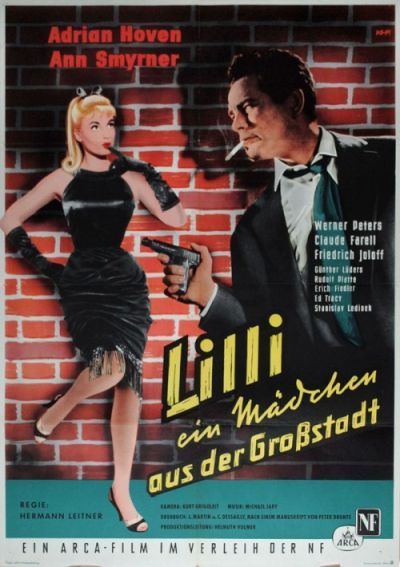 In this story, Lilli works as a reporter for a newspaper. Her introduction is already notable, driving an elegant sports car at high speed into a parked vehicle. When a policeman tries to fine her, she flatters and confuses him, kisses him on the cheek and leaves. In the newspaper office, she resists the flirtation of her boss with a move – is it early martial arts? – that leaves him on the ground. Really, we had not seen a female character like that in a German movie. It might have been slightly different in America, with some female characters in westerns and swashbucklers, but here, this was new. Although things were about to change, as I remember Lieselotte Pulver, whose Spessart Inn series of films began the same year.
Lilli is sent to report on a missionary congress in Sicily, getting there by ship. Honestly, I sincerely doubt this movie was filmed there, because we hardly see any Italian landscapes here. You see signs in Italian painted on walls indicating this is a hotel, a restaurant and so on. It’s meant to convince you that you are there because… well… it’s written in Italian language, so it must be Italy, right? Most of the scenes are inside on sets, and all of these might well have been in a German film studio. Also, some characters speak German with a fake Italian accent. It might have been convincing for a German audience in the 50s, but these feel kind of hilarious nowadays. (Although we still get German actors playing Italian characters, at least they leave out the fake accents now!) The opening credits say “Produced in the Arca studios, Berlin”, a facility which also produced a movie set partly in Africa!
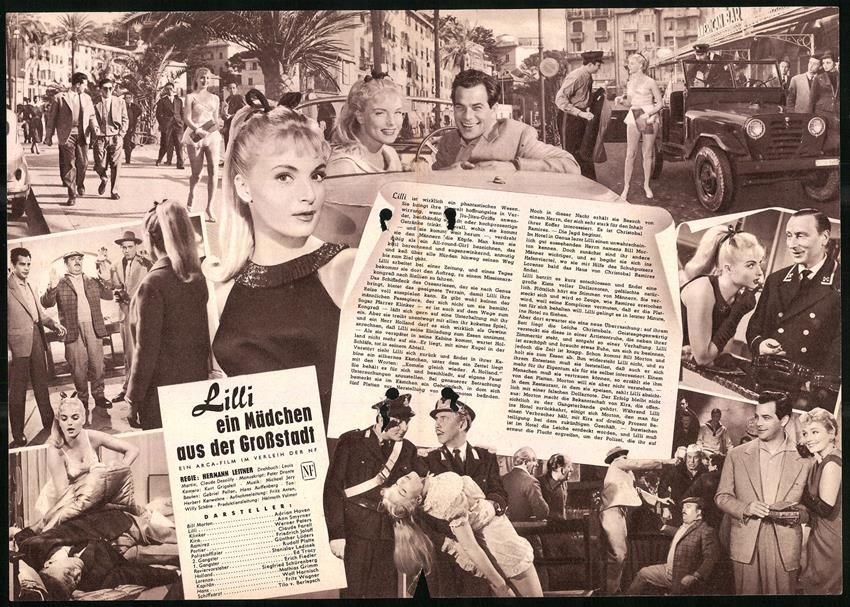
But let’s be fair. For a 50s movie, Lilli’s adventure is quite exciting. She meets an old man (Siegfried Schürenberg) onboard the ship, who asks her for a favor and soon turns up dead in his cabin. She finds money printing plates in her room. Her investigations in Sicily lead her to a car garage where a traitor from a gang (Friedrich Joloff) is killed. As one of the murderers tries to abuse Lilli, he accidentally tears off her dress, leading to Lilli running away in her lingerie, causing a commotion in the streets until friendly sailors bring her back to the hotel.
Another body appears, this time in her hotel room, and she gets friendly with potential love interest Mr. Morton (Hoven). He turns out to be up to no good, offering the gangsters a hand in getting the printing plates – most of these gangsters (including the gangster lady, below) are obviously not smart enough to deal with Lilli. When her little Italian friend is kidnapped, the big bad turns out to be the priest who accompanied her already on the ship (Peters). Lilli escapes, and has her sailor friends beat up the criminals in their own pub. The movie ends with the gangsters arrested, and Morton turns out to be Lieutenant Collins of Interpol, working undercover to help capture the villain. As Lilli already had Collins tied to a chair, she leaves her love interest struggling to free himself – a bit of revenge on her part.
Thinking about it, Lilli seems to spend most of the movie’s runtime escaping from some dangerous place or situation. She shoots with a gun at a vase, and engages in a – for the 50s – acceptable car chase. She even drives backwards, and fakes her own death by tossing the car down a slope, Dr. No style. Though probably not acceptable for today anymore, she does it all in high-heels. But that trope is ironically subverted, when after that big chase, one of her high-heels breaks. This seems to be a bigger nuisance for her than the chase! But I have to say: for a German production, in a time when there were virtually no local crime films and no one would have understood the meaning of an “action movie” here, this film is almost ground-breaking.
 However, that doesn’t mean it is “good”. Lilli survives more due to luck than intelligence, and her enemies aren’t too bright either. Characters often don’t react as would be appropriate or logical. Why the chief of police (Rudolf Platte) feels the need to chase Lilli, because a body was found in her room, escapes me; she is hardly a danger to the public. Morton walking into the gangsters’ den and immediately being accepted by them is implausible. Lilli and Morton kissing, when they have barely met or exchanged more than three words, is even more so. The revelation of the priest being the villain has no punch at all, despite clearly being intended as a big twist. Another problem is dialogue which doesn’t give enough information for scenes to work or have impact. But then, this is close to the first attempt at a German crime movie after WWII, and doesn’t take itself too seriously. Lilli is adequately sassy, some of the gangsters are quite simple minded, and everyone falls head over heels for Lilli, as if they had never seen a beautiful girl before.
The cast is almost a “Who’s Who” of German actors at the time. Schürenberg (the German dubbing voice of Clark Gable and Shere Khan in The Jungle Book) would become very well-known due to his “Sir John” character in the Edgar Wallace movies. They also often featured Peters prominently, who made a career out of playing secondary villains. He would later appear in Dario Argento’s first giallo and could be seen next to Sean Connery in A Fine Madness (1966). Platte was a very well-known actor who started in films in 1929 and would work into the 1970s. Joloff was part of SF-TV series Raumpatrouille Orion (“Space Command Orion“, 1966), a German equivalent to Star Trek, and the German voice of James Mason and Dr. No. The Austrian Hoven had a big run in 50s and 60s German genre cinema, then became a director of horror and erotic movies at the end of the sixties. But perhaps the biggest name appears at the end. Udo Jürgens was a huge star in the German music scene, with hit after hit until his death in 2014. Here, he sings the title and end songs, and plays one of the sailors.
After this movie Smyrner made a career in German and Italian movies of the Sixties, appearing in German krimis, romances, adventure movies, westerns and even the early wave of erotic comedies at the end of the decade. She could also be seen in two early American SF movies. According to another well-known actress, Smyrner was interested in both men and women, though struggled with her image as an early “sex bomb”. After she left the film scene, when German film production effectively stopped in the early 70s, she started to write articles for Danish newspapers, mostly about theological themes.
The Lilli movie, though almost forgotten today, paved the way for things to come. One year later, crime-comedy Nick Knatterton, based on another beloved comic strip, from magazine Quick, made it to the big screen with a similarly impressive cast. 1959 also saw the release of the first Edgar Wallace movie Der Frosch mit der Maske (“Face of the Frog”). That crime film focused more on horror, and was a major hit with audiences, leading to a series of 32 Edgar Wallace movies through 1972. Obviously, the less serious approach of Lilli, didn’t quite click with audiences at the time. But without this kind of pioneering work, would we have seen what came after? This little flick is amusing fluff, doesn’t harm anyone, and might have been a revelation for German girls in the 50s, with no other choices than becoming a house wife or a secretary! While the story is kind of a fantasy, Lilli shows there may be alternatives.
Dir: Hermann Leitner
Star: Ann Smyrner, Adrian Hoven, Claude Farell, Werner Peters
a.k.a. Lilli – ein Mädchen aus der Großstadt



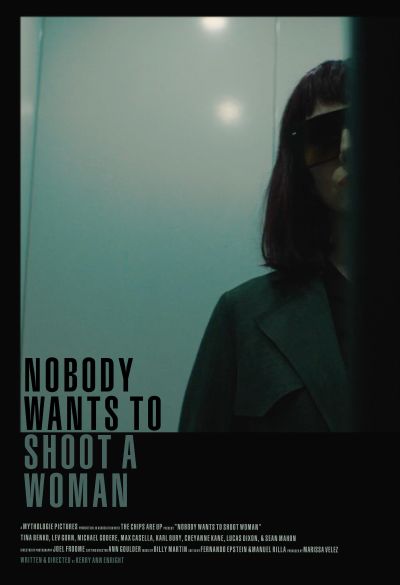 Mary (Benko) moves in to a new Brooklyn neighbourhood, along with her husband, John (Gorn) and teenage son, Johnny. But neither of them are comfortable, the middle-class morality being an ill fit for John’s career as a bank robber. Unfortunately, John has an addictive fondness for gambling, which leads to him being gunned down on their front porch. This leaves Mary excluded by most of the other residents, and in a precarious financial position, unable to find legitimate employment. Eventually, she convinces John’s sketchy associate Sean (Godere), to bring her on board for his next robbery, and Mary discovers a hidden talent for such activities. This brings with it a new-found inner confidence in her everyday life.
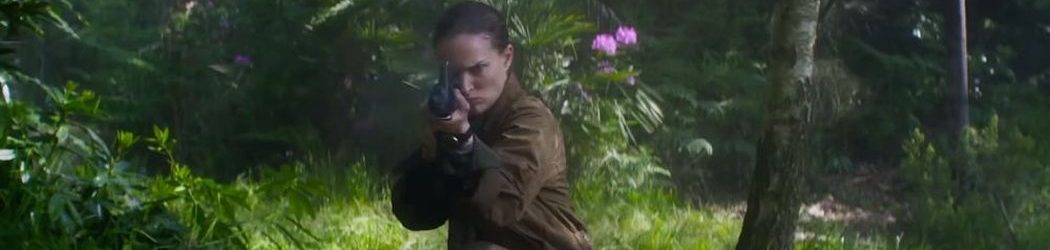
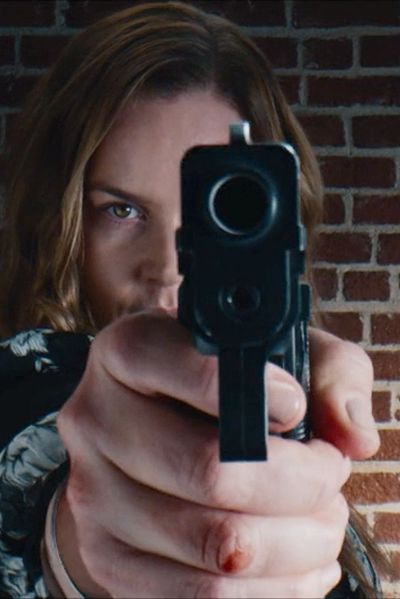 I gave serious consideration as to not covering this here, since it is kinda fringe. The protagonist, Rebecca Kamen (Cornish), spends much of the movie handcuffed. This is not particularly conducive to action. But there are just about enough moments, as shown, where she gets her hands on a firearm, to crawl over the qualifying threshold. Don’t expect much in the way of girls-with-guns action. In fact, don’t expect much, full stop. For as the tagline above suggests, I preferred this the first time I watched it, when it was called The Usual Suspects. It begins with the police investigating a scene involving arson and murder, where one victim attempted to paint a name in their blood on the wall: “Jovan”.
  This one is fairly fringey, in terms of qualifications for the site. But I do feel, any film where a woman picks up and wields a chainsaw with bad intentions… Yeah, that’s pretty much a golden ticket to inclusion. You will have to be quite patient though. Very patient. It begins with a car crash which leaves Magda (De Mol), very much the worse for wear and badly concussed, in a gully off the road. She is rescued by Guy (Breck), an elderly gentleman who lives nearby, and who insists on nursing Magda back to health. However, matters are complicated by some rather dubious people, including Justin (Mills), who are after Magda and/or something in her possession.
  ★★½
★★½ ★★½
★★½ And this will cross Ghana off the list of countries for action heroines, in a charming and rather fascinating little glimpse into African culture. After their mother falls ill, Bibi (Mumin) and Kiki (Makafui), have to raise 20,000 cedi that day, to fund her medical treatment. I presume that’s a lot of money in local terms. After failing to do so by legitimate means, they team up with a dubious pal, Padlock (Asante), to hijack and rob a bus as it rolls through the countryside. There are four rules he tells them they must abide by. Keep to the plan; speed is key; don’t get caught; and… Well, he can’t remember the last one, but it probably doesn’t matter, does it?
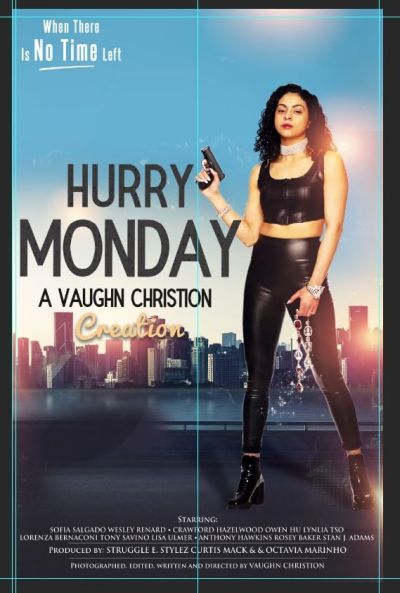 The phrase “blandly competent” comes to mind here. There’s not a great deal to criticize about this, from a technical standpoint. For example, the dialogue is audible, although does vary somewhat in tone, depending on the location. It’s reasonably well-shot, and knows better than to try and go beyond the restrictions of its resources. However, this lack of ambition may be its biggest problem as well, because it’s very intent on colouring strictly within the lines. Smaller-scale films need to push the envelope a bit to stand out, and this instead seems content to go the obvious route at almost every turn. Even the story’s main surprise was not much of one, and provoked little more than a shrug.
 ★★½
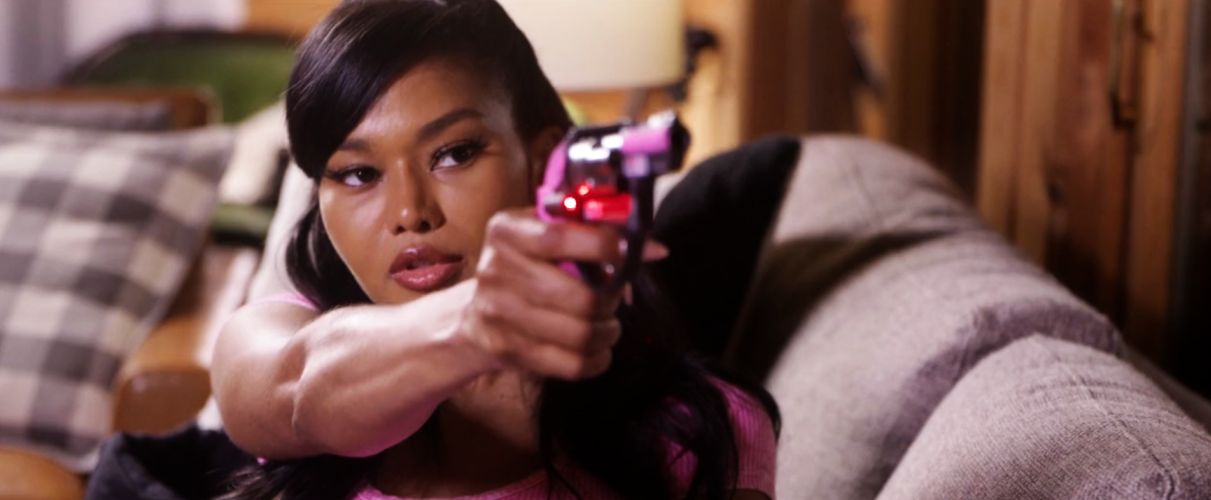
★★½ I think, if you’re going to try and recreate the eighties, it might help if you were there. I was. Co-writer/director Tabet? Not so much. She seems repeatedly to confuse the look and feel of the decade with the seventies. The repeated needle-drop of Sweet song “Fox on the Run” – actually released in 1974 – is the most blatant example. It explains why the results are a bit of a mess. A well-intentioned mess, to be fair, and you can usually see what they are aiming for. However, throwing a character in solely so they can refer to eighties films like Commando and Cobra, is painfully clunky, and is a more accurate reflection of the approach in which this indulges.