




★★★½
“Eeenie Meanie – minor no.”
 I don’t know which is more irritating: a film that isn’t very good, or a film which teeters on the edge of greatness, then botches it. This falls into the latter camp. Writer/director Simmons does a lot right, especially considering it’s his feature debut. But just when my finger was hovering over the seal of approval, the film makes a near-disastrous wrong turn. This happens to a degree I found myself annoyed and impressed in equal measures. The first thing it gets right is casting Weaving, who has quickly become one of my favourite action actresses. Here, she plays Edie, who been driving getaway for her criminal dad since her early teens. Now though, she’s trying to go straight: she has a bank job and is attending college.
Naturally, life isn’t that forgiving. A one-night return to her useless, junkie, intermittent boyfriend John (Glusman) left her pregnant. When she goes to tell him, he’s neck deep in trouble from his latest scheme, which has left him in debt to local boss Nico (Garcia). No problem. John can pay it off by robbing $3 million from a local casino, which will be giving out the money as the prize in a poker tournament, loaded in the trunk of a muscle car. He just needs someone to steal the vehicle and be a getaway driver. Much against her better judgment, Edie finds herself agreeing to help, to save John’s life. But again, fate has no interest in making it easy for her. Various figures from Edie’s past return to run interference, both emotionally and more directly.
Simmons has a crisp ear for dialogue, and there’s a blistering pace from the beginning. We learn quickly about the skeleton of Edie’s dysfunctional upbringing, then how she’s doing her best to escape it. However: you can take the girl from the dysfunction, but you can’t take the dysfunction from the girl. That’s clear when her bank is robbed, and she critiques the criminals’ work: “They made, like, five mistakes before they even hit the drawers.” In motion, this is a beautiful thing to behold, with some solid, crunchy car-chases and action which feels grounded. The problems are the emotional and dramatic elements, which ring horribly hollow. I get John saved her from being pimped out by her foster father. But her loyalty to him doesn’t sit with her otherwise hard-nosed pragmatism.
Worse still is her inexplicable desire to reconcile with her now wheelchair-bound father (Steve Zahn), in a scene which appears to have been spliced in from a Hallmark film. Things get mercifully back on track for the heist and its aftermath, which are thrillingly staged. Just when I was creeping towards the seal of approval again, it can’t stick the landing, with a finale too tidy for its own good. It’s like Simmons fell too much in love with his lead character – something I certainly understand – and pulled a happy ending out of thin air for Edie. Given some of her acts, I would be hard-pushed to say she deserved it, morally. Yet it is another fine entry in Weaving’s filmography, and despite the missteps, far from a bad start for Simmons either.
Dir: Shawn Simmons
Star: Samara Weaving, Karl Glusman, Andy Garcia, Jermaine Fowler
 From what I can tell, Arisen is a massive zombie apocalypse saga, with a heavy military focus, by Fuchs and Glyn James. There are fourteen books in the main series, but Fuchs has also spun off related sets to tell other stores set in the same universe, such as Arisen: Raiders. The Operators series appears to be another. It looks to be intended as a trilogy: at the time of writing (March), part one is out, with part two next month and the finale in 2026. It feels like subsequent installments might be more team-oriented, but part one? Hoo-boy.
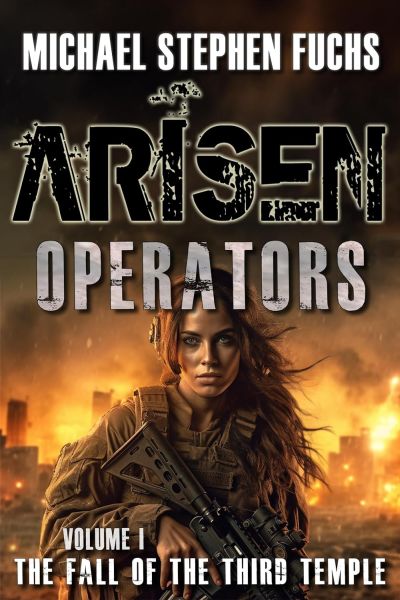 Yeah, this is the first book to ever get a five-star action rating from me. It just doesn’t stop. There’s a sub-genre called “hard SF,” which according to Wikipedia, is “characterized by concern for scientific accuracy and logic.” I suggest this could be labelled as hard action, with a great deal of information about hardware, like guns and vehicles. Here’s a sample paragraph: “The boat itself is a low-observable, reconfigurable, multi-mission surface tactical mobility craft with a primary role to insert and extract SOF in high-threat environments, but can also be used for fire support, maritime interdiction, and VBSS missions, as well as CT and FID ops.” I’m not sure what much of that means. Though I suddenly have a strong urge for a glass of whisky and a cigar.
 On seeing the title and poster (which looks suspiciously AI-generated, and I know
  When you think of the martial art form known as Muay Thai, New Jersey is probably not the first place to come to mind. But it’s in the town of Toms River, on the Jersey Shore, that Prairie Rugilo set up an all-women’s gym with the aim of teaching students Muay Thai. It began as occasional classes she taught in the Brick Police Athletic League, but demand allowed her to set up her own, dedicated space. If you don’t know, Muay Thai is described here as “the art of eight limbs”, which personally, raises more questions than it answers. What are the other four limbs? Was it developed by Thai spiders? Let’s just call it a form of kickboxing, and move on.*
 For a good while, this struggled to retain my interest, and when it did, the problems outweighed the positive aspects. Fortunately, after a solid hour of faffing around in ways that provoked mostly rolling of my eyes, the film found its stride. That’s funny, because it’s a running reference. Ok, not very funny. Down the stretch it both figuratively and literally pushes the pedal to the metal, in quite an impressive manner. My reaction was divided. Part of me wondered, where the heck this was earlier on? However, rather than petering out like a sad trombone, there’s no question it’s better for a film to finish strongly, and give the viewers something positive to take away with them.
  This is distinctly a film of two halves. The first is undeniably more impressive, taking the revenge motif and going in an interesting, and at least somewhat novel, direction. However, not long after the half-way point, the script decides to change direction radically. This leaves behind the grounded entity which we’ve had so far, in favour of something with distinct supernatural tendencies. I’m not averse to these per se. Yet they’re an ill fit with what has gone before, and need to be integrated considerably better. Then, things derail completely for the finale, pulling things out of nowhere to achieve a solution, in a gobbet of exposition that completely lost my interest. So, probably 3½ stars for the first half, 1½ for the second.
  Marni (Johnson) is stuck in the titular town, where oil fracking is causing problems from earthquakes to poisoning the local water supply. She’s barely scraping by as a single mom to teenage son Jason (Strange), working as a bartender for sleazy owner Daryl (McMahan), who has a bad case of wandering hands, and hustling customers at pool. Her life is upended when Steph (Carpenter) comes into the bar, kicks Marni’s ass on the pool table, and the two end up making out in the back alley. When Steph becomes aware of Darryl’s safe full of cash, she suggests they liberate it, to finance a new life for them and Jason, far away from Extraction.
 While this is an excellent and very original premise for a novella series, though, the execution of it here has to be called somewhat lackluster. Lilly’s prose style tends to be repetitive, both in language (and in using character’s names over again where a pronoun would serve her better) and in ideas, with points often being restated or reemphasized in the same paragraph when it’s not needed; she also has a tendency to tell when there would be more effective ways of showing. Some attempt was made at editing, but the proofreading was poor (there are only a few typos as such, but I finally deduced that the three or four bracketed repetitions of a sentence in different words were vestiges of textual corrections that weren’t edited out in the final draft!).
 Indeed, that would make a fine “Matilda Lutz overcomes impalement to take vengeance” double-bill with this. The reboot isn’t bad at all. It certainly is miles better than the eighties version, mostly because of Lutz. She may not be quite as muscular or buxom as the comic-book version. But she does bring the required intensity, and that goes a decent way to making this watchable. The supporting cast are good too, although I was less convinced by the plot in general, which is little more than a grab-bag of clichés. We begin with the quick slaughter of Sonja’s village, then see the adult Sonja (Lutz) roaming the forests of Hyrkania. These are under threat from Emperor Dragan (Sheehan) and his psycho sidekick, Annisia (Day).
  The title above is the one by which it appeared on Tubi, though everywhere else calls it Aggression. I guess both are appropriate, in different ways. Neither shed a great deal of light on proceedings here. Then again, you could argue, the film itself is largely deficient in the area of enlightenment too. It takes place in rural France, where Sarah (Nicklin) has been reunited with her sister Marie (Duchez), after twelve years living in England. The circumstances are not happy, the visit being the result of their father’s death. However, there appears to be a dark past surrounding the circumstances of Sarah’s departure. Meanwhile, Marie is mute, although this does not play into the scenario which unfolds.