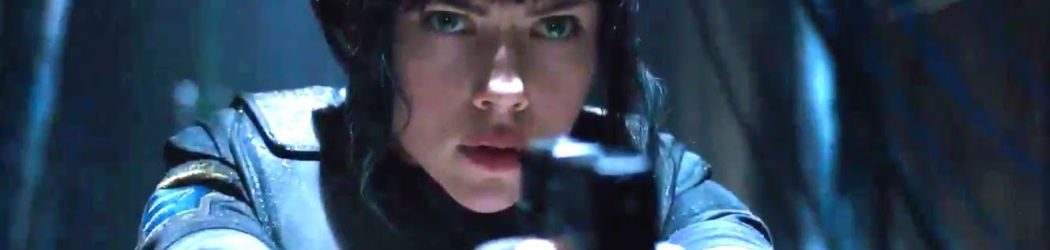

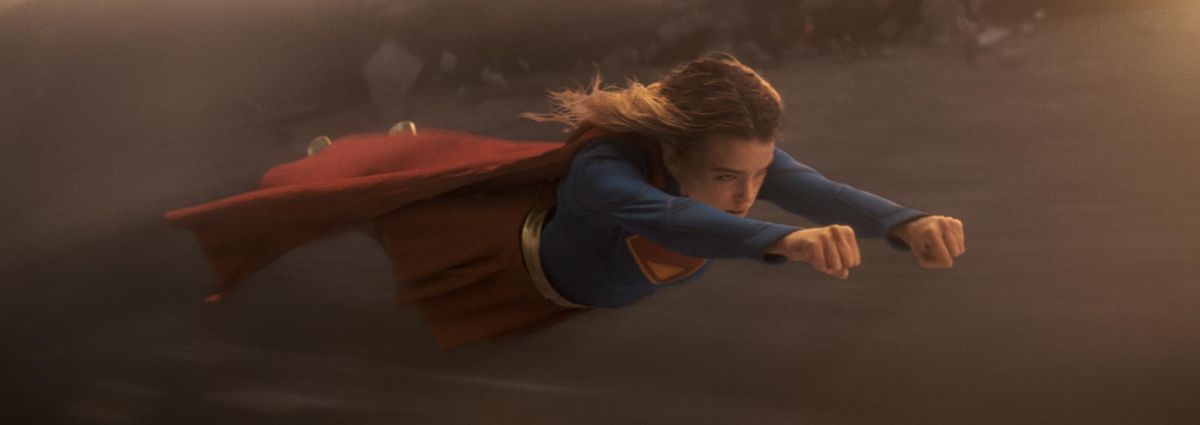
Supergirl (2026)

★★★
“A girl and her dog.”

Watching reviews by some fans for the new Supergirl movie is like seeing someone being publicly tarred and feathered. But I do understand how this works. A review titled “Supergirl is an acceptable, though not great, summer superhero movie” wouldn’t get you many clicks, right? Almost any big studio movie seems to get the same treatment: heavily, negatively criticized; scrutinized as to its wokeness (which admittedly is a problem in today’s film landscape); and judged as garbage, long before the average Joe or Jane has a chance to see the movie and make up their own opinion about it. The numbers of views on YouTube have a clear message: social media thrives on vitriolic hatred, not a balanced attitude. I sometimes get the impression the reviewers have not even seen the movie themselves, arguably rendering their opinions worthless. How can anyone judge a movie that they have not watched?

This isn’t meant to say there aren’t problems today with the way movies are written, directed, produced or marketed. And the other side of the coin are ‘professional’ journalists, who appear to act as media mouthpieces for the industry. They consider every movie by established directors or big studios as great entertainment, glossing over its faults. There is something foul in Hollywood and I don’t want any of it. The big problem is, the average cinemagoer can’t rely on reviews or critics any more, and I think that’s a shame. Yes, any review will always reflect the author’s personal attitudes. But in the cases above, there is no balance, and the respective review is frequently very far from an objective dissection of the film. Let’s see if I can do better: though in any case, you should decide which movies you’ll support with your money – if at all.

Supergirl already got the YouTubers up in arms, when star Milly Alcock made some potentially ill-considered comments, including stating that Supergirl “probably goes both ways” sexually. That was perhaps not smart – unless the marketing department was targeting an audience which was never really interested in the character to start with. Supergirl, created in the late 1950s by Otto Binder, was originally intended as a tamer version for girls, of what Superman was for boys. Nevertheless, the majority of people who read Supergirl and kept the title alive over the decades were young men. She had a rich comic book history before the ill-fated Supergirl movie from 1984, with the lovely Helen Slater. And though DC decided to kill the character off sensationally in 1985’s “Crisis on Infinite Earths”, she made an indirect comeback in several forms, until officially returning as her true self in 2004.

Most of the buyers of her comics continue to be male. Not because “all men are creeps”. But because Supergirl was a cool character – and admittedly, also very pretty. But I have never heard about the supposed “queerness” a reporter asked Alcock about. From what alternate universe did this journalist come? Alcock continued, “What makes this film beautiful is that it’s not centered around a man, it’s not centered around love at all.” To be fair, the love story in the 1984 movie didn’t really work. But it’s a leap to conclude that a movie about a female action character is immediately better because it does not feature a love story. Look at Wonder Woman, where the love story between Diana and Steve was an integral part of the story, and see how well it worked. It’s really up to the screenwriter.

Comments like Alcock’s – though probably given without much thought – put her in the same category as Rachel Zegler, whose remarks contributed to the justified downfall of the live-action Snow White remake. That’s a shame. If a movie is bad, it’s one thing. But if the main star shoots her own film in the foot… The makers of this Supergirl mistakenly thought they had a movie targeting a female demographic of a certain age. The results of the first week indicate that 59% of those watching were male, the great bulk of those over 25. Contrast Wonder Woman, which drew a majority female audience. It’s a remarkable miscalculation. If you annoy the audience, don’t be surprised if it doesn’t show up for your movie. Who knew? Apparently not Alcock, and the financial flop turns out to be entirely studio-made.
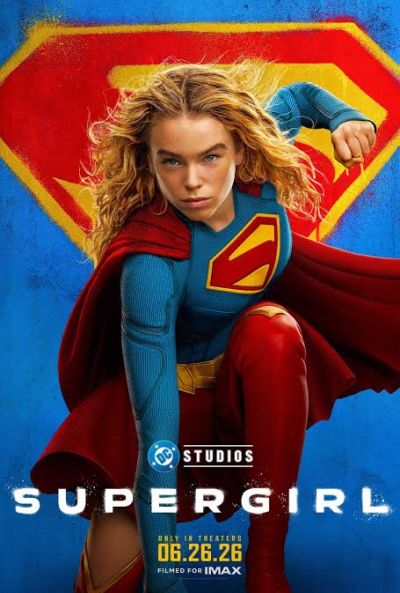
Anyway, what’s the story? Supergirl continues from 2025’s Superman, which in its last scene introduced Supergirl. She is Kara Zor-El, Clark’s cousin, owner of Krypto the Superdog, and together with Clark, the only survivors of the planet Krypton. The Superman movie didn’t show the destruction of Krypton (we have seen that too often on screen in the past) but Craig Gillespie, director of Supergirl, gives us glimpses of it, or flashbacks to Argo City, the city that survived due to SF-technology on a chunk in space. Its inhabitants are nevertheless doomed, due to kryptonic poisoning. So, Kara’s father sends her to Earth, to her cousin who already lives here. The makers generally stay true to Supergirl’s origins, though there is no orphanage into which Superman puts her, nor surrogate parents like the Danvers as in the comics.

However, how it shapes Kara is very different from the original character: this Kara is jaded, cynical and stands in sharp contrast to Clark’s true blue heroism. Even when the movie was in production, she was compared to a “punk rock girl” – more or less the opposite of the original Kara. Obviously, this Supergirl has problems, and in 2026, The Powers That Be have opted out of the traditional image of Supergirl. Separate from any other concerns, it really depends on your acceptance of this new version, and if you are able to enjoy Milly Alcock in that role. Her interpretation has as little in common with the original character, as Daniel Craig’s had with the original James Bond. That this version of Kara would not follow the traditional values was already apparent on the official poster that replaced the famous Superman-Reeves statement “Truth, justice and the American way.” with “Truth. Justice. Whatever.” You either accept that or you won’t like the movie at all.

Supergirl is accompanied by her pet Krypto – still a super-annoying, not very realistic-looking CGI-dog. She celebrates her 23rd birthday in an intergalactic bar, then more or less accidentally gets involved with a 13-year old girl, Ruthye (Eve Ridley). Her parents were killed by the evil Krem of the Yellow Hills (Matthias Schoenaerts). Ruthye wants revenge but Kara is not interested in helping her. That is, until Krem pops up and poisons Krypto with an arrow. As she has only 3 days left until Krypto will die, Kara follows Krem with Ruthye, whom she just can’t shake off. I have to be honest; this is not much of a story. I’ve heard the movie went through different test screenings with audiences, and suspect a lot of what was originally in it ended up on the cutting-room floor. Which I’m generally in favor of, because I don’t really enjoy seeing 160 minutes long superhero movies. But here it felt as if the movie was kind of an emergency patchwork.

Why the flashbacks to Argo City, given we didn’t need any of Krypton in Superman? Yes, it might help frame Kara as a trauma survivor, since she watched her people die, slowly and painfully. But did we need the inserts of Superman (David Corenswet), save for audiences caring more about him than the new Supergirl? Why does bounty hunter Lobo (Jason Momoa) suddenly appear in the movie, only to quickly disappear from it again? Why is there an entire sequence with only Ruthye and Lobo in prison, while Kara is off, recovering from the effects of a green sun? I think Warner Bros. saw a potential flop in the making after test screenings, and tried to save what they could. Reducing the length (= more showings); bringing in Corenswet, whom audiences reacted quite positively to last year; and adding Lobo, a long-time DC comics fan-favourite.

The fact that the production had three different music composers over time, does not reflect well on it. That said, the music of Claudia Sarne, the composer the production finally settled with, is adequate: I liked it. But Gillespie obviously felt (or was forced?) to follow James Gunn’s way of using music: underlay an action scene with a cool rock song. Gunn has been doing this since his first Guardians of the Galaxy movie in 2014, and the result here is even less convincing than in his Superman last year. I yearn for the classic music of a John Williams (1978’s Superman – The Movie) or Jerry Goldsmith (1984’s Supergirl).

The big problem here – apart from the re-interpretation of Supergirl – is that there is little at stake. Kara wants to save her dog. Ruthye wants revenge, though the actress is never really able to deliver this convincingly, coming across as a little brat. Lobo just wants the bounty for someone’s head – and not even Krem’s. When I go to the movies to see a superhero movie, I expect that someone saves the world, prevents global annihilation, or at least brings order to the criminal underworld of Gotham. This movie feels very small because the ambitions of its protagonists are very small. I could at least understand why John Wick went berserk over his dog; I don’t feel an emotional connection here. The villain Krem is evil and… well, that’s it. He feels like lazy screenwriting. Villains should have an attitude, their own worldview, a philosophy, a big objective. Krem doesn’t have any of this. Yes, there is sex trafficking, which seems to be what Krem does. But we never get a good explanation for why or what purpose. Hitchcock once said, “The more successful the villain, the more successful the picture.” The mediocrity of its villain reflects negatively on this movie. 

The end is also more than questionable: Supergirl repeatedly tells Ruthye she should not take revenge, because this is not the way, she won’t feel better after it, yadda, yadda, yadda. But then Kara takes revenge on Krem, making her appear a hypocrite. Also, I think heroism usually, albeit not necessarily, comes with a sacrifice. If Kara would have had to give up Krypto for some bigger purpose, e. g. saving all the girls captured by Krem, the story might have had a much bigger impact. Bonus: I would finally have gotten rid of this obnoxious CGI dog. Honestly, I despise him so much and don’t think he is cute at all. But be careful what you wish for; they might replace him with Streaky the Supercat!
There are editing and creative choices that baffled me. Instead of showing a bar brawl with Kara, the camera focuses on Ruthye in front of us, hiding from the fight. Mind you, in action scenes, the camera often gets so close we can barely tell who is fighting whom. In one flashback Clark tells Kara her powers will set in “right now” – and we cut away to another scene of Kara sitting in a room listening to music on her headphones. A couple who wants to trade Kara and Ruthye for their kidnapped daughter, poisons Kara – how did they know that their poison would work on her? In another scene in a prison, small, lightly-built Ruthye takes on a henchman around double her size, possibly four times as heavy, and easily beats him. There is no explanation given how she does that. While Kara isn’t physically big either, we know what kind of power Kryptonians have. But Ruthye?

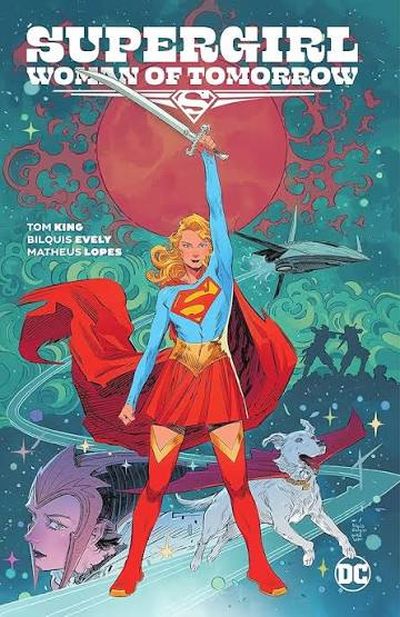
Some people have pointed out that the colour palette of this movie is mainly brown, dark or garish and I agree with them. While I personally didn’t have a big problem with it, I do prefer more colour in my superhero movies. This film was based on Supergirl: Woman of Tomorrow (left), by Tom King. While I haven’t read this myself, most reports say the movie has little resemblance with the original comic and changed its ending. Although the comic itself was an “Elseworlds” story, so you could argue it’s not really representative of Supergirl. All quite negative, right? Why am I then not as harsh as the YouTube fan critics mentioned above?

First of all, I still found the movie entertaining, despite all its flaws. That doesn’t sound much, but believe me, there are many movies out there which are either plain boring or don’t even try to be fun. Case in point: the week before, I saw The Death of Robin Hood with Hugh Jackman. Supergirl is far from perfect but at least it tries. Milly Alcock is indeed fun and a good actress. I figured what direction “her” Supergirl would go, when she was cast. I had seen her as a relentless rebel girl in Australian series Upright, and a larger audience discovered her in the first season of House of the Dragon as Rhaenyra. She has and is a great talent: while this movie doesn’t do her justice, she could have a great career in the right roles.

Eve Ridley does her best as Ruthye, but the part doesn’t offer much and she was not really convincing in it. The idea here is obviously that Ruthye is a counterpoint to Supergirl, creating a conflict between different objectives. It kind of works, though, I would have preferred the movie without an annoying teenager who constantly repeats herself like an NPC, and is little help during the search for Krem. Jason Momoa has been the fan-choice for Lobo, as long as there have been plans for a Lobo movie. Though this version seems a tame, “free from 12 years on” version, he is very enjoyable. I really, really would like to see a single movie with him as the Czarnian bounty hunter. But the new DC film universe under the current Warner Bros. management is already imploding. Again.

There are moments I like. If you can accept the idea of Kara being a more complex, work in progress (the ending suggests she may finally settle on Earth and support Clark), then that may help you enjoy the movie more. This Kara has a quite cocky attitude which sometimes made me chuckle quite a bit. At the same time, Alcock can bring the gravitas to more serious scenes if she is given those. To repeat myself: it’s all in the writing. I have to say, I expected more from Craig Gillespie, who directed the great I, Tonya a couple of years ago. But directors are dependent on the scripts they are given. A lot of the creative decisions concerning the movie (such as Supergirl killing Krem), were apparently made by Gunn, not Gillespie who seems more the “yes”-man of the production.

I understand screenwriter Ana Nogueira had never written a real movie before which is astonishing considering that it is said to have a budget of $170 million. It also seems questionable that she has already been chosen by Gunn to write upcoming DC movies Teen Titans and Wonder Woman. It’s estimated that the movie needs to make $300 million to cover its costs. At the time of writing, it’s a lot less than half that, only $116 million worldwide, and is losing screens rapidly. That doesn’t bode well for the movie. Though, it has been said that Gunn has further plans for Supergirl, as she plays a part in the next Superman-themed movie Man of Tomorrow – this time hopefully at her cousin’s side. Let’s hope, it’s not once again centered around the insufferable Krypto!

Dir: Craig Gillespie
Star: Milly Alcock, Matthias Schoenaerts, Eve Ridley, Jason Momoa
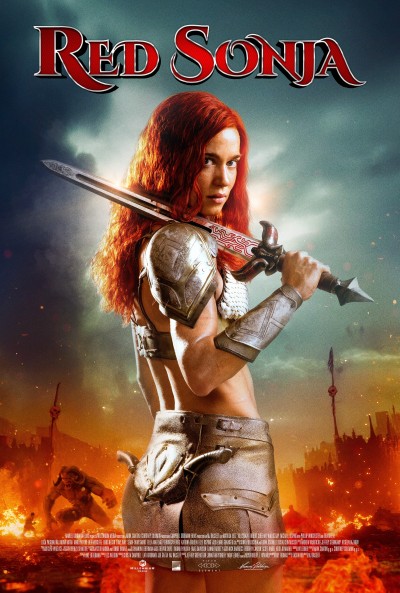
Red Sonja (2025)

★★★
“Better red than dead?”

It has been forty years since the first crack at adapting the Marvel comic series, in turn inspired by Robert E. Howard’s character, Red Sonya of Rogatino. The first stab, released in the wake of Conan, starred Brigitte Nielsen, and was pretty bad. There have been rumblings of further attempts over the years, with a Robert Rodriguez version, starring Rose Macgowan, gaining traction in the late 2000’s. Though given the dreck in which Macgowan has appeared, it’s probably for the best this never came to fruition. Instead, we have a lower profile – read, smaller budget – version from director Bassett, who previously gave us mercenary Megan Fox, and lead Lutz, who was totally awesome taking her Revenge

Indeed, that would make a fine “Matilda Lutz overcomes impalement to take vengeance” double-bill with this. The reboot isn’t bad at all. It certainly is miles better than the eighties version, mostly because of Lutz. She may not be quite as muscular or buxom as the comic-book version. But she does bring the required intensity, and that goes a decent way to making this watchable. The supporting cast are good too, although I was less convinced by the plot in general, which is little more than a grab-bag of clichés. We begin with the quick slaughter of Sonja’s village, then see the adult Sonja (Lutz) roaming the forests of Hyrkania. These are under threat from Emperor Dragan (Sheehan) and his psycho sidekick, Annisia (Day). 
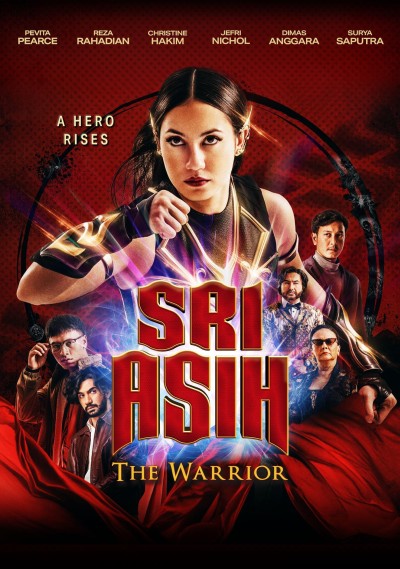
After being captured, Sonja is made to fight in gladiatorial combat. She helps the other captives escape, and they fight a guerilla war to prevent Drakan from obtaining the other half of a mystical tome which has great power. Sonja is almost killed by Annisia – the impalement mentioned above! – but brought back by Ashera, the forest goddess, to face her enemies again. Pretty rote fantasy stuff, in other words. It’s the stuff around the edges that is more fun and, beyond the lead actress, is where the improvement is biggest over the Nielsen version. 

I enjoyed the arena scenes, which felt like Spartacus with monsters. Always nice to see Rhona Mitra (Doomsday), though her role is briefer than I’d like. I also liked Day, whose portrayal of Annisia is entertainingly unhinged, like a psycho version of Lady Gaga. Her relationship with Dragan doesn’t play out as I thought, and I would have preferred more places where the script confounded expectations in this way. I was a little disappointed by the fights, which aren’t as hard-hitting as I expected. Although they feel workmanlike and competent, the hits only seem to have much impact on a couple of occasions. Some editing might have helped: 110 minutes feels longer than necessary.

On the other hand, for a reported $17 million budget, it looks decent, and Bulgaria offers some impressive backdrops on which to paint things like the largely-CGI arena. There are occasional moments of self-effacing humour which help, such as the scene where Sonja gets her battle bikini. The end clearly wants a sequel: however, the very token cinema release (one midweek screening in theatres!) suggests the studio had little faith in it. A pity. I’ve definitely seen much worse, and would welcome further tales of Hyrkania. 

Dir: MJ Bassett
Star: Matilda Lutz, Robert Sheehan, Wallis Day, Luca Pasqualino

Sri Asih: The Warrior

★★★
“No Marvel: and that’s okay.”

Turns out that Marvel and DC are not the only ones creating “cinematic universes” based on comic book. Another example can be found, perhaps surprisingly, in Indonesia. This film is part of the Bumilangit Cinematic Universe, and is a follow-up to 2019’s Gundala. I haven’t seen that, but I’m 99% sure that the scene in the end-credits is a direct cross-over to that, featuring its hero, given the apparent prediction late on of a team up to come between him and Sri Asih. Otherwise, though, this stands on its own, and you don’t need to have seen Gundala, or be familiar with the comic-book series about Sri Asih, created by R.A. Kosasih, and first published all the way back in 1954.

This is the third incarnation of the character, which was also first seen on the screen in 1954, in a now lost Indonesian movie of the same title. In this version, we begin with the birth of Alana during a volcanic eruption, in which her father is killed. Brought up by her mother, Alana is highly talented in martial arts, but has problems controlling her temper. After she fails to throw a fight as arranged against rich playboy and serial abuser Mateo Adinegara, he sends his men to beat up Alana’s mother, and the situation then escalates. Someone kills Mateo and his father, industrialist Prayogo Adinegara (Saputra) vows revenge. The result ends up triggering Alana’s transformation into her final form, the reincarnation of fire goddess Sri Asih.

Which is convenient, because someone is trying to carry out a ritual to obtain ultimate power, a process which require the sacrifice of a thousand souls. With the help of cop Jatmiko (Rahadian), who teeters between honesty and corruption, and childhood friend Tangguh (Nichol), now a journalist, Sri Asih has to figure out what’s going on, and stop the ritual. It’s all earnestly naive in an adorable kind of way. There’s a touching faith in journalistic integrity, and also lines like, “If you are unable to learn how to defeat your anger, it’s only a matter of time before it defeats you.” Occasionally this does topple over into clunkiness, such as when someone late on literally says, “I just remembered <key plot point about the thousand soul sacrifice>” Really?

However, if you can buy into the tone and go along with it, you’ll have a good amount of fun. It certainly does not feel like 134 minutes, which is more than can be said for some Marvel or DC product, though this is somewhat less highly polished. I do wish the fight scenes had been less CGI heavy: the impact is considerably more when Sri Asih and her opponents are knocking chunks out of concrete pillars than when she’s flying unconvincingly through the air. The best thing about Indonesian martial arts is the hard-hitting aspect, and that only intermittently comes through. It does have a cheerful “can do” attitude that’s endearing, and I’d not mind checking out further installments. 

Dir: Upi Avianto
Star: Pevita Pearce, Reza Rahadian, Surya Saputra, Jefri Nichol

Gehenna: Naked Aggression, by Patrick Kindlon and Marco Ferrari

Literary rating: ★★★★
Kick-butt quotient: ☆☆☆☆½

“What I need is stories where men get kicked in the chest. Stories where guns only run out of ammo for dramatic effect. I need pulp. I need exploitation. I need fun.”  I used to read a lot of comics, before moving to America. As in, most weekends involved a trip to Forbidden Planet, Gosh!, or Mega City Comics, coming home with a carrier bag of new issues. Then there were the trips to Paris… But I just kinda stopped – no particular reason – when I emigrated. There is still a large cardboard box, unopened from the move 25 years ago, in our boxroom. Some are probably worth a bit, e.g. the first issue of Hellblazer. But reading the first issue of Gehenna makes me want to restart. Well, if space, time, money and aging eyesight weren’t issues, anyway.
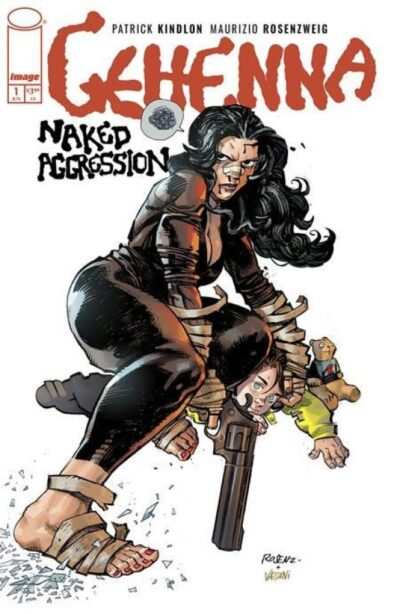
“This book is equally for the diehard comic reader and someone who hasn’t read sequential art since Garfield,” according to co-creator Kindlon. I’m certainly closer to the latter category, but certainly found it accessible, once I got into the comic-book rhythm again. It’s different from word-based literature, and even from cinema, where the pace is dictated entirely by the director. In a comic-book, you can linger over a panel to admire the artwork for as long as you want, or whizz through them so you’re basically picking up subliminal imagery. The text becomes a complement to the imagery, filling in the gaps. And the imagery is great. I now have a new backdrop on my PC desktop. Page 18 of the PDF, should you be interested. 
“Everything went to hell. And now that’s where I live.” But this also means exposition and action can co-exist: the latter doesn’t need to pause. Consequently, over the 24 pages here, there’s barely a pause for breath. You reach the end, to be honest, not necessarily sure what’s going on, but this is just part one of four. I presume things will become clear – or, at least, clearER – in due course. We have a dark-haired woman, kidnapping the son of a gangster because of reasons apparently connected to her husband’s death – leading to the quote above. There’s another woman, blonde, following in her wake – with bad intent if her line, “I’ll call you when the woman is dead”, is anything to go by. I will bet the house that they will end up facing off against each other, before very long. I certainly hope so. 

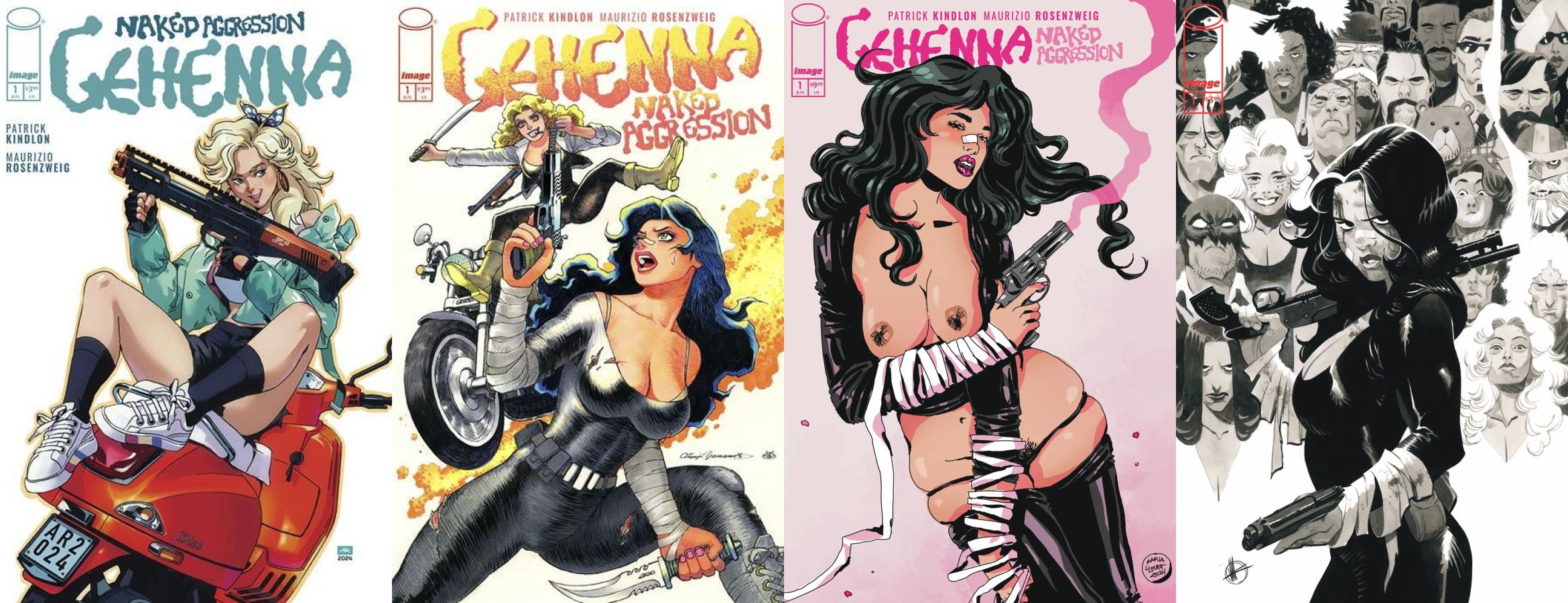
“It’s pulling from Beyond Hypothermia and Naked Weapon, and all of Hong Kong,” says Kindlon. So far, Naked Aggression has been more about the aggression than the naked – though cleavage certainly abounds, and an alternate cover (below) does deliver. It is difficult to judge the series overall, in the same way as giving your verdict of a film based on its opening twenty minutes. We’ve all seen movies which hit the ground running, only to run out of steam. But there’s no reason this shouldn’t be able to sustain the blistering pace: it’s not like a comic-book is going to run out of budget. If we weren’t looking to move house, this might well be the one to entice me back into the comic-shop. Failing that, I’ll just have to wait for the movie version, hopefully starring Eva Green and Charlize Theron. 

Author: Patrick Kindlon (text) and Marco Ferrari (art)
Publisher: Image Comics, available through their site, from July 2, or for Kindle through Amazon.
Book 1 of 4 in the series, also available in four alternate covers as below.

Catwoman: Hunted

★★
“A cat-aclysmic cat-astrophe!”

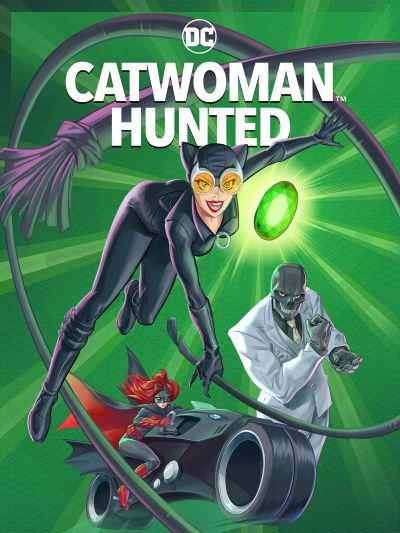
Catwoman: Hunted is a 2022 DC animated movie. Here is a little confession: Catwoman alone never worked for me. In combination with Batman, there is that special chemistry, a feeling that makes the character work but alone? Nope! Neither in the comics with her solo title, nor in a movie solely focused on her (Catwoman with Halle Berry still makes me tremble… but not in a good way!) does this character function for me. A burglar dressed in a cat-suit? No, actually that comes across for me as old-fashioned (do thieves that climb up houses still exist, today?). Strangely, whenever the character appears on the screen contrasted with Batman, it works.

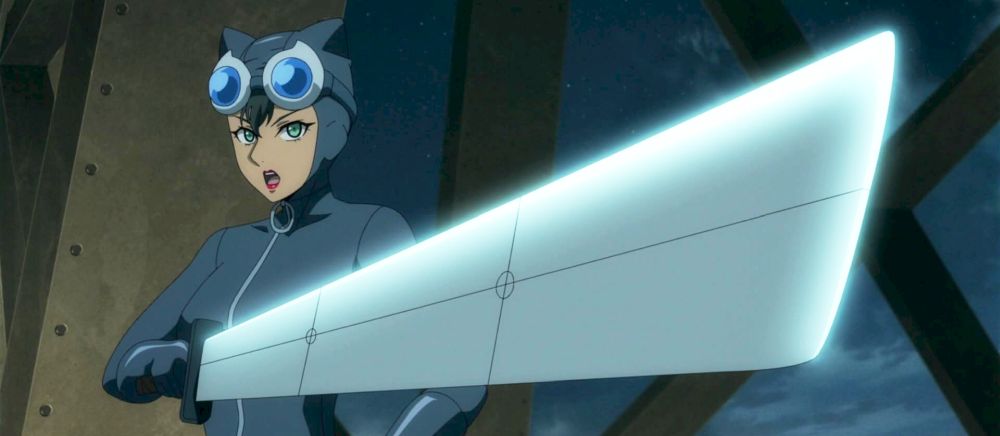
Anyway, it doesn’t stop people from trying to give the most famous Cat-orientated character of the DC universe further solo adventures. In this movie, Selina Kyle appears in classical dress at some kind of cosplay event. Everyone is dressed either as a DC hero or villain: she is next to Batman villain Black Mask in her classic 1940s costume, only to later switch into her modern sexy suit and steal a diamond. Unfortunately, she is discovered and hunted by the Leviathan crime syndicate that set up the party. The diamond was Black Mask’s entry fee to the society. Catwoman is saved by Batwoman who kind of forces her to do… well, what? Kind of spying on Leviathan. Once again being discovered – for a thief she is really not that successful – she and Batwoman must face several opponents…

What sounds as if it could be an interesting story, turned out to be a very disappointing movie. I had to watch it twice because even though the film is a short 78 minutes, I almost fell asleep. The introduction to the story feels clumsily handled, scenes are overlong, and after we know where the story wants to go, the movie basically is a constant follow-up of fight scenes of Catwoman and Batwoman against a range of well-known and lesser known DC villains. These include Cheshire, Nosferata (one I had never heard of before, and I used to read DC comics quite regularly in my youth), Solomon Grundy and the Cheetah herself, Barbara Minerva who is Leviathan’s chairwoman, though Talia al Gul is managing everything from the shadows.
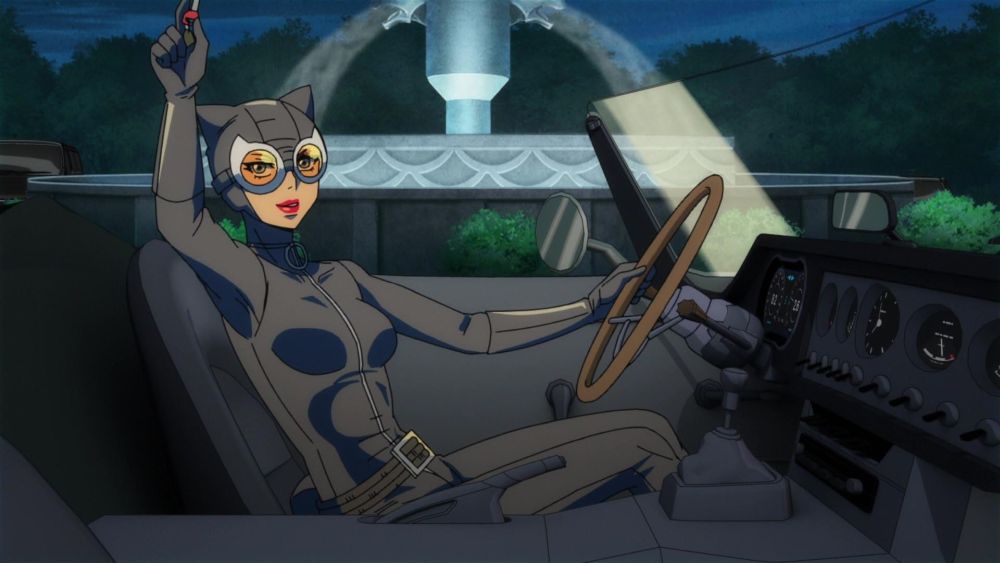
It feels as if someone threw as many characters, mainly female ones, into the script as possible, perhaps to hide the fact that Batman isn’t in the picture. But they don’t necessarily have the knowledge how these characters usually act. That may be partly the fault of director Shinsuke Terasawa (Wikipedia lists the movie as a Japanese-American production; maybe Warner’s wanted to save money?) but the script also has structure problems. What I’d call act one wasn’t finished until half the film’s running time was over. And the script doesn’t develop any further from this point on. You’re left to wonder what the big plan was, or what Catwoman was supposed to do, but this question is never answered. The remainder is a bunch of fight scenes, heaped on each other until this is finally over.

The script is by Greg Wiseman, whom I personally admire for his wonderful, unfortunately underrated, Disney animated classic series Gargoyles from the late 90s. He also was involved in animated series such as The Spectacular Spider-Man and Young Justice, a series that also has its fans, despite flying under the radar. But here he seems missing the right feel for the established DC heroes and villains.

Take the Catwoman of this film for example. We all know how this character should be played, though there are different interpretations of the character on the big screen over the years. This Catwoman comes across as downright awkward and arrogant to the hilt. We know of Catwoman’s erotic flirtations with Batman, but here she is “in heat” the whole time which just feels wrong. I know how it sounds but this Catwoman feels… well… oversexualized. And just because she has a thing for Batman doesn’t mean you just can switch this behaviour to Batwoman. Yes, we know Batwoman is nowadays a lesbian, since this side-character from the Batman comics of the 50s was resurrected in modern times. But that doesn’t mean that she must almost be seduced by Catwoman. Then Catwoman drops the ball again, as if the whole point of the scene was just about showing us how incredibly irresistible she is to everyone. Thank you very much, female self-esteem!

More than this – and difficult even for me, who usually accepts some very unbelievable things in story-telling – this Catwoman seems almost to have superpowers. I have no problem having her, teamed with Batwoman, fighting the assassin Cheshire, against whose poison she had earlier taken an antidote, or Nosferata, who reminded me of a female version of classic character Man-Bat. But the two fighting and beating 50+ assassins of the League of Shadows? No. Just no. Sometimes it borders on the ridiculous. When Catwoman shoves a bundle of explosives in Solomon Grundy’s mouth and tells us: “That’s all folks!”, I wondered who had the marvellously stupid and tonally deaf idea of referencing Porky Pig in a DC movie! It just feels tonally wrong.

Another ill-fitting decision is the score by Yutaka Yamada. Don’t get me wrong. His music will probably please you if you like jazz, but for a DC action movie it’s just the wrong choice. What almost – but only almost – saves the movie is the final chase when Barbara Minerva turns into an oversized version of her Cheetah personality and goes after Catwoman. For the first time in this movie you have the feeling Catwoman is in real danger. But this is too little too late. It can’t compensate for all the mistakes that had been made in the movie before.
Don’t take the above too hard; someone unaccustomed to DC or Batman comics might actually enjoy this. For me, someone who knows and loves the characters, it felt like a gigantic misstep by the creative team who made this film. And I still can’t help the feeling that it would have been a much better movie if Batman had been the main character, having to deal with an opposing Catwoman. The best thing here was a 40-minute extra on my Blu-Ray, about the history of Catwoman in comics, TV and movies. That was really interesting. The main feature… not so much!

Dir: Shinsuke Terasawa
Star (voice): Elizabeth Gillies, Stephanie Beatriz, Kirby Howell-Baptiste, Zehra Fazal 

Supergirl (1984), on its 40th anniversary

★★★
“Revisiting the original Maid of Might”

Before Supergirl: Woman of Tomorrow arrives on our screens in 2026, starring Milly Alcock from House of the Dragon in the title role, I thought, it would be a good time to revisit the original Supergirl movie, which was released in the United States forty years ago this month. So what is Supergirl? A campy trash/cult classic? A fine, forgotten superhero movie? A guilty pleasure? A lame forgettable flop of the 80s? Hopefully, after reading this review you’ll be able to make your own, well-informed judgment!

Originally, the character of Superman’s cousin was supposed to appear in Superman III, but after a new script was written, the character was moved to her own movie. Alexander and Ilya Salkind, the producers who had given Superman life on the big screen in form of Christopher Reeve, probably thought they might score as big with Supergirl as they had with the first two Superman movies. Unfortunately, when Superman III came out in 1983 it was heavily criticized, and fell well below financial expectations, which caused Warner Brothers to give distribution rights to the Salkinds, who would sell it to Tri-Star.

It may not have been the best move, for it seems the film got little marketing (though did get a royal premiere in Britain), and was also sharply edited down. It’s a bit difficult to be certain how many versions of the film exist, but three are well-known: 1) The theatrical cut that runs a bit over 90 minutes. 2) The international version, also called “European theatrical”, though that did not come out in German cinemas. 3) The so-called director’s cut of 138 minutes, which is overly long, especially by 80’s standards. Nowadays, you’re happy when a big movie doesn’t exceed the 2-½ hour mark. How times have changed!

The box-office also ended far, far below expectations and resulted in the Salkinds selling their rights to make any further Superman-related movies. Which is… kind of regrettable, I think, because this movie is not half as bad as it is usually made out to be. I’ll go into its obvious flaws later. But what is the story about? Introducing Supergirl to the film world was not so easy. After all, we had all seen Superman’s home world Krypton blow up in the original movie. But the film actually followed, without really explaining how scientists did it, the original comics which introduced Supergirl in 1959. Argo City, home of Kara Zor-El’s (Slater), was saved from the catastrophe that befell Krypton and in the film survived in “inner space”, whatever that might be – today we would probably call this another dimension.

Here, Kara lives with her parents, other families and scientist mentor Zaltar (Peter O’Toole). The parents are played by Mia Farrow and Simon Ward in cameos; obviously the producers wanted to give Supergirl the same support, with famous or well-known actors, as they did for the Man of Steel. After losing the Omegahedron, the power source of the city, Kara follows it via unexplained Kryptonian technology to our Earth to bring it back. Unfortunately, evil wanna-be witch, quack doctor and esoteric Selena (Dunaway) has taken it with plans to conquer the world. Their mutual interest in young gardener Ethan (Bochner) and Kara’s need to conceal her real identity, going by the alias of school girl Linda Lee, complicate matters further.

From that summary, you should be clued in to what the movie is. It’s a loose repackaging of the Superman story; though some aspects are different here, at the core it’s the same. Maybe this was one of the reasons why the movie failed to attract audiences. But the story and some characters chosen for it come with problems too. While Superman could still be seen as science fiction, Supergirl seems more like a fantasy movie. While Clark Kent’s continuous attempts to dupe Lois that he is Superman were used in the original two movies to wonderfully hilarious effect, this aspect doesn’t appear here at all.

Then again, how could it? Supergirl has just arrived on Earth, differently to Superman. Christopher Reeve’s Superman was originally heavily involved in the script but Reeve politely declined; maybe he didn’t want to play second fiddle to someone else? So the script was rewritten, with Superman on a “special mission” in another galaxy. Neither her room mate – who happens to be the younger sister of Lois Lane – nor Jimmy Olsen, the only character from the Superman movies to appear, know her, so there can be no “A-ha!” moment. Nor can love-struck gardener Ethan see that the brunette school girl he was just talking to, is also the blonde girl in the super-dress. Whoever wrote this should get a “D-” in basic logic. At least Superman changed totally in behavior and wore glasses when he played Clark Kent. Here, there is no believable excuse for it.

The film has other problems. One is a lot of unnecessary characters that are neither needed, nor add anything essential to the plot. It’s especially apparent with actors probably cast for their comedic talents. Peter Cook, often well-matched with Dudley Moore on stage and film, might be a good comedian but is totally unfunny here. The same goes for Brenda Vaccaro as Dunaway’s sidekick: compare her to Ned Beatty’s Otis, alongside Gene Hackman, and you’ll see how ineffective Vaccaro’s role is here. I’ve already mentioned Lucy Lane and Jimmy Olsen. Why are they here? What do they add to the story? Do they do anything that has an impact?

Trimming should have happened in the writing phase. If they would have eliminated, reduced or at least given these characters something of meaning to do in the plot, the movie might have been much better. Additionally, there is a side-plot of female bullies picking on Kara, seeming only to serve the purpose of showing that Kara has the same heat-vision as her cousin. Other strange decisions were made by the screenwriter, and slid past the producer and director. When Kara lands on Earth the first people she meets are two drunk, wannabe rapists who try to molest her. Hurray for feminism, I guess, as Kara shows them that a Kryptonian teen can defend herself. It’s an ill-fitting scene in a movie apparently intended to be family- and kid-friendly. Wonder Woman 1984 also had such a stupid, distracting scene. So either there is something I  don’t understand, or film directors and screenwriters have not learned much over the four decades between the movies!

Also, the “love story” between Ethan and Kara is essentially a “non-love story”. His love for her is induced by Selena’s magical potion, who wants the man for herself. If the first person Ethan saw after waking up had been a cow, would he have fallen in love with a cow? The length of the movie was already criticized when it originally came out, even though it was shorter at the time. And the version that I knew from seeing the movie in the late eighties on German TV was even shorter. You can hardly expect a movie, of whatever quality, that has been edited down so much to still make much sense at all.

It’s no surprise O’Toole and Dunaway were nominated for Razzie Awards, though it’s not all their fault. Obviously, director Jeannot Szwarc had no problem with Dunaway going as campy as she wanted. It’s a pity because her role could have been convincing or even menacing, played straight. There is no doubt Dunaway, with a fine reputation of playing difficult characters, could have given a good, villainous performance. Heck, she already played a first class femme fatale in the Musketeer movies for the Salkinds in the 70’s. Of course when you go camp, you can hardly blame Dunaway for trying to repeat what Gene Hackman successfully did as Lex Luthor, But you have to be really funny, something that worked for the Hackman-Beatty pairing but not here.

O’Toole has only two significant scenes in the movie, at the beginning and the end. His performance in the first seems a bit uninspired and odd. I wouldn’t be surprised if he was drunk while doing it; the actor was famous for this, like Richard Burton or Oliver Reed. The second, where Zaltar seems to have given up all hope and sacrifices himself for Kara, is quite well done and touching. Although a strange decision was made in the German dubbing, where someone came up with the idea of casting the German voice of Clint Eastwood for him!

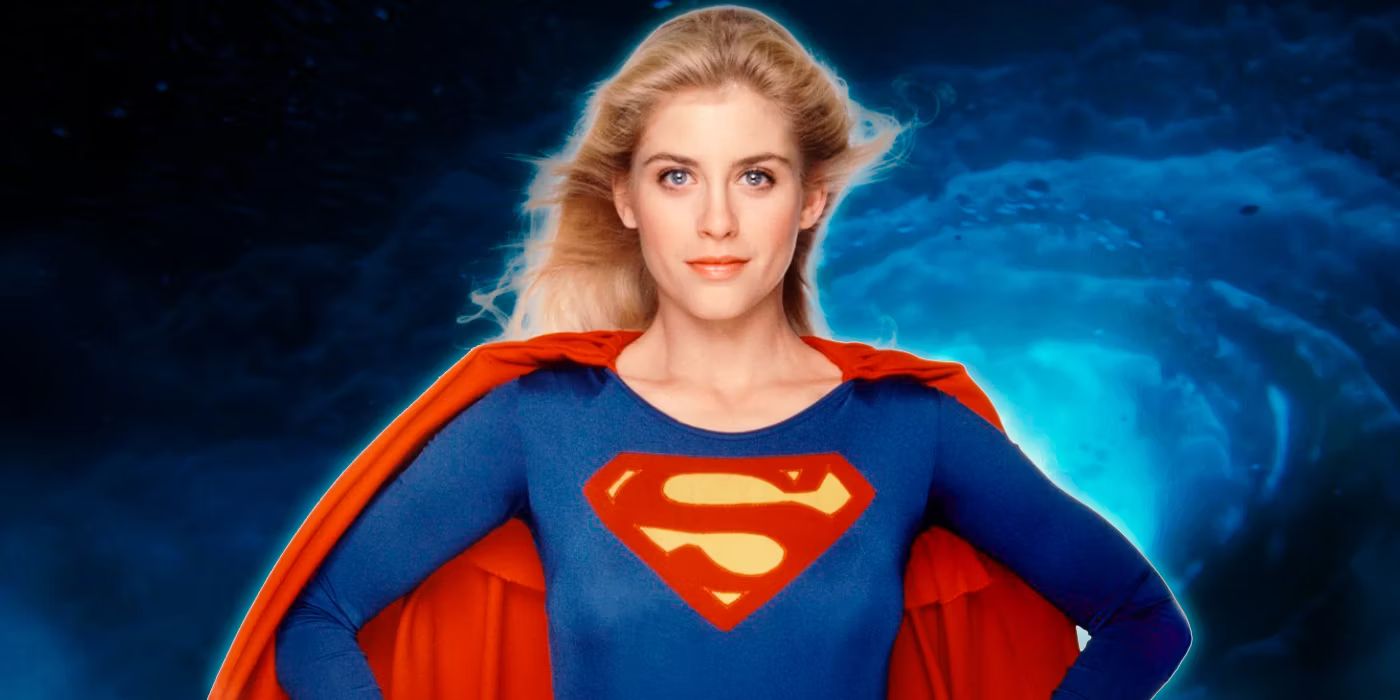
For all the negatives I have listed, there are quite a few positives, shining bright in this movie pursued by bad luck. Helen Slater probably gave the performance of her career. She is really, really good playing the female version of the true-blue hero, as well as the innocent-looking big-eyed teenager in Argo City, and her cute school girl role of Linda Lee. Slater was even nominated for a Saturn Award for her performance. If the film had been better – or at least financially successful – maybe she could have had a similar career to the one Christopher Reeve enjoyed due to his Superman role? Alas, it wasn’t to be…

The special effects of the film may look dated today – and they are. But considering all of it was before the advent of CGI, digital and computer effects, it’s impressive what could be achieved by in-camera-tricks, visual illusions, miniature and composite effects. Sure, a lot of effects could be simply generated on the computer today. But even a cardboard photo cut-out of Supergirl, drawn quickly out of the water, is astonishingly effective and can only be recognized for what it is today, due to DVDs and Blu-Rays. How do you show Supergirl almost torn to pieces by a monster in 1984? At that time all the filmmakers had were some distortion effects by a changed perspective – nevertheless, it works, and there are some very nice effects.

As kitschy as it seems, I personally loved the aerial ballet of Supergirl when she arrives. For the first time too, we get to see the Phantom Zone: it’s constantly mentioned in the Superman movies, but here it is actually a set in Britain’s Pinewood studios (used for many Bond movies), and must have been one helluva work to create. Selena’s traps and the shaking, fiery ground are impressive, as are her manipulations in the abandoned event park. My favourite effect might be Kara fighting an invisible monster which you only can recognize by its impact on the environment, e.g. giant footprints on the ground, breaking fences, etc. This seems directly inspired by the classic “ID” monster from Forbidden Planet.

All in all, the effects were as good as possible at the time, so shouldn’t be judged by today’s standards. The film in addition boasts great production design, luscious exterior shots, a well-timed tractor-on-the-loose action sequence, appropriate and good-looking costumes (especially for Dunaway), all of which are undeniable pluses. Then there is the – as always – great Jerry Goldsmith score which makes up more than half of the movie’s atmosphere. It’s especially impressive, considering I could hardly imagine anyone else being able to step in the shoes of John Williams, who scored the original Superman score.

Supergirl is still not a great comic book superhero movie. Nor a bad one: more somewhat mediocre, but kind of sympathetic. As mentioned, the movie had bad luck, being both too late and too early. Too late, as it seems audiences had started to grow tired of the whole Superman circus: within six years people had been exposed to four Superman-related movies. The “All-American” hero had become kind of passé with Schwarzenegger, Stallone and co. introducing the new, harder and gritty anti-hero who would dominate the screens for the next decade. Alternatively, you had more goofy heroes like Eddie Murphy in Beverly Hills Cop or the Ghostbusters. A simple, straightforward hero didn’t fit into this time anymore.

But the movie might have been too early as well. At that time, audiences were simply not interested in female comic book heroes as flops like Red Sonja, Sheena and Brenda Starr proved again and again. Even a further attempt in the early 2000s with Elektra, Catwoman and the like failed. It’s only recently that movies like Black Widow, Captain Marvel or Wonder Woman are really scoring big at the box-office. This was also before the “girl power” era. In the late 90s and early 2000s, with TV shows like Charmed, Buffy, Xena, Kim Possible and movies like The Craft, Mean Girls or Legally Blonde, a movie about a school girl fighting an evil, powerful witch could have scored big – but well… not in the 80s!

So… maybe “Supergirl” was just a bit ahead of its time. Judge for yourself.  What about my interest in the movie? Well, I saw photos of it in film magazines, years after it was in cinemas. At that time the movie had not been shown on TV and my family had no VCR yet. All I had was some photos and my imagination to tell me what the movie might be about. For me the film belongs in the category of enjoyable fantasy movies of the 1980s together with fare like The Neverending Story or Highlander. That photo of young Helen Slater with her clenched fist, flying with the glowing sun in the background, still hangs on my wall! So I may be a bit biased concerning the film. But aren’t we all regarding our favourites?

Dir: Jeannot Szwarc
Star: Helen Slater, Faye Dunaway, Hart Bochner, Peter Cook

Knuckle Girl

★★★
“Punches below its weight.”

This film is based on a Korean webcomic, but has been relocated to Japan. I can’t help wondering if something was lost in the process, because it feels like I should have liked this more than I did. Ran Tachibana (Miyoshi) is a promising amateur boxer, who gets devastating news when the body of her sister Yuzuki is found inside a burned-out vehicle. The cops call it suicide and quickly close the case. Except Ran doesn’t believe the corpse is Yuzuki, and begins to investigate what might have happened. The search leads her to an underground fight club run by the brutal Nikaido (Ito), who is holding Yuzuki hostage. He makes Ran an offer: beat his undefeated champion, and he’ll let Yuzuki go.
Naturally, it’s not as simple as that, with Nikaido reneging on his word. Fortunately, Ran has help in the shape of bike mechanic Kamiya (Maeda) and hacker Naruse (Hosoda), who help her go after Nikaido and take down his operation. There’s also concerns on the criminal side, with Nikaido’s bosses feeling he’s a loose cannon. It all feels too much to cram into a single movie, and I suspect it might have been better served in the form of a TV series. As is, elements like Yuzuki’s “magic blood” don’t appear to have much purpose. They seem there purely so fans of the comic will go “Oh, yeah!” and make little or no sense to casual viewers like me.

I think it’s probably a case whee less would have been more in terms of plotting. Keep it simple, perhaps removing side characters like Kamiya or Naurse, and focus just on Ran infiltrating the fight club and working her way up through it. Sure, it wouldn’t score points for originality, but it might have sustained my attention better. As is, in between the action, I must confess this sometimes struggled to retain focus. Considering the obviously non-trivial amount of resources that went into the production, it’s a shame they didn’t put as much effort into the story. For this undeniably looks spiffy, with the underground arena, in the shape of an eye, well-designed, and I liked the over-perky pair of MCs as well.

But I’m here for the fights, and these were… decent enough. I appreciated that the film acknowledged the heroine’s lack of size, and explicitly discussed how she would need to use her speed and agility to beat larger opponents. That’s true, even with the equalizer of knuckle-dusters, given to her by Nikaido to even up the betting odds a little. Miyoshi only had a few months training, but it’s likely easier to train an actress to fake fight, than a fighter to fake act, and it’s adequately convincing. But there are really only three or four sequences in the whole thing, with the story having to rush past most of them, because it has to deal with all the other elements. It’s all okay, I suppose, yet definitely feels like a wasted opportunity.

Dir: Hong-Seung Yoon
Star: Ayaka Miyoshi, Gôki Maeda, Hideaki Ito, Kanata Hosoda

The Marvels

★★
“Bombs away!”

Like it or not, the history of action heroines is littered with commercial failures. Cutthroat Island set the gold standard for a long time, but there have been many others, from Barb Wire through to Mulan (no – the other one…). The reasons for their failure varied: sometimes the film was at least partly to blame; sometimes, it was external factors. But last year, The Marvels took things to a new height. Not just the biggest bomb of the year. Or even the biggest bomb in girls with guns movies. While Hollywood accounting will always leave such things uncertain, The Marvels may well be the biggest loss-maker in film history. It had a production budget of $270 million, which doesn’t take into account marketing or other post-production costs, and took in only about $206 million worldwide. Take off things like the cinemas’ cut, and the loss for Disney and Co. is estimated at a staggering $237 million.

Why did The Marvels fall so hard? To be honest, discussing that is perhaps more interesting than talking about the film itself. Not that it’s terrible. There are movies where, you see three minutes and are left wondering, “What the hell were they thinking?” and whose failure was inevitable. Cats, for example: even as something of a connoisseur of bad movies, I’ve not been able to bring myself to watch more than clips. The Marvels is not on that level. Sure, it’s not very good, and we will get to that. But it’s no worse than other movies from the Marvel and DC Cinematic Universes. Line this up with Morbius, Suicide Squad and Madame Web – I’d defy someone without prior knowledge to point the finger at The Marvels as being the worst-ever bomb.

I think a whole slew of factors went into its failure, beyond the quality of the movie. As we saw recently with Furiosa: A Mad Max Saga, even good films can tank abysmally. Here, in no particular order, are the elements I think were involved:

  • Superhero fatigue. After Avengers: Endgame, interest and ticket sales could only go down.
  • A sequel to a film no-one wanted. Sure, Captain Marvel did well. But it was certainly helped because it came between Infinity War and Endgame. She is not anything like an iconic character.
  • A run of underwhelming Marvel entries. Thor, Black Panther, Ant-Man, Guardians of the Galaxy. All made less than the preceding films in those franchises, and were less well received critically. At some point people will just stop watching.
  • General downtown in cinema going. The pandemic whacked the legs out from box-office returns, and people haven’t come back. In this case, perhaps related to:
  • Quick release on streaming. It was available on Disney+ less than three months after hitting cinemas. Anyone on the fence would be forgiven for thinking, “I’ll just catch it at home.”

It’s worth mentioning a couple of reasons I don’t think had much impact. Some suggest the actors’ strike handcuffed the film, preventing the stars from doing publicity for it. Others blame a backlash against women-led movies. But neither of these seem to have affected other entries. For instance, you might have heard of this little woman-led film called Barbie? It did okay, or so I’ve heard. You don’t need to invoke conspiracy theories to explain The Marvels‘ failure. The fact it’s taken me, a devoted fan of action heroine movies, more than seven months to get round to watching it, probably tells you all you need to know.

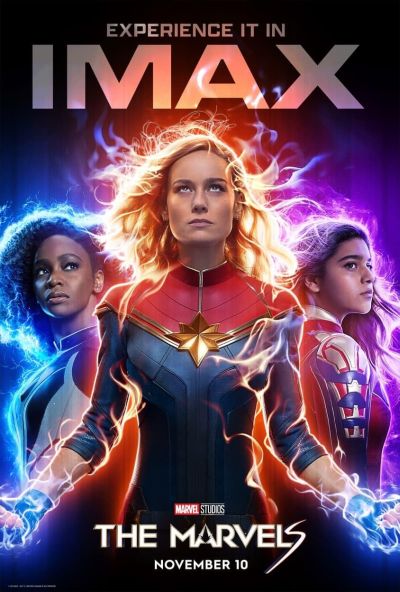
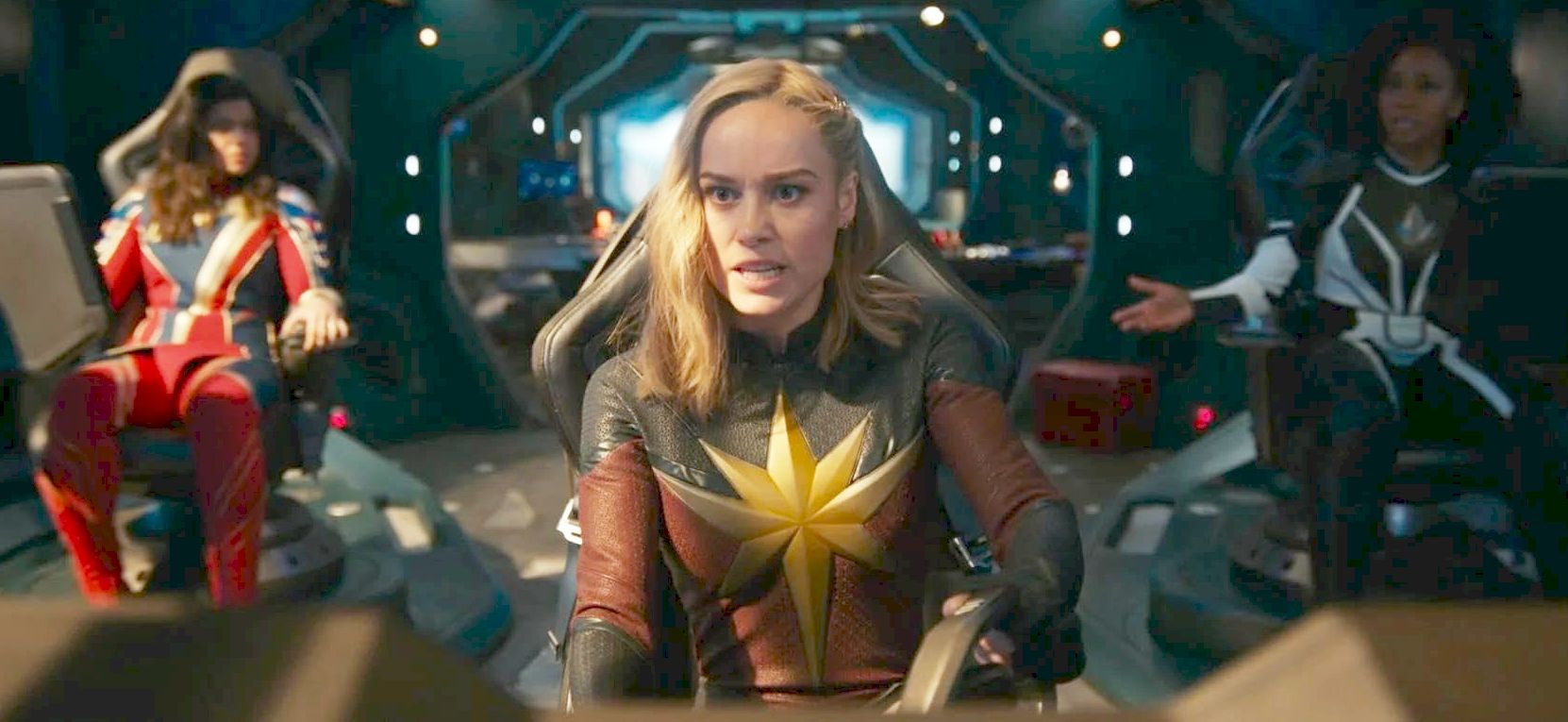
So, let’s get to the film, which sees three action heroines for the prices of one! How can you go wrong? Well… As well as Carol Danvers, a.k.a. Captain Marvel (Larson), there’s Monica Rambeau (Parris), whom I last saw as a little girl in Captain Marvel, so I guess several decades have passed since then? Like so much here, don’t expect an explanation. She apparently got superpowers after some “Hex” thing, and can manipulate electromagnetic radiation. There’s also Kamala Khan (Vellani), Ms. Marvel, who is a dedicated Captain Marvel fan-girl, but has powers courtesy of a magical bangle. However, the other bangle is in the possession of Dar-Benn (Ashton), leader of the Kree who intends to use it for malicious purposes. Because reasons, Danvers, Rambeau and Khan swap places with each other whenever they use their powers, which complicates trying to stop Dar-Benn.

I’m not prepared to swear to all of the above, since the film makes the assumption I have seen the related TV shows WandaVision and Ms. Marvel, which fill in the background of both Monica and Kamala. I have, in fact, not. This, combined with my general apathy about the MCU, left me frequently confused and/or uninterested in the finer points of whatever was going on. The lack of internal characterization present here which resulted from it, left me not caring very much about anyone – especially Khan, who seems like an annoying teenager, shoehorned in purely to appeal to other annoying teenagers. [Memo to Marvel: make movies to appeal to a minority, and only a minority will find them appealing] Rambeau isn’t much better, and Danvers just seemed like your basic, overpowered superhero.

Most of the running-time – and, at least, it’s relatively short, not much more than 90 minutes before the closing credits start – is spent bipping around the galaxy, going to places the film presumes we know, and meeting people we are supposed to recognize. I would say, the budget shows up on screen, and the action is decent, especially when the three heroines figure out how to team-up properly. But it tends to have the same problem as in Captain Marvel, where the fights frequently feel so artificial as to be lacking in impact. The only sequence which genuinely entertained me had the crew of a space-station pursued and eaten by feline-shaped extra-terrestrials, while Midnight from the musical Cats plays. It’s utterly glorious. Shame it is also so totally at odds with the po-faced approach generally taken elsewhere, which leaves little or no impression at all.

To be honest, I’d rather have five $50 million movies than one costing $270 million, and if this brings an end to the fondness for ridiculously over-priced Hollywood movies, it’s a price I’m willing to pay. It’s a shame it will, almost certainly, have a negative impact on our genre, because we’ll be forced to hear again that nobody wants to see action heroines. That’s not the case, of course. But if you spend more than a quarter-billion dollars and this underwhelming result – complete with, inexplicably, musical numbers – is all you can manage, it’s not hard to conclude something needs to change.

Dir: Nia DaCosta
Star: Brie Larson, Teyonah Parris, Iman Vellani, Zawe Ashton 

Madame Web

★★★
“Adventures in Babysitting.”

Having read quite a number of articles on (p)reviews for this movie and now having seen it myself, I’m beginning to think you can buy negative reviews to torpedo product that might compete with yours. I’ve seen this before, e. g. when the press tore down John Carter so that The Hunger Games could become the defining blockbuster franchise of the decade. Or when it became very obvious Disney had ties to RottenTomatoes.com: the Internet may recall this as the “Great Captain Marvel online war” :) It seems this takes place in particular with comic-book or superhero movies not from Disney/Marvel. It happened regularly with the X-Men movies, when 20th Century Fox still existed as an independent studio. It happened when the – admittedly, very often not so good – DC movies came out: neither Black Adam nor Aquaman 2 were as bad as the reviews made them.

And now, it seems to happen with “Sony’s Spider-Man Universe” (SSU). That the quality of these vary greatly is not in question. Of course they do. While the Spider-Man films with Tom Holland are beloved by fans, and seem to be well-regarded by critics, things don’t look so bright for the extended universe Sony is building. The first Venom movie with Tom Hardy was torn down by the media, but cheered by the cinema-going masses; the second was similarly split. Then Morbius with Jared Leto got almost entirely negative reviews and that trend continues with Madame Web. Things don’t look good for Kraven the Hunter, another entry in the universe due out later this year.

I’ll be honest and admit it: Madame Web is not a great cinematic revelation, it’s definitely not the “must-see” superhero film of the year and probably won’t blow your socks off. But – and this is where I feel I get justifiably angry – “not great” is not the same as “bad”. I’m coming to the conclusion you can’t trust sites like Rotten Tomatoes, and you shouldn’t read reviews before you watch. A movie review (and this counts for mine too) can’t tell if you will like a movie or not. Follow your instinct and make up your own mind, that’s my friendly advice to the dedicated film-goer. This is not to say Madame Web is perfect entertainment. But I will defend it against anyone saying it is a “bad” movie. You may call it bland, boring or mediocre if you like, but that’s not the same. I’ve seen enough bad movies in my lifetime to know, bad looks very different.

So, what’s up with Madame Web? The film starts in the South American jungle, where pregnant scientist Constance (Kerry Bishé) seeks a specific spider for its medical uses, but is killed by assistant Ezekiel Sims (Tahar Rahim), who wants the spider for himself. Apparently – though it is never explained how – he uses it to become a wealthy and still astonishingly young looking man (this prologue happens in 1973, than jumps to 2003, so he should be around 60?). The so-called “spider people” can’t save Constance, who was bitten by a spider before giving birth, but give her daughter up for adoption.

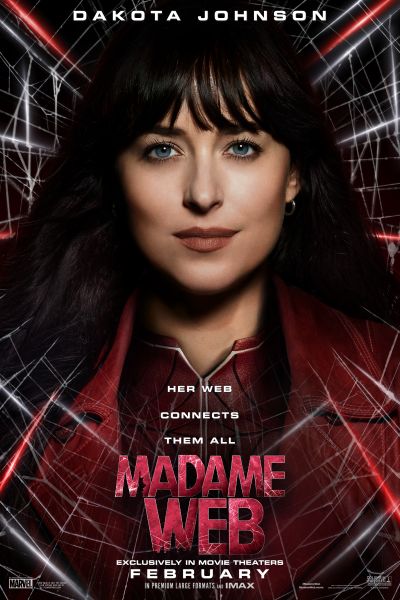
Jump forward to 2003. Cassandra “Cassy” Webb (Johnson), Constance’s daughter, is a paramedic who saves lives everyday, but is strongly averse to emotional attachment. I wondered what she does in her leisure time – but then, the same could be said about me! After being drowned, dead for three minutes, and revived, she has visions which turn out to be clairvoyant; she can glimpse the future moments before it happens. After experiencing the death of a colleague, she realizes she can act to stop her visions taking place. [What a revelation!] While on a train she foresees the death of three girls, killed by a masked man with superpowers. She tries her best to save them; no easy job as she has to improvise and out-think her pursuer constantly, while taking care of young girls who don’t necessarily follow her orders. That’s the moment you realize this movie might be made with 30-year-old moms as its target audience, which is something I have not seen before on the big screen.. Kudos for originality, I think.
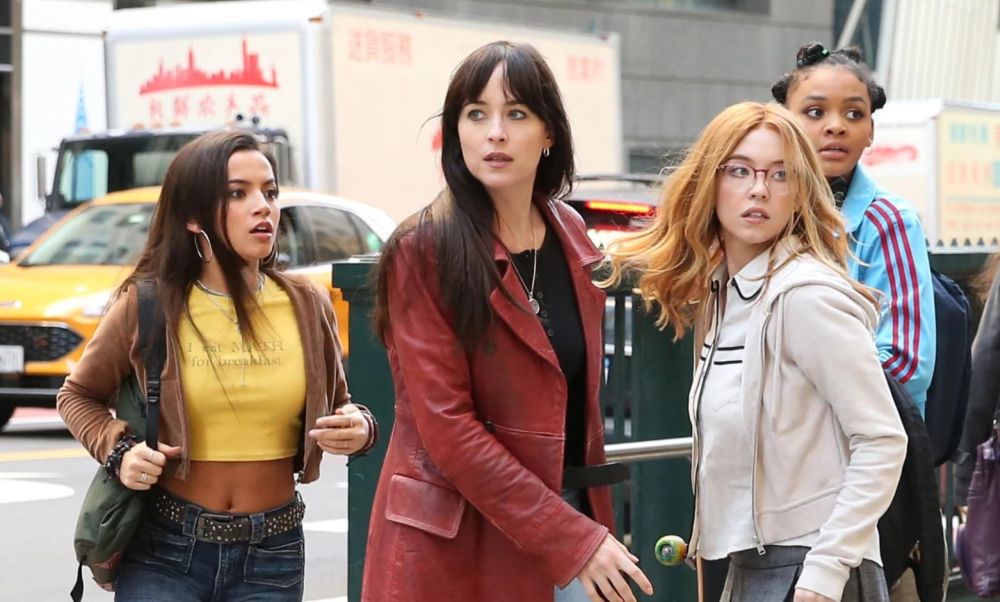
Some changes from the comics were obvious. I’m no expert on all things and characters around Spider-Man but last time I saw Madame Web, was a 90’s animated series where she was an old, blind woman in a wheel-chair, She controlled the web of time and sent ol’ Spidey on a mission. This film goes full circle, having Cassie at the end in a wheel-chair and wearing dark glasses – enough time to age, when she needs to appear in a Spidey movie playing 20-something years in the future. Also, the three girls who will be Spider-Women and -Girls of the future (played by Sweeney, O’Connor and Merced) are not really characters I know. Having had a thing for the Spider-Woman comic an eternity ago, I remember that Mattie Franklin was white and the niece of J. Jonah Jameson. Here she is black and her background has totally changed. I guess the aim is to be as diverse as possible.

I personally don’t mind a movie centered on female characters in the Spider-Man universe. Heck, for decades I’ve been waiting for a Black Cat or Silver Sable movie, though right now that prospect seems quite dim considering the reaction here. But having this movie precede the Tom Holland Spider-Man does give me the feeling this is another attempt to give a hero’s tale a backstory based on an earlier woman (as done terribly by British TV classic Doctor Who). That said, this movie is not “woke”. Yes, the villain is a man but there is no male-bashing or ridiculing, as has become so common nowadays e. g. by Disney. It just puts female characters at the focus of the story and that’s absolutely okay by me.

What did surprise me is the main protagonist. Madame Web is neither one of many charismatic villains the Spidey-universe offers, nor what I’d call a “hero”. Making her the center of the story is a gamble, with the need for a scenario where she becomes the main character. Which the screenplay does quite well, I’d say. It would have been easier to make a movie about the Spider-Women or Spider-Girl, but here we are. Also, the title character has no super-powers which are interesting to watch. She can’t crawl up walls, jump from roof to roof, or has super-strength. She can just see a bit into the future. That’s it, until the end when she develops the ability to be in several places at once to help her girls (yeah, it’s definitely a movie for moms!). It means the screenwriters really had to think hard to provide the necessary action. and have their protagonist use her wits to counter her opponent, who unfairly uses early face-identifying computer programs to find the three girls.

A word on the actors. Dakota Johnson (daughter of Don Johnson and Melanie Griffith, granddaughter of Tippi Hedren) has long left the memories of her early Fifty Shades of Grey success behind her. She is a good, professional actress and I’ve never seen a bad performance from her. This movie is no exception. The “girl” actresses don’t register strongly here; their characters are hardly given much to do here, which can be considered a weakness of the script, except being kind of a pain in Cassie’s neck. Tahar Rahim as the villain, comes across a bit bland which might not be the actor’s fault – the character is just not very interesting. His main goal is to stop these girls, who may become dangerous for him later. Ironically, as Cassie realizes, it’s exactly this fear of the future which leads to his downfall here and now, at her hands.

Once again, I stress Madame Web is not a bad movie. It may be too long – though less than some of the bloated blockbusters Hollywood produces nowadays. It could have a more interesting villain, with better motivation. They could have chosen a more interesting main character. But if there is one real problem with all the new SSU movies, it is the lack of humor. A bit of it, integrated into the heroine’s or villain’s character, would go a long way in making a superhero movie a more entertaining product. But maybe that’s not the route Sony wants to go, perhaps to distance themselves from the style of Marvel. It would be regrettable: a surprise hit like Venom showed how that element is appreciated by audiences. If you give them drama, action and suspense, they must also have the chance to let go of the tension with laughter. An approach classic James Bond movies employed, to good effect, at the beginning of the action movie genre.

All in all, the movie, its direction, script, acting performances, etc., are solid. Not great. Also not terrible. It is an acceptable solid superhero comic-book movie, though the superhero thing comes across here as toned down. Just don’t expect the big typical blockbuster epic that too many people may nowadays associate with the genre. Who knows? If Sony continues in this manner maybe they can actually get their SSU to work for the large audience? If not, I imagine they can still put all of these newly released characters in the next Spider-Man movie with Tom Holland!

Dir: S. J. Clarkson
Star: Dakota Johnson, Sydney Sweeney, Isabela Merced, Celeste O’Connor

Jailbait

★★★
“Old for her age.”

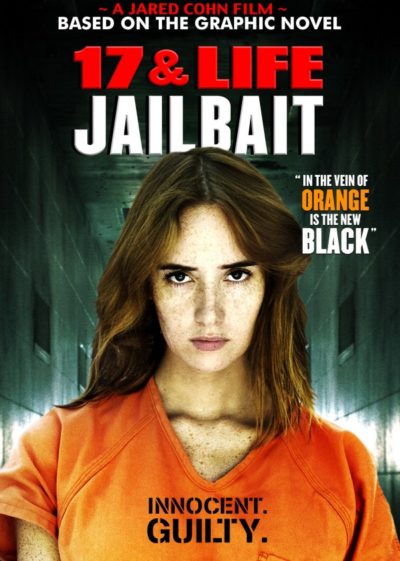
Of all the scathing reviews this has accumulated on Letterboxd.com, I think my favorite is the one which starts, “Obviously written by someone who knows absolutely nothing about the penal system.” Yes, seriously. I strongly suspect things like this were written by people who know absolutely nothing about women-in-prison films, and who inexplicably managed to overlook the title of the damn movie in their expectations. Me, I had initially overlooked this, believing it to be just a retitling of the same director’s Locked Up, a glorious slab of WiP insanity. When I discovered it was actually a different movie entirely. it went quickly to the top of my pending pile.

While an earlier work, and it’s clear Cohn is still honing his exploitation craft, this is still a fine slice of modern B-cinema, Not least is the casting of Lane, at that point in her thirties, as “teenager” Anna Nix. This certainly does not hang around. Inside five minutes, including opening credits, she has killed her step-father as he tries to be molest her, been tried convicted and sentenced to 4-9 years behind bars in juvenile detention. Only a few seconds later, we get our first of many looks at the lead actress’s spectacular breasts: artificially augmented, yet top tier work. It’s not long before there’s lesbian sex with her cellmate Genie (Jacobs); abusive sex with sleazy warden Frank Baragan (Hanks); drugs, first smoked, then injected; solitary confinement while naked; and coercion from Kody (O’Brien), the leader of the Low Riders prison gang, who says Anna must join them or face the consequences. Followed, eventually, by more lesbian sex.

In other words: everything you would expect from the genre. Of course, if you go in expecting Orange is the New Black – and, let’s be honest, making that comparison on the poster (above) was… unwise – then you’re probably not going to be happy. Me, though? I went in, looking for something along the lines of Locked Up, and will be checking “Satisfied” on my customer survey. Sure, the only thing less convincing than Anna’s teenage credentials is probably her cello playing (don’t ask), while both script and performances appear to be there, only because Cohn was told they were required elements in a feature film. This is me not caring.

To my surprise, the “Based on a graphic novel” claim is actually legit. I wondered what the creators thought when they heard the rights to their work had been bought by infamous studio The Asylum. Then I saw the cover of issue #1. I suspect the reaction was likely, “Cool! Where’s the cheque?”, and also that the resulting adaptation is a faithful one. Of course, this is a penal establishment where a SWAT team is immediately ready to rush in at the drop of a shiv, yet inmates are allowed to shoot up openly in the prison yard. It’s utterly ridiculous, and complete nonsense. I wouldn’t have it any other way.

Dir: Jared Cohn
Star: Sara Malakul Lane, Erin O’Brien, Steve Hanks, Jennifer Robyn Jacobs