
★★½
“Post-apocalypse, talk will still be in abundant supply.”
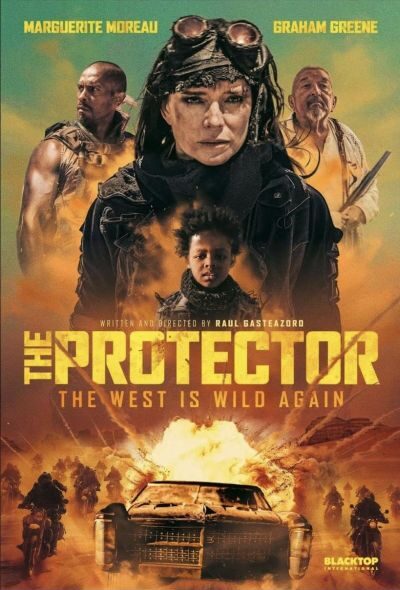
[Note: not to be confused withProtector] The year is 2042. A plague knows as The Rot has decimated the land, and those who survived it are in a precarious state, with the water supply having almost run out. There is one source left: an underground aquifer which has enough water for a century. Needless to say, its highly coveted, but access to it has been cut off by the native American tribe under whose land it sits, with the road heavily mined by Chief Brand (Greene, in what must have been close to his final role before passing away). Warlord Gael (Aryeh-Or) lets Key (Moreau) out of jail, knowing she has a map through the minefield and can give him control of the aquifer.
But, wait! There’s more! Because another issue facing society is mass infertility, with children almost non-existent since The Rot. Key finds herself acting as guardian to one rare kid, Kellan (Lane) on her journey. Oh, and there’s also a mad pastime called “Dirt-Joust”, which is like jousting, only with hot-rods replacing horses – it appears fuel is not hard to come by – on which the combatants ride on the bonnet. It’s not a career choice with a pension plan, shall we say. To be honest, it’s a shame we didn’t get to see more of this sport, since the scene we do get is kinda rad. But then, doing so would have only been possible by cutting out the many, many scenes of chit-chat.
That’s the main problem here, I found. The obvious point of comparison is Mad Max, and in its female protagonist, particularly the new iterations of the franchise, such as Fury Road. However, there, the plot was basically there to act as a delivery mechanism for jaw-dropping action scenes. Here, it’s as a vehicle for moral lectures, pontification and general conversation. It feels as if writer-director Gasteazoro did not understand the assignment, or the rules of the sub-genre. It’s a shame, because there are elements here which work. Not the least of which is Moreau, who looks the part of a world-weary heroine who has had it up to here, and carries herself well, on the rare occasions when she is called into action.
The film also looks pretty nifty. I haven’t been able to find out the budget: it likely wasn’t a huge amount, yet unlike things like Road Wars: Max Fury, it rarely if ever looks cheap. Some wobbly CGI flames are about the worst element on offer. , It instead feels like the film is mostly intended to be a vehicle – pun not intended – for Gasteazoro’s liberal views on a variety of topics, from ecology, through the rights of indigenous people, to same-sex marriage. I would venture to suggest that a post-apocalyptic film might not be the best route to change minds and influence people on these subjects. Give me ninety minutes of dirt-jousting instead, and I might be prepared to listen to you.
Dir: Raul Gasteazoro Star: Marguerite Moreau, Aryeh-Or, Mark Lane III, Graham Grene
Mamoru Hosoda is one of the senior figures in Japanese animation, with thirty-five years of experience since he joined Toei Animation in 1991, after graduating from college. He made his feature debut with One Piece: Baron Omatsuri and the Secret Island in 2006, though this came only after he had almost directed Howl’s Moving Castle for Studio Ghibli. He subsequently left Toei, to go freelance, and his works since have met with both critical and commercial success. Mirai was nominated for an Oscar in 2019 as Best Animated Feature – the first non-Ghibli film to be so honoured. 2021’s Belle , loosely inspired by fairy-tale Beauty and the Beast, was the second-biggest movie at the Japanese box-office that year, domestic or foreign.
His latest movie and the follow-up to Belle, Scarlet, was a long production, taking four and a half years to complete. It mixes traditional 2D cel animation with computer-generated animation, and is a take on Shakespeare’s story of Hamlet, with its titular heroine seeking vengeance on the people who murdered her father, the monarch of 16th century Denmark. Her first attempt backfires, when she consumes the poison intended for her uncle Claudius, the leader of the plot. Scarlet wakes to find herself in the purgatory of the underworld. She needs to complete her revenge in order to move on to the Infinite Land; otherwise, her spirit will collapse into nothingness. It turns out that Claudius is in the underworld too…
Both Dieter and Jim watched and reviewed this one independently. Below, you’ll find their respective ratings and thoughts, with Dieter going first.
★★★★★
“The undiscovered country from whose bourn no traveler returns”
On the fourth anniversary of Russia invading the Ukraine a movie like this hits harder, I feel. At the same time, the Berlin Film Festival has ended and while a whole lot of boring message movies got awards, this one was not even in competition. I guess it also won’t win any Oscar awards. For the same reason: it’s just too good. It would blow any competing features out of the water. And yes, this is a strongly subjective review. Watch the movie and judge for yourself, I suggest.
But… I’m already starting with the end. I was honestly blown away by this movie. While neither the idea of a female Hamlet is new (see the 1921 Hamlet: The Drama of Vengeance with Asta Nielsen) nor doing a Shakespeare-inspired anime (there is the anime series Romeo x Juliette from 2007) what director Mamoru Hosoda has done here for Studio Chizu, is fascinating. No idea why he chose the story of Hamlet as an entry point: perhaps because it’s the most universally-known revenge story next to Death Wish? It would have worked just as well with new, fictional characters and other names.
I didn’t mind. It only serves as a basis on which the director discusses the general but often overlooked and therefore more essential questions of humankind: What defines our humanity? What do we live for? What does death mean? What is love? What can be forgiven? What cannot? How much are we shaped by the environment we grow up in? And if we spread a loving and peaceful attitude can we change the world for future generations?
These are big, important ideas which do not normally form a part of “entertainment culture” or political discussions today, as everyone is too much occupied in serving their own self-interest. Actually, I would locate these questions more in the areas of philosophy and religion. At the same time, the animation style itself is impressive: not just the usual 2D cell animation nor CGI animation. I don’t know how to describe it: while most of it seems classically drawn, many of the backgrounds seem photo-realistic as if they are “real”, including the desert, water, ruins and a jungle. Also overwhelming is the sky of this “other land” which looks like waves, over which a giant dragon flies and occasionally erupts in deadly lightning.
While the visual style takes some time to get used to, this is not necessarily a bad thing. It’s different and new and that’s it. I liked it but I can understand if other people might reject this approach. It’s really a matter of individual taste. Putting all these aspects aside, I found the movie really entertaining. It’s an epic, bombastic movie with a passionate heroine, lots of fights (somehow these medieval Danes seem to have quite some knowledge of martial arts) and – surprisingly – beautiful songs. With Scarlet being shown training hard since her early youth, her fighting larger opponents doesn’t seem that much of an overstatement. She also doesn’t always win, which helps to make the fights look more realistic.
If Mamoru Hosoda might not be as famous or successful as Hayao Miyazaki or Makoto Shinkai (Your Name), so far, he has always delivered excellent and interesting movies. Scarlet is his 8th movie (I challenge the uninitiated to discover his other movies, and especially recommend The Girl Who Leapt Through Time and Summer Wars) and was co-produced by Columbia Pictures. I regret that movies like this only ever run for one day here, and occasionally some more in some tiny cinemas as I think they deserve so much more exposure. Here is hoping, I may have contributed to making this excellent movie more well-known, and create some interest in its potential audience watching it, or at least giving it a chance.
★★★
“Better red than dead.”
Up-front confession: I haven’t seen any of Hosoda’s other work, so am not familiar with the style. Indeed, for a while, I was confusing him with Mamoru Oshii, of Ghost in the Shell and Avalon fame. Which isn’t as much of a stretch as it may seem. Oshii’s work seems to rely a lot on a loose narrative, using the virtual world in Avalon as a convenient loophole through which any plot thread can pass. You could make much the same argument for Scarlet, with the underworld being a realm where stuff simply can happen, because it’s the underworld. I’m not a huge fan of this kind of plot armour, and would likely have been happier if Scarlet had been pursuing her vengeance in the everyday world.
The early stages will feel rather familiar to any fan of Game of Thrones. Scarlet can only watch as her father, a beloved figure, is executed in the name of political machinations. She then vows revenge, and undergoes a rigorous training program to that end. Very Arya Stark. Fortunately (or perhaps not?), it finds its own way after she consumes poison, and Scarlet finds herself in the afterlife. It’s necessarily a shock, but she has the mental fortitude to adapt. She’s joined there by Hijiri, a paramedic from the present day. In effect, he acts as her conscience, continuing to treat the wounded as he had done in life, and questioning the need for her revenge. This becomes especially pertinent after we hear the message Scarlet’s late father had for her.
I cannot fault the visual side of things here at all. Dieter encouraged me to see this on the largest screen possible. Unfortunately, it did not last long in cinemas here: two weeks after release, it was down to showing in just twenty-four theatres nationwide. But having seen it in my living-room, I would not have minded a much larger viewing experience, and can only imagine the impact. It’s not seamless, in that you can often tell which sequences were old-school, and which were zeroes and ones. But the overall effect is undeniably impressive, and on that basis alone, I’d say it deserved an Oscar nomination more, say, than Zootopia 2.
However, as the above likely suggests, I was not particularly impressed with the plot. The basic elements were there – you can’t go wrong with revenge of the Shakespearean kind – but there are elements which seem not to serve this. For example, there’s a significant chunk where Scarlet and Hijiri are simply hanging out with elderly souls. It feels like John Wick paused his revenge, to spend an afternoon helping out at the local senior centre. I guess the eventual aim is that Important Lessons™ need to be learned by Scarlet about the value of life. But if you compare this to the works of Hayao Miyazaki, the moral lecturing here comes over as less than subtle.
I did like the contrast between Hijiri and Scarlet. Interesting that the “caregiver” character here was male and from the present times, while the vengeance seeking warrior was female and out of the middle ages. This subversion of standard tropes is thought-provoking, without needing to deliver any explicit messaging, and the relationship between the pair works well. If you’re familiar with Hamlet, you’ll also get a kick out of some of the references (the versions here of Rosencrantz and Guildenstern are particularly memorable). But any film which uses a dragon – another Game of Thrones nod? – as a convenient prop for the story-line, needs to be answering questions about its scripting. It’s this which stopped Scarlet from being more, for me, than just a well-crafted, pretty thing at which to look.
Dir: Mamoru Hosoda Star (voice): Mana Ashida, Masaki Okada, Koji Yakusho, Kōtarō Yoshida
There are certain actors who are capable of elevating the material with which they work. Peter Cushing. Rutger Hauer. Klaus Kinski. They could all appear in B-movies, and make them B-plus films. I’m steadily, increasingly convinced that Milla Jovovich deserves to be thought of similarly. I am pretty sure that, without her in the lead role, its rating would be an entire star lower, if not beyond that. But she compels the viewer’s attention, and the end result is considerably more enjoyable than with almost anyone else. It is, after all, not much apart from a combo platter of elements from Taken and Rambo. Indeed, director Grünberg was responsible for Rambo: Last Blood. He knows disgruntled veterans.
The one here is Nikki Halsted (Jovovich), whose daughter Chloe (Myers) sneaks out to party with friends on her 16th birthday. She gets roofied, and abducted by a sex trafficking group called The Syndicate, run by a shadowy figure known only as The Chairman. However, Nikki is a former Special Ops soldier, which returned from the Middle East specifically to be with Chloe, after the death of her husband, Chloe’s father. So she’s not letting any well-dressed (but curiously white) pimps get in the way. And Nikki has the very particular set of skills necessary to make The Syndicate pay for having taken, um, I mean abducted Chloe. Neither the cops, led by Captain Michaels (Sweeney), nor her former commanding officer, Colonel Lavelle (Modine) can stop her.
There are a couple of odd stylistic choices. It basically skips the first burst of vigilante activity for Nikki, jumping from Chloe’s abduction to Nikki hanging upside down in a meat-packing warehouse. It was rather disconcerting. My other gripe was a fondness for things to unfold in darkness or a close cousin thereof. We are here to see Milla carving off the ears of traffickers, or gnawing chunks out of their faces with her teeth. Not peering into the darkness and “using our imaginations”. Maybe it was a ploy to avoid ratings board issues? Certainly, this does not skimp on the old ultraviolence in general. After a couple of Netflix movies which were very restrained, I found the savagery here quite refreshing.
Then there’s the ending, which… It would be an example of “go big or go home”, with a twist I did not see coming. But does it work? While it does explain some things that seemed a little strange at the time, it may pose more questions than it answers. I think my main concern though, is that writer Bong-Seob Mun has added an unnecessary level of complexity to proceedings. I was enjoying this perfectly well before the revelation showed up, and while it certainly came as a shock, did it add anything overall? Did it really? Mind you, I would be there for a film simply entitled Milla Jovovich Punches People For 85 Minutes – so what do I know?
Dir: Adrian Grünberg Star: Milla Jovovich, Isabel Myers, Matthew Modine, D.B. Sweeney
Kiki (Owens) was in a detrimental relationship with drug dealer Axar (Wheatley), until an arrest and subsequent jail time acted as a wake-up call. She cleaned up her act while inside, got out on probation, and has just succeeded in winning back custody of her teenage daughter, Lola Ray (Wylie). However, Axar – who slid out from charges on a technicality involving mishandled evidence – comes crawling out of the woodwork, wanting to resume their relationship, and offering one last score which will set the family up for life. This goes badly and violently wrong (of course!), but Kiki ends up in control of a cryptocurrency wallet containing close to a million dollars. Naturally, that’s not where the story ends.
Indeed, the early going goes bouncing about in time like a rubber ball, beginning with Kiki being hauled out of a van by a masked man, in the middle of the desert. We then kick back to see the various events which led up to that point, as outlined above. I’m not sure this approach necessarily adds much, beyond offering an immediate hook at the start. It always feels like the use of this gimmick indicates film-makers are unsure about the overall strength of their narrative, having to cherry-pick an incident to lure people in. That is somewhat the case here, with a story that doesn’t have much to offer which wasn’t familiar.
For example, the mother prepared to go to dodgy lengths for her child is rather clichéd, and the supposed twist provided by the reveal at the end, of what actually happened, is nowhere near as much a surprise as the makers think. However, there are enough positives in other elements to make this a tolerable watch. Owens’s performance gives Kiki a commitment which helps paper over the cracks, and there are a couple of excellent supporting actors. Veteran Lew Temple only has one scene, as the detective investigating the shootout, but almost steals the film with his probing interrogation of Kiki. He knows for sure something is up; he just can’t prove it, given Kiki’s stonewalling. Similarly, Jolene Andersen is great in her single scene as very bad cop Stanikov.
However, these moments only highlight the rest of the film, which is nothing special at all. I didn’t feel Kiki was particularly sympathetic, not least because she jumps back in with Axar far too easily for my tastes. Certain subsequent events – part of the reveal – also suggest she’s hardly a good person or a fit mother. Indeed, you could credibly argue she’s worse than Axar, and certainly little worse than Stanikov. Again, this feels like a misstep by the makers, who seem to like their lead character more than they give the viewer reason to do so. Having a kid feels very much a lazy and insufficient excuse for her actions. While it’s understandable, this does leave the film touting a questionable moral, albeit unintentionally.
Dir: Robert Orr Star: Kacy Owens, James Oliver Wheatley, Akina Wylie, Robert Laenen
This is certainly something different. It begins in 1975, when a young woman fights off and kills a wannabe rapist. This causes her to be recruited by an underground assassination group, who specialize in what they call “pest control”. This means eliminating, with extreme prejudice, those who are considered detrimental to society. Decades later, she is Hornclaw (Lee), the matriarch of the organization. But times are changing, and not necessarily for the better. Hornclaw is, inevitably, older and age is taking its toll, with her health beginning to fail. The group is wanting to change direction, and be more profit oriented, rather than socially aware. And a new, young recruit, Bullfight (S-c Kim), has little patience for the old mistress.
I really liked the heroine here. While there have been plenty of female assassin movies, their protagonist are inevitably young and pretty. I blame Luc Besson. :) While older, more grizzled and weatherworn action heroes exist – think Liam Neeson – action heroines aren’t typically given the same grace. Contrast, say, Kate Beckinsale (now in her fifties) in Wildcat. Still very nice. Not to say that Lee is ugly. There’s a “silver fox” thing going on that is attractive; see also, Helen Mirren. But the actress has wrinkles, with a face that has been lived-in. You just don’t see that in our genre; the ability to grow old visibly is something largely reserved for men. I simply wish the film had done a bit more with it.
Or maybe it does too much. It certainly feels like there’s an excess of sub-plots, to the point that it feels tricky to keep track of them. Sometimes, subtlety is not exactly the movie’s strong suit either. One of those threads involves Hornclaw rescuing a stray dog. The canine – eventually named Braveheart, which amused me far more than it should – is too blatant and obviously a metaphor for Hornclaw. When she takes him to the vet, he specifically tells her, “It’s so cruel to be abandoned because you’re old and sick.” I rolled my eyes. Similarly, we get conversations about produce and knives, recycling the idea you shouldn’t reject something based on its appearance. The fruit in question ends up ruthlessly crushed by Bullfight, if the metaphor wasn’t clear enough.
There are also the whole “This is my last job” and “Awkward witness” plot points, now such clichés it’s almost refreshing to see them used again. Almost. However, Lee is a strong enough actress – she has a long, well-regarded history of non-action performances – the film is able to survive. The action is well-staged too, with Hornclaw appearing to take some wince-inducing punishment, which borders on elder abuse. [While there’s clearly some stunt doubling going on, it’s done well enough to be largely unobvious] I might actually have preferred to have seen a film which coloured in the space between Hornclaw becoming an assassin, and the experienced to the point of jaded veteran we see, for the most part, here. Yet the original spin at its core is enough to counterbalance the formulaic approach in other elements.
Dir: Kyu-dong Min Star: Hye-young Lee, Sung-cheol Kim, Woo-jin Yeon, Mu-yeol Kim
With a running time of 155 minutes, this may be the Gone With the Wind of low-budget urban cinema. To be fair, it didn’t feel that long. To be honest, this might have been partly because it was watched in five separate chunks, over the course of about a week. However, in comparison to some entries I’ve seen, this is technically competent. Director Freddie (whose last name appears to have been abandoned) knows where to point the camera, and he has assembled a decent enough cast of actors, presumably found in the Charlotte, North Carolina area where the story unfolds. Though in this genre, “decent enough” is code for “does not generate physical pain with their performances.”
It opens with a quote from the Bible – Jeremiah 29:11, to be precise. This will become relevant, although not for another two hours or more. Instead, we are into what is probably trope #1 for the genre: the rise-and-fall story. In this case, the heroine is Nia (Evans), whom we first meet in prison. New inmate Sheba (Abell) realizes that Nia used to be her idol, when Nia was on the outside and called ‘Baddie Bedina’. Her reputation had her dead or on the run. In reality, she’s been inside for a decade, with ten more to serve, and tells her life story to Sheba. This begins with her as a young girl, struggling to take care of her disabled father, a situation which eventually forces her into prostitution.
She’s good enough at that to become one of the top escorts in the city, the #1 girl at the agency for whom she works, the subtly-named “Harlots”. One of her most regular and richest customers is businessman JP (Tillman), who falls for Baddie. She discovers his business is crime, and saves his life (top) when his enemies attack them at his house. After he goes to prison, for assaulting a slumlord, she takes over and expands the territory under their control – with surprising ease, it has to be said). This comes at a price, and the eventual reprisals force Baddie on the run. She hides out in a remote cabin which her father built with his friend Arthur (Massey).
Trouble follows: unsurprisingly, because she blabs her location to the head of Harlots, after about 30 seconds of chit-chat. Considering they didn’t exactly part on good company, this is incredibly dumb of her. However, she has an ally because Harold is… No, I can’t even. Let’s just say, I did not see his identity coming, and that Bible verse becomes increasingly relevant. It’s certainly unique among GWG films: whether it’s good or not is likely a sharp matter of both personal opinion, and religious conviction. Nia speaks about taking the consequences for her actions, yet there’s a (literal) get out of jail free card here. Credit to Freddie for taking a different route – I just can’t say it’s one that worked for me.
Dir: Freddie Star: August Evans, Torri J. Tillman, Carlos Massey, Destiny Abell
I don’t think I’ve ever seen an Italian kung-fu movie before. To be fair, the bulk of the lifting in that department is done by Chinese actress Yaxi Liu, who was a stunt double in the live-action Mulan. She plays Xiao Mei – yes, this leads to amusing confusion about Xiao and “Ciao!” – who comes to Rome in search of her vanished sister, Yun. The triad folk who brought her from China expect Mei to work as a prostitute, and soon discover that will not be happening, in impressively violent fashion. She flees, and finds an unexpected ally in Marcello (Borello), whose restaurant owning father knew Yun, and who has similarly vanished.
Meanwhile, behind the scenes is growing antagonism between Wang (Shanshan), who runs the local triad group, and Annibale (Giallini), in charge of the traditional organized crime in the area. Mei’s actions, attacking members of both gangs, are not helping, and things only escalate further when she and Marcello discover what happened to their missing relatives. You can probably work out the rest for yourself, providing the count of kung-fu movies seen previously is greater than about three. Just be prepared for it to take its time getting there. This runs a hundred and thirty-nine minutes, and I found that the main problem. While the basic story is solid, there’s a bunch of stuff on the edges that could be discarded, such as Wang’s rapper son.
There are really only four genuine action scenes in this, and given the duration, that spreads them perilously thin. However, all four are really good, to the point you will certainly wish it had more. There’s Mei’s escape from migrant processing (which has a lovely sequence of kitchen-fu); a battle against two of Annibale’s minions; her frontal assault on the restaurant which serves as a front for Wang’s activities; and, finally, her one-on-one fight with Wang himself. The last named felt like it should have been the climax: instead, it takes place when there is still thirty minutes left on the clock, leaving a long, slow march to the end-credits. I’ve not seen such an over-extended ending to a movie since Return of the King.
That said, I never particularly felt the film was boring: there’s stuff here’s which is superfluous, yet is still adequately interesting. This counts as a well-done gender reversal: typically it would be the male who shows up, looking for his sister, and is helped by a waitress. It helps that both Liu and Borello are left to act in their native tongues, communicating largely through Google Translate (!). This avoid the awkward “acting in a second language” which would otherwise have been necessary. I also enjoyed the backdrop of the Eternal City, filmed in a way which emphasizes its grandeur and history. I didn’t feel like my time – and it used up a lot of it – was wasted. Had Mainetti found reason to throw in a few more fights, this could have been a classic, rather than a well-rounded throwaway.
Dir: Gabriele Mainetti Star: Enrico Borello, Yaxi Liu, Marco Giallini, Chunyu Shanshan
a.k.a. Kung Fu in Rome
I am quietly co-opting the title of the recent Netflix documentary, for a more general piece on the topic of Aileen Wuornos – arguably the first, and certainly the most infamous, female serial killers. Firstly, I do have some qualms about including her here. After all, she’s certainly not what you’d call an “action heroine”. But a girl with a gun? Definitely. Representing the dark side of that trope, absolutely. But that doesn’t, and shouldn’t, mean people like her shouldn’t be covered here. Especially when, as with Wuornos, they have inspired any number of cinematic works, ranging from the straight-laced documentary to the luridly sensational. Both directions have their own merits.
With that out of the way: was Wuornos, as is often claimed, “the first female serial killer”? That’s largely a matter of definition. There were certainly earlier women who killed indiscriminately, some in much greater numbers than Wuornos’s seven confirmed victims. The most famous would be Countess Elizabeth Báthory – herself the inspiration for many movies – who was accused of killing as many as 600 in 17th-century Hungary. But, in general, multiple murderers seem to have had different motivations depending on gender. Women are more likely to kill for profit; men for sexual gratification.
History precedes her
Indeed, the modern era killer with the highest possible number of victims is a woman – probably one you’ve never heard of. Mariam Soulakiotis, known as ‘Mother Rasputin’, was the abbess of a Greek monastery. She would typically lure wealthy women to the convent, torture them until they donated their fortunes, then kill the “donor”. She also had a scam involving a cure for TB, which inflated her numbers dramatically, albeit through negligent homicide. During her trial, figures of 27 murders and 150 negligent homicides were given, though some suggest the true total for which she bore responsibility was over five hundred. That figure would surpass the tally even of the likes of Pedro Lopez, the “Monster of the Andes”, often regarded as the most prolific serial killer.
Here are a selection of other women, generally regarded as having killed considerably more than Wuornos’s seven victims – and mostly had cool nicknames bestowed upon them in the media. I’ve not included medical personnel like Jane Toppan, because that would be a whole other list.
35 victims: Vera Renczi, Romania, “the Black Widow” – poisoned two husbands, multiple lovers, and her son with arsenic during the 1920s. But her existence is unconfirmed, and she may be an urban legend.
17 victims: Irina Gaidamachuk, Russia, “Satan in a Skirt” – pretended to be a social worker to gain access to the homes of elderly women, kill them with an axe or hammer, then rob them (pictured, right).
16 victims: Juana Barraza, Mexico, “La Mataviejitas (the little old lady killer)” – A former pro wrestler known as “The Silent Lady”; like Gaidamachuk, she targetted old women, bludgeoning or strangling them during robberies.
14 victims: Belle Guinness, USA – enticed men to visit her rural property through personal ads. Her crimes were only discovered after her supposed death in a fire, though her fate is unconfirmed.
14 victims, Sararat Rangsiwuthaporn, Thailand, “Am Cyanide” – Borrowed money to feed an online gambling addiction, then poisoned those to whom she was in debt.
13 victims, Tamara Samsonova, Russia, “the Granny Ripper” – Started killing at age 56. Murdered, dismembered, and in some accounts cannibalized, people in her flat.
12 victims, Enriqueta Martí, Spain, “the Vampire of Barcelona” – Self-proclaimed witch that abducted, prostituted, murdered and made potions with the bodies of small children. That’s enough Wikipedia for me.
11 victims, Nannie Doss, USA, “the Giggling Granny” – Confessed to killing four of her husbands, her mother, her sister, her grandson, and her mother-in-law by arsenic poisoning.
11 victims, Marie Alexandrine Becker, Belgium, “the Belgian Borgia” – Poisoned wealthy clients in order to supplement her income while working as a seamstress.
10 victims, Jeanne Weber, France – Strangled ten children, mostly while babysitting them, though also including her own. In the most unsurprising verdict ever, found not guilty by reason of insanity.
Damaged people damage people
If you ever want proof of the above, Aileen Wuornos’s early life would be it. She came from a broken home, her mother filing for divorce from her father shortly before giving birth to her daughter at the age of sixteen. When Aileen was three, her mother abandoned her, and she was taken care of by her grandparents. Who were both alcoholics. Aileen accused her grandfather of molesting her, and by the age of 11, she was sexually active, exchanging her favors for cigarettes and drugs. She became pregnant at 14, and was thrown out her grandparent’s house shortly after giving birth, living rough in woods and turning tricks to survive.
Her life from there through the late eighties, was an all-you-can-eat buffet of more or less petty crime (theft, check forgery, robbery) and suicide attempts. There was also a bizarre marriage at age 20 to the 69-year-old president of a Florida yacht club. This proved short-lived – likely mercifully for everyone – being annulled after nine weeks. In 1986, she met motel maid Tyria Moore in Daytona Beach, and the pair moved in together. But in November 1989, Wuornos killed her first victim, 51-year-old store owner Richard Mallory. She later claimed this was in self-defense, after Mallory attacked her. There may have been some truth in this, because he had been convicted of attempted rape, albeit back in 1957.
However, it’s stretching credulity to accept this also applied to all of the six other men she shot dead, between May and November the following year. Naturally, such a spree did not go unseen, with an increasing media frenzy, especially after a witness reported it was two women she had seen abandoning a victim’s car. Fingerprint evidence – obviously, her dabs were on file in Florida due to her criminal record – helped the net tighten on Wuornos. After the arrest Moore, who had fled to her family home in Pennsylvania, agreed to turn state’s evidence against her lover, in exchange for immunity from prosecution.
In January 1992, she went on trial for the murder of Mallory. After a two-week trial, she was found guilty and sentenced to death. Wuornos subsequently pleaded “no contest” (effectively guilty) or guilty to five other murders, with one left uncharged because the body was never found. She also received the death sentence for those killings. Her attitude and explanation changed dramatically over the years. At some points she stoically maintained the self-defense claim. But at other times, she admitted her guilt, saying in court, “I am as guilty as can be. I want the world to know I killed these men, as cold as ice. I’ve hated humans for a long time. I am a serial killer. I killed them in cold blood, real nasty.”
The wheels of justice ground slowly, as they tend to do in these cases. It was more than a decade after receiving her first death sentence, that Aileen Wuornos was executed, in October 2002. It had taken so long, the state of Florida had switch from the electric chair to lethal injection as the preferred cause of death. Anyone hoping for closure from her final words would likely have been more confused than anything: “Yes, I would just like to say I’m sailing with the rock, and I’ll be back, like Independence Day, with Jesus. June 6, like the movie. Big mother ship and all, I’ll be back, I’ll be back.” To date she has not, in fact, come back.
However, approaching a quarter century since her execution, the ghost of Wuornos still haunts society in a variety of ways, remaining a topic of dark fascination. There have been books, there have been TV investigations, and even an operatic adaptation of her life. There have, naturally, been movies, at all levels. The best-known is 2003’s Monster, which won Charlize Theron an Academy Award for her depiction of the killer. But we also have seen the more lurid Aileen Wuornos: American Boogeywoman. Below, we’ll cover the first fictional retelling of Aileen’s story; a documentary which came out not long after her death; and as evidence of the ongoing interest in Wuornos, a Netflix film about her, released just last October.
Overkill: The Aileen Wuornos Story
★★
“Undercooked and overdressed.”
Less than eleven months after Wuornos was convicted on her first murder charge, this TV movie was broadcast on CBS. If you’re at all familiar with the facts of the case, this won’t have much to offer. It does go a little bit deeper into the police procedural, in the shape of Capt. Steve Binegar (Grimm) and investigator Bruce Munster (James). Interesting that it does depict the FBI’s indifference to the case, the investigation basically being left up to the local cops. This gives credence to an article I read, which quoted an unnamed profiler with the bureau as saying there was no such things as a female serial killer. However, said local law enforcement comes up largely smelling of roses.
I’ve a feeling this may be because some members of the police were actively involved in the production, a fact which caused them some trouble due to the conflict of interest. There were, according to The Selling of a Serial Killer, re-assignments as a result, though nothing more formal appears to have happened. This may also have been based on the story Wuornos’s girlfriend Tyria Moore sold, though I’ve not been able to confirm this. The main problem is simply that a TV movie is a profoundly inappropriate medium in which to tell the story of a serial killer prostitute. Particularly one who was a lesbian, though you would be hard-pushed to work that out here. Aileen/”Lee (Smart) and Tyria (Overall) seem much more like room-mates than lovers.
The limitations of the form mean that we don’t really get to see much of… anything, to be honest. The formative influence of Wuornos’s appalling childhood is only seen in a couple of murky flashbacks. The killings themselves come nowhere near the description of them by the authorities as brutal. The closest we get to the grubbiness required for an authentic portrayal is probably the chaste shower scene in which Aileen examines her wounds, behind which we get entirely inappropriate sexy sax music. Though let’s face it: as the picture above proves, Smart and Overall are both far too conventionally pretty, despite being somewhat uglified up. I did laugh at how even the witness sketch impressions of the pair were prettier than the ones actually used by the police.
As long as you’re fine with an obviously watered-down idea of the story, this isn’t terrible. The actors generally do a good job: I’m not familiar with Smart, but there are points when she is able to capture the body language and mannerisms of the real Wuornos effectively, and her performance does balance between making Aileen sympathetic and demonizing her. I also liked James, an actor I know more from villainous roles such as his replicant in Blade Runner. Seeing him here as a smart detective certainly felt against type. But the whole endeavour feels like a jar of “hot” supermarket salsa. You expect to get something spicy, only to find it has been relentlessly toned down for mass-market consumption.
Dir: Peter Levin Star: Jean Smart, Park Overall, Tim Grimm, Brion James
Aileen: Life and Death of a Serial Killer
★★★★
“Lethally blonde.”
This is Broomfield’s second documentary around the topic of Aileen Wuornos, having previously made Aileen Wuornos: The Selling of a Serial Killer. It’s a glorious doc – one of my all-time favorites – but is more tangential, being about those around Wuornos, seeking to exploit her situation for their own personal gain. He thought he was done with the topic, but he was called as a defense witness during Aileen’s final appeal against the multiple death sentences, largely because among those exploiters was her lawyer at the time, Steve Glazer. But around appearing in the witness box, Broomfield decided to make a second documentary, this time focusing on the woman at the centre of proceedings, all the way up to her execution by lethal injection in October 2002.
What I love about Broomfield’s work is, he goes where the story leads him. Some documentarians – and I’m looking at you, Michael Moore – go into production with An Agenda (caps used advisedly). They then craft the end product towards that agenda. To me, that’s less a documentary than propaganda. Broomfield seems to have a much more open mind, and the results sometimes end up going in unexpected directions. Here, it’s clear that he has sympathy for Wuornos, but doesn’t pull any punches about her personality and mental state. He presents footage both of her claiming self-defense and absolutely confessing to having committed cold-blooded murder. The scary thing is, Wuornos appeared to me to be highly credible in each, contradictory situation. Maybe I’m just easily fooled. Sobering.
Certainly, there is evidence of Aileen’s anger issues. During his final interview, we see how she can go from calm discussion to volcanic ferocity in short order, for little or no reason, and storming out while flipping Broomfield the bird. If there had been a firearm to hand during this outburst… Yeah, watching this, the idea of her killing seven in less than a year definitely seemed possible. Rage and easy access to guns is a dangerous combination. But as the film proceeds, it appears Wuornos’s mental situation deteriorates into frequent surges of paranoia, claiming mind-control weapons are being used on her, and that the cops knew who she was after the first murder, and let her continue killing so they could exploit things in the media.
Should someone so clearly ill in the head be executed? Political considerations – it being an election year, with the governor wanting to appear strong on crime – appear to have overridden any judicial concerns. A cursory mental exam pronounced her fit to die, and the sentence was duly carried out. On that day, Broomfield was interviewed by the media (a classic case of the snake eating its own tail). He said, “Here was somebody who is has obviously lost her mind, has totally lost touch with reality. We’re executing a person who’s mad, and I don’t really know what kind of message that gives.” As someone not averse to the death penalty, this documentary certainly made me pause for thought, and that alone proves its quality.
Dir: Nick Broomfield and Joan Churchill
Aileen: Queen of the Serial Killers
★★
“More of a propamentary.”
This would likely have benefited had I not watched Life and Death the previous night, because any comparison does not work in this documentary’s favour. Titled on the print just Aileen, forgetting that awkward serial killing thing, this is less balanced, and skews heavily towards Wuornos as victim – of the legal system, her clients and life in general. “Actually, she was made, and that’s chilling,” said co-director Turner, apparently opting to ignore the concept of free will. The bias is apparent, in the way the film concentrates heavily on Wuornos’s first murder, that of Richard Mallory. While that is the only one where there was a full trial, it’s also the only one where I think there’s credible evidence to support her claim of self-defense. The film barely mentions the other six victims.
I won’t argue that prosecutors did everything they could to obtain a conviction. That would be… their job? The footage of a reporter quizzing lead prosecutor John Tanner about Mallory’s sexual assault conviction in the fifties, just made me wonder, how the heck Wuornos’s team didn’t pick up on this? Checking the background of the victim for something like that seems like Defense Lawyering 1.0.1. In general, though, Turner and Cunningham are largely re-treading the same ground as Nick Broomfield: indeed, some footage here appears to be repurposed from his films, or at least comes from the same sources. I was a little surprised how this largely glossed over Wuornos’s upbringing, which I’d have to consider a huge factor in her issues.
The new stuff is mostly from Australian film-maker Jasmine Hurst, who corresponded long-distance with Wuornos for year, and interviewed her in 1997. I felt she was the whole endeavour’s weakest aspect. Her adoration for the killer is wildly improper from that start, Hurst drooling over Wuornos: “She’s like the trifecta. Gay, female, sex worker. And killing white men.” Hey, it is the Netflix trifecta, anyway. Later on, Hurst delivers this doozy of a statement: “It didn’t matter to me at all if none of the men had raped her. Those men may not have raped her in the moment, but they are icons of previous rapists that she didn’t fight against.” That the makers saw fit to leave that comment in the movie, says a lot about their agenda.
For, make no mistake, an agenda is what we have here, and what differentiates it most sharply from Broomfield’s work. Turner and Cunningham aren’t seekers after truth. They are convinced they know it, and want to drag the viewer to agree. That’s why we get comments on Reddit about the film like, “I feel so dumb for falling for the Aileen is evil stuff. This doc changed my mind completely.” More than one thing can be true, y’know. Yes, she did not receive a fair trial. Yes, she had a rough life. But she was also evil, and an incredibly angry sociopath. Not that you’d know it from the footage here, almost all showing Wuornos at her most serene.
This is a rough, to the point of savage, piece of cinema. If you do not like seeing people get their head blown apart, you should stay away, because that happens more then once here. The provider thereof is Jessica Brok (Jones), who was once part of a black ops operation which went across the border from South Africa into Angola, in search of a poaching ring, only to find far worse. The subsequent ambush wiped out most of her team, though she was able to kill the brother of the poacher’s leader. Over a decade later, she is finished with the business, and living quietly with her young daughter, under a new identity. The business, however, is not finished with her.
For the leader, Lazar Ipacs (Lukunku), has been harbouring a grudge against Jessica, and has finally tracked her down. With the help of a former colleague, Daniel (Berning), he lures her into a trap and prepares to make her regret… Absolutely everything. But Daniel has second thoughts, throwing Jessica a lifeline which lets her escape. The hunt is on. The only question is, who is the hunter and who is the hunted? After a few lower-tier henchmen are taken out, Lazar’s wife Sherri (Mboya) discovers Jessica has a daughter, and Lazar kidnaps her, intending to use the child as leverage. If you’re thinking that might be a bit of a poor decision, give yourself two points.
The best thing I can say about this is, while running comfortably over two hours, it doesn’t feel like it at all. There’s not much of a lull: a brief period of peace depicting Jessica’s new life working on a wildlife sanctuary is as quiet as things get. Once she is kidnapped, there is little pause for breath thereafter. It is fair to say that the action here is more inclined towards the comic-book, rather than the realistic. Jessica, for example, takes more damage than any normal human could be expected to survive. She takes an arrow right through the thigh, and basically shrugs it off, while stepping on a grenade booby-trap leaves her with little more than slight tinnitus. However, the same goes for Lazar and Daniel.
Taken in that spirit, I enjoyed this a great deal, and it’s the first film I’ve watched in 2026 to merit our Seal of Approval. The characters here are broadly-drawn, yet no less effective for it. Credit especially to Lukunku and Mboya, who make a spousal pair who are the stuff of your worst nightmares. The script doesn’t do anything particularly new – especially obvious, the way Lazar and his men spurn opportunity after opportunity to kill Jessica, to the point it begins to feel like a deliberate running joke. Yet it feels like its simplicity leaves the film stripped-down and lean, rather than underwritten. I suspect director/co-writer Orr might be a big fan of Revenge. I am too: there’s much worse from which to take inspiration.
Dir: Alastair Orr Star: Danica De La Rey Jones, Richard Lukunku, Clyde Berning, Hlubi Mboya
I’ve seen a lot of reviews slagging this off as irredeemably bad, and that’s fair comment. Its execution is often lazy to the point of incompetence, and the talents of the cast are largely wasted. And, yet… Was I not entertained? More than I expected, reading those reviews. Oh, sometimes in the wrong way, certainly. But it’s clear the makers were in on the joke. To a certain degree, as with the likes of Sharknado, that critic-proofs it, because it is intended to be stupid and implausible. When you have a dog running around for half the film with a wine-bottle on its muzzle, or canines which can climb trees and ropes… Yeah, it’s clear the creators aren’t letting reality get in the way.
This is a spiritual sequel to 2006’s The Breed, in which Michelle Rodriguez and her friends land on an island populated by feral attack dogs. Society wasn’t holding its breath for a follow-up, yet here we are. In this version, a film about those events gets abandoned, and 13 years later, influencer Vince Vertura brings five colleagues to the island location to rescue the now thoroughly wild pups. This goes about as well as you would expect, and they quickly start getting turned into doggie chow. Siblings Violet (Curry) and Collins (Steiner), have to try and survive, with the kinda help of Vertura’s personal assistant, Thalia (Gardner), and the other, largely useless, Internet personalities.
I was hoping for more, based off the poster, and the fact that this re-teams Currey and Gardner, who worked so well together in the awesome Fall. This is not awesome, though I did laugh at the exchange between them: – What idiots climb up a cellphone tower? – Someone with a death wish, that’s who. clearly intended as a knowing reference to their previous film. Oh, and if you are expecting much Hayden Panettiere, given the artwork, you will be disappointed. She shows up at the beginning, then vanishes until the very end. Though she does end up going full Kristi Noem on the dogs, as they besiege the boat on which Violet and Thalia are holed up. [Yeah, I watched a certain South Park episode last night!]
There is some light bow-work from Violet, and it’s certainly a movie that will be appreciated more by cat people, if you know what I mean. You will have to be very tolerant of effects for the dog attacks, which rarely reach the level of anything remotely convincing. Say what you like about The Breed, at least they did use real animals. These are largely bad CGI, and I speak as someone who has seen far too many straight-to-video Chinese films, which set the bar for bad CGI. The Furst’s filmography is littered with movies titled such as Trailer Park Shark or Ghost Shark, and this is not dissimilar. Indeed, at one point a dog falls overboard right into the mouth of a shark. If you don’t find that greatly amusing, this may not be for you.
Dir: The Furst Brothers Star: Grace Caroline Currey, Virginia Gardner, Riele Downs, Zak Steiner