




★★★
“High-quality torture porn”
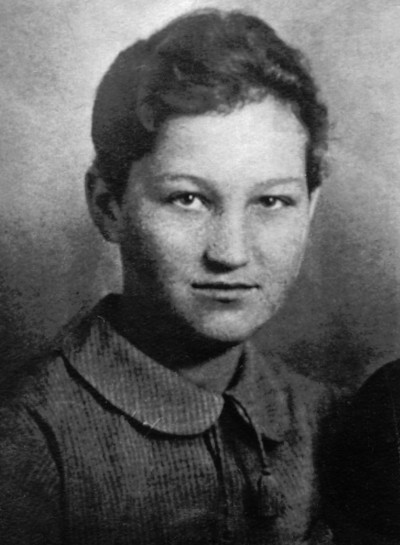 This was originally made under the working title of The Passion of Zoya, and the Joan of Arc reference is on point. Both were young warriors fighting against the occupation of their native land, captured by the enemy and tortured before being executed. But they became a rallying point for their country as it succeeded in expelling the invaders, and are now revered as national heroines. The real Zoya Kosmodemyanskaya (pictured) was an 18-year-old teenager in 1941, who signed up to be dropped behind the front-line as the Germans invaded Russia, and carry out missions of sabotage intended to make life difficult for the Nazi army. It did not end well, but she became the first woman Hero of the Soviet Union in WW2, less than three months after her death.
Unsurprisingly, the facts are a bit murky, with the regime at the time intent on making a heroine of her, who could be used for propaganda purposes. [There was another film of the same name made in 1944, to that end. It’s on YouTube; I need to find subtitles before I can review it] This was criticized on its release for historical inaccuracies, but most of the events match the Wikipedia page, at least. There is perhaps artistic license over her motivation, signing up after her fiancé was killed in action. Whether her capture was triggered by the betrayal of a colleague in the sabotage cell, Vasily Klubkov (Kologrivy), or the betrayal was after her capture, as depicted here, I don’t know.
As ever, I’m here for the cinematic experience, not a documentary. As such, it’s well made, though concentrates to such an extent on her post-capture experience that it seemed to border on the exploitative. The lengthy sequence where Zoya is stripped and whipped, is the most obvious example, and her stoicism as she refuses to give up any useful information makes things worse. Perhaps the most interesting character beside Zoya is Hauptmann Erich Sommer (Cerny), who seems to feel for his captive, explicitly ordering the troops under his command to refrain from abuse. Not that they necessarily obey. I likely was more impressed by the earlier stages, depicting Zoya’s training and her activities behind enemy lines, which are tense and well-assembled.
There’s no doubt she was being positioned as a heroine, from the first reports of her death in state newspaper Pravda [which included a gnarly, NSFW photo of her corpse]. This feels like it’s trying to do the same thing, right up to her defiant speech on the scaffold: “Comrades, beat the Nazis. Burn them! Poison them! There’s 200 million of us, you can’t hang us all.” I imagine that would have had the intended effect in 1942, of inflaming patriotic anger and willingness to fight. But I can’t say I was particularly moved, with my main reaction to Zoya’s death being relief that her torment was over. More depth and less torture would have been preferable, I’d say.
Dir: Maksim Brius + Leonid Plyaskin
Star: Anastasia Mishina, Nikita Kologrivy, Wolfgang Cerny, Darya Jurgens
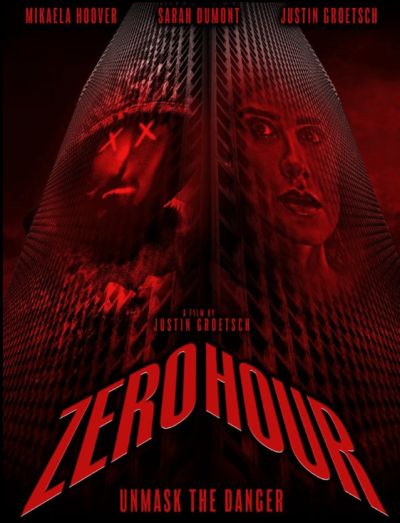 Not to be confused, in any way, with Zero Hour!, the 1957 Canadian film which was spoofed mercilessly in Airplane! This unfolds mostly over one night in a high-rise, where Ida (Hoover) is the last person left in the building, having taken over from best friend Katrina (Dumont). She finds herself being harassed by a pair of masked figures, and simultaneously receiving messages on her phone and computer from her husband, Isaac (Groetsch). Which is perhaps even more disturbing to her, because Isaac was killed in the home invasion which opens the movie. So what’s going on? Has he become a ghost in the machine? Do they have cellphones in the afterlife? Or is there a more prosaic explanation?
 This is distinctly a film of two halves. The first is undeniably more impressive, taking the revenge motif and going in an interesting, and at least somewhat novel, direction. However, not long after the half-way point, the script decides to change direction radically. This leaves behind the grounded entity which we’ve had so far, in favour of something with distinct supernatural tendencies. I’m not averse to these per se. Yet they’re an ill fit with what has gone before, and need to be integrated considerably better. Then, things derail completely for the finale, pulling things out of nowhere to achieve a solution, in a gobbet of exposition that completely lost my interest. So, probably 3½ stars for the first half, 1½ for the second.
 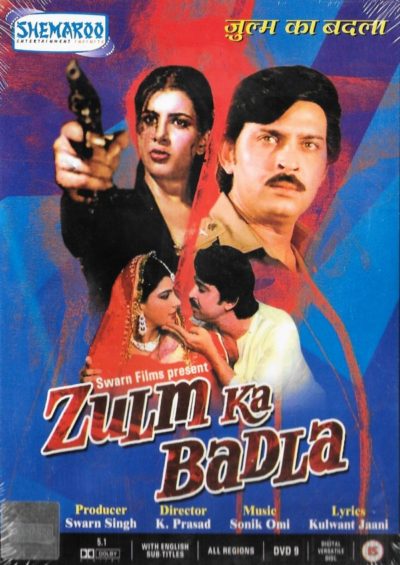 In recent years, the gap in cinema between Bollywood and Hollywood has closed dramatically. The likes of Indian blockbusters such as RRR (technically Tollywood rather than Bollywood) can stand, in terms of technical competence, beside their American equivalents. It’s mostly due to a dramatic improvement from Asia, because it wasn’t always the case, as we see when we go back to the mid-eighties for this slice of vengeance served cold. It looks pretty rough if you compare it to what Hollywood was making at the time, and in many ways feels like it’s about twenty years older than it is. I still found it more watchable than I expected, but then, I’m somewhat used to the style of Indian cinema. Newcomers might find this a bumpy ride.
 Zemlya is a gigantic closed city, in the middle of the Arctic tundra, its ten million inhabitants entirely cut off from the outside world. Indeed, there may not be an outside world: no-one knows, for the authorities hunt down and terminate anyone who tries to leave. One of their hunters is Kate
 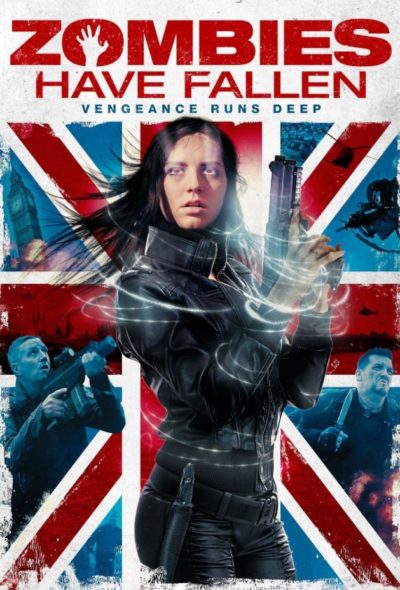 It’s not often that a film cost less to make, than the television set on which I watched it. But it appears this was the case here, with the budget reportedly coming in at five hundred pounds. No, there’s not a “thousand” missing from that. £500. What you get is probably not too far from what you would expect for that – some of the aerial photography and locations do appear to represent good value for money. Budget isn’t the real issue here though. This British film’s main problem is the drastic shift in story for the final third, when it suddenly morphs, for no reason, from a SF/thriller, into a full-on zombie apocalypse which the makers have neither the budget nor the talent to depict.
 I’m not kidding. Director Deodato is best known as the man behind one of the most notorious of all “video nasties,” a film which created such a furore, he had to produce the actors to convince the Italian courts he hadn’t killed them. But in almost fifty years of work (he’s still active today), Deodato has done everything from spaghetti Westerns to science-fiction. And more than a decade before Holocaust, back in 1968, he directed this bawdy action-comedy.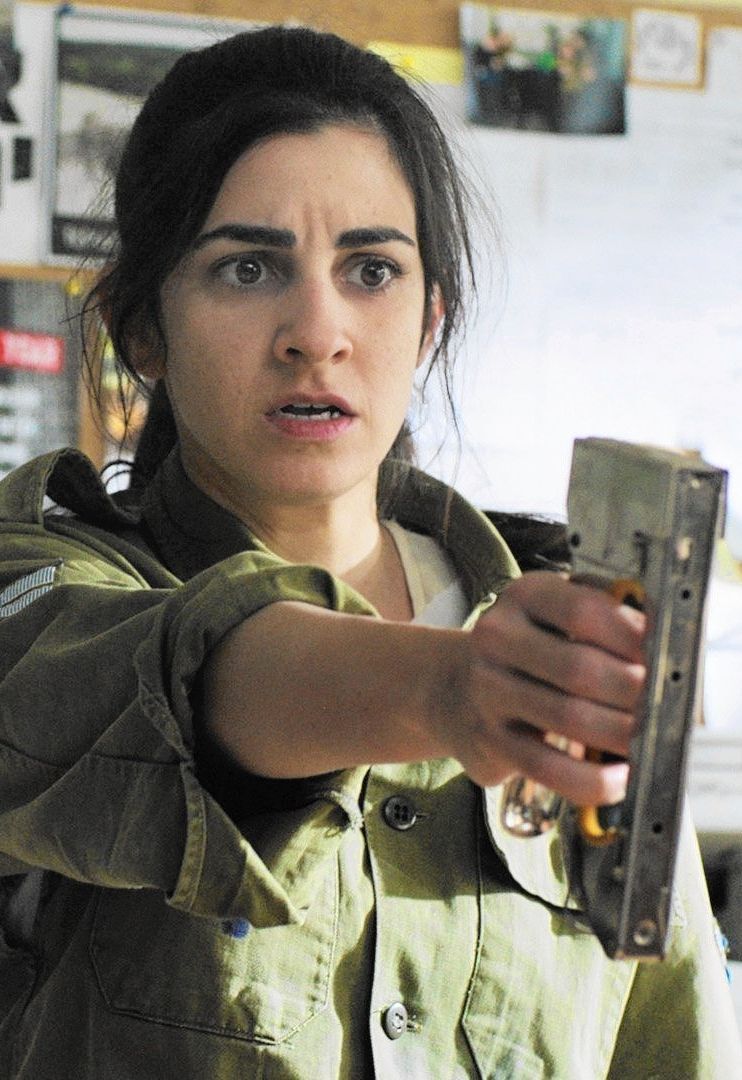
 The main mission given to Rie (Shiratori this time) is a little bit different, from her usual, straight-forward assassinations. Instead, she’s given the job of protecting a witness. Nana (Matsuda), the disgruntled mistress of an organ-trafficking ring, who has had enough and agreed to co-operate with the police. Rie is part of the protection detail, but soon finds out that the gangsters, under ever-so strange boss Kaneda (Nogami) with his transvestite tendencies, are not going to sit back and wait for Nana to take the witness stand. Oddly, the cops let Nana stay in her own apartment, perhaps figuring that’s the last place her former lover would look. but when that is unsurprisingly stormed, Rie takes the target back to the operative’s flat, where they hang out, exchanging small talk – that’s mostly Nana, of course, since Rie is about as talkative as the enormous pet fish she has in a tank, and to which she feeds goldfish.
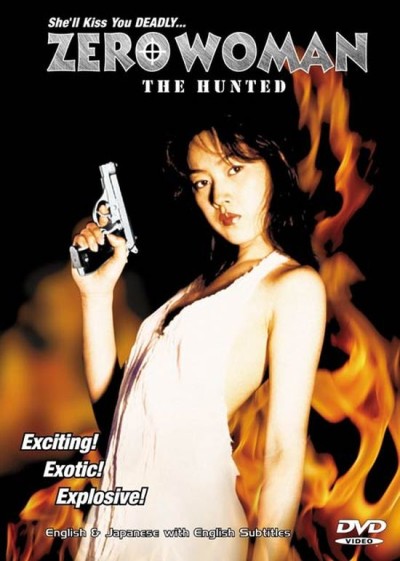 If ever I become an evil overlord, I will ensure my minions’ idea of security does not involve walking slowly in the open, towards an attacker, while firing wide of them from a range no greater than a slightly oversize dinner-table. That’s the first thing we take from this, which begins with a thoroughly implausible scene where Rei (Ono, who had been a part of 90’s J-pop group CoCo) manages to drown her target, a German industrialist, despite him being roughly twice her size, and without anyone in or around the swimming-pool noticing anything. She then climbs out, pulling a gun from who knows where, kills bodyguards who’d fail the Imperial Stormtrooper accuracy exam, and abseils down the side of the building to escape. That sets the tone for much of what follows, combining a reunion with someone from her past, a blossoming relationship with a chef, and her boss’s traditional surly reluctance to allow anything as banal as “personal happiness” to distract his #1 killer from her work.