



★★
“Respect the hustle.”
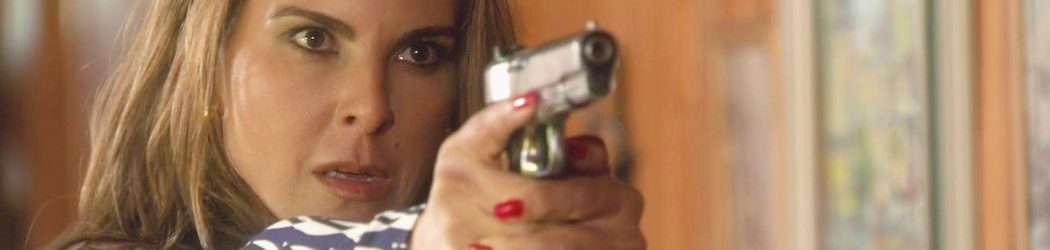
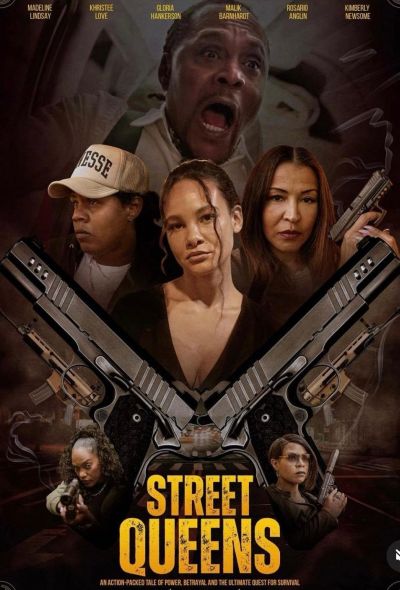 This gets an extra half-star, simply for trying to go in some unexpected directions. I’ve seen enough of these urban flicks to know the template from which they are largely stamped. Now and again, this doesn’t so much colour outside the lines, as forget about the lines entirely. It doesn’t always work. God knows, it doesn’t always work. Still, I respect the attempt. It used the word “duplicitous” inside the first minute, and you get a voice-over saying things like, “The crimson stains of her actions seemed to fade momentarily, offering a fleeting illusion of absolution. A fragile attempt to reconcile the duality of her existence.” That’s some fancy-ass, hi-falutin’ language for a film in this sub-genre.
Unfortunately, it also manages to be an incoherent mess. Perhaps it makes sense to those involved in the production. I note that, on the IMDb, there are six writers. Okay, technically, one “created by”, one writer, a story editor, two story consultants AND a “screenplay by”. It feels as if they were all operating independently, and only met each other at the movie’s premiere. Because I cannot offer much more insight to the plot than the official synopsis. To wit, “Three formidable women, Nia (Lindsay), Bella (Hankerson), and Dragon (Love) rise to power in the male-dominated realm of organized crime.” Even here, I have questions. For it’s not exactly ‘male-dominated’ – the subject of gender barely crops up.
Indeed, it seems the trio’s biggest threat is also a woman, the very strange Goldie (Rosario J Anglin), who also goes by another name. “I love blood, that’s why they call me the Stallion,” she says. Um, what? I can see that leading to a nickname like the Tiger, or Wolf. But a male herbivore? Though I will say, she might be the best character here, simply because she acts permanently off her face on pharmaceuticals. It’s disconcerting, and if I’m not sure I’d call it good acting, you will remember it. The basic idea is that our heroines decide to get in on the drug trade, after first robbing a high-stakes gambling night. However, the illusion there is rather fragile, given it seems to be taking place in a studio apartment.
Anyway, they use the seed money obtained there to bribe Dr. Martin (Barnhardt) into supplying them with opioids. Lots of opioids. This doesn’t go down well with a number of people, eventually leading to the trio becoming the target of a robbery themselves. Things seem to get sorted, until a “Six months later” caption, further violence, and we are informed that Street Queens 2 will be coming soon. I’m unsure whether this is a threat or a promise. The coolest thing here might be the animated, comic-book style opening credits; it’s certainly the last point at which much of this makes any sense. It did keep me watching – more or less. Just do not ask me probing questions about anything that transpired.
Dir: Jibril Haynes
Star: Madeline Lindsay, Khristee Love, Gloria Hankerson, Malik Barnhardt
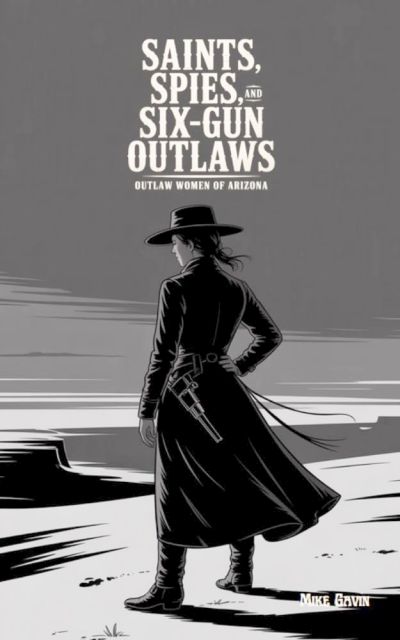 This is a slim little book – more of a booklet, really, coming in at only 74 pages in length. But since it combines both our topic of discussion and local interest, because I live in Arizona, it was an easy decision to pick up a copy, after Dieter brought it to my attention. It does use quite a loose definition of “outlaw” – it is something only really discussed in the book’s epilogue, dividing them into three categories. Most obviously, are the ones Gavin calls “The Breakers of Law”, such as stagecoach robber Pearl Hart, whose exploits were dramatized in
  This begins with a caption detailing the horrendous number of gun deaths annually in Brazil, including several thousand per year in police actions. Given the synopsis, I wondered how the film was going to reconcile this with its own subject – would the answer to gun violence be…
  This is based on the
 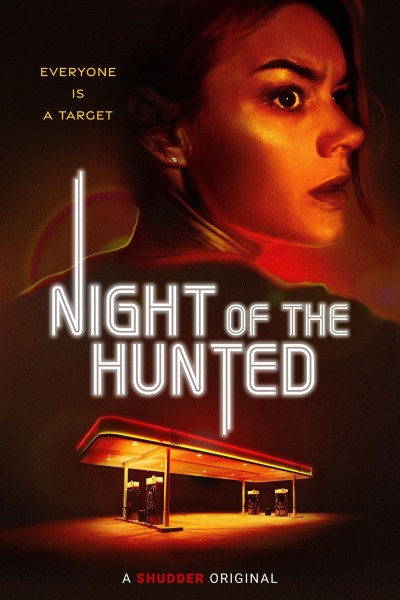 It has got to the point where ‘A Shudder Original’ has become more a threat than a promise. I was hoping for much more from Khalfoun, who gave us the brilliant
 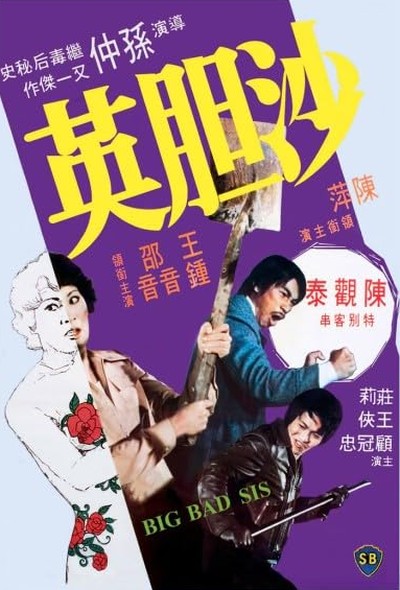 Despite this being from Hong Kong, I’m actually tagging this one in the “Pinky” category, because in a lot of ways, it feels closer to a pinky violence movie from Japan, being basically the story of a posse of bad girls. Except, this being Hong Kong in the seventies, where even juvenile delinquents were expected to hold down a responsible job. In the case of Fung Ying (Ping), this is working in a massive garment shop. It feels almost like prison labour, not least because of various predatory types, to whom Fung takes exception, becoming an unofficial shop steward. It helps she’s a bit of a bad girl herself, a former gang member.
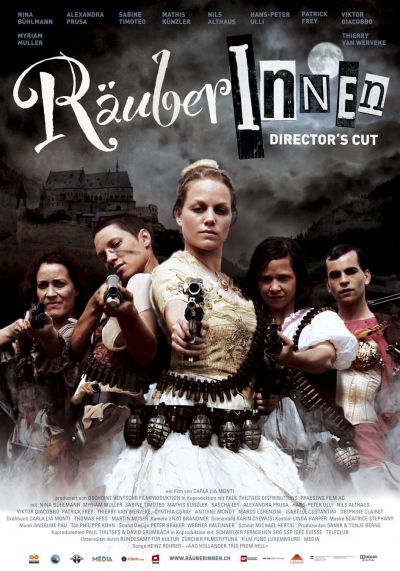 There’s a moment here which is probably a good litmus test for how you’ll react to this overall. The heroine, princess Emily (Bühlmann), opens a locket to look at the picture of her dead father. Only, it’s actually John Waters. If you do not know who that is, this film is probably not for you. If you do know who he is, understand why he is called the ‘Pope of Trash’, and have a limited tolerance for his kind of movies, it is probably not for you either: I fall into this category. I was at least forewarned by the synopsis: “A castle maid-turned-fugitive joins a group of sex workers to create a gang of female bandits that fight against the sexually deviant patriarchy.”
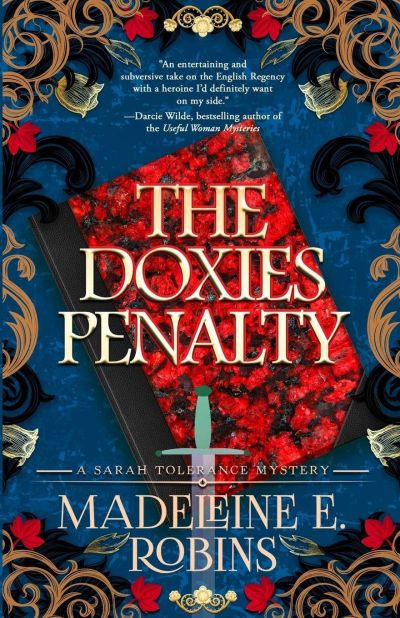 So, for the benefit of readers who haven’t read, or don’t remember, the earlier books or my earlier reviews, Miss Tolerance (born Sarah Brereton) is a scion of a lower-nobility family, which disowned her as a teen when she ran off with her brother’s fencing master. (The pair were in love, and would have married if her father hadn’t forbade it.) After her man died young, Sarah took shelter with the one relative who’d have her, an also-disowned aunt who owns a high-end brothel (fortunately, there’s a small cottage out back); and rather than resort to prostitution like many young women in her situation, she’s created a profession for herself as an “Agent of [discreet] Inquiry.” (She’s smart, inquisitive, able to blend in a variety of social settings and pass as a man if she has to; and since she packs pistols and learned how to fence from her late life-partner, she can handle rough stuff if it’s thrown at her.)
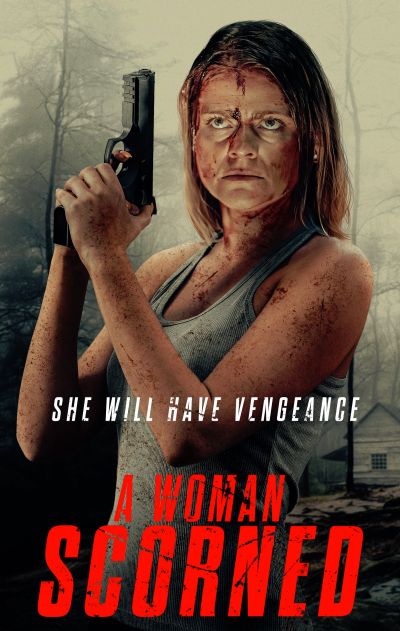 This had a fair number of decent and well-done elements. However, it very much feels like these are balanced by the aspects which fall short of adequate. How you react to this will likely be determined by your ability to overlook the latter, and appreciate the former. The basic idea is lean and mean. Sisters Jas (Purvis) and Laura (Pauley) are on a country weekend, when they encounter a car-load of men led by the particularly sleazy Randy (North). This leads to a home-invasion, a dead Laura, and Jas going on a rampage of revenge through everyone Randy can throw at her. Fair enough there, with enough brutal violence to leave the most blood-thirsty satisfied.
 This one is fairly fringey, in terms of qualifications for the site. But I do feel, any film where a woman picks up and wields a chainsaw with bad intentions… Yeah, that’s pretty much a golden ticket to inclusion. You will have to be quite patient though. Very patient. It begins with a car crash which leaves Magda (De Mol), very much the worse for wear and badly concussed, in a gully off the road. She is rescued by Guy (Breck), an elderly gentleman who lives nearby, and who insists on nursing Magda back to health. However, matters are complicated by some rather dubious people, including Justin (Mills), who are after Magda and/or something in her possession.