




Literary rating: ★★½
Kick-butt quotient: ☆☆☆
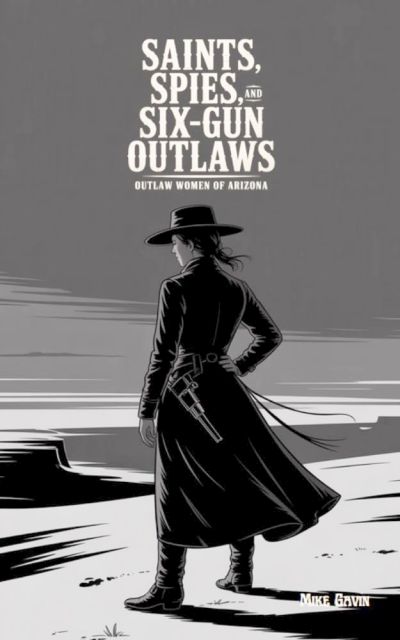 This is a slim little book – more of a booklet, really, coming in at only 74 pages in length. But since it combines both our topic of discussion and local interest, because I live in Arizona, it was an easy decision to pick up a copy, after Dieter brought it to my attention. It does use quite a loose definition of “outlaw” – it is something only really discussed in the book’s epilogue, dividing them into three categories. Most obviously, are the ones Gavin calls “The Breakers of Law”, such as stagecoach robber Pearl Hart, whose exploits were dramatized in The Woman Who Robbed the Stagecoach. “Their crimes were against the statutes of the state.”
As well as Hart, this covers Eva Dugan, the only woman executed in Arizona, who was hung in 1930 [Not-so fun fact: the executioner misjudged the drop, causing Dugan to be decapitated!], and the state’s most notorious killer, Winnie Ruth Judd, “The Trunk Murderess”. Are these latter two what I’d call “outlaws”? Or just criminals? There is a difference, albeit perhaps more so in perception than dictionary definition. Although there is also uncertainty as to whether both Bugan and Judd even committed the murders of which they were convicted. It is kinda disappointing that, in the true sense of the word, one woman who committed one (1) robbery, is about all Gavin could find in the history of the state, and back to when it was a territory.
Nor am I entirely convinced they “stood against power”, as Gavin claims. That feels more like an attempt to force post-feminist ideology onto them, though it might be more applicable to his third category, “The Breakers of Power… Women whose very existence challenged the authority of the state itself.” In this, he puts Apache warrior Lozen (whom I’d first heard of in the Warrior Women series hosted by Lucy Lawless); entrepreneur China Mary of Tombstone; and Teresa Urrea, the “Saint of Cabora.” who became a Joan of Arc-like figure for Mexican freedom fighters, on both sides of the border. But, again: Lozen is the only one whose “challenge of authority” seems like it was a conscious act.
In between, we find “the Breakers of Convention… women whose primary crime was a refusal to be caged by the rigid expectations of their society.” These might be the most interesting figures, and it’s here where the limited space perhaps hurts most. While it’s laudable Gavin sticks to facts, without engaging in the speculation often seen around the likes of Calamity Jane, the average space allowed here is barely half a dozen pages. It’s enough to sketch only the basic details of a life, when some of them deserve much greater exploration. Pauline Cushman’s life as a Civil War spy, turned de facto sheriff, certainly merits more detail that her Wikipedia page provides. As a pointer towards some topics for further research, this is adequate. Just don’t expect much more.
Author: Mike Gavin
Publisher: Self-published, available through Amazon, both as a paperback and an e-book
Stand-alone volume.