
Terminal Angels

★★½
“Justice is more than a match for evil!”

This is not our first time here attending the Godfrey Ho rodeo. Indeed we wrote quite warmly about Lethal Panther., and Cynthia Rothrock vehicle Undefeatable had its moments. But this is our first experience on this side of the heady, WTF? to be obtained when Ho does what he’s best known for doing. Which is, splicing entirely new footage into an unrelated movie, to fit whatever marketing end he’s aiming towards. He was most notorious for this during the ninja film craze of the eighties, when he used this tactic to splice a couple of scenes into either cheap or unfinished movies from the far East, so they could be sold to the ninja-crazy VHS audience.

However, as this example shows, he wasn’t above taking basically the same approach for the then popular girls-with-guns genre out of Hong Kong. We’ve already covered many examples of these, such as Angel. Its success spawned any number of follow-up, both official sequels, and unofficial knock-offs with the word “angel” in the title, e.g. Angel Force or Angel Terminators 2. This would be one of the latter, which takes what appears to be a Thai action film of the same general kind – cops vs. drug dealers – and wraps around it footage about Paula (Bells), an American reporter who gets hold of photos incriminating a businessman as a drug lord. She has to survive, while back in Thailand, the police do battle with the drug runners.

You can tell, because the only points at which the original film overlaps with the new footage is during awkward phone conversations. I think I would far rather have watched a decent i.e. wide-screen print of the original movie, rather than this badly-dubbed hack job. Sadly, I’ve not been able to determine the original movie used, but we’ve seen our share of decent Thai girls-with-guns action. I won’t lie, I was amused here by the pirating of various New Wave songs from the Pet Shop Boys and The Art of Noise. This reaches its ludicrous peak during a disco scene where customers dance to A Flock of Seagulls song, Telecommunication. The footage is sped-up, like some of the action scenes – which is a shame, because the fights really do not need it.

It’s very equal opportunity too, with both sides having their share of women, giving and receiving damage. Indeed, the best fight sees two female cops brawl against four thugs sent to kidnap them. It escalates from fists to crossbow-fu, with a number of highly wince-inducing moments. But all too soon, you’re back in the crappy insert footage, which ends with the laughable line of dialogue quoted top. Though to be a hundred percent sure you get the point, this is followed up with, “Criminals aren’t able to escape the net of justice.” There’s likely a decent film buried somewhere in here. You just need a pick-axe and a wheelbarrow to find it.

Dir: Godfrey Ho
Star: Laura Bells, Richard Gibb, Brent Gilbert, Daniel Welk
Lady Lawman

★★½
“Badge of honour.”

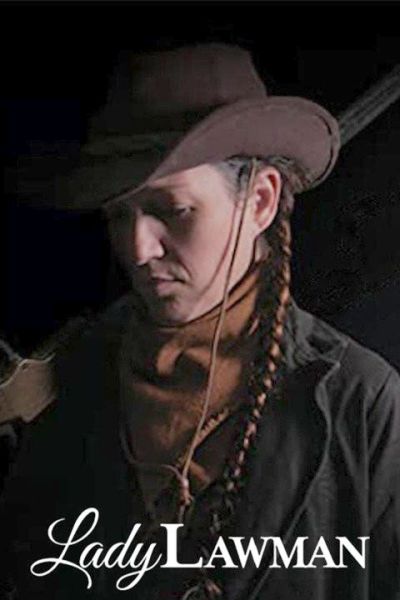
After the pleasant surprise which was Lady Outlaw, I went back to the well of Mauser movies, for this one, which seemed similarly themed, but made three years earlier. It’s definitely a bit less successful. More talk, and that is almost impressive considering how chatty Outlaw was. The central performances are okay, but some of those around the edges… Hoo-boy. However, this did actually introduce me to a historical action heroine I hadn’t heard of. So let’s discuss the real F.M. Miller, though it’s clear the film is filling in a lot of blanks – not the least of which is giving her a first name, Francis. In reality, nobody seems to know what her initials stood for.

However, she certainly seems deserving of respect. She was made a deputy Marshal in 1891, and consequently worked mostly transporting and guarding prisoners. But a contemporary report said, “Miss Miller is a young woman of prepossessing appearance, wears a cowboy hat and is always adorned with a pistol belt full of cartridges and a dangerous looking Colt pistol which she knows how to use.” Here, she’s a rancher, who is brought on board by Buck Johnson (Jecmenek), to help hunt down notorious outlaw Richard Andrews (Leos). He’s an interesting character, being a Black slave-owner. Or former slave-owner, the film taking place after the end of the Civil War. He turned to outlawing, and became quite a leader, to the point his men are willing to die for him.

Which is where Buck comes in, because he lost two deputies in a suicide attack by Andrews’s men. As a replacement, he brings Francis (Jasso) on board – initially for her tracking abilities, learned before her husband was gunned down by highwaymen. However, after bringing in Andrews’ sidekick by herself, she earns her marshal’s badge, and the search is on for Andrews. This involves rather more riding and talking than anything, up until a grubby brawl in the mud during a rainstorm, which is actually well-handled. However, given the blank slate that Miller presents, I would prefer them to have given her more to do. There’s no surprises here, in particular the personal connection between her and Andrews, which is not the revelation the film seems to think.

Jasso is fine as the heroine. There’s a down to earth quality about her which is winning, and she knows it’s her gun which levels the playing field against men larger and stronger than her. Jecmenek is decent too – Buck is absolutely ruthless, which makes sense by the end of the film. “Violence solves everything,” he says. Elsewhere, as mentioned, more of a mixed bag, and that’s being charitable. Some scenes are more wooden than a fence-post, and given how dialogue heavy this is, we have a real problem. Still, based on it and Outlaw, it seems Mauser’s talents are trending in the right direction. If we get the cross-over hinted at by the end of Outlaw, I would certainly not mind.

Dir: Brett William Mauser
Star: Ryan Lakey Jasso, Jake Jecmenek, Carlos Leos, Ernest Martinez

Masterless Ninja

★★½
“I hate being bored.”

This is actually an improvement over the same director’s Ninja Girl (Kunoichi), made two years later. Just do not ask me what’s going on in detail. It begins with the following caption, which I transcribe as it appeared: “It was the Sengoku Era, a few years before the events of Honnoji [1582]. The Iga relied on a hierarchical system in which the jyonin ruled over the genin, before Oda’s forces destroyed their nation. [Jyonin: high-ranking ninja] This meant that countless genin and female shinobi died by orders of the jyonin, [Genin: low-ranking ninja] without the chance [Shinobi: ninja] to flee their villages.” I hope that has cleared everything up. Because, trust me, that’s more or less all you’re going to get. 
The heroine is Uragami (Hijii), and she is a… [/checks notesshinobi, I guess? She’s part of a war between two groups of ninjas, though she’s not exactly getting much support from her own side, with some of her colleagues suggesting a career in farming or even child-minding. Still, even though she’s not great on the “obeying orders” department, her talents prove enough to keep her occupied, such as a mission to bring back an intelligence report from a genin who infiltrated enemy territory. However, all that goes to one side, after her long-time friend, Kamari, is abducted. She decides to go rogue, and will not let anything stop her from freeing Kamari, despite the unpleasant truth which is revealed as a result. 

Well, somewhat unpleasant, I guess. Due to the confusion surrounding the various plot elements – in particular, who is doing what to who, and why – the emotional impact of it all is close to zero. It doesn’t help that the pacing is weird: we get what feels like it should be the final fight, and the film then dawdles along for another ten minutes of idle chit-chat, revealing more stuff about which I couldn’t bring myself to care. Fortunately, the film is saved by some decent action sequences. Hijii seems to know her way around a fight, and if the editing is occasionally a little too kinetic, it’s rarely bad enough to make you lose sight of the face-off’s overall progress.

While I was hard-pushed to care much about events in general, Uragami makes for a decent heroine, with a feisty attitude, and a zero-tolerance policy for glass ceilings. Or whatever the equivalent is for 16th-century Japanese shinobi. I was worried that in the final battle against [name redacted for spoiler purposes – and not at all because I failed to make a note of it…], she would end up needing help from one of her male allies. Pleased to report that wasn’t the case, with this sister capable of doin’ it for herself from beginning to end. That even includes a battle in the middle of a forest, where all I could think about was the uneven footing inevitably resulting from such a location. Nice heroine: shame about the plot. 

Dir: Seiji Chiba
Star: Mika Hijii, Masayuki Izumi, Mickey Koga

After Blue

★★½
“WTF?”

No, really. What we have here may well be the most bemusing film I’ve ever reviewed on the site. It almost exists in an alternate dimension, where concepts such as “good” or “bad” have no meaning. This simply is, and it’s entirely up to you to deal with it. This takes place in a future where humanity was driven off Earth to find other habitable planets. The titular one here had a nasty side-effect, in that it killed off all the men: “Their hairs grew inside because of the atmosphere.” Wait, what? Anyway, it’s now matriarchal, and living in small communities based on nationality. There appears to be some friction between France and Poland, and it’s key to what happens.

On the beach one day, Roxy (Luna) discovers a woman (Buzek) buried up to her neck. Rescuing her proves a mistake, because she kills Roxy’s three friends before departing. Turns out she was a criminal the Poles buried there so she’d drown, and is called Katajena Bushovsky. Or Kate Bush for short, which eventually leads to unforgettable lines like, “You shaved Kate Bush an hour ago.” This is not a sentence I expected to hear when I woke up this morning. [What the director has against body hair, Polish people and Kate Bush, remains positively opaque.] For Roxy’s sins, she and her mother, Zora (Löwensohn), are sent to the mountain which is Kate’s hideout, meeting and/or fighting a slew of wild and weird characters along the way.

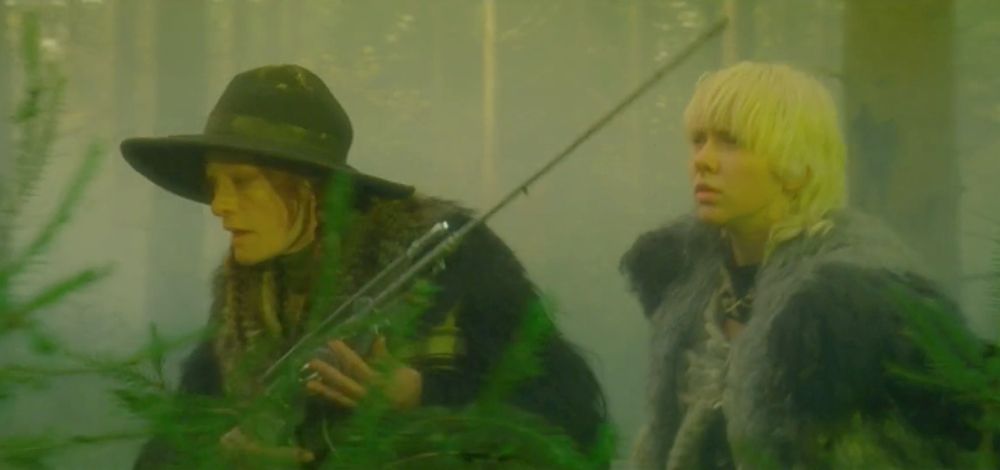
It’s considerably less coherent than the above makes it seem, feeling like a fever dream filtered through far too many French bandes dessinées. There are some cool elementsL the hats frequently worn by the women (top) seem to have been bought of the rack at Pinky Violence R Us, and the guns are named after fashion labels. “I’ll shoot with my Gucci. It can put a hole through rock, through wood, through bones,” is also not a subtitle I expected to read. If you are into the works of someone like Panos Cosmatos, you might enjoy this. I, however, am not, and at a hundred and twenty-nine minutes, I must confess my full attention tapped out, with about thirty still to go.

However, that is considerably further than I expected. This was something I threw on, thinking I’d discover it was nothing but pretentious art-wank, bail quickly, and pretend it never existed. Yet here I am, writing a review. It probably is nothing but pretentious art-wank, to be clear. Yet there is something to be said for a film-maker who gets to unleash his fully unfettered imagination onto the screen. How it got funded, is another question: laundering drug money would seem a plausible explanation. Then again, it’s French, so… /Gallic shrug. This certainly is not a film I would recommend, and being made to watch it again could be seen as cruel and unusual punishment. But I didn’t feel my time was entirely wasted.

Dir: Bertrand Mandico
Star: Paula Luna, Elina Löwensohn, Vimala Pons, Agata Buzek
a.k.a. Dirty Paradise

Chicks with Sticks

★★
“Two minute penalty, unnecessary cliches.”

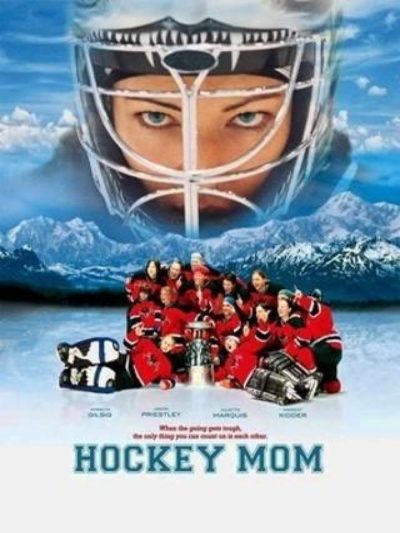
Printed directly from the finest template of sports movie tropes, this is less a script than a bullet list of plot points you’ve seen a thousand times before. Struggling single mom (check) Paula Taymore (Gilsig) had to give up a promising ice hockey career to take care of her son (check). A bar argument leads to a challenge match against a local men’s team (check). Paula has to assemble a women’s side (check), from a ragtag group (check), including an ex-convict (check), sassy Black girl (check) and a witch (check). Can she overcome adversity and local prejudice (check), find love with hunky single dad Steve Cooper (Priestley, and check) and triumph in the big game? (BIG BOLD CHECK, LARGE FONT).

It’s not just the storyline that comes out like a prepackaged frozen dinner, the style and approach to the content is equally safe, competent and, ultimately, bland. That means training montages, a soundtrack of bland country and pseudo-inspirational pop/rock, and attempts to yank on audience’s emotional heartstrings which could not be more blatantly obvious. Yet there are reasons these things have become overused stereotypes: it’s because they are effective. You may know, with absolute certainty, the women’s team are going to fight back after falling 4-1 down. This doesn’t make it any less heartwarming when it happens, and this is effective enough as undemanding cinematic comfort food. It’s the kind of movie you curl up on the couch with, clutching a cup of hot chocolate, some Sunday afternoon.

What’s odd is that there are moments where it does have the opportunity to break away from the obvious. For example, there’s a plot thread where one of the women absconds with the hard-raised team funds. However, this is discarded almost as soon as it has begun, with no actual resolution. In its place suddenly appears, out of nowhere, the fact that the goalkeeper is throwing the game for gambling purposes. Still, nothing a few stern words from Paula can’t sort out, amIrite? There’s no effort at all put in on the side of their opponents, who might as well be a pack of skating Neanderthals. Their idea of wit is putting a camera in the women’s locker-room, an element that has not aged well, to put it mildly.

The performances are likely better than the material deserves. Kidder, as Paula’s mom, manages to be heartfelt without coming over as insincere or sacchariney, and Gilsig has her moments, mostly when struggling to balance her family responsibilities with her own hopes and goals. Of the supporting cast, Marquis comes off best, making a strong impression as acidic goth Felicity Carelli, though singer Michie Mee seems thoroughly out of place. Whoever thought it made sense to have her rap the Canadian national anthem, probably has found themselves on an RCMP watch-list. You may not need to know anything about hockey to watch this. However, you won’t learn anything about it either.

Dir: Kari Skogland
Star: Jessalyn Gilsig, Margot Kidder, Jason Priestley, Juliette Marquis
a.k.a. Hockey Mom or Anyone’s Game

Gehenna: Naked Aggression, by Patrick Kindlon and Marco Ferrari

Literary rating: ★★★★
Kick-butt quotient: ☆☆☆☆½

“What I need is stories where men get kicked in the chest. Stories where guns only run out of ammo for dramatic effect. I need pulp. I need exploitation. I need fun.”  I used to read a lot of comics, before moving to America. As in, most weekends involved a trip to Forbidden Planet, Gosh!, or Mega City Comics, coming home with a carrier bag of new issues. Then there were the trips to Paris… But I just kinda stopped – no particular reason – when I emigrated. There is still a large cardboard box, unopened from the move 25 years ago, in our boxroom. Some are probably worth a bit, e.g. the first issue of Hellblazer. But reading the first issue of Gehenna makes me want to restart. Well, if space, time, money and aging eyesight weren’t issues, anyway.
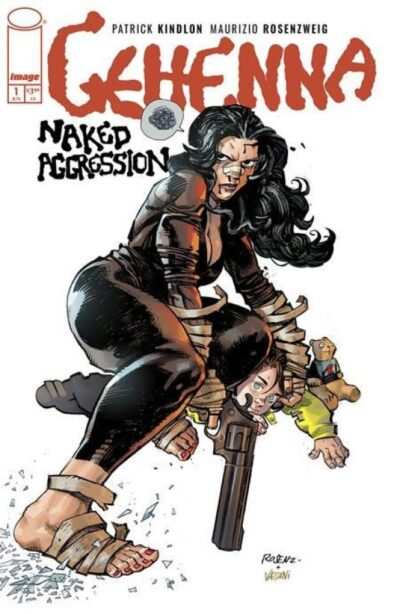
“This book is equally for the diehard comic reader and someone who hasn’t read sequential art since Garfield,” according to co-creator Kindlon. I’m certainly closer to the latter category, but certainly found it accessible, once I got into the comic-book rhythm again. It’s different from word-based literature, and even from cinema, where the pace is dictated entirely by the director. In a comic-book, you can linger over a panel to admire the artwork for as long as you want, or whizz through them so you’re basically picking up subliminal imagery. The text becomes a complement to the imagery, filling in the gaps. And the imagery is great. I now have a new backdrop on my PC desktop. Page 18 of the PDF, should you be interested. 
“Everything went to hell. And now that’s where I live.” But this also means exposition and action can co-exist: the latter doesn’t need to pause. Consequently, over the 24 pages here, there’s barely a pause for breath. You reach the end, to be honest, not necessarily sure what’s going on, but this is just part one of four. I presume things will become clear – or, at least, clearER – in due course. We have a dark-haired woman, kidnapping the son of a gangster because of reasons apparently connected to her husband’s death – leading to the quote above. There’s another woman, blonde, following in her wake – with bad intent if her line, “I’ll call you when the woman is dead”, is anything to go by. I will bet the house that they will end up facing off against each other, before very long. I certainly hope so. 

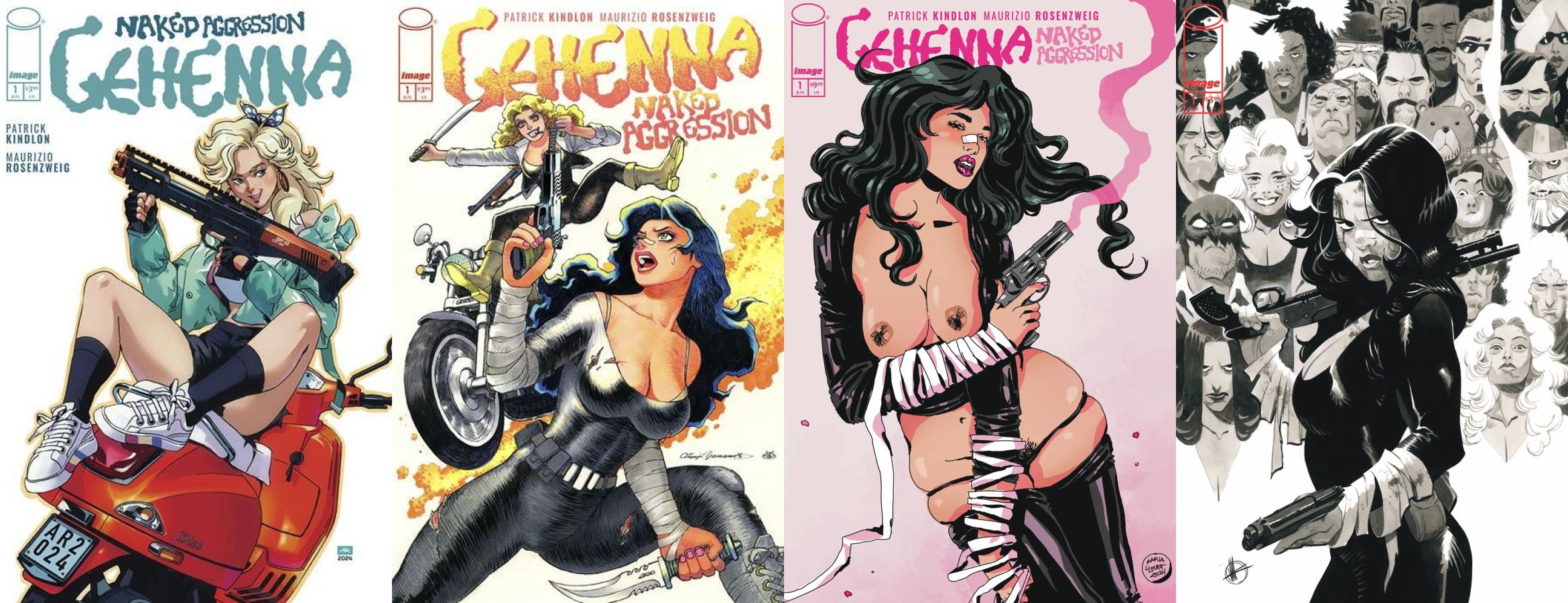
“It’s pulling from Beyond Hypothermia and Naked Weapon, and all of Hong Kong,” says Kindlon. So far, Naked Aggression has been more about the aggression than the naked – though cleavage certainly abounds, and an alternate cover (below) does deliver. It is difficult to judge the series overall, in the same way as giving your verdict of a film based on its opening twenty minutes. We’ve all seen movies which hit the ground running, only to run out of steam. But there’s no reason this shouldn’t be able to sustain the blistering pace: it’s not like a comic-book is going to run out of budget. If we weren’t looking to move house, this might well be the one to entice me back into the comic-shop. Failing that, I’ll just have to wait for the movie version, hopefully starring Eva Green and Charlize Theron. 

Author: Patrick Kindlon (text) and Marco Ferrari (art)
Publisher: Image Comics, available through their site, from July 2, or for Kindle through Amazon.
Book 1 of 4 in the series, also available in four alternate covers as below.

Two Weeks to Live

★★★½
“Family values.”

If you described this as a dark spoof of Hanna, you might not be so far away. Since the death of her father, Kim Noakes (Williams) has been brought up off the grid by her controlling, survivalist mother, Tina (Clifford). She makes a trip to civilization to scatter his ashes, meets brothers Nicky (Rizwan) and Jay (Taheen Modak), who prank her that the world is ending. Falling for this, Kim decides to take revenge on the man who killed her father, crime boss Jimmy Davies. But in doing so, she kicks of a spiral of events putting her new friends, her mother and herself in severe peril, from the dangerous and smart Alan Brooks (Flemyng).

The comedy here is largely “fish out of water,” with Kim largely unaware of the nuances of modern life – but capable of killing you, eight different ways, with the contents of a drawer. Conversely, the brothers are naive and dumb respectively, and utterly unsuited for the violent mess into which they have become involved, desperately clinging onto normality. Admittedly, their own actions don’t help, Jay lifting a suitcase full of money from Davies’s house. Tina has own agenda too, having gas-lit her daughter in a variety of ways, lies which becomes more apparent to Kim over the course of the six, thirty-minute episodes. It’s all well-written, and I’m surprised it came and went without apparently much fanfare: I stumbled across it by accident, in Tubi’s “British crime” section.

You definitely need a British sense of humour to appreciate this: a lot of the comedy is bone-dry and self-deprecating, with Tina in particular a mistress of that most English form of wit, blistering sarcasm. However, the action proved rather better than I expected given the source and format. This does peak quite early, with a blistering brawl between Kim and Jimmy (above), which is one of the more hard-hitting I’ve seen on British television. [Jimmy is played by genre veteran Sean Pertwee, who is always good value. I could have sworn he was in Game of Thrones as well, which would have reunited him with Williams. But it seems he is the only British actor who wasn’t employed on the show!]

I was slightly sad that nothing thereafter quite reached the same level of hand-to-hand awesomeness. There is still a reasonable quota of action, but it’s more gun-based: the family which stays together, slays together, as Brooks and his henchwoman close in on the two families, and the cash-filled luggage. I found this the sort of unexpected delight which is a pleasure to stumble across. I had no real idea what to expect when I put on the first episode, but by the end, was shot-gunning episodes like they were tequila. While it would be nice to see more – I guess unlikely at this point – things are tidied up adequately, albeit in a somewhat contrived manner, involving a reluctant land-mine. All told though, more hits than misses.

Creator: : Gaby Hull
Star: Maisie Williams, Mawaan Rizwan, Sian Clifford, Jason Flemyng

Who Cares!

★★½
“Hop to it!”

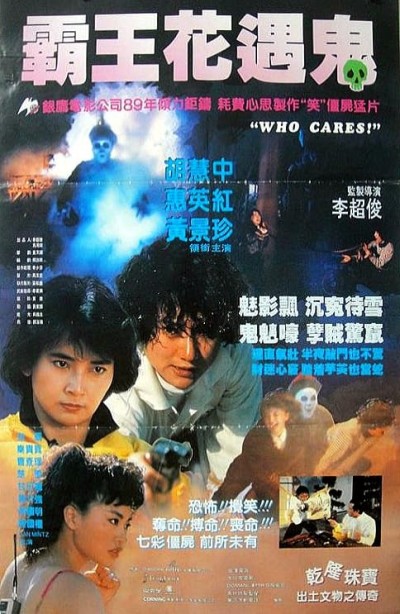
I would have sworn I had seen every example of Hong Kong girls-with-guns movies from the eighties. But this one had managed to escape my attention completely for 35 years, until accidentally stumbling across it on YouTube. It’s perhaps partly because it never seems to have received any kind of post-VHS release, being unavailable on DVD or streaming sites. Which is a little surprising since it combines two genres that have been quite popular in the West: not just GWG, but also hopping vampires, as in the Mr. Vampire franchise. It’s a rather awkward combo, and there’s definitely significant potential wasted. Yet I’m fairly certain it’s going to be unlike anything you’ve seen before.
It begins with a gang robbing a mausoleum of antiques for their boss, Yiang Wei (Wei). However, included in their haul is a pearl, which was the only thing keeping a traditional Chinese vampire (Kwai) pinned down. It’s now free to roam the land, terrorizing the possessor of the pearl, who is the only person that can see it. Meanwhile, a special police squad has been set up to investigate the ring behind the recent slew of antique thefts. In charge of it is Sergeant Wang Wai Shan (Hu), who follows the evidence to Wei, after one of his minions turns up dead, a victim of the vampire. Wang and her mostly-female team then find themselves having to take on both the hopping undead and the criminals.

The results are kinda decent, but it’s not hard to think of ways it could have been better, particularly from the perspective of this site. I was expecting to get a final battle pitting Wang against Wei. Doesn’t happen. I did like how the cops find a way to control the vampire, and I was thinking it was then going to end up as Wang + vampire against Wei. Doesn’t happen either, with Wang entirely sidelined, and replaced with a climax which is simply villain versus vampire (before an ending which is… certainly an ending, and that’s all I can say). Hu deserves better, and so does Sophia Crawford, who is one of Wei’s minions, and gets almost nothing to do. Admittedly, it was only Crawford’s second film.

Not to say that Wei is a slouch. I simply preferred earlier scenes, such as Wang and her squad battling the largely invisible vampire around her father’s apartment, with a range of improvised weapons, from crosses – would those really work on a Chinese vampire? – to flamethrowers. It’s fairly refreshing how nobody really mentions the fact a woman is in charge, with everyone apparently accepting Wang’s role, and there’s not too much in the way of dumb slapstick, which can derail proceedings. As horror, it’s certainly light in tone. Perhaps it might have benefited from sticking to one genre or the other, instead of trying to be two things at once, and coming in as largely forgettable in both departments.

Dir: Chiu-Jun Lee
Star: Sibelle Hu, Dick Wei, Kara Ying, Kwai Po Chun

Inspector Sabiha

★★★
“In-flight entertainment.”

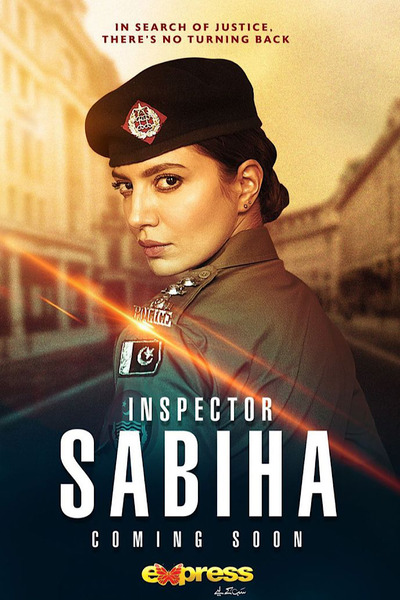
Under other circumstances, this six-episode TV series, would potentially be a marginal entry. But, just as I try to take the historical era into account, I think the location from which a film comes should also be a consideration. Some countries and cultures are simply more action heroine friendly than others. What would be groundbreaking in one region, might not even qualify from elsewhere. This is from Pakistan, and is almost the first such entry in our site’s history. [There’s just Hunterwali which… yeah!] I originally saw this in a condensed movie version, at an altitude of forty thousand feet and a ground speed of 555 mph. For I stumbled across it on the in-flight entertainment system while flying back from the UK to Arizona.

It adequately occupied a bit of time on what ended up being a fourteen-hour flight, thanks to an engine issue delaying the take-off. My grumpiness at this was, however, somewhat alleviated by unexpected GWG on the seat-back TV. By Western standards, it would definitely be considered mild, almost to the Lifetime TVM level (which makes sense, basically being a TV movie). But Pakistan isn’t exactly a beacon of empowerment. This female cop was “a giant step for womankind in the Pakistani drama arena”, according to local writers, so we need to cut it some slack. The heroine, Sabiha (the unfortunately named Butt), is the daughter of Inspector Saeed Shah, who was murdered in the line of duty while undercover. She wants to follow in his footsteps – her uncle Akbar (Ehteshamuddin) is also on the force.

He has a nasty revelation: her father, who was also his brother, had gone over to the side of the criminals. This was something covered up to avoid embarrassing the force to outsiders, though it’s an open secret within the police. Sabiha is devastated by this, adding on to problems with her self-confidence as she goes through the training, to the point she is unable to fire her gun, despite the encouragement of a friendly trainer. She eventually is able to cowboy up and persist. Passing the police exam gives her the access necessary to investigate her father’s case, find out the truth about his death, and dispense justice to those who were responsible.

To be honest, Butt doesn’t really look the part – too much make-up for a cop, by Western standards. Nor is she especially convincing in action, though it is cool when she whips off her burqa to reveal her police uniform underneath, and storms the villain’s headquarters. There are some decent emotional moments too. In this area, the heroine is outdone by her mother (Iffat Omar), who is impressively intense, such as when begging her husband not to go undercover. Writer-director Sarwar cuts up the time-line, so we bounce back and forth from Sabiha’s training to her childhood, but it always remains comprehensible. Despite not having seen Gunah, the series to which this is a prequel, it proved good enough to hold my attention. Though considering my location, guess I couldn’t exactly walk out…

I subsequently found all six TV episodes with English subs, and a playlist is embedded below. 

Dir: Adnan Sarwar
Star: Raba Butt, Enteshamuddin, Yasir Hussain, Yasir Nawaz

Sira

★★
“Just deserts.”

Sira (Cissé) is a young African woman, travelling through the fringes of the Sahara Desert in Burkina Faso, on the way to get married to Jean-Sidi (Barry). However, their caravan gets involved in an incident with Islamic terrorists, which escalates into murder, with Sira being abducted by the terrorist leader, Yéré (Minoungou). He changes his mind, raping Sira and leaving her in the desert, because she is “not worthy” to die by his weapon. She survives, and stumbles across the terrorist camp, and takes shelter nearby, sneaking in to obtain food and water. After a group of other kidnapped women show up, to be used as sex slaves, Sira begins to put a plan in motion, with help from an unexpected ally.

Lured in by the poster, I was hoping for something along the lines of Revenge, especially in the wake of early dialogue about how the heroine had been trained to take care of herself by her brothers. But this is a very different kettle of fish. I have a bunch of questions, not least over the time frame involved. Sira is living in the rocks beside the camp for the better part of a year. It’s long enough, to go from not being aware of a pregnancy, to giving birth in the same rocks. While it’s certainly a memorable image to have her blazing away with an automatic weapon, her child strapped across her back… It doesn’t make a great deal of sense.

Yéré’s terrorists don’t appear to do anything much for the great bulk of the time either, except sitting around. They do eventually go out on an attack in the final twenty minutes, but the amount of terror they generate is minimal. Indeed, everyone does their share of sitting around since nobody seems particularly bothered by Sira’s long-term absence. The police, and the authorities in general, are notable by their absence until the very end. Though this may be an accurate assessment of the local situation; I can’t say. Jean-Sidi makes a half-hearted effort to join up with Yéré’s forces. The fact he’s a Christian proves a bit of an instant red flag there, and Yéré does not take kindly to the attempt. 

It’s only at the very end things crack open, with the terrorist camp proving to be unexpectedly flammable. It does offer a glimpse into a culture of which I had little experience or knowledge, and Sira is an interesting character, one whose resilience is remarkable, given the circumstances under which she has to operate. This was the first time Burkina Faso submitted a movie to the Oscars (it was filmed in Mauritania for safety reasons), and is technically decent. But for a film over two hours long, it’s in need of significantly greater narrative impetus. It has the shape of a thriller, yet definitely wants to be a drama. At least I get to cross another country off my map of world cinema.

Dir: Apolline Traoré
Star: Nafissatou Cissé, Lazare Minoungou, Abdramane Barry, Nathalie Vairac