
Queen of the Ring

★★★
“Bit of a test of stamina.”

Coincidentally, I watched this the night after Sinners, another period piece which looks at the place of a specific culture in society. There, it was music in predominantly black society of the thirties; here, it’s professional wrestling in the overwhelmingly white society of the fifties [the presence of in this WWE champion Naomi as Ethel Johnson, feels very much a token gesture]. Definitely fewer vampires in this, however. It’s the story of Mildred Burke (Rickards), who went from working as a waitress in a diner, though wrestling at carnivals, to become one of the biggest draws in the ring of her time. The end of the film calls her the first woman to become a millionaire through sports. 
It’s not an easy journey, being both helped and hindered along the way by sometimes manager, sometimes promoter, sometimes husband, sometimes abusive bastard Billy Wolfe (Lucas). She also has to deal with scepticism regarding her talent, other wrestlers and promoters trying to muscle in, and even legal barriers, with many states forbidding women’s wrestling bouts outright [In the UK, the city of London banned such matches until as late as 1979]. All while also being a single mother, trying to bring up her son. This builds to a battle for the Women’s Wrestling World Championship in 1954, pitting long-running title holder Burke, against her now ex-husband’s wrestler, and Mildred’s long-time rival, June Byers, whose dislike of the champion goes back to the carnival shows. 

Definitely the best thing about this is Rickards, who very much looks the part of a wrestler: fit and well-toned, without ever seeming muscle-bound. Though it is odd how little she seems to age over the course of proceedings – likely close to twenty years all told, if the age of her son is any guide. Beyond the mere physicality, the Mildred we see here is also a warm and winning personality, and it’s very easy to root for her. As a fan of wrestling in general, I enjoyed the glimpse into the past of the pastime, and it treads a decent line between being accessible to non-fans, without dumbing everything down too much. Though there are some goofs, in terms of period wrestling: tapping out in submission only started in the nineties. 

The main problem, and it’s a significant one, is the film is far too long, at a hundred and forty minutes. It’s clear that writer-director Avildsen was in love with his own script, but there are long chunks – mostly in the second half – which feel closer to soap opera. The whole scene with Burke and Wolfe buying out a whole hotel, so their black wrestlers don’t have to go somewhere else, seemed like pure virtue signalling, and caused me literally to cringe. There simply isn’t enough going on here to justify the running-time, and while the good stuff here is often very good e..g the lesson on how to cut a good promo, it definitely feels like a case where less would have been more. 

Dir: Ash Avildsen
Star: Emily Bett Rickards, Josh Lucas, Tyler Posey, Francesca Eastwood

Outlaw

★★★
“A Rocinha Tale”

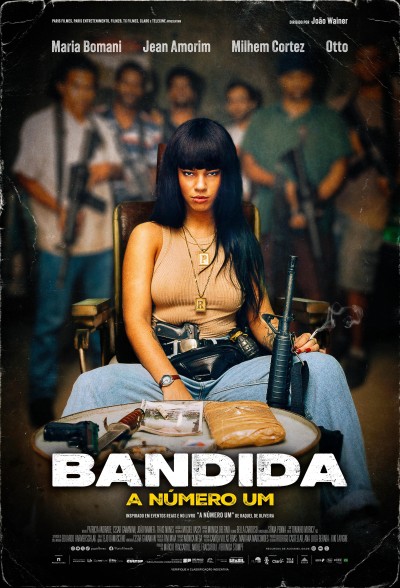
Interestingly, this is based on a somewhat true story, written by Raquel Santos de Oliveira. She comes from Rocinha, one of the most notorious slums in Rio, where she grew up on the streets. “By 11, I was already carrying a .38 revolver,” she says. In the mid-eighties, she was the girlfriend of Ednaldo de Souza, the man in charge of crime in Rocinha, and took over after he was killed in a gun-battle with police. She exited the gang a few years later, and was able to straighten our her life, quit using cocaine, and wrote a book, Number One, at the suggestion of her therapist. While fictional, it’s clear it draws a great deal from Rsquel’s own experiences.

It begins with the childhood of Rebeca (Bomani), which includes being sold off into prostitution at an early age. She’s able to dodge that, by instead working for local boss Amoroso (Cortaz), until the boss gets assassinated on the order of rival Del Rey (Otto), who thene takes over. Rebeca is able to switch sides, and falls in love for another member of the gang, Pará (Amorim). Naturally, any happiness they find together is short-lived and when she loses him as well, Rebecia decides to take revenge, even though her target is operating in cahoots with corrupt members of the police force. The story unfolds in flashback, Rebeca making a tape as her building is under attack, believing her story is all that will be left of her.

This makes an interesting contrast to non-GWG film, Elite Squad, which takes place in a similar setting, only told from the point of view of an honest police officer. [It’s highly recommended, by the way] Outlaw doesn’t run more more then eighty minutes, and so there’s isn’t a lot of slack. Indeed, I suspect it might have been better told over a longer period, since there are points where it feels like it is galloping through its story, mixing historical footage with modern content, aged to look like it’s the eighties. It is quite effective on a high level, but in the second half especially, I didn’t feel as if my attention was being solidly held, due to a narrative which seemed to lack flow.

It does seem like Wainer was heavily inspired by the gangster works of Martin Scorsese, such as A Bronx Tale. Okay, that one was directed by Robert De Niro, but he was clearly Scorsese influenced as well. It’s very down-to-earth, rather than glamourous, and doesn’t stint on the violence which goes along with the criminal territory. The strong sense of place you get might be the best element of the film, since Bomani only occasionally succeeds in inhabiting the skin of her character. If this had been the pilot for a TV series, such as one of my telenovelas like Dueños del paraíso, I would likely be interested in watching it. As a complete story, it’s fine but leaves little impact.

Dir: João Wainer
Star: Maria Bomani, Jean Amorim, Milhem Cortaz, Otto
a.k.a. Bandida

Road Wars: Max Fury

★★
“Mock fury”

Just as Furiosa ended up being a sequel that nobody wanted, what we have here is a mockbuster sequel that, as far as I can tell, nobody was asking for. This is, at least loosely, set in the same post-apocalyptic universe as The Asylum’s earlier (unseen) knock-off, Road Wars, which sought to ride on the coat tails of Fury Road. The sequel begins with Shane (Wells, who actually appeared in the old-school Mad Max 2) being cast out of his very small tribe in the desert. It’s not long before they regret their decision not to impose the death penalty, as he turns around and shoots James dead, before heading off to join his new tribe. Five years later, James’s daughters Naomi (Shah) and Greta (Kaur) are living with their mother Sarah (Wilson) and step-father, in their secluded compound. An attack leaves the parents in need of antibiotics, so the daughters head off to pick them up. Doing so, however, puts them back on Scott’s radar, and he intends to take the chance for some long-delayed revenge.

Obviously, anyone watching this and expecting something on the scale of George Miller’s episode is going to be extremely disappointed. Me? Not so much. I’m familiar with The Asylum, and knew what I was letting myself in for. But even by their standards, this is cheap. The apocalypse happens entirely off-screen, and what you get instead is a bit of running and driving around the desert landscape. The latter is distinctly low-key, with barely half a dozen vehicles and no destructive mayhem to speak of. The two that do get blown up, the explosions are obviously digital – the studio clearly wanted to get their security deposit back from the car-hire company at the end of the day. For the classic Thunderbird, I understand that choice. However, the other is a beat-up junker of a pick-up truck, and it says a lot they weren’t willing to write off the five hundred bucks.

They weren’t willing to write much elsewhere either. After the prologue, things get kinda confusing for a spell, with it largely unclear who is attacking the family, and why. Things do eventually settle down, and we get the required bickering between the younger, headstrong Naomi and her older, more cautious sibling over what to do, who should do it, and how. I was expecting the trip to get the antibiotics to be more fraught with peril than it is i.e. not at all, with a combination lock the only difficulty faced. Mind you, the final confrontation with Shane is just as underwhelming. Despite occasionally decent cinematography, there was a specific point at which I realized my moderate and restrained hopes were unlikely to be met. This occurred when Naomi randomly smears mascara – or engine grease, it’s hard to tell – across her eyes, for absolutely no apparent reason beyond imitating Furiosa. Being a mockbuster isn’t easy, I get it. That doesn’t excuse the lack of effort here.

Dir: Mark Atkins
Star: Preet Kaur, Chandni Shah, Vernon Wells, Lindsey Marie Wilson

Inspector Sabiha

★★★
“In-flight entertainment.”

Under other circumstances, this six-episode TV series, would potentially be a marginal entry. But, just as I try to take the historical era into account, I think the location from which a film comes should also be a consideration. Some countries and cultures are simply more action heroine friendly than others. What would be groundbreaking in one region, might not even qualify from elsewhere. This is from Pakistan, and is almost the first such entry in our site’s history. [There’s just Hunterwali which… yeah!] I originally saw this in a condensed movie version, at an altitude of forty thousand feet and a ground speed of 555 mph. For I stumbled across it on the in-flight entertainment system while flying back from the UK to Arizona.

It adequately occupied a bit of time on what ended up being a fourteen-hour flight, thanks to an engine issue delaying the take-off. My grumpiness at this was, however, somewhat alleviated by unexpected GWG on the seat-back TV. By Western standards, it would definitely be considered mild, almost to the Lifetime TVM level (which makes sense, basically being a TV movie). But Pakistan isn’t exactly a beacon of empowerment. This female cop was “a giant step for womankind in the Pakistani drama arena”, according to local writers, so we need to cut it some slack. The heroine, Sabiha (the unfortunately named Butt), is the daughter of Inspector Saeed Shah, who was murdered in the line of duty while undercover. She wants to follow in his footsteps – her uncle Akbar (Ehteshamuddin) is also on the force.

He has a nasty revelation: her father, who was also his brother, had gone over to the side of the criminals. This was something covered up to avoid embarrassing the force to outsiders, though it’s an open secret within the police. Sabiha is devastated by this, adding on to problems with her self-confidence as she goes through the training, to the point she is unable to fire her gun, despite the encouragement of a friendly trainer. She eventually is able to cowboy up and persist. Passing the police exam gives her the access necessary to investigate her father’s case, find out the truth about his death, and dispense justice to those who were responsible.

To be honest, Butt doesn’t really look the part – too much make-up for a cop, by Western standards. Nor is she especially convincing in action, though it is cool when she whips off her burqa to reveal her police uniform underneath, and storms the villain’s headquarters. There are some decent emotional moments too. In this area, the heroine is outdone by her mother (Iffat Omar), who is impressively intense, such as when begging her husband not to go undercover. Writer-director Sarwar cuts up the time-line, so we bounce back and forth from Sabiha’s training to her childhood, but it always remains comprehensible. Despite not having seen Gunah, the series to which this is a prequel, it proved good enough to hold my attention. Though considering my location, guess I couldn’t exactly walk out…

I subsequently found all six TV episodes with English subs, and a playlist is embedded below. 

Dir: Adnan Sarwar
Star: Raba Butt, Enteshamuddin, Yasir Hussain, Yasir Nawaz

EFC

★★½
“Ducks one set of cliches, walks right into another.”

I wanted to like this more than I did, because the makers are aware of the tropes of the mixed martial arts genre, and in the first half, make a concerted (and largely successful) effort to avoid them. However, the movie is much less successful in the second half, and ends up replacing those cliches with a different set. The result leaves the film just as formulaic – albeit not in the direction I expected. It begins in expected fashion, with a title bout in the EFC, between Alexa Star (Aboya) and Cassady Jones (Rose). The former prevails, but the champion is then attacked after the bell by her opponent.

For reasons never quite explained, Star is stripped of the title, and an eight-woman tournament set up to crown a new champion. This event is hotly anticipated, due to the previous events having gone viral. However, sleazy shareholder Frank Russo (Zeppieri) has other plans, to asset strip the federation, in contrast to EFC President Donna Carter (Jones), who wants to make women’s MMA the equal of the men’s version. I was expecting the tournament to progress to the expected Star-Jones rematch, saving the company in the process. Doesn’t happen. For Cassady loses her first round bout, but Carter throws her a lifeline, suggesting that with the business degree, she can be of more help to the federation as a manager, fighting in the boardroom rather than the ring.

This was definitely not what I was expecting, and credit to the script for going in this unexpected direction. However, it feels as if they are much less comfortable in the world of high-finance, television right and leveraged buyouts. These elements never ring true, and there’s a certain point where it becomes easy to predict where things will end up. If you guess this may be with Cassady making an impassioned plea to the shareholders, to elect her to the board and let her take the company to the next level… I can neither confirm nor deny. There’s also a subplot about fighters failing their drugs tests, which gets started, then dropped very quickly, only to resurface out of nowhere as a “gotcha” for Russo.

I think I might have preferred the results if the film had stuck to the beaten track, because the action sequences are well-staged enough, that they do not deserve to get sidelined in favour of unconvincing business negotiations. All the actresses involved manage to look the part, and at least give the impression of knowing their way around a punching-bag. Less successful is Rose’s transition from MMA to MBA, especially after you’ve heard her character unleash a torrent of F-bombs at Donna for daring to suggest Cassady use her college degree. Her academic credentials should have been established first, with an intellectual fighter in itself being a novel proposition. The overall result is something which I can’t call a success. Yet as failures go, it’s definitely one of the more interesting.

Dir: Jaze Bordeaux
Star: Karlee Rose, Richard Zeppieri, Kathryn Aboya, Stephanie Jones

Huntress

★½
“Ze German WW2 Chainsaw Massacre”

The Texas Chainsaw Massacre was fairly notorious in Britain in the eighties and nineties, being famously banned on video. Naturally, this meant I had to see it, and… I was initially underwhelmed. However, I’ve gradually come to appreciate its raw intensity over the years. If I ever doubted its merits, watching this largely shameless knockoff should act as a reminder. Because it shows how flat and uninteresting the premise can be, when executed poorly. This relocate things from seventies Texas to Germany in the last days of World War II. A medevac team is trying to get injured and grumpy officer, Colonel Franklin (Christian) to a hospital before his leg falls off from sepsis.

Along for the ride are nurses Ellie (McDowell) and Annie (Sarah Hawthorne), a pacifist medic, Will (Sohns), and a couple of GIs to provide protection. It’s not long before they run into trouble and out of fuel. Fortunately – or so it seems initially – they encounter friendly, and attractive local, Helga (Savage) who gives them her homemade sausages and says she has plenty of gasoline at her house, just over this way a bit. If you have read the opening paragraph, you’ll be able to work out where the rest of the film is going. Let’s just say, the moral of the story is: do not accept smoked meats of unknown provenance, from strange women in the middle of woods. Truly, words to live by.

Yeah, turns out she is the acceptable face of a family of psychos, along with sister Greta and mother Ursula. Or maybe it’s the other way round, I forget. Naturally, the convoy members enter the house in easily disposed of ones and twos, with an utter disregard for military protocol. For example, another moral might be, don’t drop your guard in order to slow-dance with mysterious veiled women, in the middle of large, spooky houses during wartime. Only bad things can come of it. The consequences are, a great deal of slowly creeping about corridors, which the makers mistakenly think generates tension. It actually generates tedium. I mean, Colonel Franklin has an excuse, having been shot in the leg. Everyone else? Not so much.

It’s not a terrible idea, and the performances are largely serviceable. However, the parallels to Texas become more blatantly apparent, the deeper we get, all the way until a final shot which is utterly a gender reversed clone of that in TCM. But rarely does this come anywhere close to capturing the same sense of unfettered insanity. If you’re going to try and ape a stone-cold horror classic, you have to bring your A-game, because otherwise, the comparisons will do you absolutely no favours. Instead, I was more left wondering how people go from running along a corridor in one shot, to being chased through the woods in the next. This one is a nightmare, alright. Just in all the wrong ways.

Dir: Matthew M. Howe, J. Christian Ingvordsen
Star: John Christian, Braxton Sohns, Maggie McDowell, Violet Savage

Light

★½
“Dark, more like.”

Fair play to Woollard and his team for making a feature movie with no resources to speak of. The problem is, watching this, it’s painfully obvious that they had no resources to speak of. Two space-suits and a fog machine are not enough for a film, especially in a genre like science-fiction, which tends to rely on spectacle. Oh, smaller scale works can still be remarkably successful: the night before this, I watched glorious and highly recommended time-travel film Beyond the Infinite Two Minutes. But if you’re not going to offer epic scale, you need to have something else to repay the audience. An hour and three-quarters of watching characters stumbling about in the gloom is not it.

I was lured in by this synopsis: “After crash-landing in an escape pod on a dark and misty planet, a mother is hunted by an alien creature which is drawn to the lights she must use to find her missing son.” That high concept sounds pretty cool, and I hoped I was in line for an action heroine take on Pitch Black, perhaps. It just never materializes. There are, indeed, two women who have crash-landed: Tallie (Lilly) and Nia (Ann-Roche, under the name of Chrissy Randall). It’s the latter who is desperately seeking her son, Luccas, only to be hampered by the presence of the hungry creature.  She and Tallie have some things in common. However, it’s what separates them, which might be more important.

Turns out the pair’s presence on the planet is not coincidental, because the monster’s excrement is a precious stone – think oysters and how they make pearls. Some parties therefore have a definite interest in providing a steady stream of sustenance for it. However, the potentially interesting ideas here are utterly undone by the woeful execution. 90% of the scenes are one or other woman, shot in close-up to try and hide the lack of scale, while they talk to each other over the radio. It’s boring after about ten minutes of this. The bad news is, you’ve got another hour and twenty of the same thing, before they finally come into each other’s presence for a (brief) spot of plot resolution.  Don’t expect to be impressed by the creature, either.

It’s never a good sign when you have to read the director’s comments on Reddit to make sense of a film. I also learned the film was a metaphor for illegal immigration. Yeah. That whirring sounds is this legal immigrant’s eyes rolling. On the plus side, it’s muddied enough in its plotting that this was unclear at the time, so I guess it wasn’t heavy-handed, albeit more through incompetence than design. Admittedly, I may potentially have tuned-out during the scenes which alluded to this moral topic. However, if a film is going to do such a dismal job at holding my attention, I don’t feel responsible for missing out on any nuances of plot.

Dir: Matt Woollard
Star: Christine Ann-Roche, Gia Lily, Tedroy Newell. James Woollard

Gold Raiders

★½
“The Tomb was already booked, presumably”

To be fair, for most of the time, this was likely hovering around the two-star range. Not brilliant: it was rather obvious why this had taken six years from being shot, to receiving distribution. But there was some heart evident, and I look kindly on projects which appear to be trying. Unfortunately, we then reached the end, which was clearly intended to work as some kind of stone-cold cliffhanger. Regular readers will know my aversion to these in books. It’s far worse in a movie, especially where you know – given the time elapsed – there’s precious little chance of a sequel to provide any resolution. I’m sure the entire cast has moved on to other things since.

It’s the story of the Sierra sisters, Hera (Swenson) and Athena (Lee), who are part of a secret group called The Society. They have been feuding across the centuries against another secret group called The Order. Hera and Athena are now on the hunt for the lost treasure of the pirate Blackbeard, reported to be buried somewhere near the coast of Virginia. The sister think they have a good handle on it, and along with their local guides, head into the swampy territory in search of the buccaneer gold, guided by Hera’s psychic visions, which pop up conveniently, as needed by the plot. Naturally, The Order are also keen to get their hands on it, and not everyone in the Sierra’s party might be entirely trustworthy.

It begins with an unconvincing depiction of Blackbeard’s death and a somewhat rousing battle for a relic called the Eye of Quetzalcoatl. But once we get past that, the bulk of the movie consists of an awful lot of wandering around marshland here, in lieu of… well, anything much. For example, it might have been nice to have learned about the goals of both The Society and The Order, and why they have been pitted against each other for so long. Nah. Let’s instead just have another of Hera’s obscurist visions where figures, whose relevance remains uncertain, make cryptic statements like, “Remember, as I have risen, things can be buried – can be unburied. Your past journeys will reveal the clue to salvation.” Look, can’t you just email her a Powerpoint presentation?

It doesn’t help that, for a centuries old secret organization, the representatives of The Order are… well, a bit crap. There’s only about four of them to start, and let’s just say, rigorous competence doesn’t appear to be a requirement for selection. Mind you, when they do show an evil streak, shooting people dead in cold blood, Hera and Athena are so blase about it, that the moment is robbed of almost all power. Not that there’s a huge amount of power to begin with, even before we get to one of the most “Wait. Is that it?” endings in recent memory. Well played marketing department though, for the poster and changing the title from the original one of Sierra Sisters: The Hunt for Blackbeard’s Treasure.

Dir: Josh Relic
Star: Kathleen Swenson, Celeste Lee, James Blackburn, Sam Barber

Snow White and the Seven Samurai

★★½
“That whirring sound? Akira Kurosawa, spinning in his grave.”

I added an extra half-star here out of how much I was entertained by this. Although this was more a result of us yelling things at the screen than any intrinsic merits. The idea is kinda cool, but if you can’t think of ways this should have been improved  you are simply not trying. Anya Voight (Dorn) is known as ‘Snow White’, because her father, Joseph (Eric Roberts),  is a coke dealer. He’s killed by a mysterious assassin, and when his will is read, her jealous stepmom, Quinn (Vitori), is highly annoyed to discover Anya will be the one inheriting the business, and has plans to go legitimate. 

She sends her mysterious assassin (Jackson) to kill her stepdaughter, but he is driven off by Luna (Tellone), the leader of a sect of onna-musha, female samurai. Once numerous, they got into an ill-advised was with organized crime, and are now only seven in number, each a specialist in a different weapon. They agree to teach Anya, so she can take revenge on Quinn for killing Joseph. Cue the training montage! There is also a subplot where Quinn is trying to eliminate the three other bosses with which her late husband had partnered. However, this is functionally useless, and one of the avenues for improvement would have been eliminating this thread entirely. Spend the time instead, giving more than two of the samurai adequate character depth, for example. 

For if this had gone the way of The Asylum’s Mercenaries, it would also have helped. Cast seven women who know one end of a katana from the other, instead of… maybe one and a half? Give us something like Lady Bloodfight. Instead, while there’s no shortage of action – the final assault on Anya’s former home takes up much of the final third – very little of it makes an impact, save an unexpected twist regarding Joseph’s death. Vitori is fun to watch, really getting her teeth into the “evil stepmother” role. Hardly anyone else makes a significant impression. This is why we were forced to make our own entertainment, e.g. yelling “How not to be seen”, every time someone with a mask showed up. Which was frequently – largely to allow for recycling actors, I suspect.

Jackson, best known as an MMA fighter, obviously makes for a formidable opponent, though his role is almost wordless and doesn’t merit the above the title billing he receives on the cover. I’m fine with that: the problem is more that the film needs someone as a protagonist who can hold our attention, as well as a sword. Sadly, Dorn isn’t good enough in either category. Tellone might have made a slightly better lead actress, though that wouldn’t help problems in the script, such as the way Anya goes from fencing amateur to professional samurai, in only a few days. The best thing about this is the title, and disappointment thereafter is almost inevitable.

Dir: Michael Su
Star: Fiona Dorn, Gina Vitori, Sunny Tellone, Quinton ‘Rampage’ Jackson

The Queen of Villains

★★★★½
“Hard-hitting, and hitting hard.”

Not long ago, I tagged Black Doves as the best television of 2024. If I’d seen this before December 31, it would have beaten it out. It’s a top-tier depiction of the world of Japanese women’s professional wrestling in the eighties, weaving truth, fiction and legend together in a way that’s highly effective – probably even if you’re not a particular fan of sports entertainment.  It’s the story of Kaoru Matsumoto (Retriever), who escaped a dysfunctional family to join All Japan Women’s Pro Wrestling (AJW). Initially struggling to achieve success, she found her niche as nightmare villain Dump Matsumoto, feuding with former friend Chigusa Nagoya (Grace), until the pair faced off in a legendary, brutal battle, destined to lead to public humiliation for one of them.

We all know professional wrestling is staged, with the outcomes predetermined, right? [Do not used the word “fake”: I will cut you!] Here, things are… murkier. This treads a delicate line between that and kayfabe, the wrestling term for promoting it as reality, and genuine competition. The stance here is interesting, suggesting that while those in charge, like promoter Toshikuni Matsunaga (Saitoh), can have a result in mind, that relies on those in the ring agreeing to it. This isn’t always the case [one wrestling show I remember attending definitely had a genuine fight, for backstage reasons], and here, Matsumoto is a loose cannon, prepared to go to any lengths to put herself over. Or her character: the lines are certainly blurred here, to the point of near invisibility.

What matters, is that the audience believed it was real, to the point that Matsumoto received death threats as the feud intensified. It’s perhaps hard to understand just how popular AJW was, but their TV shows were getting considerably bigger ratings in Japan at its peak, than WWE or WCW were during the Monday Night Wars. It was a true cultural phenomenon – oddly, with teenage girls at the front of fandom. Nagayo and tag partner Lioness Asuka (Goriki), known as the Crush Gals, were basically Taylor Swift: they actually had a successful music career. Below, you can see the video of the real match mentioned, between Nagayo and Matsumoto. I defy you to find any wrestling bout, anywhere, where the crowd were so utterly into it.

The show does a fabulous job of capturing this, and the bouts as well are very well-staged – the real Nagayo worked as a technical advisor. Wrestling at the time was very different from what it is now, especially for women, and Matsumoto’s brutal style was unprecedented. She could chew up and spit out current WWE champion Rhea Ripley, using her as a tooth-pick. Indeed, it feels as if the final match is the dramatic pinnacle, and should end the fifth and final episode. It doesn’t and it feels like it’s heading for an anti-climax thereafter, until recovering [while not mentioned, it’s caused by AJW’s rule that wrestlers had to retire at age twenty-six!] But the drama behind it also has a great deal of nuance, depicting her troubled family life, and willingness to do whatever was necessary for her career.

This came at personal cost – not least her friendship with Nagayo. But it also affected her relationship with her family, in particular her mother and sister. Matsumoto initially wanted to become a wrestler, so she could protect them from her abusive and alcoholic father, but in the end, even her family were not safe from the ripples of her in-ring “villainy”. It all works on multiple levels, and provoked genuine emotions in me, to a degree rarely managed by any TV show, least of all one based on (lightly fictionalized) reality. Towards the end, the promoter lets a young girl in to see the show, and I was left wondering whether this was perhaps intended to be someone like Manami Toyoya, the greatest woman wrestler of all-time.

Another series, perhaps The Queen of Heroines? We can but hope. 

Creator: Osamu Suzuki
Star: Yuriyan Retriever, Victoria Grace, Takumi Saitoh, Ayame Goriki