



★★★
“In-flight entertainment.”
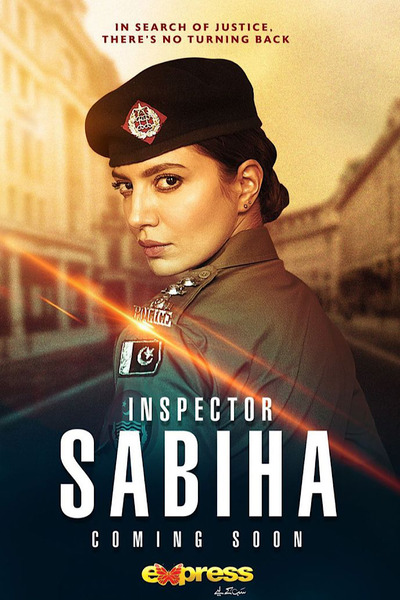 Under other circumstances, this six-episode TV series, would potentially be a marginal entry. But, just as I try to take the historical era into account, I think the location from which a film comes should also be a consideration. Some countries and cultures are simply more action heroine friendly than others. What would be groundbreaking in one region, might not even qualify from elsewhere. This is from Pakistan, and is almost the first such entry in our site’s history. [There’s just Hunterwali which… yeah!] I originally saw this in a condensed movie version, at an altitude of forty thousand feet and a ground speed of 555 mph. For I stumbled across it on the in-flight entertainment system while flying back from the UK to Arizona.
It adequately occupied a bit of time on what ended up being a fourteen-hour flight, thanks to an engine issue delaying the take-off. My grumpiness at this was, however, somewhat alleviated by unexpected GWG on the seat-back TV. By Western standards, it would definitely be considered mild, almost to the Lifetime TVM level (which makes sense, basically being a TV movie). But Pakistan isn’t exactly a beacon of empowerment. This female cop was “a giant step for womankind in the Pakistani drama arena”, according to local writers, so we need to cut it some slack. The heroine, Sabiha (the unfortunately named Butt), is the daughter of Inspector Saeed Shah, who was murdered in the line of duty while undercover. She wants to follow in his footsteps – her uncle Akbar (Ehteshamuddin) is also on the force.
He has a nasty revelation: her father, who was also his brother, had gone over to the side of the criminals. This was something covered up to avoid embarrassing the force to outsiders, though it’s an open secret within the police. Sabiha is devastated by this, adding on to problems with her self-confidence as she goes through the training, to the point she is unable to fire her gun, despite the encouragement of a friendly trainer. She eventually is able to cowboy up and persist. Passing the police exam gives her the access necessary to investigate her father’s case, find out the truth about his death, and dispense justice to those who were responsible.
To be honest, Butt doesn’t really look the part – too much make-up for a cop, by Western standards. Nor is she especially convincing in action, though it is cool when she whips off her burqa to reveal her police uniform underneath, and storms the villain’s headquarters. There are some decent emotional moments too. In this area, the heroine is outdone by her mother (Iffat Omar), who is impressively intense, such as when begging her husband not to go undercover. Writer-director Sarwar cuts up the time-line, so we bounce back and forth from Sabiha’s training to her childhood, but it always remains comprehensible. Despite not having seen Gunah, the series to which this is a prequel, it proved good enough to hold my attention. Though considering my location, guess I couldn’t exactly walk out…
I subsequently found all six TV episodes with English subs, and a playlist is embedded below.
Dir: Adnan Sarwar
Star: Raba Butt, Enteshamuddin, Yasir Hussain, Yasir Nawaz
 I wanted to like this more than I did, because the makers are aware of the tropes of the mixed martial arts genre, and in the first half, make a concerted (and largely successful) effort to avoid them. However, the movie is much less successful in the second half, and ends up replacing those cliches with a different set. The result leaves the film just as formulaic – albeit not in the direction I expected. It begins in expected fashion, with a title bout in the EFC, between Alexa Star (Aboya) and Cassady Jones (Rose). The former prevails, but the champion is then attacked after the bell by her opponent.
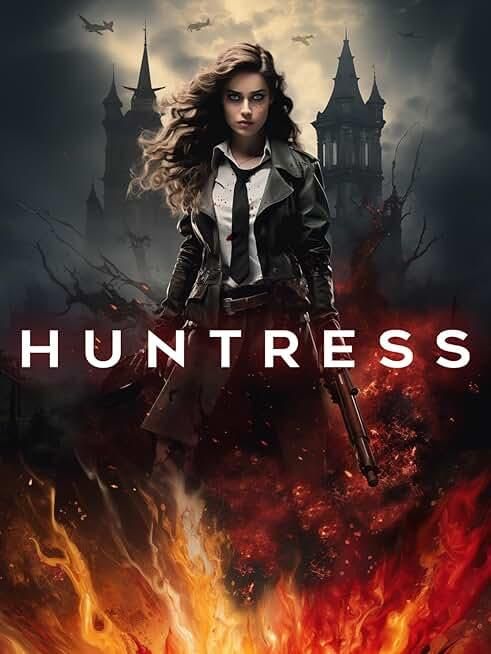 The Texas Chainsaw Massacre was fairly notorious in Britain in the eighties and nineties, being famously banned on video. Naturally, this meant I had to see it, and… I was initially underwhelmed. However, I’ve gradually come to appreciate its raw intensity over the years. If I ever doubted its merits, watching this largely shameless knockoff should act as a reminder. Because it shows how flat and uninteresting the premise can be, when executed poorly. This relocate things from seventies Texas to Germany in the last days of World War II. A medevac team is trying to get injured and grumpy officer, Colonel Franklin (Christian) to a hospital before his leg falls off from sepsis.
 Fair play to Woollard and his team for making a feature movie with no resources to speak of. The problem is, watching this, it’s painfully obvious that they had no resources to speak of. Two space-suits and a fog machine are not enough for a film, especially in a genre like science-fiction, which tends to rely on spectacle. Oh, smaller scale works can still be remarkably successful: the night before this, I watched glorious and highly recommended time-travel film Beyond the Infinite Two Minutes. But if you’re not going to offer epic scale, you need to have something else to repay the audience. An hour and three-quarters of watching characters stumbling about in the gloom is not it.
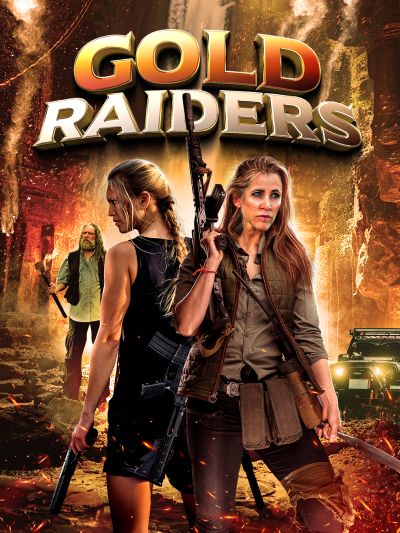 To be fair, for most of the time, this was likely hovering around the two-star range. Not brilliant: it was rather obvious why
 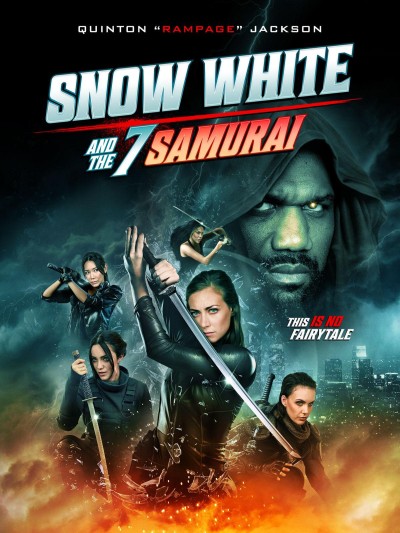 I added an extra half-star here out of how much I was entertained by this. Although this was more a result of us yelling things at the screen than any intrinsic merits. The idea is kinda cool, but if you can’t think of ways this should have been improved you are simply not trying. Anya Voight (Dorn) is known as ‘Snow White’, because her father, Joseph (Eric Roberts), is a coke dealer. He’s killed by a mysterious assassin, and when his will is read, her jealous stepmom, Quinn (Vitori), is highly annoyed to discover Anya will be the one inheriting the business, and has plans to go legitimate.
  Not long ago, I tagged
  We all know professional wrestling is staged, with the outcomes predetermined, right? [Do not used the word “fake”: I will cut you!] Here, things are… murkier. This treads a delicate line between that and kayfabe, the wrestling term for promoting it as reality, and genuine competition. The stance here is interesting, suggesting that while those in charge, like promoter Toshikuni Matsunaga (Saitoh), can have a result in mind, that relies on those in the ring agreeing to it. This isn’t always the case [one wrestling show I remember attending definitely had a genuine fight, for backstage reasons], and here, Matsumoto is a loose cannon, prepared to go to any lengths to put herself over. Or her character: the lines are certainly blurred here, to the point of near invisibility.
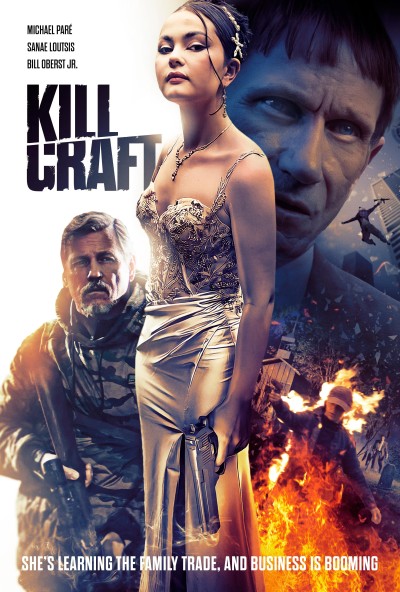 There is potential in the idea here. It’s a shame it ends up feeling like two separate movies, both of which come out feeling under-cooked. The main focus is on Marina Delon (Loutsis), a teenage girl with the typical teenage girl problems, e.g. bickering parents, generally sullen demeanour, etc. Except, her dad Thomas (Paré) is actually an assassin, working for the very strange Poe (Oberst). This has contributed to the marital strife, because his work is why mom is in a wheel-chair – and is not happy about it, to put it mildly. However, things are up-ended after Thomas is killed on a job, and Marina decides to take over the family business.
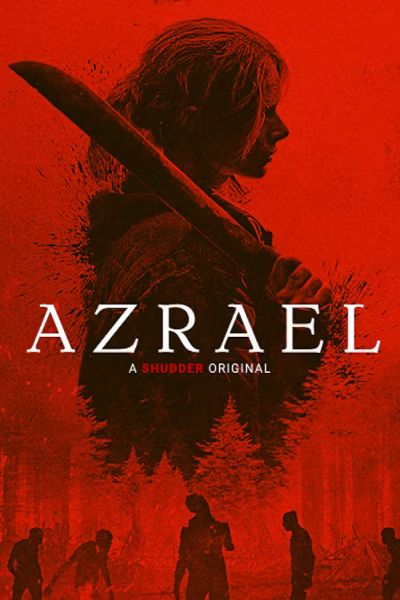 What the film has is a mute woman, Azrael (Weaving) and her boyfriend, Kenan (Stewart-Jarrett), getting captured by an equally silent cult in a forest. The time and era is uncertain, but they do have working cars, so it seems fairly contemporary. They want to sacrifice her to dark, humanoid creatures which inhabits the woods, but she is able to escape back into the wilderness. She attempts to return, so she can rescue her boyfriend, and encounters the group’s spiritual leader, the pregnant Miriam (Sonne). After failing to save Kenan, and narrowly escaping from the dark creatures more than once, as well as getting buried alive, Azrael vows to take bloody and fiery revenge on the cult, and also discovers the true nature of Miriam’s pregnancy.
 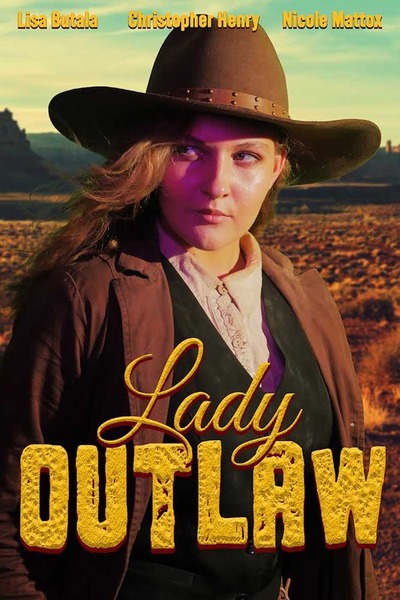 This low-budget Western does a lot of things right, but is not able to tie up all the loose ends in the final act. Most of which are ends that never needed to be loose in the first place. It takes place in 1890’s Oklahoma, when the gang of George ‘Bittercreek’ Newcomb (Henry) is trying to head back home. The gang includes a female outlaw, Rose Dunn (Butala), who is perhaps a little more moral than some members of the gang e.g. Tom, played by veteran villain Michael Ochotorena, this time covering up his impressive face tattoos. The situation comes to a head after Rose rescues a saloon girl, Ellie (Mattox), who just shot a man dead.