




★★½
“At no point, does anyone call her death…”
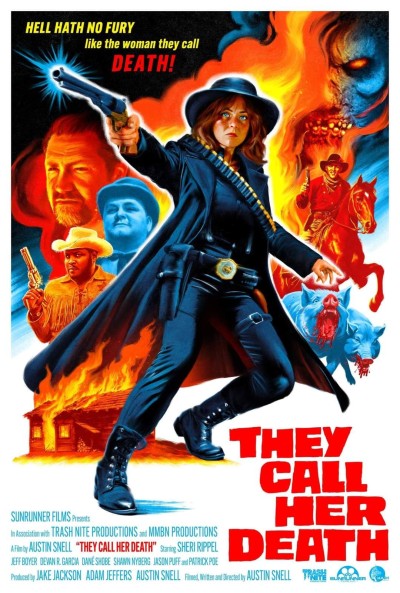 It’s clear what Snell is going for here. This is a throwback to the spaghetti Westerns of the seventies, along with Italian exploitation films from around the same time. I certainly admire the effort which went into this: for example, rather than shooting digitally and applying effects to imitate film, Snell actually shot on Kodak 16mm stock. I did not know that was still a thing, to be honest. Some of the other elements, like the music, also do a good job of reproducing the era – the movie poster is another one. I’ve seen enough of this kind of movie (mostly through Project Kinski), to appreciate what he’s doing.
Unfortunately, I’ve seen enough of this kind of thing, to be able to differentiate the good from the bad, and a fair bit of this skews towards the latter. Molly Pray (Rippel) can only watch as her husband is gunned down in front of her by a bounty-hunter, having been framed for the murder of a lawyer, But she will not accept this, and begins to unravel the threads of the conspiracy, which made Mr. Pray an unwitting victim. And when I say, “unravel”, I mean with extreme, bloody prejudice. She guts some, blows the faces off others, on her way up to the chain to the person pulling the strings at the top. She’s holding a stick of dynamite. We’ll leave it at that.
If you are looking for a comparison, it would be something along the lines of Hobo With a Shotgun. That’s a film I love dearly, and that might be partly why I’m a little sniffy about this. Because if you compare Hobo to Death, the results do not favour this, almost across the board. Most obviously, while Rippel is decent, she’s barely in the same solar system as Rutger Hauer. The lack of a strong antagonist here is a problem too. Instead, Molly largely chews up one person after another. But because we don’t know much about them – beyond their connection, sometimes tangential, to the death of her husband – there’s a severe lack of emotional impact, even as she’s dismembering them for her pigs to eat.
Finally, the pacing leaves something to be desired, especially the sections where the focus drifts off Molly, such as to the friendly new deputy, who is generally on her side. Almost any time he was on the screen, I found myself quickly losing interest, and keen for it to go back to the directly focused line of Mully’s vengeance. The reliance on mostly practical effects is laudable, and there are certainly some impressively gory moments of which Lucio Fulci and his ilk would be proud. But too many of the supporting performances feel like they come from people who were available. Given the shoot took several years from start to finish, that may not be much of a stretch.
Dir: Austin Snell
Star: Sheri Rippel, Jeff Boyer, Devan R. Garcia, Shawn Nyberg
 File this synopsis under technically true: “After the shocking discovery of an unconscious man in a locked unit, the lone employee of a remote storage facility must fight to survive the night against a ruthless gang, dead set on retrieving their precious cargo – at any cost.” I guess the word with which I have the most reason to quibble is probably “fight”. For heroine Laurie Saltair (Fugrman) is more from the Brave Sir Robin school of fighting, if you’ve ever seen Monty Python and the Holy Grail. She’s much more inclined to avoid confrontation than seek it out. Which perhaps making sense when facing a larger, better armed and more experienced enemy. But where’s the
  Watching this one, I had a
  Despite coming in as a “Tubi Original” – a badge which has previously been as much
  ★★★½
★★★½ I’m always down for an Olga Kurylenko film. She’s been in some good entries on the site previously, including
  It’s surprising to me that there are currently no English-language external reviews listed for this on the IMDb. It’s certainly worthy of notice outside its native Spain, where it was nominated for thirteen Goyas, the local equivalent of the Oscars, winning Best Film and Best Actress. It takes place over a number of years around the turn of the millennium, when the Spanish state was in a notorious and bloody war against ETA, a terrorist group fighting for the independence of the Basque region. Mónica (Yuste) is a cop who is recruited by Angel (Tosar) to go deep undercover, and infiltrate ETA in order to provide information on the group, its members and their plans.
 As a child, Oo-yi came to Thailand with her mother as a migrant worker. They had the misfortune to work for the cruel Madam Bussara (Kingpayome), who had a particularly nasty habit of pimping out young girls to her lawyer, Methi. When she tried to do the same to Oo-yi, Mom stood up for her – and was beaten to death for her pains. Oo-yi was able to escape, and raised by Ni Wai (Sirikul). Now, an adult (Luevisadpaibul), she is set on vengeance, and intent on destroying Madam Bussara’s life. To do so, she becomes Thicha, “accidentally” bumps into Bussara’s son, Phatchai (Chirathivat), and begins cultivating a relationship with him. But that’s the story of revenge: it’s messy. Since her feelings for him start becoming genuine.
 And, unfortunately, in this case, it’s not messy in a good or even interesting way. It’s messy in a “What the heck is going on?” way, with a large side-order of, “Can somebody please explain this to me?”, and a garnish of “Anyone? Hello?”. To say this film poses more questions than answers would be incorrect. Because that would wrongly imply it offers any answers at all. I’m just glad the version I saw ran a mere 84 minutes, because the IMDb cites a running time more than half an hour longer. Maybe the thirty-five minutes removed for this cut were all of the explanation. Though I suggest it’d be improved by removing about the same again.
 I wonder if this film was made as some kind of bet. How many tropes and clichés can