
★★★
“It’s just a bunch of hot chicks in their nighties, playing Truth or Dare.”
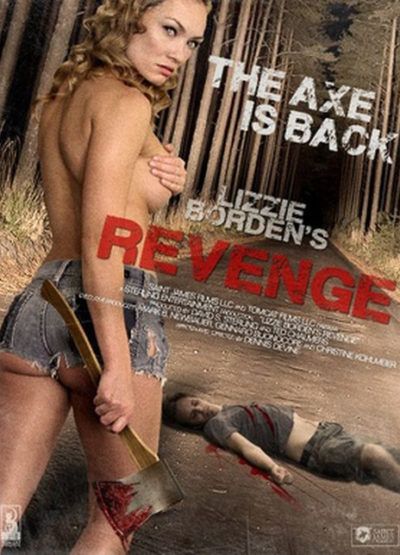 It would, certainly, be easy to look at the poverty-row production values here, and dismiss this contemptuously as a bad film. I mean, the very first shot supposedly sets the scene at the infamous New England house in 1892, where Lizzie Borden took an axe and gave her mother forty whacks. But take a look. I’m fairly sure the trash cans to the right of the house are not of 19th-century vintage. And I am almost certain the palm trees on the left are not native to Massachusetts either. Given this, the awful use of CGI blood, etc. if you were to dismiss the film as the kind of sloppy work that gives B-movies a bad name, I wouldn’t argue.
And, yet… The line of dialogue which is the review tagline above, shows impressive self-awareness, while the storyline seems deliberately cheesy: A bunch of sorority sisters on campus lockdown stage a seance. As one of them says, “With a blood relative of Lizzie Borden sitting right in the centre of our circle, something is going to happen, I just know it!” No prizes for guessing what. To quote the film once more, “We conjured up the ghost of Lizzie Borden and now her lesbian ass is haunting our sorority house?” [This isn’t for titillation: okay, not just for titillation: one theory about Borden involves her relationship with actress Nance O’Neil]
It is at its most amusing when pushing this knowledge of horror tropes, such as when the dwindling band of sorority sisters refuse to split up, leading to a conga line through the house. The characters in question may be stereotypes – the bimbo, the nerd who spouts bizarrely incoherent lines such as “A statistically higher chance of probability”, the troubled one, etc. – but most of the performances are decent enough, and it’s all impressively gynocentric. [This movie would pass the Bechdel Test, though perhaps indicates once more the uselessness of that ludicrous metric.] The men are relegated to minor roles of no real importance, and are, if anything, even more two-dimensional than the women. They also don’t shed their clothes as much: at the risk of stating the obvious, I am fine with this.
Ricci, who plays Lizzie’s descendant Leslie, is an adult star of some renown, yet is perfectly adequate here. Overall, I’ll confess this kept me considerably more amused than I expected from the early going, when the performance of the actor playing Mr. Borden almost had me reaching for the off button (it may have been saved by the always welcome presence of cult icon and scream queen Brinke Stevens, playing his wife). Certainly, you have to get past the shoddier, cringe-inducing aspects; having a taste for the trashy end of cinema is also necessary. However, director Devine is a veteran of horror as well as exploitation genres, and inserts enough sly nods to its conventions and cliches, that I was entertained.
Dir: Dennis Devine
Star: Veronica Ricci, Shanalynne Wesner, Jenny Allford, Mindy Robinson
 “Two women with swords was a sight that none of Vane’s men had ever imagined. It was like seeing a two-headed snake; one such monster would be a freak of nature, while two would indicate a terrible new species.”
 This feels like a low-budget project in many ways, but manages to punch above its weight, in part due to an impressive supporting cast. While Lou Diamond Phillips, Danny Trejo and Steven Bauer are nowhere near as important as their names on the cover might suggest, their presence provide a solid foundation on which the less well-known members of the cast can build. In particular, Danay García as Loca; having bailed on Fear the Walking Dead after about two episodes, I wasn’t aware of her, but on the basis of this, she’s a name on whom we’ll be keeping an eye.
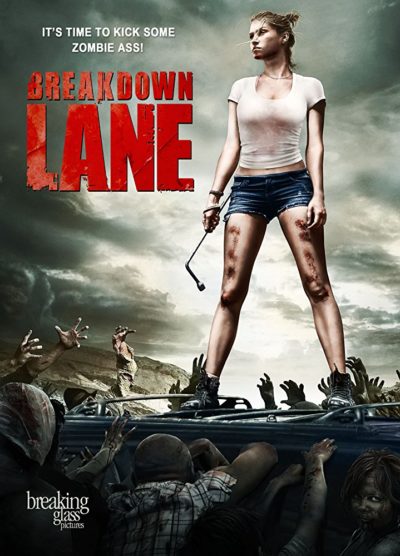 An initial twist on the zombie apocalypse and an appealing heroine aren’t enough to save this. By the end, while said heroine has transformed into a mayhem-dealing machine, any fresh elements have been discarded, for a low-budget rehash of ones which we’ve seen far too often already. It starts intriguingly, with Kirby Lane (Moore) “ambushed” by a woman in a camper with a sick man at a gas station, while on the way to meet her boyfriend (Cushing). When her car breaks down in the middle of absolutely nowhere, the only connection to the outside world is Max (Howell), the agent for her on-board emergency help provider. But things in the outside world are deteriorating rapidly, and the tow-truck Max dispatches… well, let’s just say, it might be a while. Meanwhile, Kirby has to handle the perils which threaten her, including humans both infected and cannibalistic, as she tries to fulfill her promise to link up with Max.
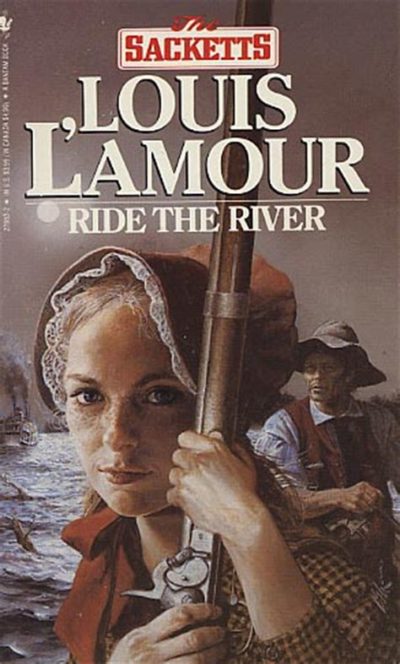 Goodreads characterizes this novel, set in 1840, as the fifth volume in the author’s Sackett series. The fictional Sackett family, in L’Amour’s writings, are descended from tough, larger-than-life Barnabas Sackett, who emigrated to America in the 1600s and settled on the frontier, and who laid down a law for his descendants that whenever a Sackett was in trouble, the rest were bound to lend their aid. This book is indeed about a Sackett, and no doubt chronologically the fifth in that sequence. But the sequence forms a multi-generational saga in which the individual books are generally about different people; though some knowledge of the family origins, as mentioned above, might be helpful (and is repeated in the text of this book, for readers who didn’t read the series opener), they can be read perfectly well as stand-alones. (I haven’t read any of the other Sackett novels.) L’Amour also wrote sequences of novels and stories about two other fictional families that bred adventurous pioneers, the Chantrys and the Talons, whose paths sometimes cross those of the Sacketts –and the paths of a couple of the Chantrys will bring them into this tale as well.
 Oh, be afraid… Be
 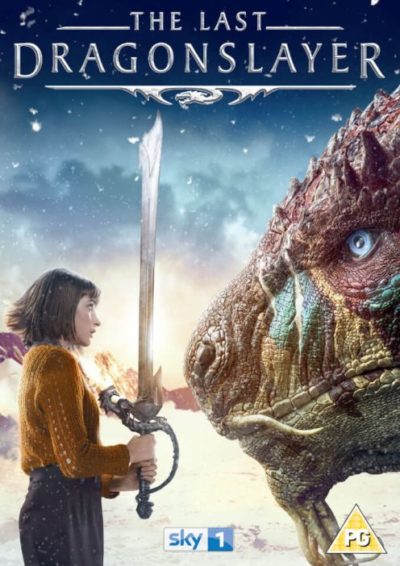 This slice of British televisual fantasy was offered up on Christmas Day, and provides a pleasant, warm and unchallenging slice of family fare. It takes place in a world where magic has ruled, but is gradually fading from consciousness and being replaced by technology. The magic appears connected to the dragons with which humanity shared the planet, uneasily. After previous battles, a kind of apartheid was set up, with the world divided into dragon and human areas. Overseeing the peace is the Dragonslayer, who is charged with killing any dragons who violate the treaty and attack humans or their territory. But some members of mankind are casting envious eyes on the unspoiled territory of the dragons, and would love an excuse to take it over.
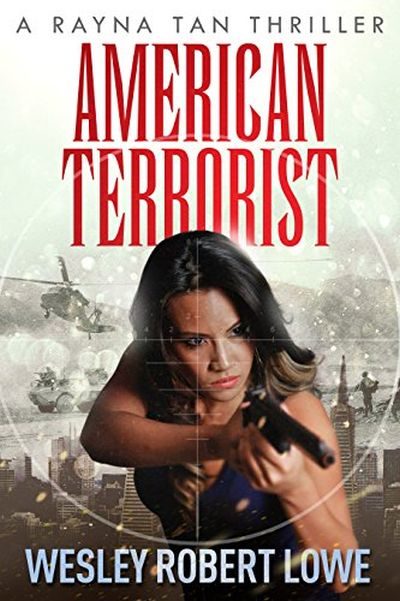 This was a disappointment, and a real chore to get through. If it had been a film, I’d have been reduced to surfing Facebook distractedly on my phone for the majority of its running time. Unfortunately, you don’t get to leave a book on in the background. It’s a stylistic and literary mess, throwing at the reader Canadian Special Forces heroine Rayna Tan, without providing any real background or character building beyond an incident in the Middle East. It then randomly switches around between her, a brother/sister pair of Islamic terrorists, Ahmed and Fatima, and their startlingly incompetent American recruits, who appeared to have strayed in from Four Lions. Throw in some unsubtle politicizing – even if I don’t necessarily disagree with the ideas expressed, it’s not what I want to read in my fiction – and it feels more like a half-finished collection of ideas than a coherent novel.
 ★★★½
★★★½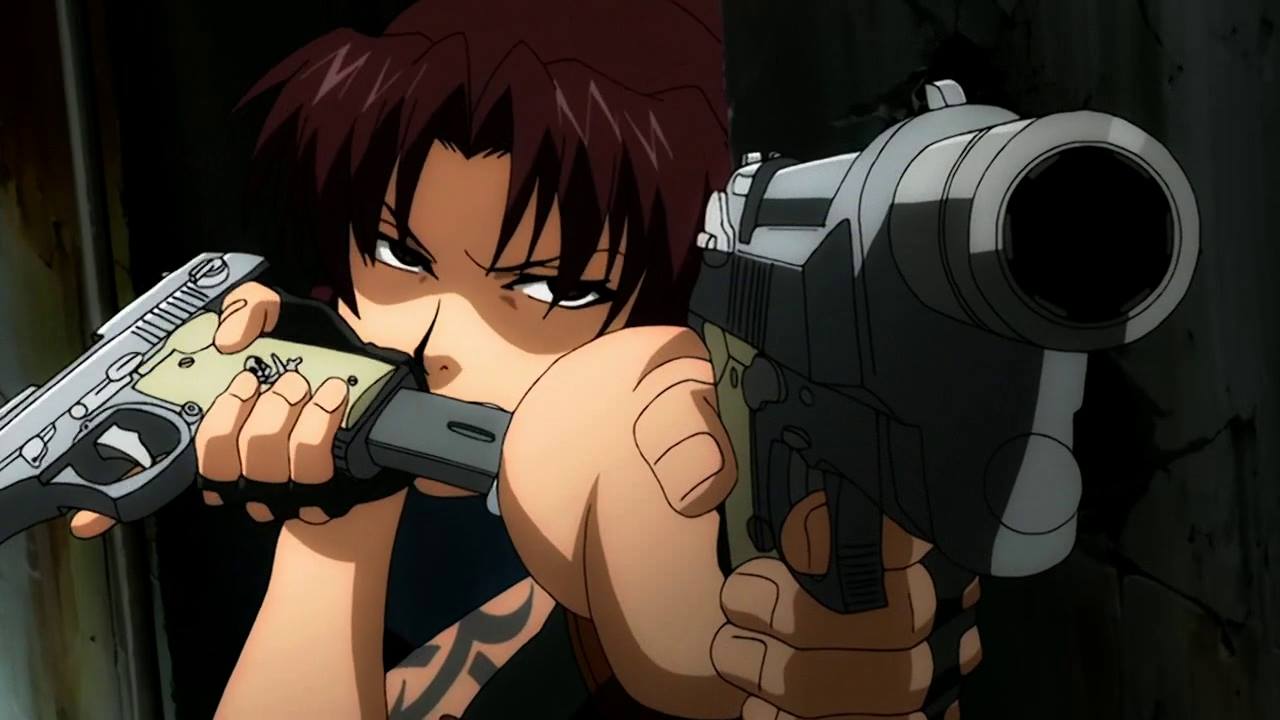 If she were the only candidate, this might end up being a bit of a borderline entry, but over the 24 episodes in the two series (there’s another five-episode arc I haven’t seen, Roberta’s Blood Trail, which came out in 2010), Revy is joined by a number of other, morally ambiguous women, all of whom are more than comfortable with firearms: