




★★★
“Prairie dog pest control.”
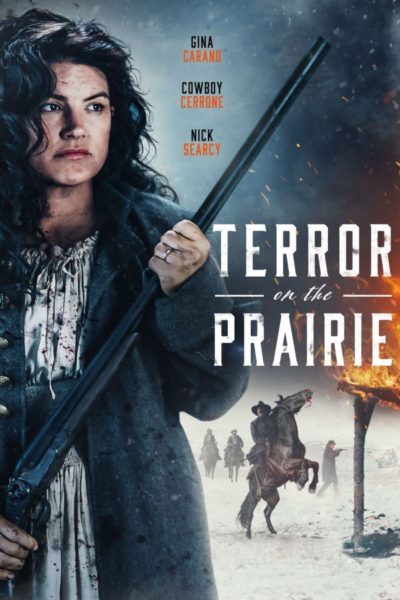 I keep hoping Carano will deliver an action film reaching the quality of her debut, Haywire. Results since then have been… well, let’s be charitable and call them uneven. The reasons for her departure from “traditional” Hollywood aren’t something I want to get into: but this, produced by conservative outlet The Daily Wire, does show the book isn’t closed on her yet. The Wire have put out a few films we’ve covered here, though again, the quality has been mixed: the last, Shut In, was not good. This is a similarly simple story, yet does a bit more with it. The pacing is too languid for my tastes, yet there were sufficient quirks to keep me adequately interested.
It takes place on the Montana plains, some years after the end of the Civil War, where Hattie McAllister (Carano) and her husband, Jeb (Cerrone), are trying to make a life for themselves and their two kids. Hattie has just about had enough, and wants to head back to her home-town of St. Louis. Before any decision can be made, life is interrupted by the arrival of a former Confederate officer, the Captain (Searcy), and his band of men. While he initially seems charming, the scalps tied to his saddle tell another story, and it’s quickly clear he has a specific agenda, rather than randomly passing through. With Jeb away in town, it’s up to Hattie to fend off the ensuing siege until her husband can return. Considering she is depicted as unable to kill a rattlesnake that entered their cabin, she’s going to need new-found resilience.
It’s a straightforward tale, brought down by too many unnecessary pauses: we really do not care what Jen is getting up to, for example. These derail the film’s reasonable efforts to build tension, bolstered by some surprisingly graphic gore (one throat-slitting in particular), and Searcy’s good performance as a thoroughly villainous antagonist, whose word can’t be trusted, despite his quoting of scripture. It might have made more sense to have Hattie depicted as competent and brave from the get-go. Instead, it leaves the Captain and his men seeming incompetent, although some of this is their initial reluctance to take her seriously, e.g. he addresses her 9-year-old son as the “man of the house.”
A novel wrinkle is the director’s decision not to accompany the action with a musical score of any kind. It certainly keeps you in the moment, yet there is also reason why Ennio Morricone’s soundtrack is so key to Sergio Leone’s spaghetti Westerns being undisputed classics. The action, if generally restrained, is competent, and it’s probably for the best the film did not try to turn Hattie into some kind of Western MMA goddess. I did worry the return of Jeb was going to push his spouse off to the sidelines in the final reel; while it teetered on the edge for a while, the film pulled back. If not breaking any boundaries, this is worth a look, especially if you’re a fan of the genre.
Dir: Michael Polish
Star: Gina Carano, Nick Searcy, Donald Cerrone. Tyler Fischer
 Joan is always a figure who has the potential to be co-opted into other times and locations. Recently, we reviewed
 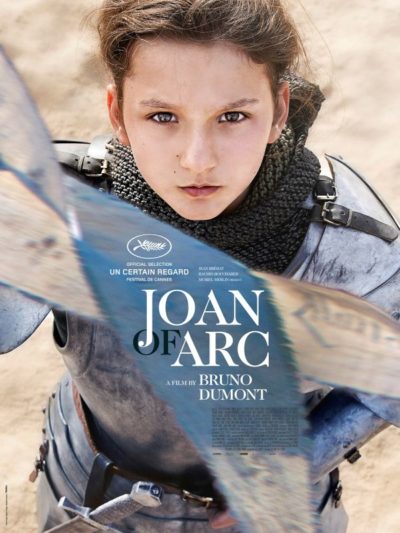 I liked this considerably better than its predecessor. Part of that was, perhaps, knowing what to expect going in: a minimalist retelling, with occasional musical numbers. Except, this proved rather more than minimalist (though still very restrained), and there was hardly any singing at all. Curse you, Dumont, for confounding my expectations. It begins, much as Jeanette ended: with a lot of standing around in sand-dunes, chatting. However, the cast this time cannot be counted on the fingers of one hand, and there aren’t any staggeringly bad performances to take you out of the movie. You still don’t get any great battles. Instead, these are basically represented by team dressage, two groups of horses and riders, swirling around near each other.
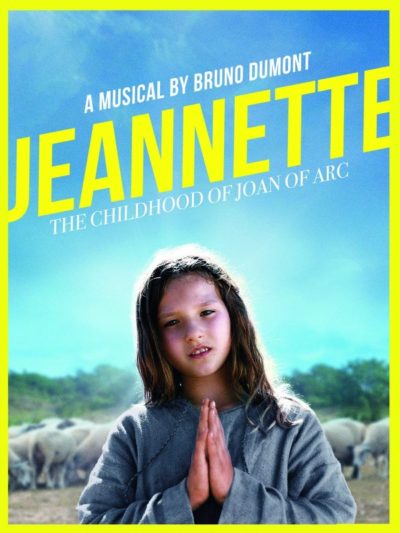 I initially intended to review this and its sequel, Jeanme, by Dumont as one entity, for a couple of reasons. They really only work as a single item. This confused the hell out me, because the second film turned up on a streaming service by itself. Five minutes in, I was so confused, I started searching the Internet, only to find I had, in effect, joined a movie already two hours in progress. Also, I suspected I would be hard-pushed to deliver 500 words on
 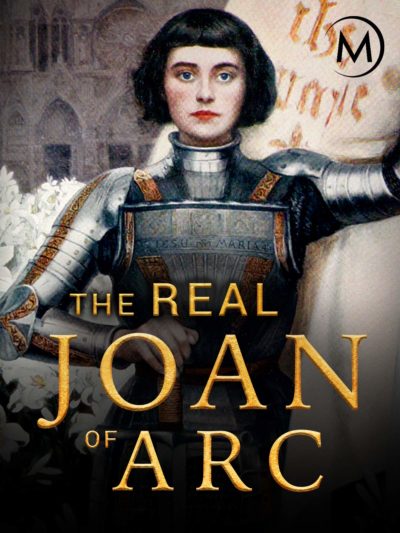 Pun mot intended, but the reality is, we know very little for sure about Joan of Arc. Not even what she looked like in detail, for there are no surviving portraits of her, dating from when she was alive. The facts about her life are equally as uncertain, because everything about Joan was subject to spin, depending on who was talking, when they were saying it, and what agenda they sought to achieve. Because everybody involved
 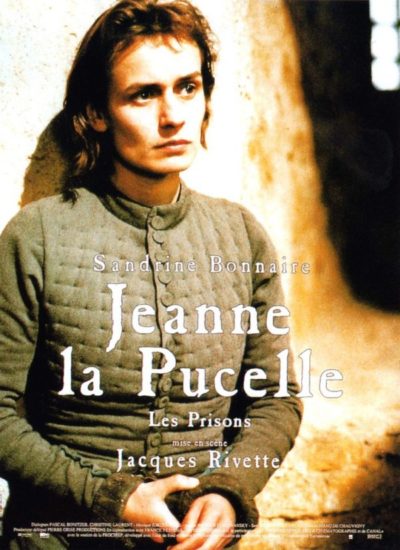 Just as part 1,
 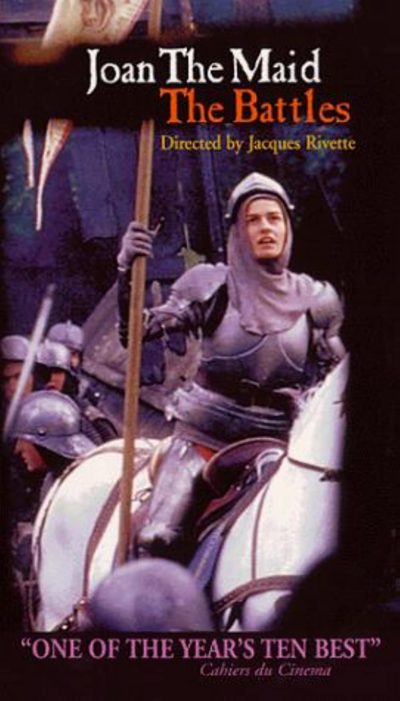 The above refers to the title, and in particular “The Battles”. It is a solid two hours before anything more than handfuls of English and French troops lobbing rocks at each other show up. So if you are here for large-scale spectacle, keep on walking. You will be disappointed. I had a certain idea of what to expect, having seen Rivette’s immediately preceding film La Belle Noiseuse. Admittedly, I saw it largely because I had the hots for Emmanuelle Beart at the time. Otherwise, a four-hour movie, containing lengthy sequences of real-time painting would probably not have been on my radar. But I kinda liked its languid pace (the copious Beart nudity didn’t hurt, let’s be honest!), and so was prepared for things in this to unfold at a similarly leisurely pace.
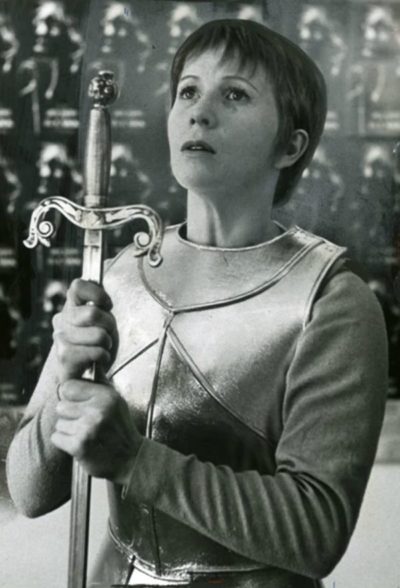 This was originally a French play, L’Alouette, written by Jean Anouilh in 1952. Three years later, a translated version was brought to Broadway, where it ran for 226 performances from November 1955 until June 1956. Julie Harris played Joan, and there was quite a star-studded cast behind her, including Boris Karloff as Bishop Cauchon, Christopher Plummer and Theodore Bikel. It was critically acclaimed, Harris winning that year’s Tony Award as Best Leading Actress, and Karloff being nominated as Best Leading Actor. The following February, a TV adaptation was screened in the United, though wasn’t the first or the last such. In November 1956, the BBC screened their version, with Hazel Penwarden as Joan, and a supporting cast including Michael Caine. Additionally, 1958 saw an Australian version, though it seems notable only for having Olivia Newton-John’s father in the cast.
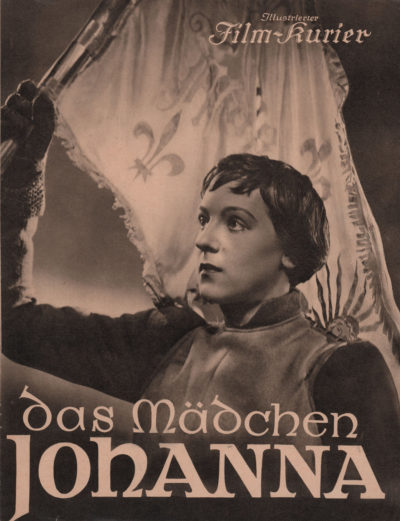 It’s basically impossible to separate this from the time and place in which it was made: that being Nazi Germany, just a few years before the outbreak of World War II. The portrayal of, not only Johanna/Joan of Arc, but the rest of the participants, has to be read in this light. It certainly explains why neither the English nor the French sides exactly come over as covered in glory. From the former camp, we have Lord Talbot, who is cruel to an almost cartoonish degree. On the latter we have King Charles VII (Gründgens), who is cynical to a fault, and has no qualms at all about using Joan when convenient, then discarding her when she isn’t.