



★★★★
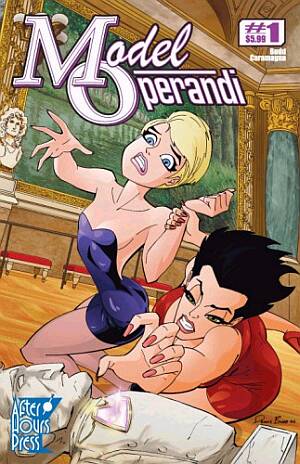
 Back in the day, I was a big comics fan, but have largely ignored the medium since coming to America in 2000 [there are still two large, unopened boxes in the hallway closet!] I think it’s perhaps the Scot in me coming out: graphic novels are an expensive way to pass an hour or so. Props first, therefore, to Caramagna and Budd, for keeping the cost of their first issue to an extremely reasonable price The story therein centers on the theft in France of a priceless diamond, the Heart of Josephine, and the quest of supermodel Legsy Diamond and Ann Lezbee, the implausibly-bosomed Special Ops Presidential Intern, to retrieve it.
Perhaps the biggest weakness is this storyline tries to cram too much in. As well as the search for the diamond, we also have Legsy’s family background, inter-model agency rivalry, her boss’s previous intrigues, a relationship with an investigating cop, and so on. While this sets up many potential storylines for future issues, it does feel somewhat heavily laid-on, and I tend to feel that less would be more. They’re going for an almost-Alias level of complexity, but twenty-plus hour-long episodes gives you much more scope for exposition than 88 pages, especially in an action-oriented title like this.
That said, the artwork rocks. Bright, crisp, colours mesh perfectly with bold lines, and capture the pop aesthetic delightfully. Every page is the kind of work which deserves to be framed and hung on the wall – though occasionally is perhaps a little too breast-fixated for me to really appreciate it! [I read it in the canteen at work, and felt a little uncomfortable doing so now and again 8-)] Style-wise, I was reminded a bit of the Adam Warren Dirty Pair comics, and that’s pretty high praise since I do have a page of art from that hanging on the wall here. I’m certainly looking forward to future editions, and this first issue is something any action heroine fan should check out.
Available now from AHP Comics, 88 pages, $5.99
Words and Ink: Joe Caramagna
Pencils and Colors: Dennis Budd
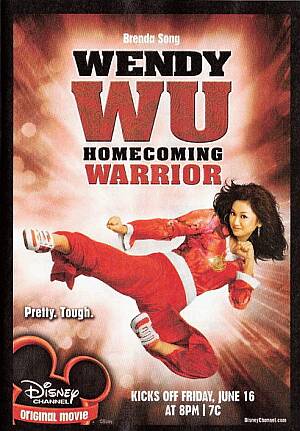 It’s kinda sad to say, but the action in this Disney TV movie kicks the ass of, not only most TV shows, but a credible number of Hollywood films. Then again, behind the fights here is Koichi Sakamoto, who is also responsible for Drive, among the best American martial-arts films of all time. And while obviously “Disneyfied”, this is still sprightly and engaging, with a couple of very decent fight sequences. It is, however,
 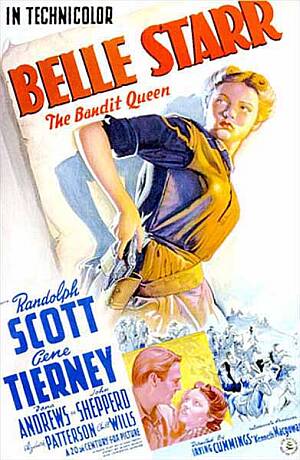 There’s something startlingly incorrect about this 1941 film, which makes its heroine, Belle (Tierney), an unrepentant Confederate mansion owner. She regrets the end of the Civil War and joins a rebel group who keep fighting, marrying their leader Sam Starr (Scott), only to find their morality may not quite live up to her own. It’s interestingly even-handed, with neither side being “good” or “bad”; Belle blames the Yankees for the death of her father and the burning of her home, but the leader of their forces, Major Grail (Andrews) is a sympathetic character who carries a torch for Belle. Naturally, given the era, Belle is more of an assistant, loading Sam’s rifles during a gun-battle, rather than firing them herself and it’s remarkable how her hair and dresses remain impeccable, even when she’s livin’ la vida outlaw. However, she’s a fine, independent-minded heroine, prepared to take decisive action to support her beliefs – highly dubious though they may be.
 Despite influences all over the place – Assault on Precinct 13, Aliens, Night of the Living Dead, The Magnificent Seven – Siri takes and runs with them very effectively. Laborie (Farès) is a career soldier, tasked with transporting an Albanian gangster to his trial; but the convoy is ambushed, so she and her men hole up in a nearby warehouse on a deserted industrial estate. However, it is being robbed by brothers Santino (Magimel) and Nasser (Naceri), plus their crew – and the attackers have also followed them, intent on rescuing their boss. Can they survive until help arrives?
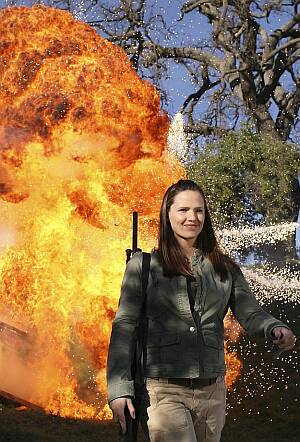 Our once-favourite TV show walks off into the sunset – literally – and we are confirmed in our belief that it is very, very hard to keep interest in a series going past the third season. Especially if you’re creator JJ Abrams, who was missing, presumably making the very Alias-like Mission Impossible III; he didn’t even return to write or direct the season finale. It was, on the whole, a credible stab at trying up loose ends: Rambaldi, the question of whether Sloan was good or evil, Syd’s relationship with her mother, and the real identity of Vaughan, about to be revealed at the end of season four, when he and Sidney were in a car-wreck. This led into the main arc of the series, a hunt for ‘Prophet 5’, a shadowy organization intent on the usual things shadowy organizations want. As opposed to, say, the Alliance, the Covenant, K-Directorate, SD-6, etc…

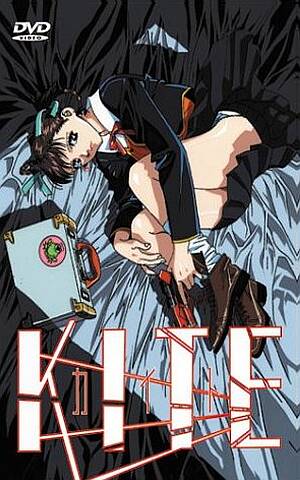 Concerns about some content here means Kite has had a tortuous release in the West. First time out, in 1998, it was shorn basically of all explicit sexual content: given the potentially underage nature of the animated heroine, Media Blasters didn’t want to be hit with a kiddie porn charge – laughable though that may seem for a “cartoon”! – and played it very safe. Subsequent releases over the next six years restored first much, in the “Director’s Cut”, then all (“Special Edition”) the footage, but the OAV* might just work better without the sex. It’s hardly as if I finished it and thought, “Y’know, what this really needs is some sequences of the heroine getting
 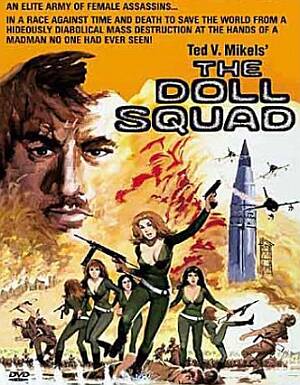 To describe this as eagerly anticipated would be… well, wholly wrong, actually. I’ll tell you how long the DVD has sat on our shelf: I bought it on
 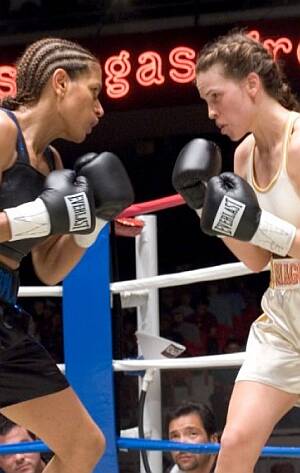 The problem with boxing films is that it’s very hard to avoid the obvious cliches. Kid from the streets, initially seen as hopeless, eventually convinces a trainer to take them on, and struggles towards the goal of a shot at the big time. Million is no different, for the first two-thirds at least. Then, there is a sudden, unexpected swerve – or would have been unexpected, if our son hadn’t ruthlessly spoilered it, by wandering in and telling us of a scene in Scary Movie 4 which spoofed it. Thank you, Robert. :-) This shifts the movie in a radically different direction, though also divorcing it entirely from the action heroine genre and robbing it of at least half a grade, since reviews here center around such aspects.
 Just imagine Jennifer Aniston watching this film: every time Ange appears on the screen, or gazes lovingly at Brad, Jen shrieks maniacally, “Die, sluuuuuut!” Such thoughts will keep you entertained during the sluggish first hour – you’ll need them, while you wait for the characters to realise what we know from the start: Mr. and Mrs. Smith are both assassins, now targeted by their respective agencies. For
  We don’t know whether the Smiths are “good”, “bad” or independent contractors, an interesting approach (we have no moral compass beyond their actions), yet disappointing. For another weakness is that the villains are merely faceless minions, when the genre needs a Big Bad for the climax – the obvious one here is the people that ordered the terminations. Liman, whose Bourne Identity was also about a killer with a contract on his head, might appreciate this more than most, and word is two such endings were shot, just not used. Still, I suspect that the sequel – likely inevitable, given this was one of 2005’s top ten at the US box-office – could very well be more fun than the original. At least we’ll have all the tedious set-up out of the way.