
Duel in the Desert

Typical. Wait ages for one roller-derby league, then two start up almost after each other. Back in June, we wrote about AZ Roller Derby, but a schism arose almost immediately, disenchanted skaters breaking off into the Renegade Rollergirls. A third group also peeled off in another direction. The reasons are not relevant: here, we don’t take sides, especially if it increases our opportunities for femayhem. Regardless, almost-certainly-not-coincidence, two of these three had their first interstate bouts within a week of each other. [While some Renegade Rollergirls took part in the second of these, it wasn’t run by them – their debut is currently scheduled for January] Here’s a comparison shoppers’ guide to events…

November 6th, Surfside Skateland, Tempe. The original federation got their skates on first, sending out an all-star team selected from the home players, called the Tent City Terrors – the name is a tongue-in-cheek tribute to local sheriff Joe Arpaio, who is nationally known…either for being tough on criminals or an incompetent publicity-whore who relies on gimmicks, depending on your viewpoint. Their opponents were the Texas Rollergirls, a group who split off last year from BGGW/TXRD; they came to take on the Phoenix ladies on Saturday, then were going down to Tucson for a match again a southern Arizona all-star team on Sunday.

The venue for the first bout was Surfside Skateland, a place with both benefits and limitations: you can get very close to the action, but it’s not designed for spectator sports, and the only seating was three rows of folding chairs at each end of the rink. If you didn’t get there early, audience members either have to stand or sit on the floor down in front. And if you opt for the latter, you might end up with a roller-derby girl flying into your lap – I leave it to the reader to decide whether this is good! On the definite-plus side, concessions are cheap: a bottle of water is only a buck, where they were also offering $2 beers. However, I didn’t bother, since with it being an all-ages show and a small venue, you can’t take your beer back to your seat, but have to drink it in the designated area. Of the two MC’s providing colour commentary and announcements, one seemed to think that the louder he bellowed into the mic, the better it was: he was wrong. We were far from the only people cramming fingers into our ears and wishing for a high-velocity rifle.

This match consisted of three 20-minute periods, with bands providing entertainment during the intermision. I’m aware of AZRD’s origins on azpunk.com, and roller derby’s close ties to the music scene (which appear almost compulsory nationwide). But it still feels like a clumsy mix, and few people seemed the slightest bit concerned when a power outage brought the second set to a premature close. There was also a half-time raffle for sponsors’ goody-bags – the same guy won about three, making for a good investment!

As for the game itself…we got our butts kicked. The visiting girls were simply faster and tougher, as well as more experienced (roller derby in Texas dates back to TXRD’s creation in 2001), and this disparity was painfully clear from about five minutes in. The first brawl saw AZ captain Ivanna Spankin left looking for the number of the truck that just hit her, and by the end of twenty minutes, Arizona was behind 42-18. This huge lead rendered the rest of the contest almost irrelevant: the two other periods were closer, but by the end, Texas had racked up a three-figure point tally too large for the scoreboard to handle, winning 102-60.

This was a little embarrassing, especially since cameras from the Game Show Network were there to capture the event. However, it’s about par for Phoenix: last season, our baseball, hockey, NFL and basketball teams all ended up near-last in their leagues, so we’re getting pretty used to defeat here. :-( [The Texas team then went down to Tucson, and did a number on them too, 110-70] We were left hoping for a better showing two weeks down the line, when our local heroines were flying out to Austin, to take on the Lone Star ladies on their home turf, but still had an enjoyable evening.

November 12th, Glendale Arena. The following Friday, the Phoenix Landsharks took on the LA Thunderbirds at Glendale Arena. Originally built as a home for the Phoenix Coyotes ice-hockey team, this cost $180m and seats up to 18,000. However, with the current NHL lockout, there are suddenly a lot of blank dates to fill. Hence the unexpected presence of roller derby, with advance predictions of up to 5,000 in attendance – which I have to say, seemed more than a little optimistic.

We got tickets through a contact at the Coyotes (thanks, Marissa!) for $15; if we’d gone through Ticketbastard, and paid the “building facility charge”, “convenience charges” and “order processing fee”, a single ticket would have been $26.40. We battled our way across town, through both rush-hour traffic and torrential rain, and saw the arena rising up in the middle of nowhere – while it’ll eventually be the centre of a whole complex, for the moment, it’s a long drive if you want a restaurant. As is, you pay stadium prices ($3.75 for a bottle of water), but can take beer to your seat.

It’s the first time we’ve been there, since we’re not hockey fans – actually, we used to go to Phoenix Mustangs’ games, we’re just not NHL ticket price fans. But I digress. It’s an impressive venue, with good sightlines and plenty of space: we settled in, a few rows from the front with no trouble [the crowd was nearer 500 than 5,000] The first difference from AZRD was obvious: a banked track. As an engineering feat, it certainly beat two strands of ropelights duct-taped to the floor, though I have to say, it looked a little dangerous. The outside barrier was a rope running around pillars (see photo), and that was all there was to prevent a skater flying off, and onto the unyielding concrete floor.

As we waited, promo videos played on the scoreboard, an enormous device hung from the ceiling like a cannon on the Death Star. Bonus points for production values on these films, which explained the rules and introduced the players, as well as promos for their sponsors: Dickies, the Platinum Girlz promotional company, etc. We learned they were calling the venue ‘The Shark Tank’, which is a catchy name, and that the rules were basically the same; the only major difference was there’d be four periods, each of ten 90-second jams, rather than three twenty-minute periods. On the downside, there was no program, and merchandise was limited to one design of T-shirt. One wonders perhaps how quickly this event had been scheduled.

Generally, though: so far, so good. The two teams came out, were introduced to the crowd (Phoenix were missing their captain, Anita Cocktail, with a torn rotator cuff), and battle commenced. Which is where things got weird. For from about two jams in, it was clear that something odd had happened. Any semblance of competitive edge vanished from the LA team quicker than air leaving a burst balloon. Arizona scored four points; then five; then four more. They won the first period 25-3, and the second by an almost equally wide margin; we also saw one thunderous body check which, save for the quick actions of one cameraman, would have propelled a Thunderbird head-first out of the track onto floor. The body language and apathy of the visitors clearly showed they were extremely pissed-off about something. But what?

During the halftime interval, we were entertained by cheerleaders and a display of swordfighting. The latter was kinda lame, but the cheerleading was acrobatic, though for some reason, as they hurled each other fifteen feet in the air above the bare concrete, all I could think of was the sound of necks snapping like twigs. All told, at least it wasn’t mediocre bands, so we’ll take it. The home team came out, and we waited for the LA Thunderbirds to return. And we waited. And waited. Finally, after much to-ing and fro-ing, their captain came out and launched into a tirade complaining about the track being waxed, and unacceptable. This didn’t seem to make much sense – the home team had no obvious problems skating – and I wondered if this was all some carefully worked angle to try and generate some heat. Except, if it was, it made little sense, and wasn’t very well executed.

Finally, after about a 40 minute delay, mutterings from LA about injuries, and amid threats of the whole team being suspended from play for a year, enough Thunderbirds came back to skate a few lacklustre jams, to give the bout some semblance of closure (the final score was round about 66-6). I’ve not had any official explanation, but I subsequently heard that a lot of the LA team were veterans of the old-school of roller derby – we did note they lacked the florid skating names of the Phoenix team – where the action was more choreographed, and were expecting something similar here. When they didn’t get it, they were peeved; if you imagine two combatants, one anticipating a pillow fight, the other a full-contact karate bout, you can get an idea of the situation.

It was rather disappointing – and hence the advantage is clearly with the AZRD, as far as the Phoenix roller derby scene goes. Though I don’t blame the Landsharks themselves for the chaotic events; they handled themselves with dignity and can clearly skate. If the above story is indeed the case, the fault is partly with the Thunderbirds (when AZRD were getting their asses kicked, they tried harder), and partly whoever it was that set the bout up, without ensuring the two sides were playing the same game. I do think, however, that starting at an 18,000 seat arena was a mistake. Selling out a 300-seat venue would have been more effective at generating buzz, and Saturday night’s events may actually have set back roller derby in Phoenix more than they helped.

The above piece probably generated more feedback and interest than any article in gwg.org history. :-) We subsequently received an email from Celeste Cooper (a.k.a. Alotta Trouble, captain of the Landsharks), giving their side of the story, while the T-Birds issued a press release. Here are both. Most bizarrely of all, at the time of writing this footnote – November 22nd – the T-Birds website says they have accepted a Landsharks offer of a rematch in January. This again raises the possibility the whole thing was artificially fabricated to generate ‘heat’ and foment a rivalry. I’m still not convinced this is the case, however – if so, it was one of the most badly-bungled angles I’ve seen in all my years of watching ‘sports entertainment’. 28th November: Alotta Trouble denies any such rematch is scheduled, though the T-Birds website still says otherwise. At this point, I throw up my hands in bemusement, and move on…

Oh, and two weeks later, Texas completed their sweep over Arizona in the Austin matches, beating Tucson 79-38, and Phoenix 72-51.

The Twins Effect II

★★★
“Film with the trajectory of a ski race; starts off high, goes downhill fast.”

I liked, and enjoyed the original film, and at first, this seems to have a great chance at surpassing it. The opening fight between our two heroines, one (Choi) a slave-trader, the other (Chung) an enforcer for the Empress, is a masterpiece that combines wire-work, CGI and gimmickry – camerawork from Azumi and what looks like a mutant Klingon batleth – to fabulous (if not fully convincing) effect. All this in a mythical kingdom where women rule, and men are reduced to “dumbbells”, while the cast includes both Jackie Chan and Donnie Yen. Even if the connection to the original is tenuous at best, the potential here doesn’t need to be specified.

However, it all goes horribly wrong. Our heroines team up with a pair of jackasses, appropriately named Blockhead (Chen) and Charcoal Head (the talentless Fong, present only because he’s Jackie Chan’s son), and their presence sucks the life from proceedings. One of them – but nobody knows which one – is the ‘Star of Rex’, a future ruler who can defeat the evil empress (Qu Ying) with the aid of the sword, Excalibur. No, really; it must have been on loan from Camelot. As you can imagine, the film proceeds to implode with spectacular speed, a downward spiral that only briefly flattens for a duel between Yen and Chan – the former playing a character called ‘Crouching Tiger, Hidden Dragon’. Oh, hold my aching sides. Even the finale is largely mundane, though the use of an icicle as a weapon by the empress did get our attention.

On the plus side, both Twins put in surprisingly solid performances – Choi, in particular, is much less irritating than before, though remains outshone by Chung. However, they still aren’t enough on their own to sustain a movie, despite the parade of celebrity cameos, especially when co-stars Chen and Fong are woefully short of the mark. With a $10.2 million budget, I just wish they’d spent a few more dollars on the script and some decent actors. Then, it might have lived up to the marvellous first fifteen minutes.

Dir: Patrick Leung, Corey Yuen
Star: Charlene Choi, Gillian Chung, Jaycee Fong, Wilson Chen Bo-Lin

Gun Crazy, Volume 1: The Woman From Nowhere

★★★½
“Muroga reclaims for Japan, what Clint and Sergio borrowed in the 1960’s.”

If the inspiration for this one wasn’t clear, Goro Yasukawa’s score will soon enlighten you: Sergio Leone. A character with a mysterious past and equally obscure agenda comes into a lawless town, and kicks ass. For The Man With No Name and his horse, read Saki (Yonekura) and her Harley. Given that Leone basically ripped off Akira Kurosawa’s Yojimbo in A Fistful of Dollars to begin with, the irony is satisfying. She has come to Tsuson – surely a nod to Tucson, less than two hours down the dusty Arizona I-10 from where I write this – to take on Tojo (Tsurumi), the local mob boss, who commits his crimes with impunity from the safety of an American Air Force base. She gets his attention when she interferes with his robbery of a wages truck, and takes the money herself. The two had met previously, though Tojo doesn’t recognise Saki; you’ll probably work out the basic circumstances long before the film reveals them, but it does add a couple of unexpectedly nasty twists of the knife.

The Okinawan setting is interesting, given tension between US forces there and the locals, dating back to a 1995 incident when three servicemen raped a 12-year old girl. Hence, the scene where Yuki demolishes two leering US soldiers has an additional level of resonance for local viewers, and the tolerance of the Americans to a brutal thug on their territory become somewhat more explicable. Yonekura is impressive in her role, and Muroga wisely doesn’t bother to introduce any love interest; the film is barely an hour long, so there just wouldn’t be room. The inevitability of the final Suki-Tojo faceoff is perhaps only exceeded by its ludicrousness – the heroine expands the definition of “unarmed” to include other limbs too. However, for an obviously low-budget work, it’s busily energetic, and rarely slides much below entertaining.

Dir: Atsushi Muroga
Star: Ryoko Yonekura, Shingo Tsurumi, Takeshi Yamato, Takashi Ukaji

Queen Boxer

★★
“Lee’s skills all but concealed by dreadful release of her debut.”

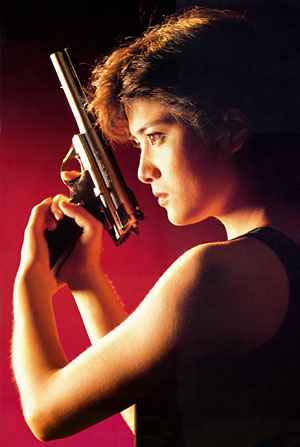
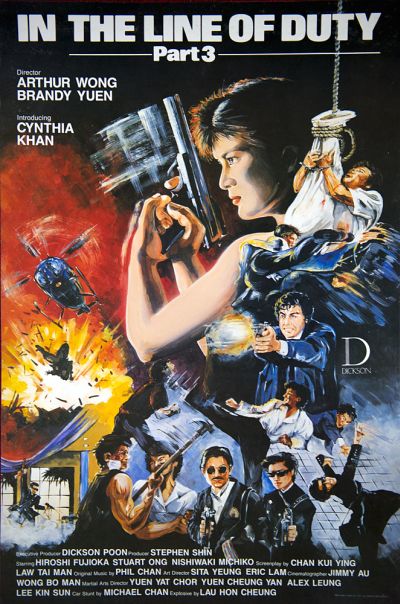
I have to say, this film would probably merit a higher score given a better presentation. Not only is the GoodTimes DVD barely VHS quality, dubbed and horribly cropped, the dialogue is missing from the right audio. Worst of all, the two tracks are out of sync, meaning that every punch is accompanied by a double sound effect. If there’s a more dreadful DVD in existence, I don’t want to see it: those responsible should suffer the fate depicted in the fabulous poster, shown on the right.

However, one suspects that even under better conditions, large chunks of this would be pretty poor, bordering as it does on the incoherent, with inadequate definition both of plot and characters. Also known as The Avenger, this 1972 film marked Judy Lee’s first film – originally from Taiwan, she was a Peking Opera classmate of Angela Mao. In this, she plays a woman for revenge on the man who killed her brother and gouged his eyes out, and teams up with another guy (Yeung), who is fed up paying protection money to the same villain. They enter the boss’s lair, but he gets shot, and they have to back off – only for her to return, and take them on by herself.

Those two action scenes are both lengthy and pretty good. The lack of directorial inspiration shown here is actually a virtue, since he basically just turns the camera on and off – this is what you need to admire Lee’s skills, which aren’t bad at all. However, up until the last 20 minutes, the only fun is making fun of the film, or listening to the chunks from Shaft and Bond ripped off on the soundtrack. That, and a glorious, deeply satisfying final shot, aren’t enough to save things – but, being honest, few movies could probably survive such godawful treatment.

Dir: Han Wah [according to the DVD sleeve, anyway…]
Star: Judy Lee, Yeung Kwan, Wong Yeuk Ping, Lee Ying

Silverhawk

★★½
“Comic-book stuff – unfortunately, in the bad sense of the phrase.”

There’s no doubt about the aesthetic they’re aiming for here; heroine with secret identity, sneering evil nemesis, gadgets, etc. Take a Marvel comic from the 60’s, transplant it to the modern Far East, and there you are. Indeed, this period is apparently where SilverHawk originated; unfortunately, the makers failed to learn from similar failures such as The Avengers, The Mod Squad and Wild Wild West, and the results are lacklustre.

The problem here is mostly a script with no idea how to fill the gaps between the fight scenes, succumbing to the nemesis of so many HK films: juvenile humour. Jen is the worst offender, playing a cop out to track down Lulu Wong (Yeoh), a.k.a. SilverHawk, who is so incompetent we’re given no credible reason to believe he’d be put in charge of tea-making, never mind a high-profile investigation. They were in the same orphanage as kids: yes, it’s that kind of script. Inevitably, they team up to go against bad guy Alexander Wolfe (Goss) who wants to control people’s minds using mobile phones – the satirical potential in this idea is, inevitably, never realised. The potential for product placement, on the other hand…Nokia and BMW are the big winners there.

That’d all be okay, if the action was above average. It’s not. While still the best thing here, we actually fell asleep during the climax, and had to rewind once we woke up. There’s little sense of escalation: once you’ve seen the opening battle, that’s pretty much all the movie has to offer, save various gimmicks. Silverhawk battles thugs on bungee cords! [The producers were clearly hoping we’d all forgotten Tomb Raider, which at least made a thin pretense at explaining itself there] Thugs on roller-blades! Wolfe is clearly not short of imagination – except when it comes to giving his henchmen firearms, naturally.

It’s great to see Yeoh, now in her forties, still do a motorcycle jump across the Great Wall. However, things like the clunky mix of languages cripple this, and the result definitely won’t help Yeoh’s career. After Tomorrow Never Dies and Crouching Tiger, the world was at her feet, but projects such as The Touch and this one have proved very disappointing. Her talent remains clear; her judgement, on the other hand, is clearly very questionable.

Dir: Jingle Ma
Star: Michelle Yeoh, Richie Jen, Luke Goss, Brandon Chang

Mulan (animation)

mulan1★★★★½
“Here be drag-ons…”

Disney movies are not the usual place to find action heroines: their classic woman is a princess, who sits in a castle and waits for someone of appropriately-royal blood to come and rescue her from whatever evil fate (wicked stepmother, poisoned spinning wheel, etc.) that has befallen her.

The first inklings of a change to this traditional attitude came in 1991 with Beauty and the Beast, where Belle was an independent-minded young lady who rejected the advances of the handsomely square-jawed hero, because he was an idiotic jerk. Unfortunately, the moral was somewhat diluted by the end when – and I trust I’m not spoiling this for anyone – the Beast turns into a rather convincing facsimile of said handsomely square-jawed hero. So, looks are everything, after all… Much more successful was their 1998 attempt, Mulan, recently released for the first time on DVD, which took a traditional Chinese legend about a girl who dresses as a man to join the army, and converted it into the traditional Disney animated feature format, complete with songs and amusing sidekick. Given the studio’s previous track record (hey, why bother paying writers to come up with new stories, when there’s public domain ones to rape?), qualms here are understandable. Perhaps most memorably, Disney gave Hans Christian Andersen’s The Little Mermaid a happy ending, though turning Quasimodo into a lovable Happy Meal probably comes close – that whirring sound you hear is Victor Hugo spinning in his grave.

And, yes, liberties were taken, though to be fair, you expect this in any screenplay – especially one whose story originally appeared in a poem written by an anonymous Chinese author around the 5th or 6th century AD. [The poem also appears on the DVD, but without any attribution or context; you’d be forgiven for thinking it was written by a Mousketeer] From here sprang a whole raft of tales, with different eras, locations or surnames, largely dependent on the author’s feelings, but having several common threads. The story takes place over more than a decade, and Mulan’s identity isn’t discovered until she has finally returned home and resumed her normal life.

There’s also no threat of execution when her deception is found out – Chinese culture may perhaps actually have a more tolerant approach to such things, though this is admittedly going only by the likes of Peking Opera, and a good chunk of Brigitte Lin’s career. And, of course, both the romantic angle and amusing sidekick were modern additions. This contrasts sharply with one version of the original, which has the Emperor hearing of Mulan’s exploits, and demanding she becomes his concubine. Mulan commits suicide in preference to this fate, an ending that, for some reason, didn’t make it into the Disney adaptation…

Perhaps the surprising thing is that there haven’t been more movie adaptations of the story – contrast the literally hundreds of movies based on Wong Fei-Hung. There have been a couple, most notably 1960’s The Lady General Hua Mu Lan, directed by Yue Fung, and starring Ling Buo as Mulan (real-life husband Jing Han played General Li). Before that was Maiden in Armor starring Nancy Chan, made in 1937, largely as propaganda to rally the Chinese against the Japanese. The most recent version was in 1999; Yang Pei-Pei’s 48 episode TV series starred Anita Yuen as Mulan [photo, right]. However, over the past couple of years, no less than three versions have been rattling around in development hell. The most eagerly anticipated one stars Michelle Yeoh as Mulan, with Chow Yun-Fat co-starring. The director is uncertain (Peter Pau and Christophe Gans are most often mentioned) and production still hasn’t started, even though it was announced back in July 2001; recent reports now have it scheduled to begin filming early next year.

Stanley Tong has also been working on The Legend of Mulan; the original plan was to shoot this in English, with Lucy Liu and The Rock as Mulan and the Hun general respectively, but this may have fallen through; with Tong now working on the next Jackie Chan film, this one seems to be on the back-burner. Finally, a Korean version, with either Jeon Ji Hyun (My Sassy Girl) or Zhang Zi-Yi, was scheduled, but not much has been heard about this lately. The Disney version, on the other hand, just came out on DVD for the first time – in part, I suspect, to act as marketing for the forthcoming, inevitable Mulan II. The trailer for the sequel is on the Mulan DVD, but Lady and the Tramp II, The Little Mermaid II, The Hunchback of Notre Dame II and Aladdin II should give you an idea of how wonderful Mulan II will be. [It’s going straight to video, of course, but it does at least have Ming-Na Wen. No Eddie Murphy though.]

That’s a shame, because the original still has a great deal to offer. Unlike many Disney films, the songs don’t bring proceedings to a grinding halt and are notably absent from the second half of the film. Indeed, the transition is deliberately abrupt: a band of happy, singing warriors is stopped mid-verse when they come across a burnt-out village which the Huns have exterminated (right). It’s a simple, but highly effective moment, where silence says a lot more than any words. [At one point a song for Mulan about the tragedy of war was considered, but this was dropped, along with Mushu’s song, Keep ‘Em Guessing – both decisions which can only be applauded.]

Obviously, in terms of action, it’s hamstrung by the G-certificate (though the British censors insisted on a headbutt being removed to get the equivalent ‘U’-rating), but allowing for this, it’s still got some exciting scenes, and the first encounter between Mulan and the Hun army is fabulous by any measure. It also avoids the pitfall of many a Disney film – making the villains more memorable than the main characters. [Everyone remembers Cruella DeVille from 101 Dalmatians; but can you name the hero?] Here, Shan-Yu is almost a caricature, but does what’s necessary quickly, allowing the other characters to be developed more completely, and compared to other Disney heroines, Mulan may be the most well-rounded human being.

Of course, Eddie Murphy comes close to stealing the show as demoted family guardian, Mushu. Unlike Shrek, where the competition for laughs with Mike Myers was painfully clear, Ming-Na Wen is content to be the straight “man”, and the film benefits as a result. Murphy’s accent is entirely anachronistic, naturally, but that’s half the fun – interestingly, the American DVD offers the option of a Mandarin soundtrack, which is a nice option. We did try it for a bit, but the Chinese Mushu just didn’t have the life and energy of Murphy, and we soon switched back. [HK singer CoCo Lee plays Mulan, while Jackie Chan is the voice of Shang in both this and the Cantonese versions] The tunes are perhaps not quite “classic” Disney, in the sense that they don’t stay in your brain for years after, to explode at the most inappropriate moments. They’re still fairly hummable though, and Jerry Goldsmith’s Eastern-tinged score compliments the similarly Oriental-flavoured animation well. The makers clearly did a lot of research, thought it does have to be said, the film does not exactly portray Chinese culture in a particularly good light; Mulan, the heroine, is shown as rebelling against it in almost every way. One reviewer describes its basic theme as, “a woman with western values overcoming the oppression of a backwards Chinese civilization.” Ouch.

However, personally, I’d say the value of having a clearly non-Caucasian heroine (a first for any Disney film) outweighs relatively minor quibbles about subtext. It may be the last great hand-drawn animated feature from the studio which invented the genre, and all but defined it for sixty years, so I have absolutely no hesitation in recommending this as an empowering and highly entertaining tale for children – of any age, but especially those too young to read subtitles. There aren’t many action heroine films our entire family loves, but Mulan is definitely high on the list.

Dir: Tony Bancroft and Barry Cook
Star: Ming-na Wen, Eddie Murphy, B.D.Wong, Soon-Tek Oh

Silk & Steel (Police Branch 82 – Rebirth)

★★
“Take a look at the cover, and work it out yourself.”

Another title in the ongoing Metropolitan Police Branch series, has much the same ingredients as the other entries: cheesecake and mildly competent action. I think this is the second entry, but as the three films have three different pairs of actresses playing policewomen heroines Mika and Rin (Hara + Iijima in this case), it’s clear continuity is less the purpose of the exercise than the aforementioned C + MCA.

Most of the gratuitous nonsense is got out of the way early, with the pair going undercover as dancers at a strip-club – hey, what are the odds against that? Though it’s notable that one of the actresses is notably reluctant to disrobe; I would tell you which one, but, really, I could hardly tell them apart and, in any case, it’s an informational nugget of absolutely no importance. After this, the film largely forgets the nudity, heading off in a subplot where Rin (or is it Mika?) gets kidnapped and brainwashed by an evil, noodle-slurping villain, and Mika (or is it Rin?) has to rescue her, which involves acting as bait and going through the whole procedure.

If you’re thinking this sounds like an excuse for some BDSM scenarios…you’d be right, though it’s relatively restrained – pun not intended! – in this area. Or perhaps it just seems that way, in comparison to Blood Gnome? There are a couple of acceptable catfights between Mika and Rin before the finale which, being totally honest, I can’t remember as being either good or bad. Actually, this is true for the film as a whole: a week after seeing it, very little remains in my memory. Either I’m getting old, or this was as forgettable as it seems.

Dir: Masahide Kuwabara
Stars: Kumiko Hara, Miyuki Iijima, Hajime Tsukomo, Edo Yamaguchi

Resident Evil: Apocalypse

★★★★
“Apocalypse NOW…”

The history of cinema has provoked many furious arguments as to which is better. Dracula or Frankenstein? Moore or Connery? Alien or Predator? And now we can add another to the list: tank-top or bustier? For we have not one, but two action heroines here, both finely-honed killing machines, with slightly different though similarly-slutty tastes in clothing. That really tells you all you need to know about this sequel, which never lets practical issues like plot – or costume – get in the way of the gratuitous violence.

Numerous reviews have complained about the lacklustre scripting, poor characterisation, etc to be found here. Hello! It’s based on a computer game! And a proper one, about shooting zombies, not wussy nonsense like finding jobs or raising children, fans of The Sims please note. Plus, it’s a sequel to boot, and if you expect sensitive drama from any film whose title contains the words “Evil” and “Apocalypse”, you simply need to get out more. It’s called expectation management, people.

The tactic here was simple and clear. Keep all the good stuff from the original, e.g. Milla Jovovich, zombie dobermans, and throw a few new elements in, this time including some stuff which, unlike Jovovich’s character, Alice, actually has a significant connection to the game. Hence, you get Jill Valentine (Guillory), a special forces chick who, in most other movies, would be the heroine, but is here largely to show you how Alice v2.0 has been improved beyond human. It’s reminiscent of how Ripley, by Alien Resurrection, had partly been transformed into what she was fighting, and Alice is now faster, stronger and cooler than she was last time – which is something of an achievement in itself.

The story more or less picks up immediately after the events of the original, with the zombiefying T-virus now loose in Raccoon City – hence an almost infinite supply of the undead. The Umbrella Corporation quarantine the place, but the daughter of their top scientist is still inside. He tracks down the human survivors inside and tells them if they rescue his offspring, he’ll get them all out of the city before it’s turned into a mushroom cloud. But just to spice things up, the top Umbrella creation, Nemesis, is now also loose in the city, using it as a testing ground.

There are, I will admit, absolutely no surprises in the plot at all. When someone comes up to “rescue” a small child who is facing resolutely away from the camera, you know that little girl will inevitably turn out to be a zombie. But guess what? I really wouldn’t have it any other way. Much like Shakespeare(!), this kind of film isn’t about unexpected twists in the plot, it’s about the execution, and that’s where this film delivers solidly.

Or at least, mostly solidly – let’s get the criticism out of the way first. Witt wants to stick the camera right in there, when what we want to do is fully appreciate the grace and athleticism of the heroines, not suffer from motion sickness. Also: hello, “R”-rating? Presumably this was for the language, topless undead hookers, and Milla’s scarily-large nipples (Chris pointed out they’re almost larger than her breasts), because it certainly wasn’t for the gore. These monsters were almost bloodless, even when shot through the head or exploded by hand-grenade – the latter would seem dangerous when you’re dealing with a highly-infectious, fluid-borne disease, but I’m quibbling here.

 Otherwise, the film takes the right pieces and puts them together in the right order, which is a good deal more than we’ve come to expect from any big-budget Hollywood action movie [Yes, I’m talking to you, Van Helsing and LXG]. The Nemesis monster is one creepy-looking dude, and Alice’s encounters with him are the stuff of nightmares. Another highlight is the return of the lickers, in a church through whose stained-glass windows Alice comes crashing on a motorbike, at the start of one very cool sequence. [Incidentally, to answer the “Why did she do that?” question raised by many reviewers, I assume she was attracted to the scene by the gunshots.]

As mentioned, the undead attack canines are also back, and just as bad as before; this time, it’s mostly Valentine who has to deal with them, at least until the end, when Alice effortlessly one-ups her rival yet again. We briefly muttered “catfight!” under our breath, and it’d certainly have been fun to see Jill and Alice go toe-to-toe, but the outcome of that would be so predictable – Alice would win, without even breaking sweat – that its omission is understandable. The supporting characters do their job adequately; Mike Epps is the comic relief, something not really present in the first film, and manages the tricky task of doing the job without becoming annoying. Oded Fehr is somewhat irrelevant as a soldier also after the scientist’s daughter, while Sandrine Holt, playing journalist Terri Morales, is understandably overshadowed by Jill and Alice. On the Umbrella side…blah evil corporate drone, blah misunderstood scientist blah, blah. We don’t care – and nor should we.

Looking around, there seemed to be two kinds of reviews for this: those who ‘get’ what’s intended here, and those who clearly don’t – partly, no doubt, powered by the fact that this wasn’t screened in advance for critics. Hell hath no fury like Roger Ebert forced to pay for his supersized bag of candy…  How you react to the film will likely be similarly split; given you’re on this site, I suspect the odds are in favour of Apocalypse, for its strong intuitive grasp of the ingredients necessary in a good action heroine, and its delivery thereof. Sure, the plot is some way short of perfect, and more/better-filmed fights would have been welcome, but the makers do a sound job of distracting you from the flaws, and there’s enough worthwhile stuff that will stick in your mind, to put it in the top quarter of this summer’s popcorn flicks.

Dir: Alexander Witt
Star: Milla Jovovich, Sienna Guillory, Oded Fehr, Mike Epps

2LDK

★★★★
“Sharing an apartment with the wrong person can be murder…”

This inspired film came about as the result of a bet at the Berlin Film Festival between Tsutsumi and Azumi director Ryuhei Kitamura (who is also doing the next Godzilla movie): make a film about a duel to the death, with just one setting, two characters, and seven days shooting. Kitamura made Aragami about two samurai in a temple; Tsutsumi, however, came up with this, about two warring flatmates (the title is Japanese shorthand for an apartment with 2 bedrooms, a living-room, a dining-room and a kitchen – luxurious by the cramped standards of their cities). Specifically, two actresses who, over the course of an evening, discover they are not only the final contenders for the same part, they also want the same man…

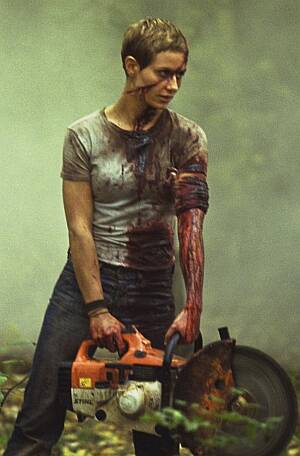
The first half is an edgy comedy about the perils of sharing accommodation: one girl (Koike) is a country girl, new to the profession, but is the sort who puts her name on her food in the fridge, right down to individual eggs; the other (Nonami) is a seasoned pro, with few moral scruples, least of all about possessions. You just know it’s going to go horribly bad, and the girls’ true thoughts are conveyed by voiceovers, as they maintain a thin veneer of politeness, at least for the first 40 minutes. Then the gloves finally come off, and the pair brawl throughout the apartment, using every weapon at their disposal – samurai swords, bleach, straw mats, you name it. Though I do have to wonder, why the hell is there a chainsaw among all the elegant furnishings?

It does probably count as mean-spirited, but this is outweighed by surprising wit, and credit is due for being a very rare example of a film where you never see a man (you hear them on the phone, or in photos, that’s all). Tsutsumi does tend to push the camera in too close for the violence, when a more detached approach would perhaps be both better, and less confusing. At barely 70 minutes, it’s almost a throwaway, yet still remains largely entertaining, and is certainly unique.

Dir: Yukihiko Tsutsumi
Star: Maho Nonami, Eiko Koike