Just as Furiosa ended up being a sequel that nobody wanted, what we have here is a mockbuster sequel that, as far as I can tell, nobody was asking for. This is, at least loosely, set in the same post-apocalyptic universe as The Asylum’s earlier (unseen) knock-off, Road Wars, which sought to ride on the coat tails of Fury Road. The sequel begins with Shane (Wells, who actually appeared in the old-school Mad Max 2) being cast out of his very small tribe in the desert. It’s not long before they regret their decision not to impose the death penalty, as he turns around and shoots James dead, before heading off to join his new tribe. Five years later, James’s daughters Naomi (Shah) and Greta (Kaur) are living with their mother Sarah (Wilson) and step-father, in their secluded compound. An attack leaves the parents in need of antibiotics, so the daughters head off to pick them up. Doing so, however, puts them back on Scott’s radar, and he intends to take the chance for some long-delayed revenge.
Obviously, anyone watching this and expecting something on the scale of George Miller’s episode is going to be extremely disappointed. Me? Not so much. I’m familiar with The Asylum, and knew what I was letting myself in for. But even by their standards, this is cheap. The apocalypse happens entirely off-screen, and what you get instead is a bit of running and driving around the desert landscape. The latter is distinctly low-key, with barely half a dozen vehicles and no destructive mayhem to speak of. The two that do get blown up, the explosions are obviously digital – the studio clearly wanted to get their security deposit back from the car-hire company at the end of the day. For the classic Thunderbird, I understand that choice. However, the other is a beat-up junker of a pick-up truck, and it says a lot they weren’t willing to write off the five hundred bucks.
They weren’t willing to write much elsewhere either. After the prologue, things get kinda confusing for a spell, with it largely unclear who is attacking the family, and why. Things do eventually settle down, and we get the required bickering between the younger, headstrong Naomi and her older, more cautious sibling over what to do, who should do it, and how. I was expecting the trip to get the antibiotics to be more fraught with peril than it is i.e. not at all, with a combination lock the only difficulty faced. Mind you, the final confrontation with Shane is just as underwhelming. Despite occasionally decent cinematography, there was a specific point at which I realized my moderate and restrained hopes were unlikely to be met. This occurred when Naomi randomly smears mascara – or engine grease, it’s hard to tell – across her eyes, for absolutely no apparent reason beyond imitating Furiosa. Being a mockbuster isn’t easy, I get it. That doesn’t excuse the lack of effort here.
Dir: Mark Atkins Star: Preet Kaur, Chandni Shah, Vernon Wells, Lindsey Marie Wilson
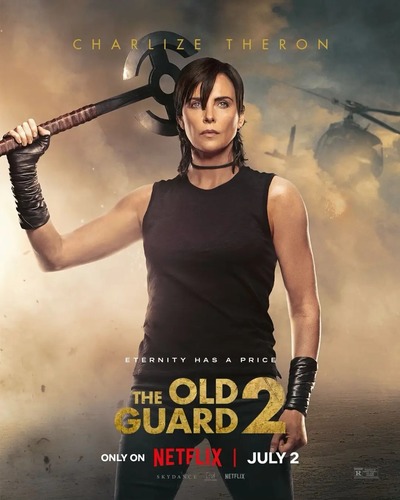
I was considerably less impressed with The Old Guard than some folk. I suspect it benefited from coming out during the COVID lockdown, when people were desperate for entertainment, and would obsess over any crap (see: Tiger King). Truth be told, it was really rather mid. Hard to believe it has been five years since then. With hindsight, we should probably have rewatched the original. Might have saved us having to look up the plot on Wikipedia, because the sequel assumes we remember everything about the first film, as if it were yesterday. We do not. It’s still basically about these immortals (or thereabout), who have been helping humanity through the ages. This seems initially to mean working with the CIA, which is certainly a choice.
As well as Andy (Theron), who has lost her immortality because reasons, there’s Nile (Layne). On the other side, we have Quỳnh (Ngô), who spent centuries at the bottom of the ocean, perpetually drowning, and is consequently slightly peeved. No, really: you’d expect full on psychosis, but she’s not much more than somewhat annoyed, and gets over it impressively quickly. There’s also Discord (Thurman), the first immortal, who has a scheme of her own to… Well, it’s complex, but it turns out that not only can immortality be lost, it can also be transferred between people. Death, where is thy sting? It all smacks of lazy, even desperate writing, inevitably leading to a scene borrowed from Star Trek II.
The film feels full of these missteps, lumbering clumsily from one chunk of exposition to the next. This builds to an assault on a Chinese nuclear facility, but there’s no sense of resolution. Because the film is more interested in acting as a bridge to The Old Guard 3, consequently ending in an ending which isn’t an ending. A third part is not something in which I have interest: any review of it here is likely to be out of genre obligation, rather than genuine interest. The only potential plus is that perhaps we might see more of Discord there, because in this installment, Thurman’s presence is wasted to a degree that is almost impressive. Though if it’s another five years before part 3, she’ll then be aged more or less sixty.
On the other hand, Theron looks eerily like she did in Aeon Flux, almost twenty years ago. And the action in general isn’t bad in quality, with both her and Ngô having their moments. It is technically sound, occasionally slick, and there are some cool car moments at the beginning. But if you compare it to something like Ballerina, both the quantity and impact of the fight sequences are clearly short of the mark. If that hadn’t been the case, I’d have been willing to forgive the clunky exposition and generally uninteresting nature of the plot. But I wouldn’t say “somewhat alright” fights come close to justifying anyone’s monthly Netflix subscription.
Dir: Victoria Mahoney Star: Charlize Theron, KiKi Layne, Veronica Ngô, Uma Thurman
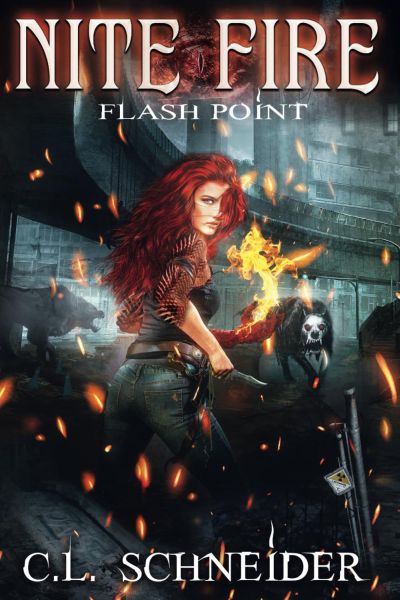
Dallas Nite is a dragon. Well, some of the time. For dragons are actually shape-shifters, capable of changing form, and that’s how she is able to pass for a human here. On her home planet, she had been an assassin for Queen Naalish, until she balked at carrying out one hit. Condemned to death, she fled through one of the interplanetary portals, ending up on Earth. Effectively immortal, Dallas has been in exile here for ninety-seven years since, making sure no other unauthorized creatures come through the portals – part of an uneasy truce between her and the aristocracy. Part of her job also involves ensuring any trace of dragon activity is covered up, these being explained instead as “spontaneous human combustion.” But after a whole family is slaughtered in fiery fashion in their home, it becomes increasingly difficult for her to keep a lid on things, and her past comes back with a vengeance too.
As urban fantasy goes, this is solid, rather than spectacular. There’s some nice world-building, with the idea of the portals well-explained, and offering plenty of scope for a variety of adventures (the epilogue does a particularly good job of pointing the way forward). I also appreciated how Dallas is employed as an investigator of “suspicious fires” by the local police department in Sentinel City which, given the obvious dragonish nature of her talents, is a good fit. Additionally, she has the ability to sense and re-experience people’s traumas. While the talent comes with baggage of its own, this is particularly useful for the case in question. It does feel like you’re joining the story in progress, almost a century having passed since Dallas’s arrival on Earth. I would be very interested in hearing, for example, what she got up to during World War II. A were-dragon would seem to offer certain advantages as a secret agent.
While the more relevant gaps of her past are filled in eventually, it is a bit of a cheat, with knowledge being withheld from the audience, that Dallas and the other characters clearly possess. We probably needed additional background on the dragon hierarchy too. There were some characters whose roles and significance remained a little too obscure. For example, Reech is one who only shows up at the half-way point, and I am still not sure exactly how he fits into things. What ends up as the central conflict, between Dallas and former apprentice Brynne, delivers some impressive battles (I said effectively immortal above, for a reason…), and focusing more directly on that could have paid dividends. At almost four hundred pages in length, there were times where getting through this did feel a bit of slog. However, a turn of the page would then bring me into something cool, and it provided enough of those moments to cross over the finish line without too much trouble.
Author: C.L. Schneider Publisher: CreateSpace Indepenedent Publishing, available through Amazon, both as a paperback and an e-book Book 1 of 5 in the Nite Fire series.
Here’s a real obscurity. 18 years old, and yet still with a mere seven votes on the IMDb. There, I had to find it by going through the director’s name, as the title brought up nothing. To be fair, it’s not even the best-known film of the year, because some guy called David Lynch made a short called Ballerina in 2007. But it turns out to be an early work from Mauser, whose Lady Outlaw we covered earlier in January. That was certainly better – as it should be, coming almost two decades later, the director having made a good forty (!) features since. It doesn’t look like his budgets have increased much, but Outlaw does a better job of working within it.
Here, the ballerina is Tara, a ten-year-old girl who sees her parents ruthlessly gunned down because of their connection to the Capello crime family. She vows to find and kill whoever was responsible, and is brought up by her big brother Angelo (Jasso). He trains her in the ways of his own profession, as a hitman for the Capellos. Eight years later, Tara (Nutting) still has not been able to take her revenge, and is studying dance at college, while working alongside Angelo. She gets a visit from the mysterious Ruby (Young), a near-legendary figure in the underworld, who offers to tell Tara who killed her parents, if she helps fix things to his advantage. But she may not like what she is told.
Mauser clearly subscribes to the notion that talk is cheap, for it is very chatty. Sometimes, this is ok: Young has a presence which commands the listener’s attention. But too often it comes off as a bad Tarantino wannabe – and even a good Tarantino wannabe would be on thin ice. Witness the lengthy early discussion about smoking, which had me wishing I had a knitting needle to jab into my ears. Fortunately, nothing thereafter is quite as terrible. However, it’s a film more interested in telling, rather than showing. There’s a corrupt female cop (Posas) in the mix, and I liked the way all the police station scenes were shot in shadow. Clearly to hide that they couldn’t afford a set, yet it works well enough.
The action is no great shakes, with Nutting being slow and having a limited set of moves. Certainly, there’s little or no indication of the expected balletic grace. She seems about as much a dancer as I am: I won’t see fifty again, and my knees aren’t what they used to be. Jasso comes off like you ordered Joe Mantegna on Temu, which isn’t necessarily a bad thing, It all builds to an ending which strongly suggests Mauser is a big fan of The Usual Suspects in addition to Tarantino. As a pastiche of better film-makers, it’s just about okay, though the ten-year-old version of the heroine may be the most disturbingly intense thing this has to offer.
Dir: Brett William Mauser Star: :Amanda Nutting, Matthew Jasso, DeMarcus Young, Valerie Posas
While Ballerina might be the most recent and largest scale example of the trend, Ana de Armas is not the first killer to don a tutu in her off hours. The ballet-dancer killer trope has been a popular one, perhaps because of the contrast it allows between artistic grace and brutal violence. Perhaps the earliest example I could find was from the seventies, where female star of The New Avengers, Purdey (played by Joanna Lumley) was a former member of the Royal Ballet. Admittedly, there aren’t many examples where the dance skills are especially relevant to the plot; they’re typically just a ironically elegant backdrop, against which the action can play out.
For whatever reason, missing parents are another common factor here. It may be that this helps allows for another area of comparison: the physically demanding training to become a prima ballerina, mirrors that needed to become a top-tier assassin. Neither are exactly compatible with what you would normally call good parenting. Easiest to make your protagonist an orphan, and bypass any awkward questions in this area! But below, you will find reviews of several notable entries in the sub-genre; or, possibly, more accurately, the sub-sub-genre.
I did decide to exclude a couple of recent examples. While certainly falling into the category of “lethal,” I’m not entirely convinced that the tutu-toting Abigail would quite be able to hold her own in a pas de deux. What seems like an obvious candidate is the Korean movie, also titled Ballerina. Except, the name there refers not to the protagonist, but her friend who commits suicide. Finally, we could perhaps have included Red Sparrow, whose heroine is ballerina Dominika Egorova. However, her career is quickly ended by injury, and she’s forced to find a different career in espionage, putting her shoes away. Worth noting though, Jennifer Lawrence did have to learn ballet for the movie.
The Ballerina
★★
“Not particularly on point.”
Here’s a real obscurity. 18 years old, and yet still with a mere seven votes on the IMDb. There, I had to find it by going through the director’s name, as the title brought up nothing. To be fair, it’s not even the best-known film of the year, because some guy called David Lynch made a short called Ballerina in 2007. But it turns out to be an early work from Mauser, whose Lady Outlaw we covered earlier in January. That was certainly better – as it should be, coming almost two decades later, the director having made a good forty (!) features since. It doesn’t look like his budgets have increased much, but Outlaw does a better job of working within it.
Here, the ballerina is Tara, a ten-year-old girl who sees her parents ruthlessly gunned down because of their connection to the Capello crime family. She vows to find and kill whoever was responsible, and is brought up by her big brother Angelo (Jasso). He trains her in the ways of his own profession, as a hitman for the Capellos. Eight years later, Tara (Nutting) still has not been able to take her revenge, and is studying dance at college, while working alongside Angelo. She gets a visit from the mysterious Ruby (Young), a near-legendary figure in the underworld, who offers to tell Tara who killed her parents, if she helps fix things to his advantage. But she may not like what she is told.
Mauser clearly subscribes to the notion that talk is cheap, for it is very chatty. Sometimes, this is ok: Young has a presence which commands the listener’s attention. But too often it comes off as a bad Tarantino wannabe – and even a good Tarantino wannabe would be on thin ice. Witness the lengthy early discussion about smoking, which had me wishing I had a knitting needle to jab into my ears. Fortunately, nothing thereafter is quite as terrible. However, it’s a film more interested in telling, rather than showing. There’s a corrupt female cop (Posas) in the mix, and I liked the way all the police station scenes were shot in shadow. Clearly to hide that they couldn’t afford a set, yet it works well enough.
The action is no great shakes, with Nutting being slow and having a limited set of moves. Certainly, there’s little or no indication of the expected balletic grace. She seems about as much a dancer as I am: I won’t see fifty again, and my knees aren’t what they used to be. Jasso comes off like you ordered Joe Mantegna on Temu, which isn’t necessarily a bad thing, It all builds to an ending which strongly suggests Mauser is a big fan of The Usual Suspects in addition to Tarantino. As a pastiche of better film-makers, it’s just about okay, though the ten-year-old version of the heroine may be the most disturbingly intense thing this has to offer.
Dir: Brett William Mauser Star: :Amanda Nutting, Matthew Jasso, DeMarcus Young, Valerie Posas
Ballerina (2025)
★★★★½
“If the ballet slipper fits…”
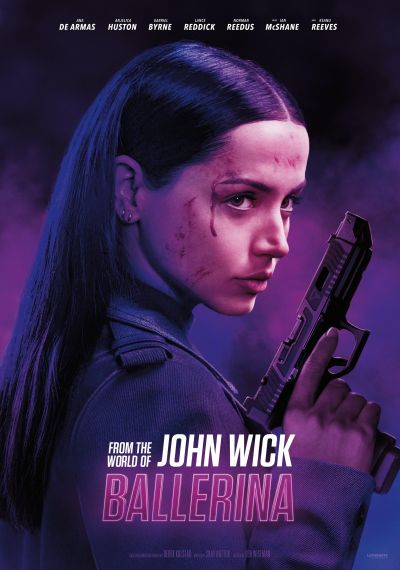
When I reviewed Furiosa, I discussed how action heroine films have been having a tough time at the box-office since before COVID-19. Add another data point to that decline, with the underwhelming performance of Ballerina. Or, to give it its clunky and excessive full title (for the first and only time), From the World of John Wick: Ballerina. Which – much like Furiosa – is a real shame, because it’s top-tier stuff. The critics liked it (76% on Rotten Tomatoes) and those who saw it, liked it too (93% audience score there). But it just did not seem to connect in a large-scale way with the cinema-going public, and will struggle to cover its $90 million budget, not excessive by today’s standards.
Admittedly, it was a rather troubled production. Filming began all the way back in November 2022, and it was in post-production the following February. But a year later, word came out that additional shooting under John Wick director Chad Stahelski was taking place. There’s uncertainty how significant those were. Suggestions that much of the film was redone have been denied by both Stahelski and Wiseman, who said they were actually due to the studio providing them with additional resources. This allowed them to add scenes, such as the opening depicting the death of the heroine’s father. But regardless, the extra work was certainly a factor in the film being pushed back a full twelve months from its original release date of June 2024.
To be honest though, I really couldn’t tell based on the end product. I have read a lot of criticism suggesting, in brief, “Nobody asked for this.” While that’s dumb – nobody asked for John Wick either – there is an element of truth in it. If they wanted a spin-off, they might have been better using Sofia Al-Azwar, the existing character played by Halle Berry, who was key to one of the best scenes in John Wick: Chapter 3 – Parabellum. It’s worth noting, the script by Shay Hatten, written back in 2017, was not originally part of the Wick universe (although Hatten was inspired by the trailer for John Wick 2), and subsequently got tooled into it. But I wonder, how often are spin-off movies ever successful? Ok, except the Minions franchise.
It’s not the first effort to expand the Wick-iverse which has fallen short either. In 2023, they made a TV mini-series The Continental, which… Um, well… We watched the first episode? You’re certainly left to wonder what might happen about the other spin-off film, focused on Caine, the blind swordman played by Donnie Yen in John Wick 4. We love Yen, and have since the days of In the Line of Duty IV, over 35 years ago. But he has a much lower profile in the West than Ana de Armas, and the appetite for films “from the world of John Wick” which do not have Wick front and center, certainly appears to be muted. Enough about such coarse, commercial considerations. How is Ballerina as a movie?
In this world, there are two specific tribes of assassins. The Ruska Roma, who are structured and orderly, and another group, known as the Cult, who are anarchic and savage. Lawful Neutral and Chaotic Evil, for those who know their D&D alignments. The two groups don’t get along, but generally tolerate each other, basically agreeing to go their separate ways and not interfere, under the current leadership of the Director (Huston) and the Chancellor (Byrne) respectively. A decade or so ago, there was Romeo and Juliet-style romance across the divided houses, resulting in the birth of Eve. When her parents tries to leave their factions, both are killed, her father dying in front of her after being killed by the Cult. She is then brought up in the Ruska Roma.
Eve (de Armas) is trained both as an assassin and a ballerina, although the latter is never of any real significance. On one of her missions, she encounters a Cult member and realizes they are responsible for killing her father. Against the express wishes of the Director, she goes in search of them, finding their headquarters in the remote (and very lovely) Austrian town of Hallstatt, and chewing her way through the Cult towards the Chancellor. But when the Director hears about Eve’s quest for vengeance, posing a threat to the uneasy truce between the Ruska Roma and the Cult, she sends a certain J. Wick (Reeves) after her, to restore the balance and keep the peace.
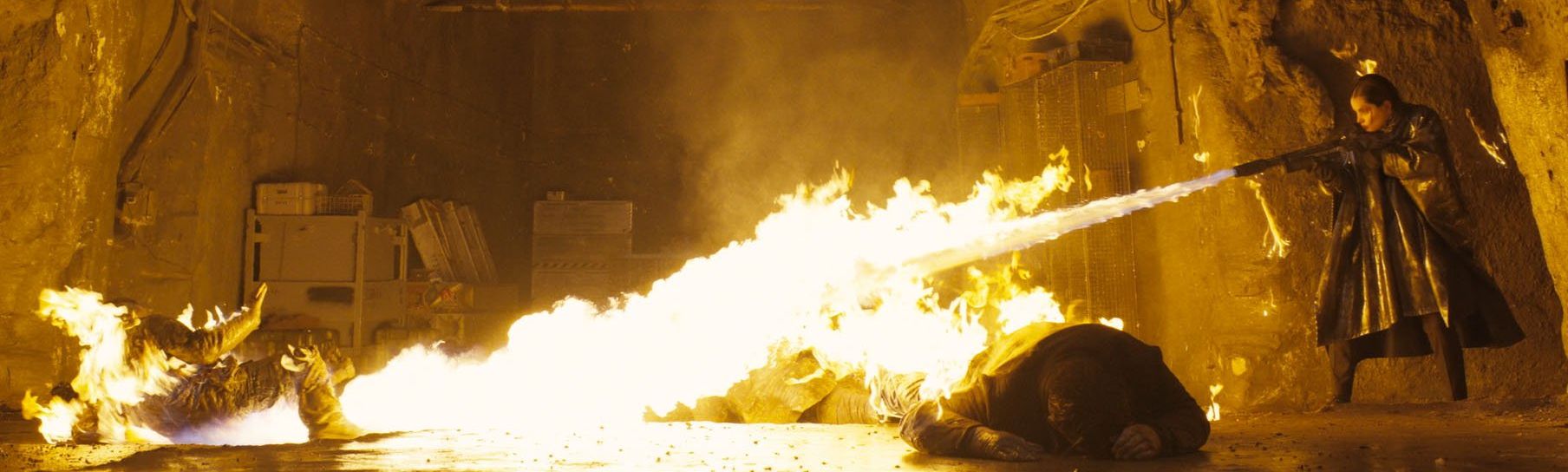
It’s borderline awesome, and on occasion, there’s no “borderline” about it. Let’s just say, I will now be looking into acquiring a flamethrower for home defense. Ok, I should explain. There’s a scene where Eve and one of the Cult members have a – bold font, capital letters, please – DUEL WITH FLAMETHROWERS. It’s every bit as epic and wonderful as that sounds, and it escapes me how they could possibly have achieved it, without reducing the entire stunt team to charcoal briquettes. That’s just the action highlight in a film which has a number of them. I was also impressed with the nightclub sequence – is this obligatory for every film in the Wick-iverse? – of Eve’s first mission, as much for the thumping techno tunes, as for the high-quality fisticuffs.
I do say, some elements feel under-developed, and I wonder if they were a result of the adjustments made during production. The character of Daniel Pine (Norman Reedus), seems particularly an afterthought, not least the fact he’s supposed to be the Chancellor’s son. Adding John Wick in does feel like an unnecessary afterthought and, to be honest, smells a little of desperation. It’s just not necessary, because de Armas is capable of carrying things. This is likely, not just to be the best action heroine film of the year, it’s quite possibly – admittedly, I haven’t seen the last Mission Impossible film yet – going to end up as the best action film of 2025. Such a pity it appears likely to be one and done for this tiny dancer.
Dir: Len Wiseman Star: Ana de Armas, Gabriel Byrne, Anjelica Huston, Keanu Reeves
Ballerina: The Original Script
As mentioned in our review of the 2025 Ballerina movie, the script as originally conceived was not part of the John Wick universe. However, it was inspired by it. Shay Hatten was only in his early twenties went he first came to Hollywood’s notice, for his Maximum King script, a still unproduced entity based on the filming of Stephen King’s only directorial credit, Maximum Overdrive. He followed that up with the script for Ballerina, which was not only bought by Lions Gate, it also got Hatten into the writers’ room for the third and forth entry in the John Wick franchise. He has since worked on both parts of Rebel Moon and is working on the upcoming Resident Evil reboot, so seems to be a fan of our genre.
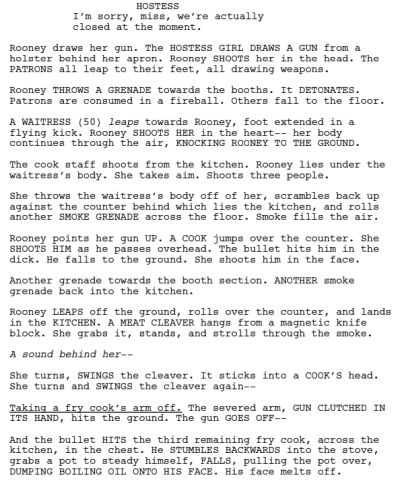
Hatten admits thatBallerina is “a script where I was really trying to go to the extreme because I was trying to get people’s attention.” It’s an understandable technique for what are called “spec scripts” – a screenplay written without a prearranged deal, rather than as paid work. You need to stand out among the thousands floating around Hollywood, and pushing the envelope is one way to do so.Ballerina does so from the get-go, showing us a long history of assassination: “The screen now divides into sixteen sections. You get the idea of what’s happening in each of them — in each, a murder from some point in the last five hundred years.” There’s also a sex scene which I’m just going to screenshot for the curious (NFSW, obvs!).
We then meet the heroine, six-year-old Rooney Brown, whose father is shot dead in front of her, immediately after giving her a ballerina music-box. She notches her first kill, pushing the assassin downstairs, and we get a caption. ROONEY KILL COUNT — 1. It’s going to go higher. Much higher. After growing up in group homes, Rooney is employed by a private military company, Whitewater (yeah, that’s subtle…), and becomes a hitwoman for them. In the early going, it’s your fairly standard Nikita clone, Rooney balancing work with a real life, and a blossoming romance with Tom, who has absolutely no clue about what her day job entails. But we do see life in the Alpine town populated entirely by killers, here named Sunnyvale. Which is perhaps close enough to be a Buffy nod, and is certainly not very Swiss.
Things change after someone tries to kill Rooney, just as she’s beginning to have Assassin Cliche #27: second thoughts about her career. She gets to them first. Unfortunately for her, it’s the daughter of Elias Muller, the mayor of Sunnyvale, described as an “intense, Willem Dafoe, Mads Mikkelsen-looking motherfucker.” He and Whitewater are at war, and he is winning… until his minions massacre Rooney’s husband and his family. She kills all the attackers, telling the last one left alive, “I’m gonna kill everyone in your organization, no more and no less.” She then heads to Sunnyvale. Approaching the half-way point, the kill count has been restrained. Well, up until her arrival in Switzerland, it’s 26. Decent, but not exactly Resident Evil: Extinction [the highest-ranked GWG film at moviebodycounts.com]
Thereafter? Fifty minutes of more or less non-stop carnage. She’s helped in her mission by Pine, who wants to take the chance in the chaos created by Rooney, to escape with his daughter. [Pine does appear in the movie as produced, though his role is rather different] And when I say carnage, I mean it. The kill count racks up like a pinball machine, and by the time she is done, is at a final score of… [drum roll] one thousand, four hundred and eight. Yes, as written, this would perhaps have ended up being the most violent movie ever made. I think we reach peak attention-seeking when she finds the Sunnyvale old folks’ home, and murders two hundred or so senior citizens. However, she’s not totally callous: she largely spares the school, going through it only to extract Pine’s daughter.
So, is it all any good? I think I preferred the version which actually reached the screen. While I’m a huge fan of senseless, cinematic violence, the second half in particular became a bit of a slog. It becomes, rather obviously, an exercise in pushing people’s outrage buttons. Since I don’t have any outrage buttons, it isn’t too effective. There’s no denying Hatten has a nice line in snark, and some of the descriptive passages are great. But this may be the poster child for less being more. I’m not sure there are many directors in existence who could have delivered the film as written. Maybe Gareth Evans? Takashi Miike? Timo Tjahjanto? The budget required would have likely meant it couldn’t have been released unrated, a necessity given the volume and degree of mayhem.
On the other hand, I do have to admire the unfettered approach. That’s the good thing about the written word. You can let your imagination run wild, without constraints such as budget or… Well, good taste. Hatten has taken full advantage of that freedom, to trample on action film conventions and push the pedal to the metal. It achieved its intended goal, and now he is a full-time writer. Hard to argue this shouldn’t be considered a success on those terms, even if it was perhaps intended less as a genuine movie, than a memorable calling-card to get his foot in the door.
Ballerina Assassin
★★
“Let the buyer beware.”
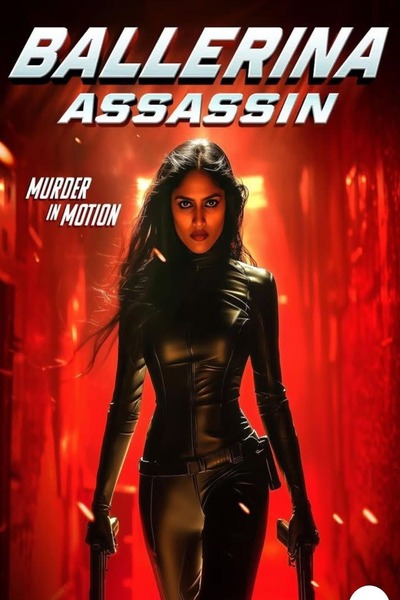
Right in the middle of us watching this, Chris got a text from our daughter: “I think we rented the wrong version of Ballerina…” Yes, independently, she was watching the same film. The difference is, we understood what we were getting into. We knew this was a mockbuster from infamous purveyor of such things, The Asylum. I thought the concept of people mistaking Asylum movies for the real thing was an urban legend. Courtesy of our daughter, we now know better. Or worse. For this is, of course, not fit to lace up Ballerina‘s shoes, and anyone expecting it will be sorely disappointed. Yet it’s not irredeemable. I’ve seen considerably worse. From The Asylum, in particular.
Though I will question the title. Heroine Maria Herrera (Kaur) is not particularly an assassin. She’s really an agent, working for a shadowy government agency run by Bixby (Keating). She is, however, a former ballerina. This comes in handy for her new mission, in which the agency seeks to trap cartel head and aspiring politician Javier Aguilar (Sellar) on his trip to the United States. Maria is tasked with getting close to his wife, Carmen (Scotto), who is going to an audition for a spot in a ballet troupe. Naturally, it’s not that simple. Maria soon discovers there is someone in the agency who is actually collaborating with Javier, and has a strong desire to see her taken out of the picture. Permanently.
As stories go, it’s fairly workmanlike. You won’t find it hard to work out who’s the mole. To be fair, the film doesn’t stretch this element out too long, which would have been irritating. It then becomes a battle for possession of a hard-drive containing incriminating evidence. Loyalties shift – Javier in particular is surprisingly sympathetic for a cartel boss – all the way till the final scene. Kaur, who also starred in The Asylum’s Furiosa mockbuster, Road Wars: Max Fury (review of that coming next week) is okay. She’s not particularly pretty, but that kinda works for the character. I was amused by her using her ballet skills to get through a laser corridor, like the kind first seen in Resident Evil.
There’s also a combat drone brought up early on, and you just know it’s going to end up chasing down the heroine. However, when it eventually does, the results are underwhelming, and this goes for the majority of the action. It’s basic stuff, with very little imagination or flair, and nobody here is able to carry it off at any level above the barest minimum. As cheap entertainment – we literally got it through our local library for free – it just about passes muster, if you’re in an undemanding mood. But it’d be much better off not inviting comparisons to what’s likely to be the best action heroine film of the year. Our daughter was highly unhappy about the deceptive marketing, and I cannot blame her in the slightest.
Dir: Michael Su Star: Preet Kaur, Dominic Keating, Nicolas Sellar, Rocio Scotto
Pretty Lethal
★★★
“Nutcrackers Sweet”
To be fair, this was actually announced back in February 2023. Though that was still after Ballerina had wrapped its original shoot. At the time, the title was Ballerina Overdrive, with the cast including Lena Headey, in the role subsequently played by Thurman. Now, it comes out feeling more than a bit as if it is trailing in the wake of Ballerina. Coming out on Amazon Prime rather than theatrically doesn’t help its prestige. While nobody is going to call this great, and it’ll be forgotten as quickly as most other streaming originals, it does at least deliver on the premise. These are actual ass-kicking ballerinas, and their artistic talents are an intrinsic component of their fighting styles.
A Los Angeles ballet troupe of five young dancers, including the working-class Zoe (Apatow) and her appropriately named nemesis, Princess (Condor), are on their way to Budapest for a performance. The bus from the airport breaks down, and they end up in the Teremok Inn, an establishment run by Devora Kasimer (Thurman). When the troupe’s instructor finds out Devora is not exactly just a boutique hotelier, and then spurns the advances of local mobster Pasha Marcovic (Sipos), it does not go well for her. The ballerinas are suddenly witnesses, and therefore very much surplus to requirements. That’s the plot, more or less. Oh, there are slight wrinkles. Devora turns out to be a former ballerina herself. But it’s mostly run, hide and fight.
This is all adequately entertaining nonsense. Disbelief obviously needs to be suspended as you watch 90-pound girls beat up men twice their size. At least there is some effort put in to making them, in the main, use their agility and flexibility, rather brute force. There’s some cool stuff with razor blades, embedded into ballet slippers or taped to fingertips, which works well. Though the sequence I enjoyed most was the one where they went full corps de ballet on Pasha’s men. It’s impossible to take seriously, yet is done with so much inventive energy I was left with a big, goofy grin on my face. Shame there wasn’t more. It’s certainly lighter in tone – and likely more entertaining – than director Jewson’s previous GWG entry, Close, with Noomi Rapace.
I actually grew to like the characters more over the course of proceedings. Admittedly, this is because my initial reaction was… not good. Obvious trope followed obvious trope. But by the end, I had even warmed to the obnoxious Princess. She gets a great moment, confronting one of the henchmen, and going on a rant which begins by complaining about the wifi, drifts through reality TV, and ends up in a sad psychic story. Finally, an amusing anecdote. While we were watching this, Chris pipes up, “You know who’d be good as Devora if they remade this? Uma Thurman.” While I certainly couldn’t argue with her there, I did have to break the news, gently, that it already was Uma Thurman.
Dir: Vicky Jewson Star: Iris Apatow, Lana Condor, Uma Thurman, Tamás Szabó Sipos
When I reviewed Furiosa, I discussed how action heroine films have been having a tough time at the box-office since before COVID-19. Add another data point to that decline, with the underwhelming performance of Ballerina. Or, to give it its clunky and excessive full title (for the first and only time), From the World of John Wick: Ballerina. Which – much like Furiosa – is a real shame, because it’s top-tier stuff. The critics liked it (76% on Rotten Tomatoes) and those who saw it, liked it too (93% audience score there). But it just did not seem to connect in a large-scale way with the cinema-going public, and will struggle to cover its $90 million budget, not excessive by today’s standards.
Admittedly, it was a rather troubled production. Filming began all the way back in November 2022, and it was in post-production the following February. But a year later, word came out that additional shooting under John Wick director Chad Stahelski was taking place. There’s uncertainty how significant those were. Suggestions that much of the film was redone have been denied by both Stahelski and Wiseman, who said they were actually due to the studio providing them with additional resources. This allowed them to add scenes, such as the opening depicting the death of the heroine’s father. But regardless, the extra work was certainly a factor in the film being pushed back a full twelve months from its original release date of June 2024.
To be honest though, I really couldn’t tell based on the end product. I have read a lot of criticism suggesting, in brief, “Nobody asked for this.” While that’s dumb – nobody asked for John Wick either – there is an element of truth in it. If they wanted a spin-off, they might have been better using Sofia Al-Azwar, the existing character played by Halle Berry, who was key to one of the best scenes in John Wick: Chapter 3 – Parabellum. It’s worth noting, the script by Shay Hatten, written back in 2017, was not originally part of the Wick universe (although Hatten was inspired by the trailer for John Wick 2), and subsequently got tooled into it. But I wonder, how often are spin-off movies ever successful? Ok, except the Minions franchise.
It’s not the first effort to expand the Wick-iverse which has fallen short either. In 2023, they made a TV mini-series The Continental, which… Um, well… We watched the first episode? You’re certainly left to wonder what might happen about the other spin-off film, focused on Caine, the blind swordman played by Donnie Yen in John Wick 4. We love Yen, and have since the days of In the Line of Duty IV, over 35 years ago. But he has a much lower profile in the West than Ana de Armas, and the appetite for films “from the world of John Wick” which do not have Wick front and center, certainly appears to be muted. Enough about such coarse, commercial considerations. How is Ballerina as a movie?
In this world, there are two specific tribes of assassins. The Ruska Roma, who are structured and orderly, and another group, known as the Cult, who are anarchic and savage. Lawful Neutral and Chaotic Evil, for those who know their D&D alignments. The two groups don’t get along, but generally tolerate each other, basically agreeing to go their separate ways and not interfere, under the current leadership of the Director (Huston) and the Chancellor (Byrne) respectively. A decade or so ago, there was Romeo and Juliet-style romance across the divided houses, resulting in the birth of Eve. When her parents tries to leave their factions, both are killed, her father dying in front of her after being killed by the Cult. She is then brought up in the Ruska Roma.
Eve (de Armas) is trained both as an assassin and a ballerina, although the latter is never of any real significance. On one of her missions, she encounters a Cult member and realizes they are responsible for killing her father. Against the express wishes of the Director, she goes in search of them, finding their headquarters in the remote (and very lovely) Austrian town of Hallstatt, and chewing her way through the Cult towards the Chancellor. But when the Director hears about Eve’s quest for vengeance, posing a threat to the uneasy truce between the Ruska Roma and the Cult, she sends a certain J. Wick (Reeves) after her, to restore the balance and keep the peace.
It’s borderline awesome, and on occasion, there’s no “borderline” about it. Let’s just say, I will now be looking into acquiring a flamethrower for home defense. Ok, I should explain. There’s a scene where Eve and one of the Cult members have a – bold font, capital letters, please – DUEL WITH FLAMETHROWERS. It’s every bit as epic and wonderful as that sounds, and it escapes me how they could possibly have achieved it, without reducing the entire stunt team to charcoal briquettes. That’s just the action highlight in a film which has a number of them. I was also impressed with the nightclub sequence – is this obligatory for every film in the Wick-iverse? – of Eve’s first mission, as much for the thumping techno tunes, as for the high-quality fisticuffs.
I do say, some elements feel under-developed, and I wonder if they were a result of the adjustments made during production. The character of Daniel Pine (Norman Reedus), seems particularly an afterthought, not least the fact he’s supposed to be the Chancellor’s son. Adding John Wick in does feel like an unnecessary afterthought and, to be honest, smells a little of desperation. It’s just not necessary, because de Armas is capable of carrying things. This is likely, not just to be the best action heroine film of the year, it’s quite possibly – admittedly, I haven’t seen the last Mission Impossible film yet – going to end up as the best action film of 2025. Such a pity it appears likely to be one and done for this tiny dancer.
Dir: Len Wiseman Star: Ana de Armas, Gabriel Byrne, Anjelica Huston, Keanu Reeves
Right in the middle of us watching this, Chris got a text from our daughter: “I think we rented the wrong version of Ballerina…” Yes, independently, she was watching the same film. The difference is, we understood what we were getting into. We knew this was a mockbuster from infamous purveyor of such things, The Asylum. I thought the concept of people mistaking Asylum movies for the real thing was an urban legend. Courtesy of our daughter, we now know better. Or worse. For this is, of course, not fit to lace up Ballerina‘s shoes, and anyone expecting it will be sorely disappointed. Yet it’s not irredeemable. I’ve seen considerably worse. From The Asylum, in particular.
Though I will question the title. Heroine Maria Herrera (Kaur) is not particularly an assassin. She’s really an agent, working for a shadowy government agency run by Bixby (Keating). She is, however, a former ballerina. This comes in handy for her new mission, in which the agency seeks to trap cartel head and aspiring politician Javier Aguilar (Sellar) on his trip to the United States. Maria is tasked with getting close to his wife, Carmen (Scotto), who is going to an audition for a spot in a ballet troupe. Naturally, it’s not that simple. Maria soon discovers there is someone in the agency who is actually collaborating with Javier, and has a strong desire to see her taken out of the picture. Permanently.
As stories go, it’s fairly workmanlike. You won’t find it hard to work out who’s the mole. To be fair, the film doesn’t stretch this element out too long, which would have been irritating. It then becomes a battle for possession of a hard-drive containing incriminating evidence. Loyalties shift – Javier in particular is surprisingly sympathetic for a cartel boss – all the way till the final scene. Kaur, who also starred in The Asylum’s Furiosa mockbuster, Road Wars: Max Fury (review of that coming next week) is okay. She’s not particularly pretty, but that kinda works for the character. I was amused by her using her ballet skills to get through a laser corridor, like the kind first seen in Resident Evil.
There’s also a combat drone brought up early on, and you just know it’s going to end up chasing down the heroine. However, when it eventually does, the results are underwhelming, and this goes for the majority of the action. It’s basic stuff, with very little imagination or flair, and nobody here is able to carry it off at any level above the barest minimum. As cheap entertainment – we literally got it through our local library for free – it just about passes muster, if you’re in an undemanding mood. But it’d be much better off not inviting comparisons to what’s likely to be the best action heroine film of the year. Our daughter was highly unhappy about the deceptive marketing, and I cannot blame her in the slightest.
Dir: Michael Su Star: Preet Kaur, Dominic Keating, Nicolas Sellar, Rocio Scotto
As mentioned in our review of the 2025 Ballerina movie, the script as originally conceived was not part of the John Wick universe. However, it was inspired by it. Shay Hatten was only in his early twenties went he first came to Hollywood’s notice, for his Maximum King script, a still unproduced entity based on the filming of Stephen King’s only directorial credit, Maximum Overdrive. He followed that up with the script for Ballerina, which was not only bought by Lions Gate, it also got Hatten into the writers’ room for the third and forth entry in the John Wick franchise. He has since worked on both parts of Rebel Moon and is working on the upcoming Resident Evil reboot, so seems to be a fan of our genre.
Hatten admits thatBallerina is “a script where I was really trying to go to the extreme because I was trying to get people’s attention.” It’s an understandable technique for what are called “spec scripts” – a screenplay written without a prearranged deal, rather than as paid work. You need to stand out among the thousands floating around Hollywood, and pushing the envelope is one way to do so.Ballerina does so from the get-go, showing us a long history of assassination: “The screen now divides into sixteen sections. You get the idea of what’s happening in each of them — in each, a murder from some point in the last five hundred years.” There’s also a sex scene which I’m just going to screenshot for the curious (NFSW, obvs!).
We then meet the heroine, six-year-old Rooney Brown, whose father is shot dead in front of her, immediately after giving her a ballerina music-box. She notches her first kill, pushing the assassin downstairs, and we get a caption. ROONEY KILL COUNT — 1. It’s going to go higher. Much higher. After growing up in group homes, Rooney is employed by a private military company, Whitewater (yeah, that’s subtle…), and becomes a hitwoman for them. In the early going, it’s your fairly standard Nikita clone, Rooney balancing work with a real life, and a blossoming romance with Tom, who has absolutely no clue about what her day job entails. But we do see life in the Alpine town populated entirely by killers, here named Sunnyvale. Which is perhaps close enough to be a Buffy nod, and is certainly not very Swiss.
Things change after someone tries to kill Rooney, just as she’s beginning to have Assassin Cliche #27: second thoughts about her career. She gets to them first. Unfortunately for her, it’s the daughter of Elias Muller, the mayor of Sunnyvale, described as an “intense, Willem Dafoe, Mads Mikkelsen-looking motherfucker.” He and Whitewater are at war, and he is winning… until his minions massacre Rooney’s husband and his family. She kills all the attackers, telling the last one left alive, “I’m gonna kill everyone in your organization, no more and no less.” She then heads to Sunnyvale. Approaching the half-way point, the kill count has been restrained. Well, up until her arrival in Switzerland, it’s 26. Decent, but not exactly Resident Evil: Extinction [the highest-ranked GWG film at moviebodycounts.com]
Thereafter? Fifty minutes of more or less non-stop carnage. She’s helped in her mission by Pine, who wants to take the chance in the chaos created by Rooney, to escape with his daughter. [Pine does appear in the movie as produced, though his role is rather different] And when I say carnage, I mean it. The kill count racks up like a pinball machine, and by the time she is done, is at a final score of… [drum roll] one thousand, four hundred and eight. Yes, as written, this would perhaps have ended up being the most violent movie ever made. I think we reach peak attention-seeking when she finds the Sunnyvale old folks’ home, and murders two hundred or so senior citizens. However, she’s not totally callous: she largely spares the school, going through it only to extract Pine’s daughter.
So, is it all any good? I think I preferred the version which actually reached the screen. While I’m a huge fan of senseless, cinematic violence, the second half in particular became a bit of a slog. It becomes, rather obviously, an exercise in pushing people’s outrage buttons. Since I don’t have any outrage buttons, it isn’t too effective. There’s no denying Hatten has a nice line in snark, and some of the descriptive passages are great. But this may be the poster child for less being more. I’m not sure there are many directors in existence who could have delivered the film as written. Maybe Gareth Evans? Takashi Miike? Timo Tjahjanto? The budget required would have likely meant it couldn’t have been released unrated, a necessity given the volume and degree of mayhem.
On the other hand, I do have to admire the unfettered approach. That’s the good thing about the written word. You can let your imagination run wild, without constraints such as budget or… Well, good taste. Hatten has taken full advantage of that freedom, to trample on action film conventions and push the pedal to the metal. It achieved its intended goal, and now he is a full-time writer. Hard to argue this shouldn’t be considered a success on those terms, even if it was perhaps intended less as a genuine movie, than a memorable calling-card to get his foot in the door.
This is not our first time here attending the Godfrey Ho rodeo. Indeed we wrote quite warmly about Lethal Panther., and Cynthia Rothrock vehicle Undefeatable had its moments. But this is our first experience on this side of the heady, WTF? to be obtained when Ho does what he’s best known for doing. Which is, splicing entirely new footage into an unrelated movie, to fit whatever marketing end he’s aiming towards. He was most notorious for this during the ninja film craze of the eighties, when he used this tactic to splice a couple of scenes into either cheap or unfinished movies from the far East, so they could be sold to the ninja-crazy VHS audience.
However, as this example shows, he wasn’t above taking basically the same approach for the then popular girls-with-guns genre out of Hong Kong. We’ve already covered many examples of these, such as Angel. Its success spawned any number of follow-up, both official sequels, and unofficial knock-offs with the word “angel” in the title, e.g. Angel Force or Angel Terminators 2. This would be one of the latter, which takes what appears to be a Thai action film of the same general kind – cops vs. drug dealers – and wraps around it footage about Paula (Bells), an American reporter who gets hold of photos incriminating a businessman as a drug lord. She has to survive, while back in Thailand, the police do battle with the drug runners.
You can tell, because the only points at which the original film overlaps with the new footage is during awkward phone conversations. I think I would far rather have watched a decent i.e. wide-screen print of the original movie, rather than this badly-dubbed hack job. Sadly, I’ve not been able to determine the original movie used, but we’ve seen our share of decent Thai girls-with-guns action. I won’t lie, I was amused here by the pirating of various New Wave songs from the Pet Shop Boys and The Art of Noise. This reaches its ludicrous peak during a disco scene where customers dance to A Flock of Seagulls song, Telecommunication. The footage is sped-up, like some of the action scenes – which is a shame, because the fights really do not need it.
It’s very equal opportunity too, with both sides having their share of women, giving and receiving damage. Indeed, the best fight sees two female cops brawl against four thugs sent to kidnap them. It escalates from fists to crossbow-fu, with a number of highly wince-inducing moments. But all too soon, you’re back in the crappy insert footage, which ends with the laughable line of dialogue quoted top. Though to be a hundred percent sure you get the point, this is followed up with, “Criminals aren’t able to escape the net of justice.” There’s likely a decent film buried somewhere in here. You just need a pick-axe and a wheelbarrow to find it.
Dir: Godfrey Ho Star: Laura Bells, Richard Gibb, Brent Gilbert, Daniel Welk
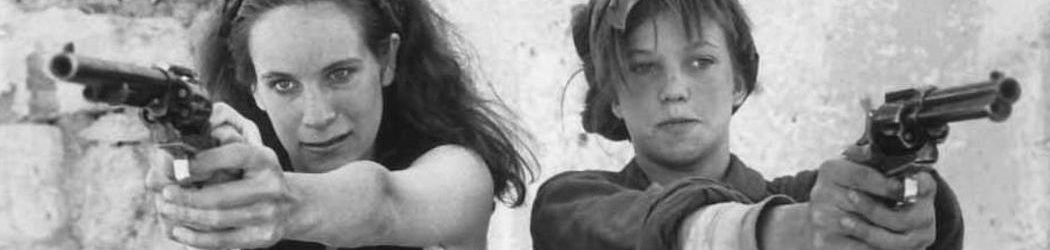
After the pleasant surprise which was Lady Outlaw, I went back to the well of Mauser movies, for this one, which seemed similarly themed, but made three years earlier. It’s definitely a bit less successful. More talk, and that is almost impressive considering how chatty Outlaw was. The central performances are okay, but some of those around the edges… Hoo-boy. However, this did actually introduce me to a historical action heroine I hadn’t heard of. So let’s discuss the real F.M. Miller, though it’s clear the film is filling in a lot of blanks – not the least of which is giving her a first name, Francis. In reality, nobody seems to know what her initials stood for.
However, she certainly seems deserving of respect. She was made a deputy Marshal in 1891, and consequently worked mostly transporting and guarding prisoners. But a contemporary report said, “Miss Miller is a young woman of prepossessing appearance, wears a cowboy hat and is always adorned with a pistol belt full of cartridges and a dangerous looking Colt pistol which she knows how to use.” Here, she’s a rancher, who is brought on board by Buck Johnson (Jecmenek), to help hunt down notorious outlaw Richard Andrews (Leos). He’s an interesting character, being a Black slave-owner. Or former slave-owner, the film taking place after the end of the Civil War. He turned to outlawing, and became quite a leader, to the point his men are willing to die for him.
Which is where Buck comes in, because he lost two deputies in a suicide attack by Andrews’s men. As a replacement, he brings Francis (Jasso) on board – initially for her tracking abilities, learned before her husband was gunned down by highwaymen. However, after bringing in Andrews’ sidekick by herself, she earns her marshal’s badge, and the search is on for Andrews. This involves rather more riding and talking than anything, up until a grubby brawl in the mud during a rainstorm, which is actually well-handled. However, given the blank slate that Miller presents, I would prefer them to have given her more to do. There’s no surprises here, in particular the personal connection between her and Andrews, which is not the revelation the film seems to think.
Jasso is fine as the heroine. There’s a down to earth quality about her which is winning, and she knows it’s her gun which levels the playing field against men larger and stronger than her. Jecmenek is decent too – Buck is absolutely ruthless, which makes sense by the end of the film. “Violence solves everything,” he says. Elsewhere, as mentioned, more of a mixed bag, and that’s being charitable. Some scenes are more wooden than a fence-post, and given how dialogue heavy this is, we have a real problem. Still, based on it and Outlaw, it seems Mauser’s talents are trending in the right direction. If we get the cross-over hinted at by the end of Outlaw, I would certainly not mind.
Dir: Brett William Mauser Star: Ryan Lakey Jasso, Jake Jecmenek, Carlos Leos, Ernest Martinez




 I was considerably less impressed with
  Dallas Nite is a dragon. Well, some of the time. For dragons are actually shape-shifters, capable of changing form, and that’s how she is able to pass for a human here. On her home planet, she had been an assassin for Queen Naalish, until she balked at carrying out one hit. Condemned to death, she fled through one of the interplanetary portals, ending up on Earth. Effectively immortal, Dallas has been in exile here for ninety-seven years since, making sure no other unauthorized creatures come through the portals – part of an uneasy truce between her and the aristocracy. Part of her job also involves ensuring any trace of dragon activity is covered up, these being explained instead as “spontaneous human combustion.” But after a whole family is slaughtered in fiery fashion in their home, it becomes increasingly difficult for her to keep a lid on things, and her past comes back with a vengeance too.
 Here’s a real obscurity. 18 years old, and yet still with a mere seven votes on the IMDb. There, I had to find it by going through the director’s name, as the title brought up nothing. To be fair, it’s not even the best-known film of the year, because some guy called David Lynch made a short called Ballerina in 2007. But it turns out to be an early work from Mauser, whose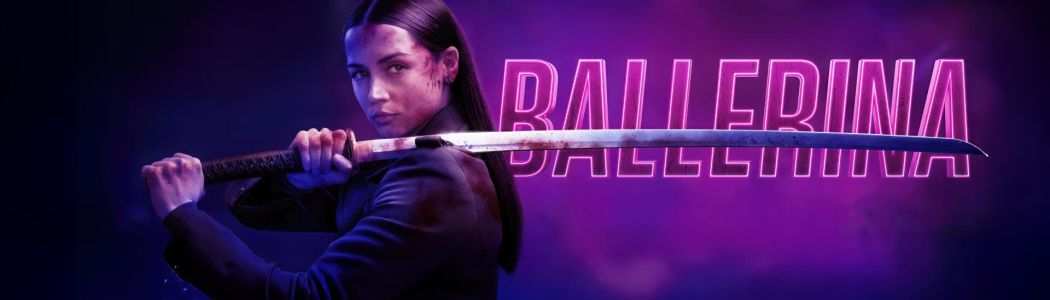
 ★★★★½
★★★★½ When I
  To be honest though, I really couldn’t tell based on the end product. I have read a lot of criticism suggesting, in brief, “Nobody asked for this.” While that’s dumb – nobody asked for John Wick either – there is an element of truth in it. If they wanted a spin-off, they might have been better using Sofia Al-Azwar, the existing character played by Halle Berry, who was key to one of the best scenes in John Wick: Chapter 3 – Parabellum. It’s worth noting, the script by Shay Hatten, written back in 2017, was not originally part of the Wick universe (although Hatten was inspired by the trailer for John Wick 2), and subsequently got tooled into it. But I wonder, how often are spin-off movies ever successful? Ok, except the Minions franchise.
  It’s borderline awesome, and on occasion, there’s no “borderline” about it. Let’s just say, I will now be looking into acquiring a flamethrower for home defense. Ok, I should explain. There’s a scene where Eve and one of the Cult members have a – bold font, capital letters, please – DUEL WITH FLAMETHROWERS. It’s every bit as epic and wonderful as that sounds, and it escapes me how they could possibly have achieved it, without reducing the entire stunt team to charcoal briquettes. That’s just the action highlight in a film which has a number of them. I was also impressed with the nightclub sequence – is this obligatory for every film in the Wick-iverse? – of Eve’s first mission, as much for the thumping techno tunes, as for the high-quality fisticuffs.
  Hatten
  Right in the middle of us watching this, Chris got a text from our daughter: “I think we rented the wrong version of Ballerina…” Yes, independently, she was watching the same film. The difference is, we understood what we were getting into. We knew this was a mockbuster from infamous purveyor of such things, The Asylum. I thought the concept of people mistaking Asylum movies for the real thing was an urban legend. Courtesy of our daughter, we now know better. Or worse. For this is, of course, not fit to lace up Ballerina‘s shoes, and anyone expecting it will be sorely disappointed. Yet it’s not irredeemable. I’ve seen considerably worse. From The Asylum, in particular.
 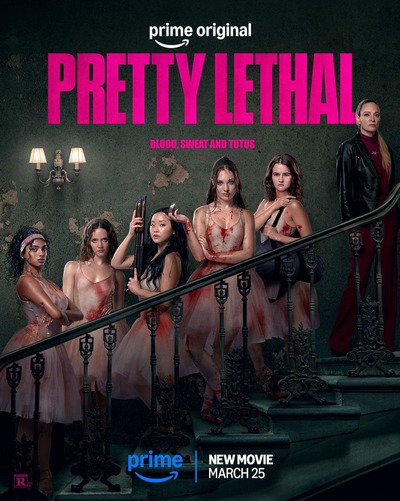 To be fair, this was actually announced back in February 2023. Though that was still after
  This is not our first time here attending the Godfrey Ho rodeo. Indeed we wrote quite warmly about
 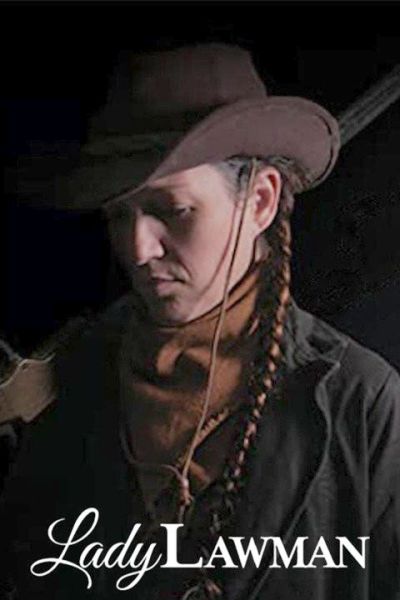 After the pleasant surprise which was