


Canaan

★★★★
“The Land of Hope and Despair”

I’ve to say this anime show is kind of unusual. While after the show there were some attempts to use the story as the basis for a manga series, it is not based on one – unlike what feels like 95% of all anime – but instead on a “visual novel”. I have absolutely no knowledge what a “visual novel” is. Wikipedia has this to say about them: “Visual novels are often associated with the medium of video games, but are not always labeled as such themselves. They combine a textual narrative with static or animated illustrations and a varying degree of interactivity. The format is more likely referred to as a visual novel game.” Well, so much for that. I guess it is similar to these old, “choose your own adventure” books of my youth, where you would make a choice at the end of the page, and depending on your decision would turn to a specific, other page, therefore creating an individual story narrative.

Canaan was inspired by a bonus on Wii visual novel 428 Shibuya Scramble. The game itself, I believe, featured live cut-scenes with real actors, but had extra content consisting of drawn anime-style images. As the game was extremely successful at the time of its 2008 release, it is unsurprising that an anime spin-off was produced in 2009. The original concept was by Type-Moon, with anime studio being P.A. Works. The original visual novel could go into different genres, depending on the protagonist the player chose. So it’s significant that the genre of the anime series also changes over time. In the beginning it can rightly be called a mystery, since you have no idea what happens here and why. Yet at the very end, it is full-blown action with a conspiracy plot sprinkled in, and elements bordering on science fiction. Albeit more “science fact”, because they are not far from possible reality, though quite exaggerated.

The new story starts two years after the “Shibuya event”, a viral attack on a train in Tokyo. Reporter Minoru Minorikawa journeys to Shanghai to find interesting stories, accompanied by young assistant photographer Maria Osawa. Osawa was involved in the event and came close to death, but was saved from the deadly virus by her father Kenji. Due to her trauma she has no clear memories of what happened there. In Shanghai, “there are a lot of stories, if people only opened their eyes to see them”, as Osawa puts it. A number of mysterious deaths lead her to meet Canaan again, a mysterious girl who once saved her life and that she longed to see once more.

Obviously, the girls feel strongly for each other and there are traces of the so-called “yuri” genre (girls in love) here. But western audiences should be careful not to think this equates to lesbianism. Yuri is seen by many fan-girls in Japan as something “pure” and “cute”. Many fans would feel embarrassed if something so concrete and direct as sexuality were superimposed on such a relationship. I guess there are cultural particularities that cannot translate 1:1 into our Western cultural understanding, because they are so very different. Anyway, what’s at stake here is much bigger. One problem is, there are a lot of different things, elements and characters introduced at the beginning, which initially don’t make sense at all. Only slowly, as the story progresses, is it revealed how they connect with each other. I wonder if players of the game maybe had it easier?

We are introduced to all the main characters in the first episode (of 13), but they still have to meet each other and their knowledge is not the same. Minorikawa feels there is a story that he can’t quite grasp, Maria is happy to meet Canaan again, but after a key incident realizes that her friend is a trained assassin. Santana, the aggressive owner of a Karaoke bar, with his mute buxom employee and girl friend, Hakko, also doesn’t reveal his big, dark secret. There is a girl called Yunyun popping up in several different jobs around the city. And why are we being shown dangerous terrorist Alphard, who just escaped a prisoner transport and obviously plans something big, together with her companions, Lian Qi and her servant Cummings?

Then we are confronted with some words at the beginning that we do not yet understand, such as UA virus, borners and unblooms. I’m not really complaining, because I’m actually in favor of a movie or series not giving everything away too early. It’s fine if audiences for once have to work things out for themselves. I liked that aspect of the show very much, but can understand that those less impressed, or just here to see some battling babes, might be disappointed, or unable to connect with the show. Though, you don’t have to be an academic to understand the story. As the story progresses and the blanks are filled in, bit by bit, you start to see the whole. There is also more than one story being told. The characters all have individual parts and roles in the big picture, and are driven not exclusively by “the big thing”, but also more personal motivations.

It turns out there were secret viral experiments, conducted on the population of a small town by the CIA, through the criminal organisation “Snake”. This caused most inhabitants to die, while the survivors developed extraordinary abilities, but with downsides. For example, Hakko can’t speak anymore because her voice creates waves that affects the brains of those who hear her, and could kill them. Yunyun needs medication to not die before her time, and so on. The aim of the experiments was to create another Canaan. She is a natural synesthete (don’t worry, we’ll explain shortly!) who was brought up and trained, like Alphard, by the terrorist Siam. Alphard felt betrayed when Siam gave the new girl the same name as her – Canaan – and Siam started to change under the influence of positive-minded Canaan. So she killed Siam. This backstory was included as a bonus with the visual novel, but since you couldn’t assume viewers had played the game, it had to be mentioned in the anime, and becomes a key reveal here.

Synesthesia is a special condition some people are born with, meaning that some sensory perceptions can be “taken over” by other ones. For example, sound can be perceived as colours by these individuals. But it can take many different forms. In Canaan’s, she “sees the colour of people”, meaning she can tell how they feel right now, as every emotion has a specific color. When she loses this ability at one point in the story, she feels helpless. With that said, the series does not portray synesthesia realistically, rather like some kind of superpower, more or less.

A confusing element is that the characters sometimes do not act or speak as we in the West would. Therefore, it can be quite the task to figure out why they do what they do, and what their motivations are, as they do not necessarily express themselves in a clear manner. Take Alphard, who lets Canaan off the hook more than once. In the audience, we wonder why she does that. But if you listen carefully, it becomes clear: Alphard defines herself through her own hatred, and wants Canaan to feel the same. She needs Canaan to be at her best when they fight. She does not just want to overcome Canaan, but destroy what she sees as the embodiment of Siam’s spirit. In a way, they are fighting about the value of the philosophical legacy belonging to their stepfather and teacher. That’s no small thing for an action story.

You could say that this is about two women finding closure with the past. Their different attitudes to deal with it become clear: While Canaan suffered as much from the loss of Siam as Alphard did, she was able to move on and establish a new positive relationship with Maria. While Alphard, despite becoming head of the terrorist organization “Snake”, has been eaten up by her hatred and suppressed feelings of guilt. She also can’t reciprocate the obsessive and essentially destructive feelings her “little sister” Lian Qi had for her. Oh, yeah: Lian Qi… She would be a feast for a psychiatrists’ conference! On a deeper level this is not really about bombs, anti-terrorist summits, political maneuverings (the US president and his VP don’t leave a good impression here), human experiments or even the big shoot-outs. It’s about the loneliness and isolation the individual characters suffer, and their hope of finding love and possibly redemption. There is a deep, poetic quality in the series, expressed in the dialogue, often less matter-of-fact but hinting at deeper meanings or feelings.

Some of the scenes depicted here are graphic and definitely not appealing. One scene involves a woman having sex with a dead man which, while you understand the intention behind it, is painful to watch. Another shows surviving town inhabitants that have lost their minds and appear very much like zombies in their behavior. The “unblooms” mentioned above, die a terrible death when they come into direct contact with sunlight. I definitely wouldn’t call this an appropriate show for younger teens. Tge grown-up storylines recommend it for older viewers, who can better appreciate the nuances it offers. At the same time, the drawing style is very beautiful – as to be expected, given those involved in the production – and the musical score gives the story a haunting, dynamic, sometimes even epic and melancholic feeling.

The final showdown between opponents – not necessary enemies – Canaan and Alphard is memorable. The audience wonder who will survive, the film makers having already demonstrated that they have absolutely no qualms about killing off main characters. While avoiding spoilers, I must say I have never seen a character exit a story in such an incredible manner! The very last scene, which is kind of an easter-egg, coming when the end titles play and after it, suggests a potential continuation of the story (similar to the open ending of Arcane) that never happened. That said, the resolution felt very fitting and “round”, so to speak.

Dir: Masahiro Andō
Star (voice): Miyuki Sawashiro, Maaya Sakamoto, Yoshino Nanjō, Kenji Hamada
Undercover

★★★½
“The long game.”

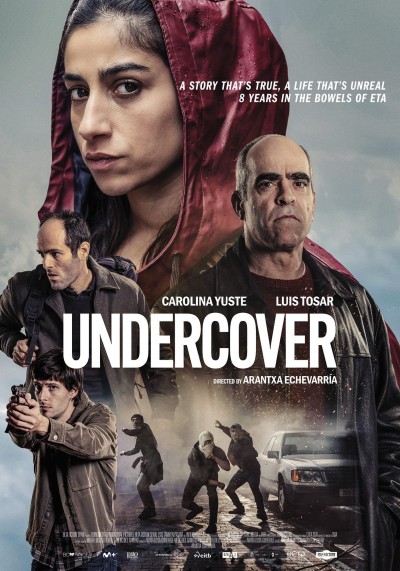
It’s surprising to me that there are currently no English-language external reviews listed for this on the IMDb. It’s certainly worthy of notice outside its native Spain, where it was nominated for thirteen Goyas, the local equivalent of the Oscars, winning Best Film and Best Actress. It takes place over a number of years around the turn of the millennium, when the Spanish state was in a notorious and bloody war against ETA, a terrorist group fighting for the independence of the Basque region. Mónica (Yuste) is a cop who is recruited by Angel (Tosar) to go deep undercover, and infiltrate ETA in order to provide information on the group, its members and their plans.
This takes a very long time, the group understandably being suspicious of outsiders and extremely cautious about in whom they put their faith. We dip into the life of “Arantxa”, the new identity of Mónica, as she becomes active in the separatist movement, laying the groundwork to be seen as reliable and, more importantly, trustworthy. It takes six years before she is finally allowed entrance and given a mission of note: providing shelter for Kepa (Gastesi), an ETA member on the run. Having gained his confidence, she is then brought in to a bigger plan, bringing leader Sergio (Anido) back into Spain, and restablishing an ETA cell in San Sebastian, to attack judges, police and other targets. 

There isn’t anything particularly new here. You can probably tick off the story elements as they show up, if you’ve seen any other “undercover cop” thrillers along the same lines. It’s basically a series of narrow escapes in which Arantxa’s true identity is almost discovered. Sergio finds the phone she uses to talk to Angel, for example, or she is almost unable to return a folder after she passed it to the cops for copying. She starts to have feelings for Kepa too, while Angel faces resistance to the operation from the highers-up. Oh, and #Sexism, because it’s Spain. All fairly boilerplate stuff. However, the secret sauce is in the execution, which Echevarría does with no shortage of skill, particularly when it comes to dialling up the tension.

It is based on a true story, though to what extent it’s accurate, I can’t say. Here, not knowing the eventual outcome going in, except at the highest level (I was aware that ETA ended up disbanding) is likely a help. Because you won’t know whether or not Mónica completes her mission successfully – and, a different question, makes it out alive. I did appreciate there’s not much effort at moral grey here. Sometimes a terrorist is just a bad guy, and if you have any doubts about Sergio, his treatment of Monica’s cat will dissolve those [If they do not, we really can’t be friends!] Again, it’s not the subtlest of plotting. Yet between it and Echevarria’s skilled hand, it all undeniably gets the job done.

Dir: Arantxa Echevarría
Star: Carolina Yuste, Luis Tosar, Iñigo Gastesi, Diego Anido
a.k.a. La Infiltrada

Woman at War

★★★★
“Feel the electricity in the air.”

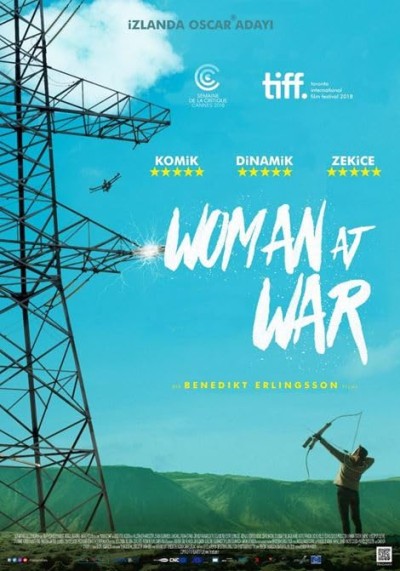
This was a real and pleasant surprise. I wasn’t even sure if this would qualify for the site, or if it would end simply being too gentle. Whole it’s not going to get any awards for hard-core action, it does fit in here. More impressively, it managed to make my empathize with someone whose views are ones I’d generally disagree with. It takes place in Iceland, where Halla (Geirharðsdóttir) is a middle-aged, single woman, waging a near one-person campaign of sabotage against heavy industry, mostly by disabling the power-lines which supply electricity to it, disfiguring the landscape and exacerbating climate change. It’s a game of cat and mouse, with the authorities keen to stop the eco-terrorist from dissuading foreign investors.

However, Halla has issues of her own, beyond the net closing in on her property destruction. A long-dormant adoption request is suddenly approved, and she can’t risk further criminal acts, as a conviction would bar her from proceeding. She intends to go out with a declaration of her manifesto, literally flung from the Reykjavik roof-tops, and a final act, stealing Semtex to blow up a key electricity pylon. Her accomplice, government employee Baldvin (Ragnarsson) is increasingly concerned about the “one last job” trope, and twin sister Ása (also Geirharðsdóttir), a yoga teacher, threatens to put a spoke in the adoption process too, by vanishing off to India for two years to live with her guru.

It’s charming, quirky and rather subversive, all at the same time. It could easily have toppled over into preachiness, but is leavened with enough humour to keep the messaging secondary to the medium. For example, there’s a poor Spanish tourist (Estrada), who is perpetually getting blamed for the attacks, simply by being in the wrong place at the wrong time, leading to his tent getting SWATted. There’s also the soundtrack, which shows up on screen as a three-piece band, and a trio of singers, who play whatever music is needed to accompany the scenes. Every character is a pleasure, not least the farmer (Johanson) who becomes Halla’s leading accomplice. I will say, any wannabe eco-warriors might well get some helpful tips here, such as the best place to hide your explosives…

But it’s Geirharðsdóttir’s film, in both of her roles. She has a quiet yet absolute commitment to her cause, and it’s thoroughly convincing, even to someone like me who thinks “Earth First” means, “We can strip-mine the other planets later.” I still found myself rooting for her, as she scurried across the Icelandic moors, using low-tech means to counter the authorities with their drones and thermal imaging cameras. For what’s as much a comedic drama as anything, these sequences pack their share of tension, and I was left wondering how it would get resolved. It is a bit of a cheat – are the Icelandic authorities that incompetent? I’ll let it pass, since this demonstrates the way message movies should be executed.

Dir: Benedikt Erlingsson
Star: Halldóra Geirharðsdóttir, Jon Johanson, Juan Camilo Román Estrada, Jörundur Ragnarsson

[A modified version of this review first appeared on Film Blitz]

Baltimore

★★★
“The art of terrorism.”

Going off the Wikipedia article about Rose Dugdale, I can’t help feeling this could have been more epic than it was. I mean, a former debutante who, “As an IRA member, took part in the theft of paintings worth IR£8 million, a bomb attack on a Royal Ulster Constabulary station using a hijacked helicopter, and developed a rocket launcher” which used – I kid you not – packets of biscuits to absorb the recoil. There’s so much there, it feels a shame the movie focuses almost entirely on the art theft. This was carried out in 1974, raiding a stately home in rural Ireland (fun fact: the house was used as a location in Haywire), with the aim of swapping the paintings for the release of prisoners. 
That said, the film does a good job of weaving several strands together. Firstly, Rose’s upbringing, and her conversion from a wealthy upbringing to political firebrand, and subsequently terrorist for the Irish Republican cause. Then there’s the actual robbery itself, and finally, the aftermath as Rose (Poots) and her two accomplices (Vaughan-Lawlor and Brophy) hide out and try to make their demands. It is definitely a sympathetic portrayal, which quietly ignores her role in civilian deaths. For instance, Dugdale made the device for the 1992 Baltic Exchange bombing in London, which killed three. And incidentally, blew up the office where I worked, around the corner in Bevis Marks. This may explain why I feel less charitably inclined towards her than the story wants.

Poots’s performance is solid enough to overcome my kneejerk aversion, and Rose as a character is depicted as someone who’s worthy of respect. You definitely get the sense she was genuine about her commitment to ‘The Cause’, born of an honest rejection of her privileged life. In this rebellion against her upbringing, she feels somewhat like a more ideologically committed, English version of Patty Hearst. [Hearst was kidnapped the same year as Rose’s robbery, and ended up robbing banks with the Symbionese Liberation Army] The film does skip over exactly how she went from activist, to hijacking a helicopter in order to drop milk churns on police stations – an incident only referenced in passing on a radio broadcast. 

What this does, it does well though. There’s an escalating sense of tension and paranoia, with Rose eventually ending up on her own (her accomplices were never caught, according to a final caption), as the net closes in. She agonizes over whether to kill a local who might suspect her, and if she should tell her boyfriend (Meade) about her pregnancy. However, while it’s far superior to Poots’s terrible Black Christmas remake, after reading the Wikipedia page, I was left hungry for further details. This feels closer to an episode of a TV series about Dugdale, rather than a fully rounded depiction of her life. I think I might end up going deeper into an apparently fascinating woman who, at her trial, pronounced herself “proudly and incorruptibly guilty”.

Dir: Joe Lawlor and Christine Molloy
Star: Imogen Poots, Tom Vaughan-Lawlor, Lewis Brophy, Jack Meade
a.k.a. Rose’s War

Black Site (2022)

★★★
“Better Red(box) than Net(flix).”

This has a fair amount in common with the disaster which was Interceptor. Both films were produced for streaming companies, and are about a sole woman in a remote military location, that is attacked by a terrorist or groups of terrorists. She then has to survive, take on the threat, deal with treachery on the inside, and handle a ticking clock scenario. It is fairly basic storytelling, occasionally dumb, and there’s nothing of note in either, we haven’t seen a hundred times before, with male or female leads. However, this is significantly more watchable, perhaps because it doesn’t push the envelope. One problem with Interceptor was its #MeToo messaging. There’s no such soap-box concerns here, and Black Site is better for it.

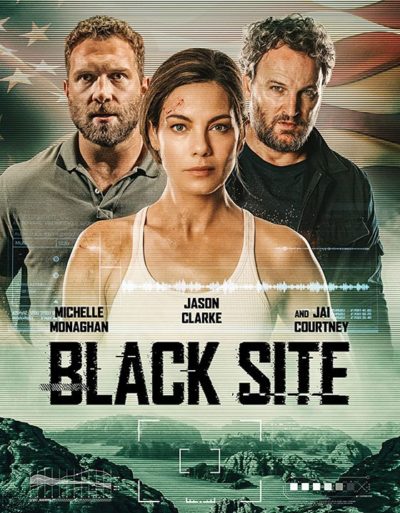
The heroine is Abby Trent (Monaghan), a CIA analyst whose husband and daughter were blown up in a terrorist attack on an “Istanbul” hospital. I use quotes, because when the camera zooms out to a satellite view, Istanbul has apparently relocated, from Turkey to somewhere down the Red Sea in Saudi Arabia. It’s not the last time the film’s geography is shaky. Anyway, Abby devotes her life to tracking down “Hatchet”, the man responsible, and is currently working at a secret interrogation facility in the Jordanian desert. Two things about it made me go “Hmmm.” Firstly, it doubles as a data storage location: that’s a no from me in IT. Second, a Mossad (Israeli intelligence) agent is wandering about. Seems unlikely.

Anyway, #2. Hatchet (Clarke) is captured and sent to the facility, only to escape almost immediately. A lockdown is put in place, but comms get cut off, and the rules – at least in this movie – are that after an hour, they’ll be deemed compromised, and a drone strike will wipe everyone out. Abby has to figure out Hatchet’s agenda, deal with insubordination and flat-out double-agents on her side, and discover the truth about the hospital bombing before the clock runs out. Despite the various idiocies noted above, it is all kept moving forward at a decent pace. Once things kick off with Hatchet’s Houdini-like escape and particularly vicious stabbing of his first two victims, there’s little slack or down-time until things go boom.

I’d like to have seen Monaghan given more to do on the action front. There is a decent fight against the in-house traitor; otherwise, she is largely limited to creeping about corridors with a gun. There are subplots, such as the team member who thinks his active experience puts him above taking orders from Abby, which ends with him taking on Hatchet hand-to-hand in a decent battle, albeit with an entirely expected outcome. Indeed, the same can be said for the film as an entity. There are no surprises, yet the action is handled in a professional manner, and this helps paper over the obvious flaws. Director Banks does solid work, considering this was her first feature, so we’ll see where she goes from here.

Dir: Sophia Banks
Star: Michelle Monaghan, Jason Clarke, Jai Courtney, Pallavi Sharda

American Zealot

★★★
“Constitutional wrongs.”

As I write this, in December 2021, abortion is again a bit of a hot topic on the American political scene. I am, personally, fairly neutral on the topic. Or, at least, to the point that I’d need to spend the entire review outlining my position. Such nuance tends not to fly on the Internet, where you are either a baby-killer or want to turn America into The Handmaid’s Tale, and moderation is for pussies. On that basis, this film is a bit of a losing proposition, likely destined to satisfy no-one with its relative fair-handedness. These days, it feels like everyone just wants their echo chamber reinforced, rather than challenged, even in the mild way this offers.

It is, certainly, a fringe entry here. Lucy (Mackenzie, the director’s fiancée at the time, now wife) is a girl. Who uses a gun. So there’s that. An action heroine though? Not so much, at least in the genuinely understood definition. Like the topic of abortion, it’s complex. For Lucy is in her final year at a Christian high school, and is shocked to discover that her classmate and best friend, Rachel (Marie), has terminated her pregnancy, in defiance of everything Lucy holds dear. After a moral conundrum (basically, the trolley problem) is posed by a teacher, Lucy decides to save future lives by shooting the doctor (Carey) at the women’s clinic, using a gun belonging to the parents of a classmate, Ralph (Miller). However, does Lucy have the moral fortitude necessary to buttress her actions, or will her qualms about the act lead her down a different path?

Though Mackenzie is too old to make a convincing high-school girl (per the IMDB, she was 28 when this came out), it’s a good performance. You can see the way in which her beliefs lead Lucy down the path, to a point where her actions do not just make sense, they are almost required as a result of those beliefs. Less successful is the “de-programming” element, which largely consists of her teacher blustering, “You can’t sacrifice the minority to save the majority. That’s just not how good society functions.” Well, about that… Seems more like a problem with society, to be honest. It’s an angle which needed more effort applied to it, in order to be convincing.

It is also perhaps a little too understated for its own good. The shooting of the doctor is so low-key, you could blink and miss it, when in many ways, it’s the most important moment in the movie, and should have been weighted in accordance with it. Still, given the budget here was just $11,000, this is no small accomplishment. It looks and sounds like a far bigger budget production, and credit is also due to both of the Mackenzies, for being prepared to take on a challenging topic in a way that tries (largely successfully) to avoid being judgmental. While many independent film-makers go the commercially easy route of genre movies, this is something more challenging. If not without flaws, it should succeed in provoking thought.

Dir: James Mackenzie
Star: Ana Mackenzie, Kendall Miller, Keana Marie, Kristin Carey

And Tomorrow the Entire World

★★★
“Chewy, yet slightly crunchy.”

Plenty of films in our genre use violence, either as a tool of the plot, or simply for entertainment purposes. Fewer consider the philosophical and moral underpinnings of violent acts, in the way this does. Luisa (Emde) is the daughter of a rich, aristocratic family who is now a law student. She rebels against her upbringing by joining the P81 commune which is fighting against extreme right-wing groups in Germany. But there is a growing schism in the commune, between those who are opposed to injurious violence, and those who feel the ends justify the means. As Luisa drifts into a relationship with group leader Alfa (Saavefra), she finds herself drawn increasingly to the latter camp – albeit without an appreciation for the potential consequences.

It would be easy for this to descend into political polemic, yet it largely manages to avoid that. Luisa and her pals may be “fighting the good fight,” but they’re clearly not without significant flaws. For instance, Alfa regards the group as his own, personal all-you-can-eat buffet of young women, with Luisa just the next platter. It also does a good job of illustrating the slippery slope, from civil disobedience through property damage to full-on violence against people. At which point, I’d say you lose the moral high ground, and the film acknowledges it can become counter-productive. As someone says after a clash between left- and right-wing factions: “They are angry, really angry, and who’s going to pay? You, Alfa? No, it’ll be someone, somewhere, who had nothing to do with this.”

It’s still a shock when the full force of the German state and (the apparently infamous) Section 129 of their criminal code, is dropped on P81, making Luisa and Alfa fugitives. They hide out with Dietmar, a former activist in the 80’s, who spent time in jail for his acts then, and now lives quietly, working as a nurse. He offers a particularly cynical view regarding the futility of their actions, based on his own experiences: “We were absolutely convinced that we could build a new society. I was going to be a minister.” This is lost on Luisa, who steals a hunting rifle from her family’s home and prepares to launch an assault on an enemy gathering.

The film opens with her tossing away the gun, but at that point it’s not clear whether this was after, or instead of, its use. It’s on that decision that the film’s climax pivots: will she step back from the precipice, or embrace wholeheartedly what it means to take a life, even of someone you regard as lower than an animal? [Pointedly, Luisa is vegetarian…] This was Germany’s entry for the 2021 Best Foreign Film Oscar, though it did not make the final list of nominees. It definitely has that sense of earnestness the Academy likes, and is not so much biased ignores any other side exists – which may be the point, it being easier to hate someone who is kept distant and seen only as “the enemy.” But even an entrenched old hack like myself still found it more thought-provoking than I expected.

Dir: Julia von Heinz
Star:  Mala Emde, Noah Saavedra, Tonio Schneider, Luisa-Céline Gaffron

The Dublin Hit, by J.E. Higgins

Literary rating: ★★★★
Kick-butt quotient: ☆☆½

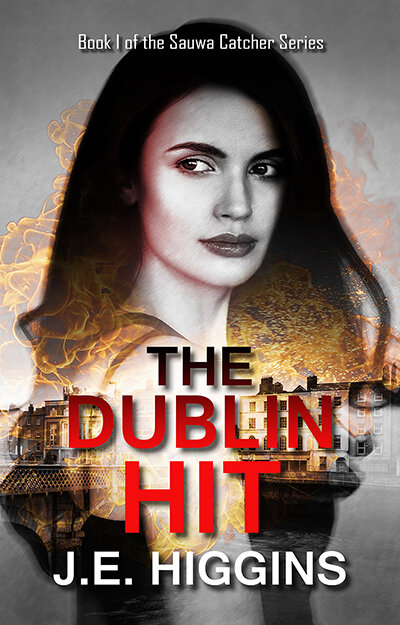
What’s most unusual about this book is its heroine. For many years, Sauwa Catcher operated as a killer for the racist South African government during the apartheid years, hunting down their enemies at home at abroad, and gaining the justifiable nickname ‘Angel of Death’ as a result. Yeah. This is not exactly the kind of person with whom you should expect to sympathize. Indeed, generally someone like this would be the villain of the piece, yet Higgins manages to make it work, far better than you would expect.
This takes place not long after the fall of that regime in the nineties, when South Africa set up a “Truth and Reconciliation Commission”, to come to terms with the crimes previously committed. Catcher had been operating in the UK, and with her support network gone, accepts a commission from a Northern Irish paramilitary group, the Ulster Volunteer Force. In exchange for funding Sauwa’s vanishing off the grid, they want her to assassinate a leading Republic of Ireland police officer, who has been feeding intel to the UVF’s mortal enemies, the IRA. But doing so will bring down not just the wrath of the Irish police, but also the IRA. Additionally, her South African past is trying to catch up with Sauwa, as one of the most notorious tools of the old government, and a team has been sent over to bring her to justice. They’re in for quite a hard task.

So, how do you make the tool of an infamously racist regime sympathetic? Mostly, it’s by carefully crafting her background. Sauwa in not South African, but came from Rhodesia, now known as Zimbabwe. That country had its similarly racist government replaced with something arguably worse, in the shape of dictator Robert Mugabe, and she saw her family slaughtered in the wholesale violence which followed. Sauwa became a refugee, moved to South Africa, and vowed to do whatever she could to prevent the same thing happening there. That started her down the current career path. It’s a case where you may not agree with the character’s decisions, yet you can see the logic in them. Even the black soldiers hunting her, former “terrorists” themselves, know where she’s coming from, and are similarly haunted by their experiences. One of them says, “I feel more akin to her – another fighter in the trenches.”

It also helps that Sauwa only kills when necessary. Though, of course, her definition of “necessary” is perhaps different to yours and mine! There is only one extended action sequence, a night battle between Sauwa and an IRA unit on a beach. That’s mostly because she is simply better than everyone else in terms of experience and tactics, that while there are other conflicts, they are over pretty quickly. Her behaviour is as much about, for example, being aware of her environment and making sure she is not walking into a trap.  Here, Higgins’s military experience does seem to prove useful, and strikes a nice balance between not enough explanation and over-burdening the reader with unnecessary detail. I’m very much interested in seeing where the story goes from here.

Author: J.E. Higgins
Publisher: Mercenary Publishing, available through Amazon, both as a paperback and an e-book
1 of 3 in the Sauwa Catcher series.

SAS: Red Notice

★★★
“Train of thought derailed”

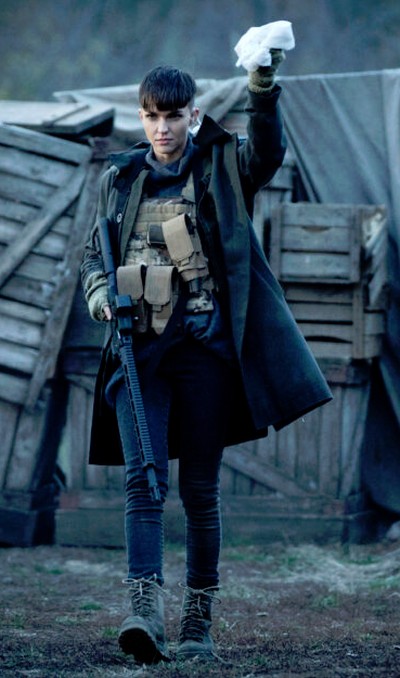
“Less than one percent of the population is psychopathic. Psychopaths often inherit the trait, and are incapable of love. They manage their relationships with clinical precision, succeeding in all walks of life. Psychopaths that can learn to love are even more rare. As rare as a black swan.” That voice-over opens this British action flick, whose main twist is the presence of female villain, Grace Lewis (Rose). She’s part of a family business, a mercenary group that gets its hands very dirty; we first see them clearing the way for a pipeline in Eastern Europe, with automatic weapons and flamethrowers. When footage of their exploits are leaked, an Interpol “Red Notice” is issued – basically a worldwide “wanted” notice. Their employer is none too happy, and that employer just happens to be the British government. So they send a snatch squad, led by special forces operative Tom Buckingham (Heughan), to capture the family.

Grace escapes, and plans savage revenge for the perceived betrayal. She takes hostage a train from London when it’s in the Channel Tunnel, and threatens to blow the tunnel (and various bits of other infrastructure) up, unless she gets 500 million pounds and safe passage. Fortunately – and what are the odds? – Tom is also on the train, taking doctor girlfriend Sophie Hart (John-Kamen) to Paris to propose.  Grace is always one step ahead of the authorities under George Clements (Serkis), thanks to a mole deep in the establishment. Tom thus becomes the world’s only chance of stopping an incident which appears increasingly likely to result in the loss of several hundred lives, as the psychopathic Grace’s plans become clear.

This brought home just how rare a true female villain is in our genre. By which I mean, one who is: the main antagonist; possesses few if any redeeming features; and who doesn’t end up becoming the heroine (I’m looking at you, later series of Killing Eve). Outside of fringe entries like Basic Instinct or Fatal Attraction, in terms of Western films reviewed here, there’s perhaps The Huntsman: Winter’s War, with Charlize Theron, Demi Moore in Charlie’s Angels: Full Throttle… and I’m kinda stuck [Other countries have perhaps done better, with films like Angel, À l’interieur (Inside) or Temptress of a Thousand Faces] Rose, recently seen here in The Doorman and who was Batwoman for one season, is an excellent choice, and you genuinely believe she’s capable of the most heinous of acts.

The problems largely lie elsewhere, most obviously the script which has little to offer beyond being Die Hard on a train. The attempts to make it seem that Grace and Sam are fellow psychopaths don’t work, with Heughan having nothing like the necessary edge. It’s better when it’s not exercising pretensions to depth, and concentrates on bringing the mayhem. Though even here, the underground setting does occasionally leave the viewer literally in the dark. Still, as a way to spend two hours on a Sunday afternoon, this was solid enough, and certainly succeeded in holding our attention, especially when its villainess was on-screen.

Dir: Magnus Martens
Star: Sam Heughan, Ruby Rose, Hannah John-Kamen, Andy Serkis

Lethal Dispatch, by Max Tomlinson

Literary rating: ★★★★
Kick-butt quotient: ☆½

“There are no heroes”, I said. “Just varying levels of evil.”

Having previously read and thoroughly enjoyed, the same author’s Sendero, picking up this entry, in the same setting and with an overlap of some characters, was a no-brainer. And I’m pleased to report, it was an equally enjoyable read, once again opening a window to a time and place in history, of which I was largely unaware. The heroine this time is Inez, a supporting character from Sendero. She’s a teenage revolutionary, who joined Peru’s Shining Path rebel group, after her father was killed by government soldiers. As we join her here, the now 16-year-old Inez has had enough and wants out. She’s told she can leave, if she completes one final mission: deliver a package to a contact in Argentina’s capital, Buenos Aires.

As ever, that “one final mission” does not go as planned. Her contact ends up dead, and she’s left with no resources, on the streets. A new friend tips her off to a job as a children’s nanny – though it’s in the family of one of Argentina’s generals, who represents virtually everything Shining Path detests, and who helped carry out mass disappearances when the military junta was in control. When her charge, Joey, is kidnapped, Inez becomes embroiled in the case, both as a suspect and as she seeks to find the perpetrators. Winning the general’s trust, she becomes a key player as the situation unfolds. But is Inez truly a player, or is she being played?

The quote at the top is an accurate summary of the book’s position. Whether neo-communist terrorist or crypto-fascist military, Tomlinson does a great job of depicting everyone as, above all, human. You may not agree with their actions, yet you can see why they took them – even those who kidnapped Joey. The one element I did find a bit hard to believe is the way a young nanny was allowed, at some points, to dictate the path of the investigation. Admittedly, her intelligence and her instincts were often dead-on, more so than the professionals. That’s credible enough, because her terrorist background meant she knows how they think. It’s just that in 80’s South America, where this is set, I doubt the opinions of teenage girls were highly respected.

Otherwise, however, this was another very solid work. It has a well-laid out plot which twisted until the very last page, where you finally find out what Inez’s package contained. Though she is not exactly Atomic Blonde, our heroine has her occasional moments. These are perhaps summed up best in this line, as she heads out to face Joey’s kidnappers: “With twenty minutes to go, I headed out into a beautiful late-summer evening in Buenos Aires, with twenty-five thousand dollars in a plastic shopping bag and a small pistol down my bra.” The matter-of-fact way in which Inez describes this, tells you all you need to know about her ability to handle any situation. If you like a heroine who remains cool under pressure, this is the perfect read.

Author: Max Tomlinson
Publisher: Sendero Press, available through Amazon, both as a paperback and an e-book
A stand-alone book in the Sendero universe.