 Welcome to our sixteenth annual round-up of girls with guns calendars. Dear lord, I have grandchildren younger than this feature. :) Not an enormous amount has changed since last time. Plans to move appear to have gone on the back burner for now. In part because our son has moved back in with us. I was assured, by a variety of sit-coms, that hilarity would ensue from this scenario. But it appears to have led purely to significantly increased Internet usage, and dishes being “left to soak” in the sink. Though our daughter is getting married on New Year’s Eve. Let’s hope it sticks this time, because we are not funding another wedding…
On the calendar front, all of the top contenders seem to be back for 2026, led – as ever! – by Tac Girls, who seem to have been doing this for longer than I have! A couple of no-shows at the bottom end of the pile, but I did find a couple of ptenti
Below, you’ll find prices (generally excluding shipping), sample images and links to purchase for all the calendars we could find. We’ll add more if we see them, feel free to email us if you know of any others.
TAC GIRLS
Amazon link – $19.95 [though you may be able to find some coupons on TacGirls.com]
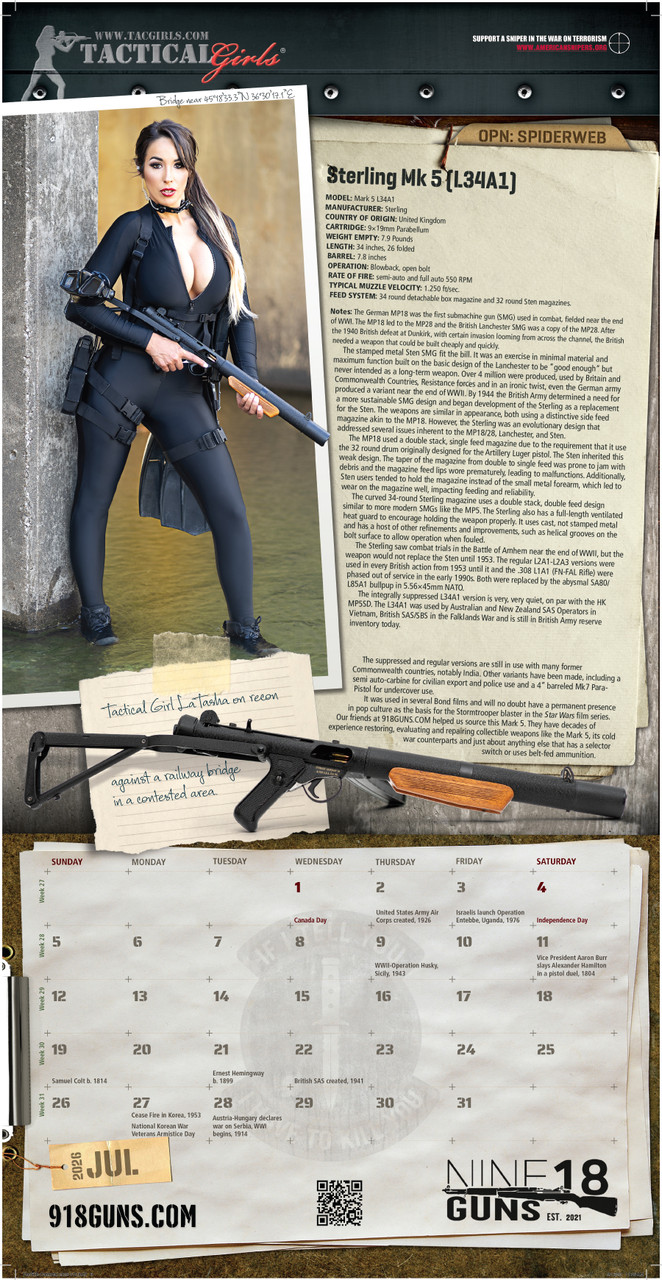
The Tactical Girls 2026 Bikini Gun Calendar has 13 months (1/26-1/27) of Beautiful Girls and Exotic Weaponry! Every Calendar includes a 12×24″ pull out mini-poster of cover model Natasha – slides out, no perforations to tear or staples to pull.
The 2026 Tactical Girls Calendar brings you 13 months of gorgeous pinup models with some of the world’s most exotic weaponry in realistic tactical settings. Includes the EAA MC14TX an AK-74 and an AR Pistol from Black Rain Ordnance. You’ll find sexy zombie hunters, secret agents, army girls and tributes to your favorite female action movie heroines cradling AR-15 carbines, battle rifles, machine guns, tactical pistols, and sniper rifles, 12 x 24 inches open!
Includes over 100 trivia dates from military, law enforcement and firearms history like The Battle of the Bulge, The Gunfight at the OK Corral and Samuel Colt’s birthday. Each month has detailed specs and notes about the weapon and the Tactical Girl’s Mission. Makes perfect Holiday gift for the Marine, Soldier, Sailor, Airman, Police Officer, Shooting Enthusiast, Hunter, Airsoft Player or History buff on your list. Fill that 2 foot square empty space on your Man Cave, garage, shop, barracks, armory or tent wall with 13 months of Girls and Guns. 100% produced and printed in the U.S.A. 10% of the print run of these calendars are donated to deployed soldiers and organizations that support them, notably AmericanSnipers.org.
WEAPON OUTFITTERS
WeaponOutfitters.com – $39.95
As last year, they have three different versions available: one (below) is PG-13 rated, while the other two are R-rated. “Carrying on the fine tradition of beautiful women with cool weaponry in calendars into the modern era, the Weapon Outfitters calendars have been a mainstay of the firearms world for over a decade, and we continue this fine tradition with the 2026 calendars. With 12 months of high resolution, studio and natural light photography of models with guns, this would make an excellent addition to any gun room, garage, or office if your HR department is REALLY cool.” Full disclosure: I was sent copies of all three. I am very happy. :)

GUNS AND GIRLS
Ebay.com – $15.32
The 2026 Guns & Girls Deluxe Wall Calendar is a must-have for enthusiasts of firearms and beautiful women. This high-quality calendar features stunning photographs of gorgeous models posing with various guns, from classic revolvers to modern assault rifles. Each month showcases a different theme, ensuring a year-round celebration of these two iconic American passions. With its large 16″ x 24″ size , the vibrant images are sure to captivate your attention. As an added bonus, this deluxe edition includes a free poster, perfect for adorning your wall or workspace. Indulge in the perfect blend of power and beauty with the 2025 Guns & Girls Deluxe Wall Calendar.

DILLON PRECISION
DillonPrecision.com – $24.95
I’m going to recycle last year’s joke about Dillon Precision, who limit the information regarding their product to: “Dimensions: 13.5 X 26.5”. They clearly believe a picture is worth a thousand words…

ZAHAL GIRLS
zahal.org – $35.00
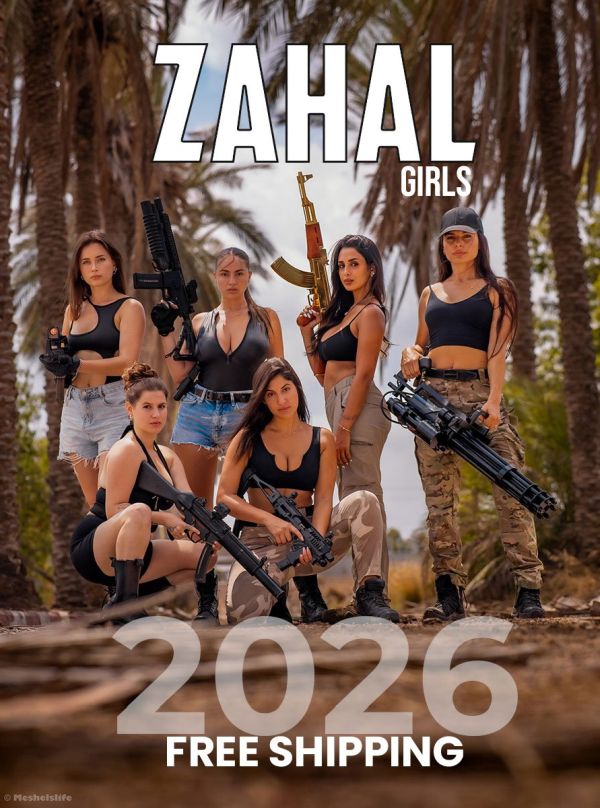
We are proud to unveil the ZAHAL Girls 2026 Calendar – our most exclusive edition yet, printed on premium glossy paper with an all-new, refined design. This stunning calendar combines the unmatched authenticity of former IDF women with cutting-edge tactical gear, captured in bold, contemporary settings. No gimmicks. No gun bunnies – only true IDF veterans. Exclusive Bonus: Every order ships FREE worldwide – no minimums, no codes. Each month presents a meticulously crafted portrait showcasing not only the individuality and strength of these remarkable women but also the spirit and ethos of the IDF. With its artistic blend of tactical aesthetics, evocative backdrops and first-class print quality, the 2026 Calendar is both a tribute and a collector’s piece. Whether displayed in your home, office or training space, this calendar offers 12 months of inspiration, empowerment and exclusivity – a celebration of courage, dedication and style.
WILD DAKOTA GIRLS
wilddakotagirls.com – $18.00
As with last year, the cover doesn’t include any armament. But the promotional videos definitely include some firearms, so that works.

THE JOY OF SHOOTING
JoyOfShooting.com – $27.99, also available in an autographed edition.
As with last year, this one is uncertain. The 2025 calendars only arrived on the site on December 7, so I am currently holding out hope that a 2026 edition will show up there in the next week or two. Below is the 2025 cover, which managed to get ahead of the curve and beat Ballerina to the punch by using a frickin’ flamethrower.

HOT CHICKS COLD STEEL
Amazon – $14.39
- Photography – Enjoy stunning, full-color photographs or artwork every single month
- Durable Construction – Sturdy, high-quality paper resists curling and ink bleed-through, and durable binding ensures longevity throughout the year
- Use Right Away – 16-month calendar is comprised of 12 full monthly pages preceded by a bonus image accompanying the last four months of the previous year
- Large, Roomy Day Blocks – All major holidays and moon phases listed, with plenty of room for writing notes and appointments
- Specifications – 16 months (January–December 2026) monthly two-page layouts plus a four month BONUS IMAGE including September–December 2025 mini grids; 12″ x 12″ (closed); 12″ x 24″ (opened); 28 pages

AMAZON
Finally, here are a couple I found on Amazon: I’m not certain if they are actually calendars, since the descriptions seem potentially rather more like a book. On another product, I found a customer review which said that was exactly what it was. So, buyer beware with regard to these, and I’m including them solely for the purpose of completeness, with no warranty given or implied…





 I am increasingly coming to the conclusion that the Baby Assassins franchise may be some kind of surrealist joke, being played on me by its makers. I really want to love the series and, as with both Part 1 and Part 2, there are moments where I do. At points, I was genuinely considering this as a Top 10 movie I saw this year – not just among GWG movies either. But then, it’ll grind to a halt, with such dedication to being mind-numbingly tedious, that it feels almost like wilful self-sabotage. In reality, I think it’s more likely to be cultural and societal impenetrability. Some elements here are ones which are relatable to a Western audience. Others? Not so much.
  Which, in case you were wondering, is: “When justice is done, it brings joy to the righteous but terror to evildoers.” Though based on this, I would suggest adding “…eventually” to the end. Because you are going to need a lot of patience here. While this is a rape-revenge movie, the sexual assault in question takes almost an hour to show up. Until that point, there are two threads, and you’ll also be waiting for them to connect. By far the less interesting is the teenage soap opera of the pure and innocent Yoli De La Cruz (Diaz), and her friends, the somewhat annoying Daniella, and the immensely irritating Adriana. Boys, parties, etc. You know the score.
 It’s rare that I can pin-point so exactly, the moment at which a book jumped the shark. But in this case, I can. I came across a paragraph which was so striking in its badness, I actually put the book down, to ponder what the heck I just read. It did not improve on several repeat attempts, and thereafter, I was simply unable to enjoy the book. Oh, it hadn’t been any great shakes to that point, but it became a genuine chore, and if I did not want to write this warning review, would certainly have become a DNF. Here we go:
 There’s an interesting idea here, which somewhat works. But it’s perhaps a little too grounded for its own good. It starts in a London flat, where senior citizen Anna Marshall (Walter) ambushes an intruder, handcuffing him to a radiator. Turns out he’s not just a burglar. He knows about her past, and wants the truth. So she tells him a story… At the very end of World War II, her identity was Brana Brodskaya (Vega). She was one member in a small group of Russian soldiers, who have been given a very important task: transport a box back from Berlin to Moscow. Oh, and bury it every night. Inevitably, their curiosity overcomes them, and the box is opened, to reveal Hitler’s corpse inside.
  I was quite startled to read some of the scathing reviews this received. For I genuinely enjoyed it, to the point it likely came one element (which I’ll get to) from a seal of approval. Sure, it’s nothing particularly new overall. However, I found it consistently enjoyable, to the level I felt no desire to look at my phone at any point. These days, that’s high praise indeed. It takes place in a slightly alternate London, where gang bosses Frasier Mahoney (Charles Dance) and Mrs. Christina Vine (Krige) are on the edge of a war for control of the city. There’s also a rogue element, in the Mushka Gang, who have turned an East End estate into a no-go area.
 I’m always down for an Olga Kurylenko film. She’s been in some good entries on the site previously, including
  The “erotic thriller” now seems almost as quaint a part of cinema history as beach party films. It feels partly as if the Harvey Weinstein scandal made nudity and sexuality taboo in Hollywood. The rise of the Internet also provides easy access to all the naked flesh anyone could possibly want. Regardless of the cause, there are no longer big budget films like Basic Instinct or Wild Things being made, let alone being #6 at the North American box-office for the year, as Instinct managed [that said, United Artists paid $2 million for the reboot rights earlier this year. We’ll see; I’m not optimistic]. So in some ways, this feels like a throwback, drawing influence from Brian de Palma and Paul Verhoeven.
 Is there anything worse than a comedy which doesn’t land? I get that humour is subjective, but this action-comedy manages to be spectacularly unfunny, to a degree I have to wonder how it got made. There are some well-known people in the cast: actors who I know have talent (to the list below, you can add Martin Kove and Jake Busey), and whose work I have previously enjoyed. What did they see in the script here, which made them think, “Yes, this is something I want to do”? For this is the cinematic equivalent of nails being dragged across a chalkboard for an hour and a half. You don’t watch this, so much as endure it.
  It’s surprising to me that there are currently no English-language external reviews listed for this on the IMDb. It’s certainly worthy of notice outside its native Spain, where it was nominated for thirteen Goyas, the local equivalent of the Oscars, winning Best Film and Best Actress. It takes place over a number of years around the turn of the millennium, when the Spanish state was in a notorious and bloody war against ETA, a terrorist group fighting for the independence of the Basque region. Mónica (Yuste) is a cop who is recruited by Angel (Tosar) to go deep undercover, and infiltrate ETA in order to provide information on the group, its members and their plans.