
Freeway

★★★★
“Little Red Riding Hood: the crack whore years…”

Right from the opening credits, a debt to the Brothers Grimm is clear. In this modern-day version, Red’s stepfather is a sleazebag crackhead, and her mother a street hooker; when both get carted off to jail, Vanessa Lutz (Witherspoon) heads, with basket, up Interstate 5 towards Grandma’s house. Except that on the way, she meets Bob Wolverton (Sutherland), the notorious I-5 killer. And what big teeth he has!
From there, the tale diverges a bit: I don’t remember a prison catfight in the original, and recall Red relying more on a woodsman with a large axe than her own handguns, but it has been a while since I read it. This is, however, unashamedly grim with a small G. Er, and one m. :-) The Lutzs take “dysfunctional” to new levels, and it’s frankly astonishing that Vanessa has retained any sense of morality, albeit a severely skewed one. I wasn’t surprised when her only decent relationship was terminated by a drive-by.

The cast is a mixture of has-beens (Sutherland, before resurrection in 24, and Shields) and will-bes (Witherspoon and also Brittany Murphy), but all deliver fine performances. The weakest point is a script more concerned with satire than logic – would they really let a convicted arsonist carry a lighter in jail? No wonder Oliver Stone is a producer, given the undeniable echoes of Natural Born Killers. As a benchmark, at one point, when Vanessa shows Bob a photo of her “real” father, it’s actually serial killer Richard Speck. If that amuses – and must confess, it did us – this film is probably for you.

Dir: Matthew Bright
Star: Reese Witherspoon, Kiefer Sutherland, Brooke Shields, Bokeem Woodbine

Gunsmith Cats: Bulletproof

★★★★
“Fast, hardware-heavy fun in Chicago, Japanese-style!”

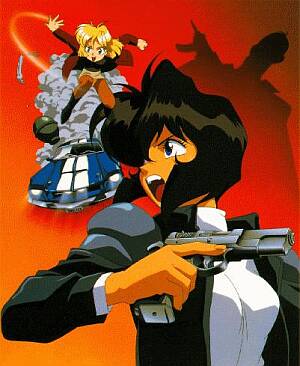
Watching this dubbed was, for once, viable since despite its Japanese origins, it’s firmly set in and around Chicago. So we did sit through some of it in English, but the accents were woefully Cal-girl and thus we’d recommend sticking with the Japanese, even more unlikely though it might be. That out of the way, this is an action-packed romp, in three episodes but effectively one story. Rally Vincent and May Hopkins, one a crack marksman, the other an explosives expert, own a gun store, but are blackmailed by the ATF into helping nail an arms ring. It’s not as simple as it seems, since the perps have connections at a high level, and the services of a former Soviet Special Forces hitwoman.

The episodic structure means there’s never a dull moment and you effectively get three climaxes for the price of one, with the car chase in #2 perhaps my favourite. If it occasionally teeters on the edge of cheesecake – Rally gets her blouse shot open – it’s made clear early on that the heroines have little time for romantic dalliance. Indeed, there’s little time for anything much, including character development, but the story charges on at a great pace, so it’s not as if they’re wasting time.

You can see why Sonoda set it in America, since handguns are illegal in Japan, and the crowded streets would likely impair the auto quotient. Creator Kenichi Sonoda’s fondness for fast cars was apparent in his earlier work, Riding Bean, and by the end of this, Chris had decided she wants a Shelby GT Cobra, just the like the one Rally drives. Drool. :-) A lot of effort went into reproducing Chicago and wiser heads than mine (who have actually been there!) say it’s accurately detailed. Though undeniably great fun, perhaps the most amusement we got was from pretending the opening song was the theme to Saturday Night Live, to which it bears a spooky resemblance…

Dir: Mori Takeshi
Star (voice): Michiko Neya, Kae Araki, Aya Hisakawa

Perdita Durango

★★★½
“The two greatest pleasures in life are fucking and killing.”

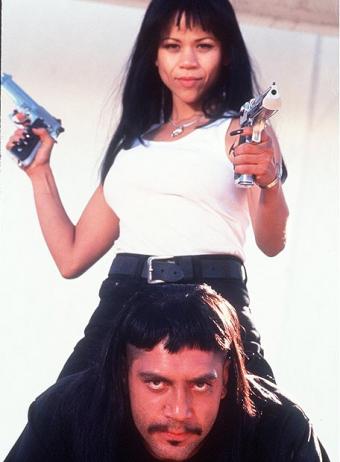
perdita_durangoDespite flaws, this merits your attention simply because of the title character, even if describing her as a “heroine” would necessitate a wholesale redefinition of the term – the quote above is entirely typical of her attitude. When she teams up with bank-robber Romeo Dolorosa to traffic a truckload of foetuses to Las Vegas (as you do…), it’s like putting a lit match to fuel. You just know there’s trouble ahead.

Romeo is into Santeria, and Perdita convinces him to perform a human sacrifice; to this end, they kidnap a slumming young WASP couple (Cross and Graham – and yes, it is Heather’s sister, though notably less well-endowed), and the film goes into nightmare mode. You get the horrible feeling that absolutely anything could happen, and de la Iglesia shows that he has no problems pouring on both sex and violence. [I should mention at this point that you should track down the German DVD, which is the only uncut version currently available, AFAIK] It’s difficult viewing – and Rosie Perez always seemed so nice. You certainly won’t sustain that view afterwards.

The film does run out of steam when this extremely menacing section is completed, and ends up petering out somewhat, as the focus moves off the couple and more onto Romeo – Perdita is pushed into the sidelights, and she deserves a much better fate. If there’s also a sense of deja vu, it’s because the story comes from the same writer as Wild at Heart, and both depict a twisted love-story/chase. Despite this, there’s enough perverted nastiness here to satisfy the most jaded palate.

Dir: Alex de la Iglesia
Star: Rosie Perez, Javier Bardem, Harley Cross, Aimee Graham

Bad Girls: season two

★★★★
“Back behind bars, but brilliant as before.”

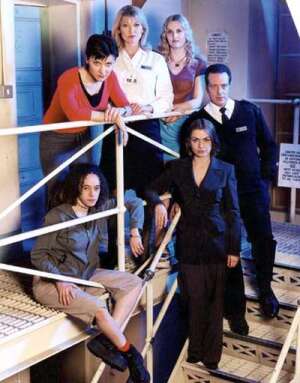
Somewhere around the middle of the series, I realised that this is soap-opera, pure and simple. As someone who’d never be seen dead watching a soap, this was disturbing. Fortunately, moments later, Jim Fenner did something else truly rotten to the core, and my attention went back to H.M. Prison Larkhall. Such is the joy of the show: it defies categorization.

All our favourites return, though both good and bad show more character development than previously. Evil guard Fenner (Ellis) in particular demonstrates amazing depth, and we find out why resident bitch Dockley is that way. Top plot-arc this season was a through-the-bars romance between lifer Niki Wade and former governor Helen Stewart, that sprouted wings, flew, then crashed-and-burned (apparently) in the final ep.

Of the new characters, gangster’s wife Yvonne Atkins made the biggest impression – a nemesis for her arrived too, but was offed after only a couple of episodes, in a disappointing second case of “sudden fatal illness as plot device”. While there wasn’t perhaps anything as heartrending as we saw in the first series, the breadth and depth of storylines remains a joy to watch. Soap opera or not, we’ll start season 3 sooner rather than later.

Star: Mandana Jones, Simone Lahbib, Debra Stephenson, Jack Ellis

Killers 2

★★★★
“Heather is sick and twisted…”

Director Latt and star (and wife) Little came to our attention through a highly-amusing comedy about TV, Jane White is Sick and Twisted. This is radically different, but still effective, thanks to Little’s performance as Heather. The sole survivor of a warehouse massacre, she is taken, catatonic, to a mental hospital. The bad news is, associates of the gangsters she killed want her dead – try convincing a doctor his staff have been bribed to off you. [They skip the potential ambivalence as to whether Heather actually is imagining everything.] The good news is, she has developed ‘hunter craze’, and is capable of enormous strength and savagery when threatened; hence her nickname, ‘The Beast’.

The detailing is poor: Heather’s hair changes length at random; crop-tops & make-up are apparently easily available; she dislocates her shoulder to escape a straitjacket, but five seconds later, she’s 100% well. Yet there is a lot to admire, especially a final battle where the gangsters give up trying to make Heather’s death ‘accidental’, and storm the hospital – it’s an excellent sequence, albeit underlit, like much of the film. We also liked co-incarceree Emma (Martin), in for clinical depression, and not the best hostage for the villains, since she wants to die. There’s something of Angelina Jolie in Girl, Interrupted about her. We haven’t seen Killers, yet happily recommend the sequel, though it ain’t One Flew Over the Cuckoo’s Nest. Refreshingly free of romantic interest, this is a straightforward story, vigorously told and largely avoiding low-budget pitfalls.

Dir: David Michael Latt
Star: Kim Little, D.C.Douglas, Mellisa Martin, Nick Stellate

Retroactive

★★★★
“Trippy time-travel done with almost enough energy to cover the plot holes.”

It’s not often I criticise a film for too much explanation, but Retroactive might have been better off with more hand-waving. I’ll explain later; first, the plot. Travis plays Karen, a police negotiator who just screwed up badly; driving down South she ends up hitching a ride with Frank (Belushi) and his abused wife Rayanne (Whirry). Frank is a psycho, and Karen ends up sheltering in a secret lab where time-travel experiments are going on – she ends up with another chance to deal with Frank, only to discover this second attempt may not be an improvement…

This is a nifty little sleeper that seemed to get buried when Orion Pictures went belly-up. It deserved a better fate, with everyone turning in sterling performances, even if Karen’s reaction to being shot back in time is too calm and understated! Belushi makes a fine, creepy redneck, a sense of tension springing from your feeling he is capable of anything at any time. The deviations with each attempt are marked and cleverly written, and the ending is satisfactorily imperfect.

Our qualms were largely because, unlike Run Lola Run or Groundhog Day, which made no attempt to explain what was happening, here there’s just enough logic to be unsatisfying. The “rules” are clearly important – for example, do time-travellers keep their memories? – yet are inadequately laid out. We spent the last 15 minutes with furrowed brows, trying to see if it made sense. It may, or may not, but either way was an unwelcome diversion in an otherwise pleasant surprise.

Dir: Louis Morneau
Star: Kylie Travis, Jim Belushi, Shannon Whirry, Frank Whaley

Bandidas

★★★★
“How the West was Wo(ma)n…”

Let us make no mistake about this, this is a frothy confection of a film, which is not intended to be taken seriously; to do so, would be a serious mistake. The closest parallel here is probably to think of it as a distaff version of Shanghai Noon, with an odd couple teaming up for fun ‘n’ frolics in the Old West. Robber baron Tyler Jackson (Yoakam) comes to Mexico to take away land from the locals so a railroad can be built. In the process, he kills the fathers of both farm-girl Maria (Cruz) and rich-girl Sara (Salma), so he can take their property and bank respectively. To get revenge, each lady independently decides to rob the same bank at the same time, and are forced to team-up; their widely-disparate characters initially cause friction, but they eventally come to respect each other, after being trained by retired robber Bill Buck (Sam Shephard).

When they start their campaign, Jackson brings in a specialist in the new ‘scientific method’ of criminal investigation, Quentin (Zahn), to help track down the bandidas. However, after discovering Sara’s father was poisoned, heis convinced by the pair that he is actually working for the wrong side, and comes across to join them. The latest security measures are defeated – with the aid of a pair of ice-skates! – and as a result a train is loaded with the Mexican government’s gold reserve, to ship it to safety in Mexico. The bandidas resolve to take the cargo, but Jackson and his gang are waiting for them…as is Quentin’s fiancée…

This was co-written by Luc Besson: he is the engine-room of European cinema, listed as a producer of no less than 60 titles over the past five years on the IMDB. He likely deserves a place in the Girls With Guns hall of fame, having directed Nikita and The Messenger, given Milla Jovovich and Natalie Portman their action-debuts in The Fifth Element and Leon respectively, worked as an uncredited co-producer on Haute Tension, and now delivers this. It came up in response to a request from the two leads, who’ve wanted to work together for a long time, and he handed the script to two Norwegians, making their feature debut [but with a lot of commercial experience].

However, there’s no doubt that it’s the leading ladies who make this one click, right from the first scene together, where Sara confronts Maria, who has snuck in to the house to argue with Sara’s father about the ongoing land-grab. The bickering between the two, which continues, in an increasingly friendly way, through the entire film. Maria snipes at Sara because the latter can’t fire a gun to save her life – in a beautiful touch, she gets terrible hiccups when she tries; Sara taunts Maria for her lack of education.

The two also argue over who is the best kisser, notably in a scene where they are dressed as Paris showgirls, and are trying to extract information from Quentin, who is tied to the bed. And Steve Zaun was actually paid to take part? ;-) That’s about as far as the film goes, sexually speaking; much cleavage, but no actual nudity. A fondness for the heroines splashing around in water, especially early on, and the above-mentioned comedic seduction scene, is about as close as we get to exploitation. That news may disappoint some readers, but it really wouldn’t be in keeping with the overall tone of the movie, which is light-hearted and firmly PG-13 rated, despite lesbian scuttlebutt which circulated afte a press conference where Penelope (gasp!) touched Salma’s butt.

What did disappoint me was the action. I expected more from Besson, who helped give us such gems as The Transporter and District B-13, as well as the titles mentioned above, though a couple of moments stand out. There’s a bravura slow-motion scene in the final battle – bullets, knives, bodies and debris fly in a single shot, the camera panning back and forth to capture the carnage. But, the most amazing part is seeing a horse, with a rider on its back, climb a ladder. This was apparently a combination of training (the horse, with a stunt rider, walked up a specially-made set of stairs) and CGI work by Parisian FX house Macguff, to replace the stairs with a ladder, add dust and bounce, etc. It’s a throwaway moment, in a throwaway film, but is worthy of note, and applause.

That may be perhaps down to the leads’ lack of experience: Cruz’s only real brush with the action genre was Sahara, Hayek has more background (working with Robert Rodriguez helps there), but neither of them would appear to be looking to make a name for themselves with their work here. A sequel is hinted at by the ending; however, that this $30m production went all but straight to video in the US and notched only $18m overseas would seem to rule this out. One wonders why, for a film set in Mexico and with two Hispanic leads, why they didn’t speak Spanish; one assumes Besson, with his eye on the international market, went for the more commercial English, even though Cruz seems slightly ill-at-ease thee.

These qualms are relatively minor, and if not the all-out action fest I was hoping for, it’s certainly among the best Westernettes of recent years. This is not a genre which has been kind to action heroines in the past, including such bombs – justifiable or not – as Bad Girls and The Quick and the Dead, as well as less high-profile turkeys as Gang of Roses. Bandidas is nowhere in the same league, and if survives almost entirely on the charisma and energy of Cruz and Hayek, that’s by itself is something which most movies would like to have. If you can certainly argue that to some extent this is a vanity project, here, I’d be very hard pushed to call vanity a sin.

Dir: Joachim Rønning and Espen Sandberg
Stars: Penelope Cruz, Salma Hayek, Steve Zahn, Dwight Yoakam

Crouching Tiger, Hidden Dragon

crouching1★★★★★
“Broads with swords.”

crouching2Not many subtitled movies can claim to have inspired commercials (Jean de Florette being the only other that comes to mind), but seeing the Mountain Dew advert obviously based on this movie makes you realise just how deeply this film has permeated into the American pop psyche. But while this contains the most spectacularly kick-ass action ever seen in Western multiplexes (note the qualifier), at heart, it’s a set of exquisitely tragic love stories, spun into a web which simultaneously confounds expectations and fails to live up to them.

 It’s clear from the start that Lee is not following the traditional approach to martial arts movies, which usually start with a thump to get the audience’s attention. He is happy to set the scene and introduce the characters for the first quarter of an hour in a stately and mannered way that belies what is to come. Similarly, the action climax happens twenty minutes before the end.

The other major variation from standard practice is that the acting is fabulous – often in HK action movies, this is an afterthought, and the likes of Jackie “two expressions” Chan and Jet “that’s one more than me” Li are never going to win Oscars. I would previously have put Yeoh in the same category, but Lee coaxes a performance of great depth from her – having Chow Yun-Fat, possibly the best, and certainly the most charismatic Asian star, to work against does no harm either. This is what lifts the film up to undreamt of heights: have Steven Seagal or Jean-Claude Van Damme ever brought tears to anyone’s eye? [Except perhaps the poor schmuck who paid for a cinema ticket!]

Yet if the acting sets a new standard, the action surprisingly doesn’t, at least not to anyone familiar with Hong Kong movies. This kind of thing has been done, to the point where it can even be mercilessly lampooned by the likes of Flying Dagger, which has its own treetop battle. This perhaps explains why its record-setting box-office in the United States (doubling the take of any previous subtitled movie) was conspicuously absent in the Far East. While Zhang YiYi’s restaurant demolition job is memorable, for me the highlight pitted Yeoh against Zhang in Yeoh’s home, a balletic battle which worked particularly well because it largely rejected the fly-by-wirework running through the rest of the movie. I’m a traditionalist in such things, and always prefer genuine physical ability to special effects.

The plot unfolds with a stately elegance, showing little regard for normal chronology. The easiest way to describe it is to break it down into smaller components – any one of which would provide sufficient content for your average kung-fu film – each running through the movie like the strands in a rope:

  • The powerful but undeclared love between two swordsmen, Li (Chow) and Yu (Yeoh).
  • The struggle for control over the legendary Green Destiny sword.
  • Jen (Zhang) and her long lost love, the bandit Lo (Chang) – who returns just in time for her impending arranged marriage.
  • Jen’s apprenticeship to the villainous Jade Fox (Cheng), who will not let her go at any cost.
  • Li’s quest for revenge against Jade Fox, who killed his master.

crouching3The sisterly relationship between Yu and Jen is particularly impressive, with the older woman trying to guide the willful youth and prevent her from making the same mistakes she did. But when (even in ancient China!) has anyone been able to tell a teenager anything? Special praise also to veteran Cheng, whose Jade Fox is a fabulous character, worthy of more screen time than she gets here – I’d love to see a prequel, setting up the story between her and Li. In comparison, the men are somewhat ill-defined, particularly Lo: you never get much sense of why Jen fell for the man who kidnapped her, and I can only really blame it on Stockholm Syndrome. Despite being reduced to a supporting role, Chow Yun-Fat is as good as ever, though I’ve heard tell that his Mandarin accent leaves a little to be desired, since he’s a Cantonese speaker naturally!

Regardless: what you have here are three of the strongest and finest female characters of the past decade, excellent acting and amazing action. The result is as close to perfect as anyone could reasonably expect.

Dir: Ang Lee
Star: Michelle Yeoh, Zhang ZiYi, Chow Yun-Fat, Chang Chen, Cheng Pei Pei

Run Lola Run

lola★★★★★
“She’s got legs… And she knows how to use them.”

The term “action heroine” moves into a whole new dimension with this movie: no gun-battles, no fight-scenes, no explosions, but it still maintains a breathless pace for almost the entire 81 minutes. Lola (Potente) needs to find DM100,000 in 20 minutes, after her boyfriend Manni (Bleibtreu) loses a bag of money he was supposes to deliver to a highly dubious character. All this is set up in about five minutes, and then Lola is off, sprinting to try and get the cash.

The key twist is the film depicting three parallel stories; all start with her leaving her apartment, but they gradually diverge, and end in three radically different conclusions. One of the film’s myriad delights is seeing how they interweave, with the differing fates of the various characters, and how tiny changes in the decisions we make can have massive consequences.

Right from the start, when Lola lobs a phone in the air and it lands spot-on the cradle, we know she has unusual powers. Her screams can shatter glass, and there’s one moment, in the casino, when she turns to the manager and looks at him. “Just one more game”, she says, and as portrayed by Potente (an amazing performance, with “future star” written through it), her gaze comes across as a force of nature more powerful than a typhoon. Lola is someone absolutely determined to have what she wants – “love conquers all”, if you like – and she even seems capable of rewinding time through sheer will, when the results go against her.

Yet, curiously, certain experiences appear to carry forward: in run #1, she is shown how to use a gun, in run #2, she needs no such tuition. A security guard we see clutching his heart in #2, is met in an ambulance in #3. Tykwer sees no need to explain any of this (is it merely being played out in Lola’s mind?), yet spotting these things are part of what makes the film so incredibly rewatchable. Even after half-a-dozen viewings, I’m still finding new facets e.g. the number she bets on in the casino, 20, is also the number of minutes she has to save Manni, since there’s simply so much crammed in.

lola2Special mention needs to be made of the soundtrack, a pumping mix of techno co-created by Tykwer, which helps drive the film along at a blistering pace, and is one of the few soundtracks I will listen to on their own. Yet there are also tender moments (probably essential to prevent the audience from hyperventilating and going into shock), which Tykwer handles with skill and aplomb. Lola is something of an aberration in his filmography, stylistically: his other work such as Winter Sleepers are much more languidly-paced, but do cover similar themes of randomness and its effects. The end result is a film which manages to be shallowly entertaining and deeply satisfying at the same time. You can enjoy it purely on a “what happens next?” level, or appreciate it as something with so much depth that it can even be viewed as a retelling of the myth of Orpheus (the evidence pointing to such an interpretation is too lengthy to go into here). Truly a film with something for everyone, and for some, like myself, it has everything.

Dir: Tom Tykwer
Stars: Franka Potente, Moritz Bleibtreu, Herbert Knaup, Nena Petri

Charlie’s Angels (movie)

★★★★
“…and then there’s the ho.”

Making movies based on a TV show is always fraught with danger. You’ve got to convince the audience to pay good money to see the same thing they can watch for free at home, yet you can’t stray too far from the central concept, or you’ll alienate the fans. One possible countermeasure is to go for an old show, less likely to have a rabid fanbase, which you can update safely. Yet this too is problematic: anyone see The Mod Squad?

Charlie’s Angels, however, avoids most of the pitfalls, and is a thoroughly enjoyable blast – little wonder it took more money at the box-office than almost any other female action movie in history. While not faultless (the lack of characterisation is particularly woeful), it never sets out to be any more than a good time, and in that capacity it succeeds admirably, mixing violence, sex and humour to optimum efficiency. The plot can be easily dismissed: the trio investigate a kidnapped computer tycoon, only to find things are not quite what they seem, as they uncover a plot to kill their unseen boss, Charlie. There – that’s that out of the way.

Almost as rapidly put aside are the lead characters: Alex (Liu), Natalie (Diaz), and Dylan (Barrymore). Margaret Cho once said – partly in reference to the original Charlie’s Angels TV series – that whenever you get three female friends, there’s the smart one, the pretty one…and then there’s the ho. True to form, the movie replicates this: Alex’s main scene has her as a ferocious efficiency expert, the main ambition for Natalie seems to be to appear on Soul Train (in a totally irrelevant but good-natured sequence), while Dylan beds the client without even reaching a “first date”. Work out which is which yourself. :-)

If there’s nothing there to keep you interested, the film makes up for it in lots of other ways. The aim was to make it seem like turning pages of a comic-book, and this certainly succeeds – there’s always something going on. While the nods to political correctness are kinda irritating (the villain and all his henchmen can muster precisely one gun between them), no-one is really taking it seriously, and the tongue-in-cheek approach saves the whole thing. The supporting cast are good, too: Bill Murray as their overseer is his usual laconic self, while Kelly Lynch and Crispin Glover give good support to Sam Rockwell.

The film manages to capture the spirit of the original show, without being a slave to it. I appreciated the nods to its predecessor e.g. the voice of Charlie being the same actor, and I believe even the speakerphone was the very one used on the TV show! The soundtrack, similarly, is a nice mix of old and new, though points must be deducted for the film being partly responsible for inflicting Destiny’s Child on the universe at large.

 It is, however, the action scenes which stand out and, frankly, make up for the film’s deficiencies in other areas. Yuen Cheung-Yan is the brother of Yuen Wo-Ping – perhaps the greatest exponent of HK action – and while not quite as innovative or super-smooth as his sibling, he’s clearly cut from the same cloth. At the risk of sounding sexist, don’t forget we’re talking a bunch of girlies here – Diaz, Barrymore and Liu all came in without significant martial arts experience, and making them look as good as they do is a great feat. Kudos, too, for the actresses in question, who clearly put in no little effort themselves. [Thank heavens Thandie Newton, who single-handedly destroyed the first half of Mission Impossible 2, was unable to take part, and Lucy Liu stepped in.]

The pacing is a little weird though; apart from one impressive battle between the trio and Crispin Glover in a back-alley (to the tune of the Prodigy’s Smack My Bitch Up), all the martial arts is concentrated in one 20-minute span near the end. At one point we have Cameron Diaz taking on Kelly Lynch, Lucy Liu going toe-to-toe with Glover and Drew Barrymore taking on a whole roomful at virtually the same time, and the cross-cutting does get a little aggravating. Barrymore’s battle is very show-offish: she tells her opponents what she’s going to do, pauses in mid-stream to name the fighting techniques, and moonwalks out of there when she’s done. A tap on the wrist and a warning not to do it again, Drew.

Indeed, much the same could probably be said of the entire movie. It works beautifully, despite its flaws, but it wouldn’t bear frequent repetition. It’s no bad thing that, because of scheduling conflicts, the sequel isn’t due out until three years after the original. Candy is indeed dandy, but it’s not the sort of thing from which you can form your staple diet.

Dir: McG
Stars: Drew Barrymore, Lucy Liu, Cameron Diaz, Sam Rockwell