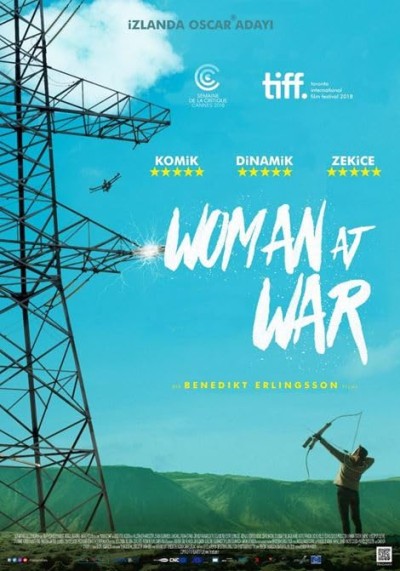
This was a real and pleasant surprise. I wasn’t even sure if this would qualify for the site, or if it would end simply being too gentle. Whole it’s not going to get any awards for hard-core action, it does fit in here. More impressively, it managed to make my empathize with someone whose views are ones I’d generally disagree with. It takes place in Iceland, where Halla (Geirharðsdóttir) is a middle-aged, single woman, waging a near one-person campaign of sabotage against heavy industry, mostly by disabling the power-lines which supply electricity to it, disfiguring the landscape and exacerbating climate change. It’s a game of cat and mouse, with the authorities keen to stop the eco-terrorist from dissuading foreign investors.
However, Halla has issues of her own, beyond the net closing in on her property destruction. A long-dormant adoption request is suddenly approved, and she can’t risk further criminal acts, as a conviction would bar her from proceeding. She intends to go out with a declaration of her manifesto, literally flung from the Reykjavik roof-tops, and a final act, stealing Semtex to blow up a key electricity pylon. Her accomplice, government employee Baldvin (Ragnarsson) is increasingly concerned about the “one last job” trope, and twin sister Ása (also Geirharðsdóttir), a yoga teacher, threatens to put a spoke in the adoption process too, by vanishing off to India for two years to live with her guru.
It’s charming, quirky and rather subversive, all at the same time. It could easily have toppled over into preachiness, but is leavened with enough humour to keep the messaging secondary to the medium. For example, there’s a poor Spanish tourist (Estrada), who is perpetually getting blamed for the attacks, simply by being in the wrong place at the wrong time, leading to his tent getting SWATted. There’s also the soundtrack, which shows up on screen as a three-piece band, and a trio of singers, who play whatever music is needed to accompany the scenes. Every character is a pleasure, not least the farmer (Johanson) who becomes Halla’s leading accomplice. I will say, any wannabe eco-warriors might well get some helpful tips here, such as the best place to hide your explosives…
But it’s Geirharðsdóttir’s film, in both of her roles. She has a quiet yet absolute commitment to her cause, and it’s thoroughly convincing, even to someone like me who thinks “Earth First” means, “We can strip-mine the other planets later.” I still found myself rooting for her, as she scurried across the Icelandic moors, using low-tech means to counter the authorities with their drones and thermal imaging cameras. For what’s as much a comedic drama as anything, these sequences pack their share of tension, and I was left wondering how it would get resolved. It is a bit of a cheat – are the Icelandic authorities that incompetent? I’ll let it pass, since this demonstrates the way message movies should be executed.
Dir: Benedikt Erlingsson Star: Halldóra Geirharðsdóttir, Jon Johanson, Juan Camilo Román Estrada, Jörundur Ragnarsson
[A modified version of this review first appeared on Film Blitz]
From what I can tell, Arisen is a massive zombie apocalypse saga, with a heavy military focus, by Fuchs and Glyn James. There are fourteen books in the main series, but Fuchs has also spun off related sets to tell other stores set in the same universe, such as Arisen: Raiders. The Operators series appears to be another. It looks to be intended as a trilogy: at the time of writing (March), part one is out, with part two next month and the finale in 2026. It feels like subsequent installments might be more team-oriented, but part one? Hoo-boy.
Yeah, this is the first book to ever get a five-star action rating from me. It just doesn’t stop. There’s a sub-genre called “hard SF,” which according to Wikipedia, is “characterized by concern for scientific accuracy and logic.” I suggest this could be labelled as hard action, with a great deal of information about hardware, like guns and vehicles. Here’s a sample paragraph: “The boat itself is a low-observable, reconfigurable, multi-mission surface tactical mobility craft with a primary role to insert and extract SOF in high-threat environments, but can also be used for fire support, maritime interdiction, and VBSS missions, as well as CT and FID ops.” I’m not sure what much of that means. Though I suddenly have a strong urge for a glass of whisky and a cigar.
The heroine here is Yaël Sion, an Israeli special forces soldier, who lost her parents in a terrorist attack when she was young, and has become utterly self-reliant as a result. We begin with her part of an operation against Palestinian terrorists on the West Bank. But it’s not long before the pandemic strikes, and political concerns become irrelevant, as the world turns into a hellhole. Every hour brings a new, ferocious battle for survival, and any sanctuary can suddenly become a deathtrap. It’s positively relentless, Yaël needing to fight not the infected, but the living. Things perhaps peak in an ocean-side fire-fight simultaneously involving the Israeli military, Hamas terrorists, civilians desperate to escape, and the undead. And Yaël, who just wants the boat described above.
While the open water is relatively safe, it’s hardly the end of her problems, as she encounters survivors, good and bad. It’s a chilling realization that survival means suppressing the natural human desire to help, even when this means condemning them to death. Yaël is utterly ruthless when she needs to be, and certainly has the skills to handle the situation. I’d love to see a movie made of this, though to some extent we already did: World War Z is a clear touchstone, with other genre classics also referenced, such as Aliens. The action here is almost non-stop, very well written, and considering the book is 573 pages, I raced through it. If any of the other entries are GWG-oriented, I’m certainly going to check them out. Just as soon as my heart-rate returns to normal.
Author: Michael Stephen Fuchs Publisher: PF Publishing, available through Amazon, both as a paperback and an e-book Book 1 of 1 (for now) in Arisen: Operators. But as discussed above – it’s complicated…
A. W. Hart, the nominal “author” of the Avenging Angels series of western adventures featuring a twin brother-sister pair of bounty hunters in the post-Civil War West, is actually a house pen name; the books are all really written by different authors. (The writer here, Paul Ebbs, though working in a quintessentially American genre, is an Englishman, but a long-standing Western fan.) Barb and I were introduced to the series because the author of one of the books, Charles Gramlich, is one of my Goodreads friends. Before starting on this one, together we’d read and liked three of the books. But, because it’s a long, episodic series (in which the books after the first one don’t have to be read in order), and I was impatient to see whether one romantic connection and another possible one set up in the first book would really come to fruition, I suggested that we make this concluding volume our next read, and she agreed. (To avoid a spoiler, I won’t say whether or not my hopes on that score were fulfilled.)
No exact dates are given here; but since the first book began in 1865 (the next book would have to have been set in 1866) and judging from the number of intervening adventures, I’d guess the main storyline here to be set no earlier than 1870, making co-protagonists George Washington (“Reno”) and Sara Bass in their early 20s at least. But the book opens with three short Prologue vignettes, the first dated “twelve months ago,” from the viewpoint of an unnamed female pushed off of a bridge to a 40-foot drop into a raging river, followed by two more dated, respectively, three and two “months ago.” None of these give us much information; but we are told that she survived, that her brother Robert Stirling-Hamer was a wealthy Arizona copper-mining magnate who has been murdered, and that his accused killer “Don” was in turn killed by bounty hunters (guess who?), but that Don’s brother in New York has now gotten an anonymous letter claiming that his brother was innocent.
Our main story opens with the Bass twins in a tight situation in West Texas, in danger from a psychotic fugitive who’s already murdered his own parents and set fire to a schoolhouse full of kids. But they’re soon to learn that there are now wanted posters out for them, claiming that their killing of Donald Callan eight months previously was an unauthorized murder. From there, the present narrative is periodically interspersed with flashbacks to “eight months ago,” doling out strategic memories of the earlier events (which will finally come together with the present), and at times some short scenes from an omniscient third-person narrator describing present goings-on in Robert’s town of Dry Mouth; but none of these fully explain what actually happened with Robert’s murder. and may at times deepen the mystery.
Ebbs writes very well, with a gift for apt and fresh (but not overdone) similes and vivid turns of phrase. He also brings the varied Southwestern landscape to well-realized life. The publisher and writers have always tried to make this series Christian-friendly; but where it’s clear that some of the authors had only vague knowledge of Christian beliefs, Ebbs actually does explicitly refer to Christ’s sacrificial death for sin in one place. A unique feature here (at least, compared to the other three installments we read) is that all of the chapter titles have biblical or hymnic cadences, and epigraphs that I’m guessing come from the Anglican Book of Common Prayer. Although the book is very violent (as usual for this series), bad language is scanty and not very rough, and there’s no graphic sexual content and little reference to sex at all. (A Catholic priest is a sympathetic character, Reno’s search for God’s guidance here is a realistically-treated and important theme, and the Bible he inherited from his dad plays a big role.) Reno and Sara’s character portrayals are in keeping with the earlier series books we’ve read (except that Sara’s ruthless streak, at one point, cranks up a notch that even startles Reno).
There are a few nits to pick here, mostly with a number of places where typos in the form of omitted words, negative statements inadvertently expressed as positives or vice versa, etc. change the meaning of sentences; but I could always tell what was meant. A statement early in the book seems to suggest that Sara has lost her faith, but Ebbs subsequently back-peddles from that. Reno’s Bible at one point is described as a “Lutheran Bible,” so while the author knew about the Christian gospel, he obviously wasn’t much versed in church history. (Many U.S. Lutherans in the 19th century were still German-speaking, so would probably still have used Luther’s 16th-century translation; but any that were English-speaking used the King James Version, like all other Anglophone Protestants.) But these are minor quibbles. Overall, I found this an outstanding entry in the series! However, Barb did not; she greatly/exclusively favors linear plots, so she was VERY put off by Ebbs’ non-linear storytelling here (and also disliked the ending, though I didn’t), to the extent of being soured on the rest of the series. So, we’ll be abandoning it, at least for a while.
Author: A.W. Hart Publisher: Wolfpack Publishing, available through Amazon, both as a paperback and an e-book Book 12 of 12 in the Avenging Angels series.
Murder by the Lake is a TV crime series co-producted between the second public German TV channel ZDF and the public TV channel of Austria ORF. It started in 2014 with a 90-minute long TV movie, followed by a further movie each year until 2017, when the yearly output was doubled. Since 2024, there have been three movies each year. So far, 22 episodes have come out, with #23 scheduled for later this year. The German title Die Toten vom Bodensee translates as “The Dead of Lake Constance” – “Bodensee” is literally “Ground Sea”, but is called Lake Constance in English. When I saw the first movie I was struck by its surprising quality. If you have read my reviews here, you know I usually don’t think much of the quality of German film productions. This is different: not only is it a show that I always watched, but one where I bought the DVDs.
German crime shows tend to be boring and tedious, though I admit some have become much much better in the 20-odd years. This is one of those exceptions: The series captured my attention from the get-go; I found the single episodes remarkable and was quickly invested in the characters, who were very well portrayed by the actors. In short: It had a different dynamic and feel than most German shows. I wondered why it felt like that until I realized something: The creators of the show have borrowed heavily from successful recent Scandinavian TV crime series, so that you easily could call this “Scandinavian Noir, German style”.
It starts with Lake Constance, which is split between Germany, Austria and Switzerland. When a crime happens that falls under the jurisdiction of Germany and Austria, the commissariats of both countries decide to work together. A new special commission of “German-Austrian Crime Prevention” is formed, headed by German chief inspector Micha Oberländer (Matthias Koeberlin) and Austrian detective inspector Hannah Zeiler (Nora Waldstätten). Also involved, though more in secondary functions, are Austrian chief detective inspector Thomas Komlatschek (Hary Prinz), as well as a pathologist.
Sounds familiar? Well, then you probably have seen The Bridge. It had a Danish and Swedish inspector working together, in a concept used for many remakes around the world. Then there is the Swedish-German-Norwegian crime series The Sandhamn Murders, perhaps the first show to adapt ScandiNoir for a warm summer environment, rather than the usual harsh, cold surroundings of typical Scandinavian shows. The same goes for Lake Constance, whose beautiful surroundings immediately inspire viewers to plan their next holidays there. And last but not least is the character of Hannah Zeiler who is unlike any ever seen in any German TV show, let alone as a police investigator. With her hair combed back tightly, a nice Lara Croft braid, and a Spock-like mind, she moves like a cat. Unless she’s driving her 1971 Moto Gucci Nuovo Falcone motorcycle.
But most interesting is her behavior. When she first appears, she is strictly business. She says hardly a word otherwise, with no interest in getting to know the wife and daughter of her new colleague. She lets no one in emotionally, and shows an aversion to personal connection. Her behavior feels awkward, even upsetting, until you get used to it. Some watchers complained she mumbled her lines, but then, most characters here speak with an Austrian accent which can be a bit difficult to understand for Germans. It might also have something to do with the idea of a character who only slowly reveals her secrets to the audience. Because what I realized after a while, was that Hannah Zeiler is actually a more clinical, streamlined and slightly tamer Austrian version of Lisbeth Salander. Or at least her distant relative.
Similar to Lisbeth, Hannah has childhood trauma, as the sole survivor of a boat accident 20 years ago, where she lost both parents. While her mother died, her father’s body was never found. Hannah was raised by her adoptive father and now boss, Ernst Gschwendner (August Schmölzer), who plays an important role here. But in contrast to her Swedish predecessor, Hannah was never physically or psychologically abused, though the accident has left her with a fear of taking to the water. Also, the idea her father might still be alive has not entirely left her. This is a larger story arc that concludes four years later in episode 6, “The Returner”. It’s fascinating to realize how the “MCU method” of preparing a story arc over years, can pay off handsomely in the end.
Like Salander, Zeiler is a social recluse, and lives in a big house inherited from her parents. Her controlled external demeanor is in contrast to the chaotic life of Oberländer. He has family problems, with a wife who feels chained to the house and their child. He is constantly on the job, driving an old Volkswagen bus: he sometimes even spends the nights there, drunk, and it’s usually not very clean. Zeller and Oberländer are bound to clash; for a long time, it was the main reason for me to watch the series. Initially, their characters seem to come from different planets – the comparison of “like cats and dogs” is very fitting. Yet they learn to respect and rely on each other. It is touching to see Zeiler start to trust Oberländer, slowly open up to him, and their relationship develop.
There was a lot of personal development around the duo, which kept the audience coming back every year, and these were good storytelling moves. The original idea was to have cases with some kind of mystic or mythological touch, although after the first movie, it was then entirely forgotten for the next nine. Mind you, this isn’t The X-Files. The angle is more related to folk customs, superstition or single elements. For example, in the first episode a murder seems related to a Celtic mask found in the lake. In another, a dead girl is found in a mermaid costume. One episode happens during a traditional and ancient local parade. Another has a belief that a house is cursed because it was built on a former path. Or there’s a film that begins with finding a baby in a basket in the lake – was this meant to be a reference to Moses?
However, these serve only as local colour for the stories, and not much more. The stories themselves are often very complicated, with the present crimes related to ones in the past. There is a common theme of how the sins of the fathers (or mothers) are visited on the sons and daughters. Very often the results are tragic. Though thanks to the officials, these family stories are revealed and there might be a chance for a better future. For example, one episode involved two men swapped at birth by accident, and brought up by the other’s mother; when one of them finds out, it leads to tragedy. Another theme through the show, is the inability of characters to communicate with each other. and say what they feel or know. That begins with Zeiler, who is so tight-lipped in the beginning, you could get the impression that she keeps state secrets, though a logical and understandable explanation emerges later.
Yeah, tragedy is very much ingrained in the lives of the show’s protagonists. Oberländer in particular is faced with this a lot: An old love returns and tries to kill him with the rabies virus(!). His wife cheats on him, only then to die in a car accident. He has significant problems with his teenage daughter Luna, who doesn’t stay the lovely little girl she was in the first episodes. What Zeiler and Oberländer have in common, is that they are essentially both lone wolves whose main focus is their work, with Komlatschek in the middle as the well-meaning and warmhearted successor of Gschwendner. He partly balances out the behavior of Oberländer, who often appears overtly aggressive and angry, and Zeiler, who especially in the beginning seems cold-hearted, odd and a bit inhuman.
Action-wise, the show isn’t anything special, though for a German TV crime show, it moves with surprising narrative speed. Guns are drawn quite often, but shooting remains a last resort, even if a rabid dog roams the woods. But I really got to enjoy Zeiler driving her fast motorcycle over long empty roads, through beautiful landscapes. I will say, over time the show lost a bit of its attraction, after her epic arc finished; I cared less and less for Oberländer’s private problems. That said, I still watched every episode. Then in 2022, Zeiler left on a motorcycle trip, never to return. What had happened? Nora Waldstätten (seen in movies such as Carlos the Jackal, and next to Kirsten Stewart in Personal Shopper) had other projects she wanted to take precedence. Since the ZDF had endured a bad experience with an actress in another crime show, resulting in no new episodes for 4 years, they moved quickly to replace Waldstätten, though no-one directly admitted the actress was fired.
In episode 16 (“Nemesis”) Oberländer got a new Austrian partner in Luisa Hoffmann (Alina Fritsch, above). Zeiler was declared dead in the final scene, Oberländer getting a phone call informing him she had a fatal motorcycle accident – strangely in Spain. Honestly, I felt quite cheated by this cheap way to write a character out of a show. The powers that be could have come up with a better, more fitting and respectful way to get the character out of the series, especially considering she was the main reason to watch in the first place. I did get a strong feeling the writers and producers chickened out from what would have been the next logical step, after the relationship building over all those years: making Oberländer and Zeiler a couple! For let’s face it: both were so special, in their own way, that any relationship with a “normal” person was doomed. Yet, they connected with each other and always understood that “the job comes first”.
But the powers that be again ignored their own character and story build-up completely – see my review for Arcane season 2 – and pulled a former girlfriend of Oberländer out of nowhere. Unfortunately, she was a criminal that betrayed him and would be shot later by Komlatschek. I gave the new actress one quick glance and, without condemning her performance, realized that special… strangeness, charisma, aura, call it whatever you want, her predecessor exuded en masse, just wasn’t there at the slightest. You won’t be surprised that I didn’t watch any of the subsequent episodes.
Oddly, while Waldstätten lasted 15 episodes, Fritsch threw in the towel after 6 (her last one, “Medusa”, was shown January 2025). The final episode I saw had Oberländer and Komlatschek becoming the new investigative couple, and it apparently stays like that for the new episodes. It’s kind of sad when I think of how Waldstätten has been getting guest roles in other, definitely inferior TV crime shows since her dismissal. I wonder who will be the next woman colleague to turn up? After all, I think TV audiences like to see a good-looking interesting female character next to the boorish, angry Oberländer. As the films usually (and still) have between 6-8 million viewers for each new episode, it would be quite risky to change the recipe for success.
Creator: Sam Davis et al Star: Matthias Koeberlin, Nora Waldstätten, Alina Fritsch, Hary Prinz
a.k.a. Die Toten vom Bodensee English-speaking audiences can watch the series with subtitles, on MHz Choice, also through Amazon Prime.
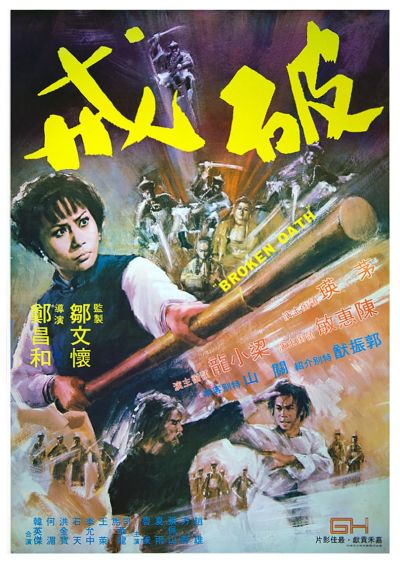
I guess, the old saying “just there for Godzilla” definitely applies to me. This movie is far from perfect, but as long as I see some skilled fighters in fancy costumes battling it out, I’m in. Additional points are given if the respective dub is at least tolerable. Broken Oath is actually an interesting movie. It is kind of a remake of Japanese classic Lady Snowblood with Meiko Kaji from 1973. The difference is that this Golden Harvest production, from producer Raymond Chow, stars Angela Mao.
She was probably the biggest female martial arts star at the time in Asian movies and had the status of a female Bruce Lee. She had starred with Lee in Enter the Dragon and one-time James Bond George Lazenby in two other movies, and also worked with classic directors like Chang Cheh and King Hu. Some of her famous films include Lady Whirlwind, When Taekwondo Strikes, Hapkido, The Fate of Lee Khan and many others. In the seventies. she could hardly walk down a street without being instantly recognized.
Broken Oath was to be her last movie for Golden Harvest which is quite inexplicable because she was a major star – did they let her go or was that her own decision? After that, she began working in Taiwanese movies with obviously lesser budgets. She lasted in movies for quite some time until the early 90s when she retired from film business. In a way it’s a pity that her golden era more or less ended in the 1970s, considering the success stars such as Michelle Yeoh, Jackie Chan, Jet Li or Donnie Yen would later enjoy – and continue to do so – in the West.
Broken Oath follows the story beats of Lady Snowblood quite closely – until it slowly becomes its own thing. It’s comparable to how Temptress of a Thousand Faces freely emulated the French Fantomas movies of the sixties. Like the Japanese original, it starts with a woman sent to prison where she gives birth to a child. On her death-bed she reveals her story of how her husband, General Liu, was killed by a gang of hoodlums; after resisting a rape attempt by one of them, she was sent to prison because the police didn’t believe her.
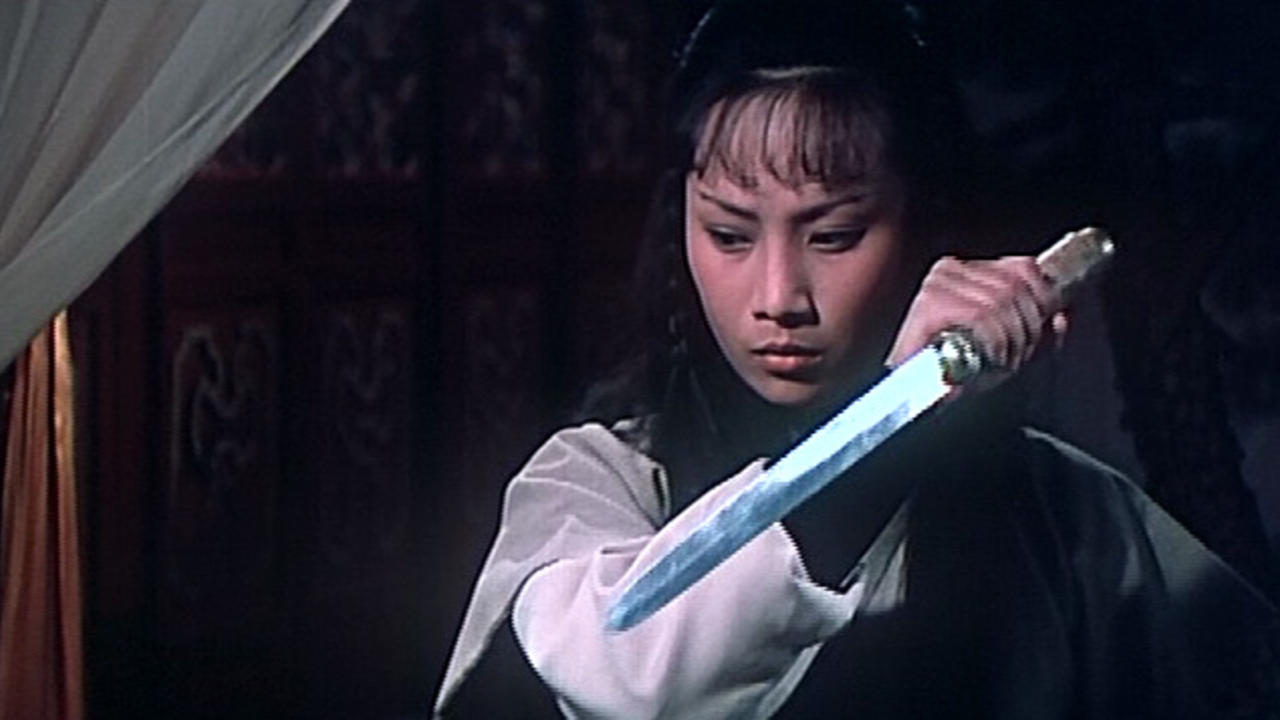
She gives birth to a girl and asks her “sisters” (inmates) to take care of the child, and to raise it to take revenge for the death of her parents. Instead, one of them, subsequently referred to as the girl’s godmother, gives her to a Buddhist nunnery with the blessings of the abbess who doesn’t think that the cycle of violence should continue. In the English dub, the little girl is called “Lotus”; the subtitles call her Jie Lian, though her original name was Xiao Mei. In any case, she has violent tendencies, though for some unspecified reason these Buddhist scholars are constantly fighting when not listening to the wisdom of Buddha. Lotus ends up killing three drifters in the wood when they try to rape her.
As she has “broken her oath” (to Buddha, I guess), she has to leave the nunnery and goes to live with her godmother, from whom she learns how to become a pickpocket and gets to know her friend and colleague Ah Shu. From there on, the movie loses connection to the original movie which I see as a good thing. Jie Lian finds the murderers, though the plot is essentially hardly more than the bones of a story, rather than a fully fleshed-out narrative. It unnecessarily complicates itself with the introduction of new characters and side-stories, but in the end the overall simplicity is indeed for the better of the movie.
For some time, I wondered if this movie was really worth my attention: I just wanted to see Angela Mao show me how hard and high she could kick. Fortunately, the film didn’t let me down. But it has to be said, it needed more than half of the movie until the whole martial arts machinery kicked – as it were! – into high gear. After being saved by an old, wise man named Qi Feng from the poisonous dust of one opponent. and his subsequent death at the hands of uber-villain Zhao Cai (both took part in the raid on Jie Lian’s parents, with Qi Feng now getting redemption by saving Lotus), things escalated quite quickly.
I have to say, I personally still prefer the melancholic elegiac beauty of Lady Snowblood and Meiko Kaji’s unmistakable charisma (I’m aware that Jim gave that movie a low rating, but for me that Japanese chanbara movie is an absolute high-ranking classic. To each their own, as they say), but the sheer number of ideas that this movie here bombards you with is remarkable. Let’s see… Steel claws as weapons; a liquid, one villain uses to spit fire and burn his victims to death; blades on a string used like a yo-yo. by an opponent played by Sammo Hung; a hat that goes over the whole head of Master Yun (later revealed to be Zhao Cai); sword fights; butterfly needles; group attacks, attack scorpions; and secret passages through stone caves hidden behind book shelves.
Really, the last 30-40 minutes of this go like gangbusters! I only wish the first half of the movie would have been like that, too. Granted, a story needs time to be built up, but let’s be honest: there is not much of a story here. Just the outspoken will for revenge, and that only happens after the godmother tells Lotus about her past. It is revealed at the end that the villains had planned to overthrow the government 20 years ago; General Liu discovered their treachery and was therefore killed. Better a good reason late than never, I guess. These things can’t quite disguise some carelessness in the story-development.
For example, Ah Shu seemed to be built up as a love interest. But he is killed off in a way, as well as the heroine’s reaction to it, which is so casual I wondered why he was even in the story. There is another character supposedly killed – silly me, believing that – who is suddenly back there to support the combatants in their fight again. The whole “she is poisoned and has to be cured” episode feels like a pointless story element, with no good reason except for extending the movie’s run time (admittedly I saw the theatrical version at 98 minutes; there is an extended version around 5 minutes longer), and giving Mao the chance to lay down and take a short break.
The actors here… well, they are Chinese actors in seventies wuxia and act accordingly. One shouldn’t expect Oscar-worthy performances here. The evil villains are evil and the rest of the actors hardly make much of an impression. Angela Mao is adequate as expected, though of course I’m more interested in her fighting skills than her acting talents. She moves elegantly and swiftly and I do believe she can fight off and kill more than half a dozen men, attacking her all at once. She is great “hero material”, and I applaud every action of hers. But I can hardly detect any burning pain underneath, or an insatiably hot appetite for revenge. Comparing that with the painful, tragic, almost longing for death portrayal of Kaji might be unjust. But it is also inevitable.
Of course, the dubbing doesn’t help. Yes, one should see movies like this in the original language version with subtitles, but I prefer a dub when I can get one. I don’t know from when this one comes (possibly the movie’s release in 1977), but the performances aren’t Anthony Hopkins and Jodie Foster acting, to say the least. I’m just happy to get lip-synched dialogue. It mostly plays inside buildings, temples or halls, giving the impression this is first and foremost a studio production. There are only a few scenes on location, though these are nice to look at. While I don’t rank the movie lower for it, I liked the beautiful, natural surroundings of Lady Snowblood much more. It’s just a matter of taste.
That said, as a whole I liked the production design, which makes you feel that the movie’s budget went into it, along with the historical Chinese costumes and some effects. It’s in contrast to Mao’s later Taiwanese films, where I can confirm she was working on a notably lower quality standard. This movie definitely has its qualities. As an old saying (incorrectly attributed to Oscar Wilde) goes: “Imitation is the sincerest form of flattery”. This might be true not only for Lady Snowblood, which Quentin Tarantino paid tribute to in Kill Bill – Vol. 1, but also for Broken Oath, as the fight between Sammo Hung and Angela Mao is definitely mirrored in the one between Chiaki Kuriyama and Uma Thurman.
When I reviewed Furiosa, I discussed how action heroine films have been having a tough time at the box-office since before COVID-19. Add another data point to that decline, with the underwhelming performance of Ballerina. Or, to give it its clunky and excessive full title (for the first and only time), From the World of John Wick: Ballerina. Which – much like Furiosa – is a real shame, because it’s top-tier stuff. The critics liked it (76% on Rotten Tomatoes) and those who saw it, liked it too (93% audience score there). But it just did not seem to connect in a large-scale way with the cinema-going public, and will struggle to cover its $90 million budget, not excessive by today’s standards.
Admittedly, it was a rather troubled production. Filming began all the way back in November 2022, and it was in post-production the following February. But a year later, word came out that additional shooting under John Wick director Chad Stahelski was taking place. There’s uncertainty how significant those were. Suggestions that much of the film was redone have been denied by both Stahelski and Wiseman, who said they were actually due to the studio providing them with additional resources. This allowed them to add scenes, such as the opening depicting the death of the heroine’s father. But regardless, the extra work was certainly a factor in the film being pushed back a full twelve months from its original release date of June 2024.
To be honest though, I really couldn’t tell based on the end product. I have read a lot of criticism suggesting, in brief, “Nobody asked for this.” While that’s dumb – nobody asked for John Wick either – there is an element of truth in it. If they wanted a spin-off, they might have been better using Sofia Al-Azwar, the existing character played by Halle Berry, who was key to one of the best scenes in John Wick: Chapter 3 – Parabellum. It’s worth noting, the script by Shay Hatten, written back in 2017, was not originally part of the Wick universe (although Hatten was inspired by the trailer for John Wick 2), and subsequently got tooled into it. But I wonder, how often are spin-off movies ever successful? Ok, except the Minions franchise.
It’s not the first effort to expand the Wick-iverse which has fallen short either. In 2023, they made a TV mini-series The Continental, which… Um, well… We watched the first episode? You’re certainly left to wonder what might happen about the other spin-off film, focused on Caine, the blind swordman played by Donnie Yen in John Wick 4. We love Yen, and have since the days of In the Line of Duty IV, over 35 years ago. But he has a much lower profile in the West than Ana de Armas, and the appetite for films “from the world of John Wick” which do not have Wick front and center, certainly appears to be muted. Enough about such coarse, commercial considerations. How is Ballerina as a movie?
In this world, there are two specific tribes of assassins. The Ruska Roma, who are structured and orderly, and another group, known as the Cult, who are anarchic and savage. Lawful Neutral and Chaotic Evil, for those who know their D&D alignments. The two groups don’t get along, but generally tolerate each other, basically agreeing to go their separate ways and not interfere, under the current leadership of the Director (Huston) and the Chancellor (Byrne) respectively. A decade or so ago, there was Romeo and Juliet-style romance across the divided houses, resulting in the birth of Eve. When her parents tries to leave their factions, both are killed, her father dying in front of her after being killed by the Cult. She is then brought up in the Ruska Roma.
Eve (de Armas) is trained both as an assassin and a ballerina, although the latter is never of any real significance. On one of her missions, she encounters a Cult member and realizes they are responsible for killing her father. Against the express wishes of the Director, she goes in search of them, finding their headquarters in the remote (and very lovely) Austrian town of Hallstatt, and chewing her way through the Cult towards the Chancellor. But when the Director hears about Eve’s quest for vengeance, posing a threat to the uneasy truce between the Ruska Roma and the Cult, she sends a certain J. Wick (Reeves) after her, to restore the balance and keep the peace.
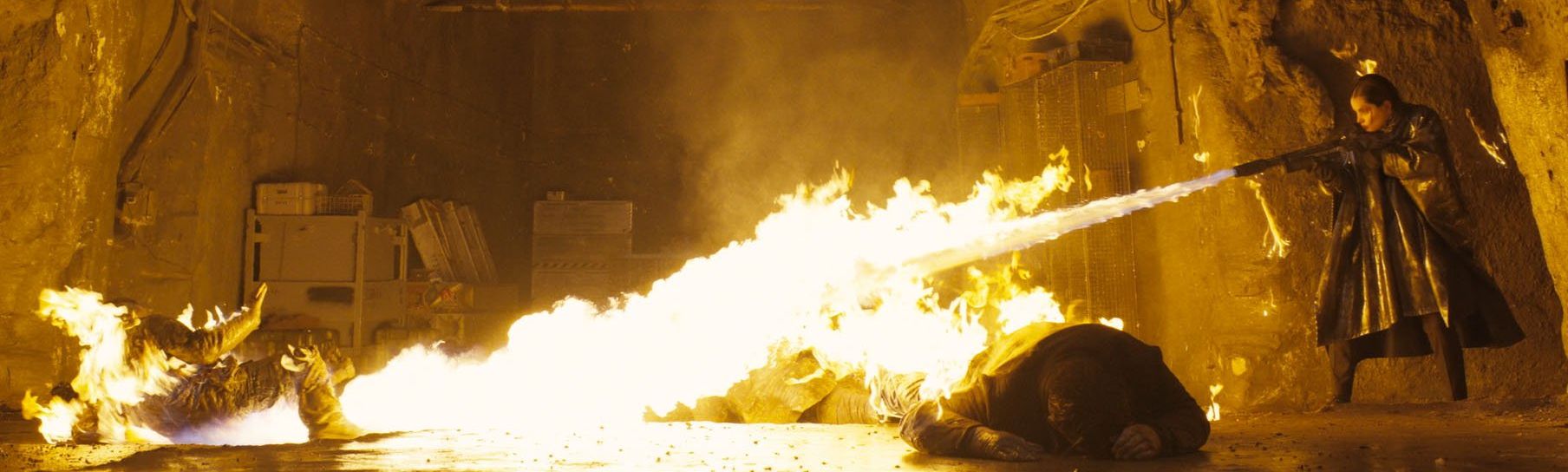
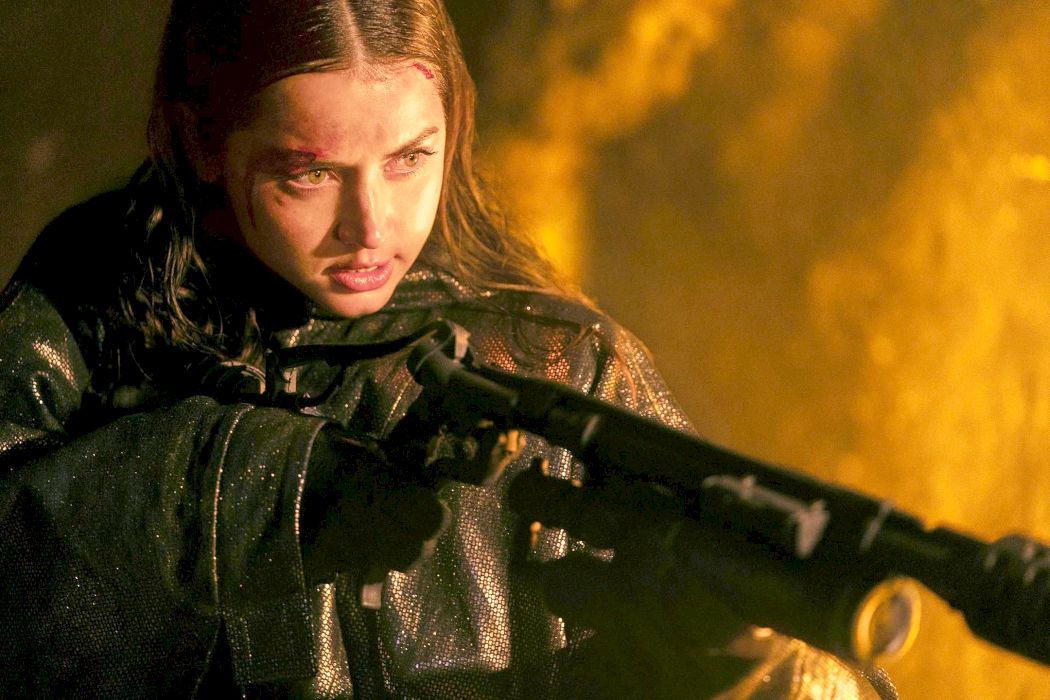
It’s borderline awesome, and on occasion, there’s no “borderline” about it. Let’s just say, I will now be looking into acquiring a flamethrower for home defense. Ok, I should explain. There’s a scene where Eve and one of the Cult members have a – bold font, capital letters, please – DUEL WITH FLAMETHROWERS. It’s every bit as epic and wonderful as that sounds, and it escapes me how they could possibly have achieved it, without reducing the entire stunt team to charcoal briquettes. That’s just the action highlight in a film which has a number of them. I was also impressed with the nightclub sequence – is this obligatory for every film in the Wick-iverse? – of Eve’s first mission, as much for the thumping techno tunes, as for the high-quality fisticuffs.
I do say, some elements feel under-developed, and I wonder if they were a result of the adjustments made during production. The character of Daniel Pine (Norman Reedus), seems particularly an afterthought, not least the fact he’s supposed to be the Chancellor’s son. Adding John Wick in does feel like an unnecessary afterthought and, to be honest, smells a little of desperation. It’s just not necessary, because de Armas is capable of carrying things. This is likely, not just to be the best action heroine film of the year, it’s quite possibly – admittedly, I haven’t seen the last Mission Impossible film yet – going to end up as the best action film of 2025. Such a pity it appears likely to be one and done for this tiny dancer.
Dir: Len Wiseman Star: Ana de Armas, Gabriel Byrne, Anjelica Huston, Keanu Reeves
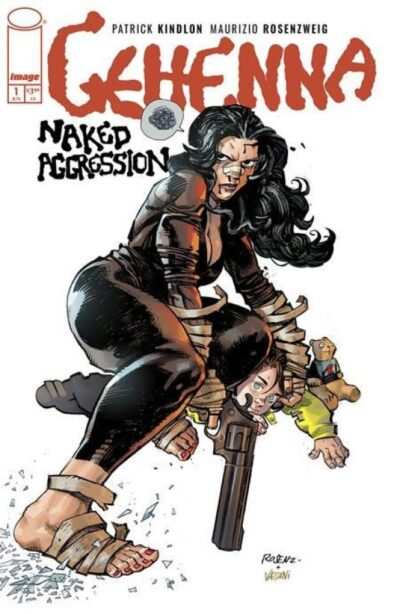
“What I need is stories where men get kicked in the chest. Stories where guns only run out of ammo for dramatic effect. I need pulp. I need exploitation. I need fun.” I used to read a lot of comics, before moving to America. As in, most weekends involved a trip to Forbidden Planet, Gosh!, or Mega City Comics, coming home with a carrier bag of new issues. Then there were the trips to Paris… But I just kinda stopped – no particular reason – when I emigrated. There is still a large cardboard box, unopened from the move 25 years ago, in our boxroom. Some are probably worth a bit, e.g. the first issue of Hellblazer. But reading the first issue of Gehenna makes me want to restart. Well, if space, time, money and aging eyesight weren’t issues, anyway.
“This book is equally for the diehard comic reader and someone who hasn’t read sequential art since Garfield,”according to co-creator Kindlon. I’m certainly closer to the latter category, but certainly found it accessible, once I got into the comic-book rhythm again. It’s different from word-based literature, and even from cinema, where the pace is dictated entirely by the director. In a comic-book, you can linger over a panel to admire the artwork for as long as you want, or whizz through them so you’re basically picking up subliminal imagery. The text becomes a complement to the imagery, filling in the gaps. And the imagery is great. I now have a new backdrop on my PC desktop. Page 18 of the PDF, should you be interested.
“Everything went to hell. And now that’s where I live.” But this also means exposition and action can co-exist: the latter doesn’t need to pause. Consequently, over the 24 pages here, there’s barely a pause for breath. You reach the end, to be honest, not necessarily sure what’s going on, but this is just part one of four. I presume things will become clear – or, at least, clearER – in due course. We have a dark-haired woman, kidnapping the son of a gangster because of reasons apparently connected to her husband’s death – leading to the quote above. There’s another woman, blonde, following in her wake – with bad intent if her line, “I’ll call you when the woman is dead”, is anything to go by. I will bet the house that they will end up facing off against each other, before very long. I certainly hope so.
“It’s pulling from Beyond Hypothermia and Naked Weapon, and all of Hong Kong,” says Kindlon. So far, Naked Aggression has been more about the aggression than the naked – though cleavage certainly abounds, and an alternate cover (below) does deliver. It is difficult to judge the series overall, in the same way as giving your verdict of a film based on its opening twenty minutes. We’ve all seen movies which hit the ground running, only to run out of steam. But there’s no reason this shouldn’t be able to sustain the blistering pace: it’s not like a comic-book is going to run out of budget. If we weren’t looking to move house, this might well be the one to entice me back into the comic-shop. Failing that, I’ll just have to wait for the movie version, hopefully starring Eva Green and Charlize Theron.
Author: Patrick Kindlon (text) and Marco Ferrari (art) Publisher: Image Comics, available through their site, from July 2, or for Kindle through Amazon. Book 1 of 4 in the series, also available in four alternate covers as below.
Spoilers will follow! At one point, Scandinavian noir, was a genre mostly well-known only in Europe and to die-hard crime novel readers. But the ground-breaking female characters who have made the genre recognized worldwide in the past two decades consists of a trio. In addition to the most well-known, Lisbeth Salander of the Millennium series, there is Saga Norén of Bron: The Bridge, and Sarah Lund of The Killing. All of these have been remade in a number of other countries – not only America. But I think it’s uncontroversial to say that none ever came close to the originals. There is something to the way these series are constructed and conceptualized by our Scandinavian neighbours, that film crews in other countries just can’t re-create.
It’s not just, for example that American productions have higher budgets. Other, non-American remakes or “new versions” aren’t able to re-create that special “air” either. It’s a specific atmosphere these series have, even though those in charge of production usually understand the attraction of the original. Although Scandinoir existed well before those three series. Elements like more realistic depictions of criminal acts, very often with social aspects interwoven, and investigators with personal problems, can be traced in literature back to the 1960s, and on television to the 1970s and 80s. A realistic local background with more down-to-earth investigators, as opposed to classic Anglo-American super-detectives like Sherlock Holmes, or private investigators like Philip Marlowe, started around then, and can still be found in long-running classic German TV crime series, Tatort (literal: “scene of the crime”).
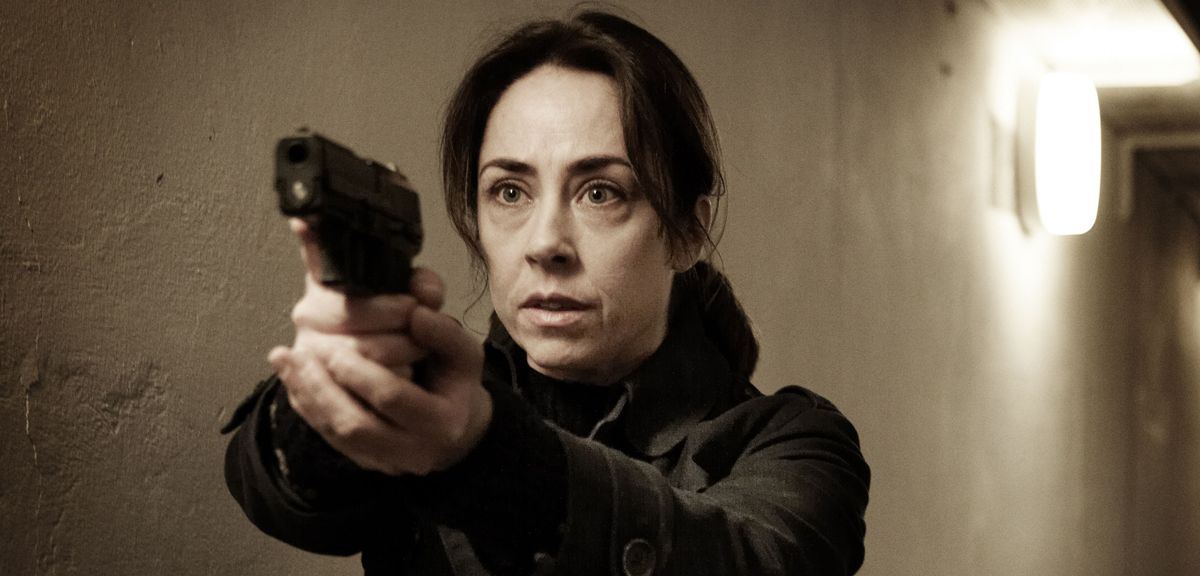
Though before these new shows, some starring some quite “damaged” women, hardly anyone except die-hard fans of crime stuff noticed. The show that served as a wake-up call for everything was The Killing. This Danish-German co-production ran for three seasons, from 2007-2012. [It seems whenever there is a new Scandinavian crime series, ZDF, the second public TV channel of Germany, is involved. They also co-produced the Millennium and Bridge shows, among other Scandinavian series.] The original version totalled 40 episodes of 55 minutes; some countries broadcast it as 20 episodes of around 110 minutes. The German version was like that: you always can tell the break between episodes, by the two-minute montage, with music underneath. It received a number of remakes, in America, Turkey and Egypt.
As typical for these Scandinavian shows, they are slow-burn mysteries. This means taking their time, introducing countless suspects and going far beyond the case, such as adding a political dimension to the scope. I was astonished to discover they did really only cover one case for an entire season. In an average episode of Tatort the case would be solved and finished after the usual 90 minutes. Here, it takes longer – much longer! – especially in the first season. It started to drag a little bit, as solving the single case of a vanished girl lasted almost nineteen hours on screen. That said, the longer experience definitely has its advantages.
For perhaps the first occasion, the suffering of the family members left behind after a beloved person dies, is shown in what feels like almost real-time. That’s remarkable, as in almost any crime story I have ever seen, these feelings are usually only vocalized in one or two sentences. Just recently, I watched an old Italian giallo and it felt almost ridiculous how the main character seemed hardly moved at all, as her entire family was exterminated, one by one. Is such behavior normal? Normal people mourn their beloved ones. Maybe some do it more quietly than others, but most movies or series leave this, very important, aspect out, with it usually secondary to finding the perpetrator. The Killing takes that time, showing us the after-effects on a family barely able to go on, needing psychological help, and taking pointless, misguided revenge, with acts that can’t bring back what has been lost.
Admittedly, they might have gone on in this direction a bit too much – especially in the first season, which is twice as long as the others – and I was starting to look at my watch. Though things are always happening, you may lose a bit of patience as yet another suspect is presented to you. What, they are proven innocent? Okay, how about this one? Oh, and there is new evidence, it might actually have been the one we let off the hook last episode! And so on.
In all three seasons, a pattern of political involvement is found. For example, a pool car belonging to a political party might have been involved in a kidnapping, with the story taking place in the run-up to elections. Suddenly, the whole process of parties in electoral battle mode can be affected by the outcome of the investigations, as well as individuals’ dirty laundry being brought up by the other side or the police. One of the main politicians in the first season is played by Lars Mikkelsen (Mads’ brother), who’d go on to play a great villain in the Benedict Cumberbatch “Sherlock” show. In other seasons, the police have to deal with other institutions and organizations hampering their work, such as the military or the secret service. The third season deals with a major industrial corporation, as the company chief’s daughter is kidnapped and might be held in one of his shipping containers.
But the main character is always the introverted police commissioner, Sarah Lund (Gråbøl). Lund doesn’t come across as the most accessible character, to say the least. It’s a character trait she shares with her sisters in spirit, Salander and Norén. Though of the three, she might be the most “normal”, and her biggest problem an inability to communicate. Maybe it’s too cold in Denmark, and you don’t want to open your mouth if it’s not necessary? She can be quite talkative – when it’s about the case. But it’s always about the case and not her family. In season one, Lund’s fiancé and son wait for her to come to them in Sweden. Though she wants it, there is always something. Her superior insists she has to continue her work, as the only one who can, despite her successor already waiting in the wings. Even after boarding the plane, she returns once again to solve crime for another day in Copenhagen. Then everything changes when her colleague gets shot.
She gets smarter in the second season, now carrying her gun with her at all times. This will save her life at the end of the series, which deals with a series of murders of former Danish soldiers. Sometimes you can’t solve everything just with your mind! But there is always an apparent lack of social competence. Lund doesn’t seem to understand the emotional needs of her family (and others) and that’s why she loses them. The case is always more important for her. She becomes quite obsessive in her investigations – even after everyone, including her new chief Brix (Morten Suurballe) sees a case as solved. You thought Columbo with his, “There is still a little question I have…”, could get on your nerves? Wait, until you meet Sarah Lund!
There is a learning curve and character arc for the character. She is hesitant to come back to work in season 2, and in season 3 realizes that she has failed, not only as a mother but in her social life in general. She would like to have a closer relationship with her son, but he doesn’t want anything to do with her anymore. She manages to take care of his pregnant girl-friend, though even in front of the hospital room where the girl and her son are holding her newborn grandchild, she still turns around because… Well, you know… The case… Ultimately, the show can be seen as a tragedy. Yes, the cases all get solved in the end. But that doesn’t mean that we get a truly happy ending.
Season 1. The father of the murdered girl kills the murderer, and will most likely go into prison for that. Season 2. The minister of justice uncovers the corruption of the ruling government, but can’t do anything against it, as everyone is covering it up. He can only decide between joining them, thereby keeping his career, or quitting. Season 3 is the worst of all. While the kidnapped girl is saved, the industrialist must remain silent about the cover-up of his board of directors, in order to keep the company going. Meanwhile, Lund finds out who raped and murdered another girl years ago, and sees no alternative but to shoot the murderer. The ending has her leaving her home country, perhaps to return one day with new evidence to justify the killing, instead of finally getting together with a past love from her youth (Kass, who would later enjoy success as Jussi Adler-Olsen’s Carl Mørck).
As there never was a fourth season, she might still be searching that evidence abroad. But happy endings certainly look different in Scandinavia. After all is said though, this is a good show with great and convincing actors. You can enjoy its complex story-lines, its gritty, sometimes almost cynical, world view and darkness, if you are willing to be patient and have enough time. The second and third seasons are much easier to watch than the first. The Scandinavian approach to crime series is definitely different one from what other European or American series offer their audiences. But if you get used to them, they can be quite addictive as this show showed. On its release, The Killing became especially successful in Great Britain, which might then have drawn the attention of American producers in this direction.
It started the new wave of Scandinavian noir in 2007, which seems to have lasted for about a decade, ending ten years later in the Hollywood adaptation of Jo Nesbø’s The Snowman, with Michael Fassbender as Harry Hole. But if you are in the mood for more psychologically damaged, Scandinavian, anti-heroines, you’ll find plenty of others, such as Annika Bengtzon or Rebecka Martinsson. There are also reports that Amazon Prime is planning a new show on good ol’ Lisbeth Salander. Who knows, maybe the era of troubled Scandinavian female investigators isn’t over yet?
Sheesh, they’ll adapt anything into a movie these days. Hey, I guess if Clue, Battleship and Ouija can become films, why not Cand… Yeah, to be clear I am joking. Do not, for the love of God, mistake this as about the quest for King Kandy. Though I am amused the Wikipedia page for the game specifically says, not to be confused with this film. For it’s actually about truck-stop hookers being stalked by a murderous psychopath. Which could, I admit, probably be adapted into a pretty decent board-game. The central character is Remy (Luccardi), an escapee from a religious cult, who finds herself stranded at the truck-stop, and befriended by Sadie (Quartin) and the other “lot lizards” there.
Remy eventually becomes part of the “team,” also including gay-for-pay Levi (Campbell), who service the truckers who pass through the high-altitude location – as well as local sheriff Rex (Baldwin). It’s a tough life, with violence a risk they face on an everyday basis, such as when a trucker shows up in a toilet stall with his throat slit, or someone decides Levi is a bit of rough. However, things escalate considerably, because the problem is: you can take the girl out of the cult, but you can’t take the cult out of the girl. After getting a visit from another member, Remy decides, as she puts it, “We must cleanse the world before we can cleanse ourselves of it.”
No prizes for guessing what that means, as if the poster doesn’t make it abundantly clear. Swab manages to do a decent job of straddling the exploitational and the thoughtful. This certainly doesn’t stint on the nudity, from the first scene which sees Sadie riding her client like she was trying to start a fire, through one of the girls taunting the cult leader by opening her legs in front of him. It’s pretty damn gory as well. But it’s not just mindless sex and violence. For instance, it would be easy for Swab to paint the victims as… well, just victims, but they’re depicted as there, and doing this work, of their own choice and free will.
I did feel that the shift from religious advocate to prostitute to spree killer for Remy was a bit abrupt. A little more time for the transition might have helped, or perhaps making her more clearly dedicated to her lethal cause from the get-go. Yet the way things turn out, perhaps indicate that was the case all along. Credit to Swab for not pulling punches either, with things continuing to escalate and the body count continuing to mount until, literally, the final shot. Hardly anyone here gets out alive, and I was left wondering if the religious fundamentalists had won. There’s a lot of films while look to recreate the bygone grindhouse era. This seeks to look forward instead, and is likely all the better for it.
Dir: John Swab Star: Olivia Luccardi, Sam Quartin, Owen Campbell, William Baldwin
[This review previously appeared on Film Blitz]
The Chinese title is 狙击之王:暗杀, which Google Translate informs me translates as “Sniper King: Assassination”. I don’t want to assume anyone’s gender, but I think I’m going to go with the alternate title above, as more appropriate, over the one on the poster. Because there’s no doubt about the amazing talents possessed by Anna (Yang), for whom a shot at three kilometers range is barely an inconvenience. We get right into the action with her being committed as a psychopath after begin captured, following her assassination of a drug lord. Yet another drug lord, actually – she has a deep hatred of them, for reasons we eventually discover, and has been taking them out with regularity.
It’s not long before someone tries to kill her in the psychiatric facility, but she’s able to escape (somewhat), with the help of struck-off former doctor, Nasipan (Tao). However, she is forced, with the aid of a nano-bomb injected into her bloodstream, to take a mission for Artest (Mak). There’s a war of succession going on in the country of “Libiwala”, with the prospect of drug production becoming legal in the country – to the joy of crime boss Roger (Lee). Artest requires Anna to liquidate all those in line for the leadership to prevent this. Or maybe encourage this. It’s all a bit murky, and the plot twists and turns until the very last scene, though never gets incoherent.
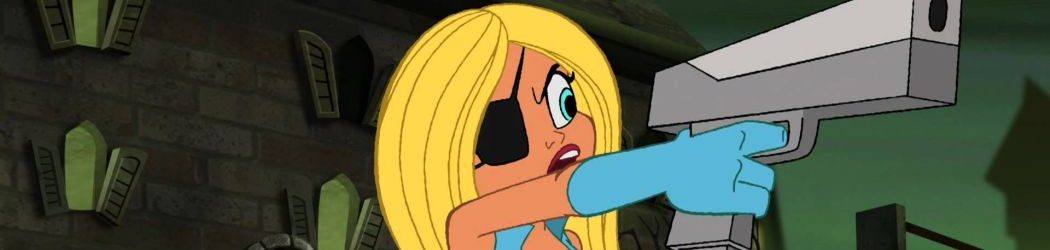
This one captivated me inside five minutes, with the hellacious firefight in the asylum, culminating in Anna sniping a sniper right through their scope. The action doesn’t let up for long thereafter, with some excellent set pieces involving both weapons and hand-to-hand combat. For the latter, Artest probably gets the bulk of it. But on the opposing side is a henchwoman who makes Gogo Yubari look like the picture of mental balance (I think she may be played by Guo Muhan, but I don’t recall hearing her name), and cuts a striking figure in her long blond hair and sword. It’s just one of the numerous things this film gets right, including occasional moments of comedy that genuinely made me laugh out loud, the movie winking at its own excesses.
It’s simply a fun experience, with characters you can get behind, and an impressively strong anti-drug message. All the players are given depth to their roles, and the chance to develop them. Even the little kid, playing the third in line to the Libiwalian throne, is not irritating – and that’s high praise coming from me, as far as child actors go. All told, this is one of the most purely enjoyable ninety minutes I’ve spent of late, easily surpassing bigger budget films like Cleaner or The Gorge, and given my expectations, is likely going to be the most pleasant surprise of the year. The whole movie is embedded below. Take five minutes to check out the opening sequence, and see if it hooks you as well as it hooked me!
Dir: Huo Sui-qiang Star: Yang Xing, Henry Prince Mak, Tao Tao, Lee Dong Hyuk
a.k.a. Sniper King: Assassination



 This was a real and pleasant surprise. I wasn’t even sure if this would qualify for the site, or if it would end simply being too gentle. Whole it’s not going to get any awards for hard-core action, it does fit in here. More impressively, it managed to make my empathize with someone whose views are ones I’d generally disagree with. It takes place in Iceland, where Halla (Geirharðsdóttir) is a middle-aged, single woman, waging a near one-person campaign of sabotage against heavy industry, mostly by disabling the power-lines which supply electricity to it, disfiguring the landscape and exacerbating climate change. It’s a game of cat and mouse, with the authorities keen to stop the eco-terrorist from dissuading foreign investors.
 However, Halla has issues of her own, beyond the net closing in on her property destruction. A long-dormant adoption request is suddenly approved, and she can’t risk further criminal acts, as a conviction would bar her from proceeding. She intends to go out with a declaration of her manifesto, literally flung from the Reykjavik roof-tops, and a final act, stealing Semtex to blow up a key electricity pylon. Her accomplice, government employee Baldvin (Ragnarsson) is increasingly concerned about the “one last job” trope, and twin sister Ása (also Geirharðsdóttir), a yoga teacher, threatens to put a spoke in the adoption process too, by vanishing off to India for two years to live with her guru.
 Yeah, this is the first book to ever get a five-star action rating from me. It just doesn’t stop. There’s a sub-genre called “hard SF,” which according to Wikipedia, is “characterized by concern for scientific accuracy and logic.” I suggest this could be labelled as hard action, with a great deal of information about hardware, like guns and vehicles. Here’s a sample paragraph: “The boat itself is a low-observable, reconfigurable, multi-mission surface tactical mobility craft with a primary role to insert and extract SOF in high-threat environments, but can also be used for fire support, maritime interdiction, and VBSS missions, as well as CT and FID ops.” I’m not sure what much of that means. Though I suddenly have a strong urge for a glass of whisky and a cigar.
 No exact dates are given here; but since the first book began in 1865 (the next book would have to have been set in 1866) and judging from the number of intervening adventures, I’d guess the main storyline here to be set no earlier than 1870, making co-protagonists George Washington (“Reno”) and Sara Bass in their early 20s at least. But the book opens with three short Prologue vignettes, the first dated “twelve months ago,” from the viewpoint of an unnamed female pushed off of a bridge to a 40-foot drop into a raging river, followed by two more dated, respectively, three and two “months ago.” None of these give us much information; but we are told that she survived, that her brother Robert Stirling-Hamer was a wealthy Arizona copper-mining magnate who has been murdered, and that his accused killer “Don” was in turn killed by bounty hunters (guess who?), but that Don’s brother in New York has now gotten an anonymous letter claiming that his brother was innocent.
 ★★★★
★★★★ But most interesting is her behavior. When she first appears, she is strictly business. She says hardly a word otherwise, with no interest in getting to know the wife and daughter of her new colleague. She lets no one in emotionally, and shows an aversion to personal connection. Her behavior feels awkward, even upsetting, until you get used to it. Some watchers complained she mumbled her lines, but then, most characters here speak with an Austrian accent which can be a bit difficult to understand for Germans. It might also have something to do with the idea of a character who only slowly reveals her secrets to the audience. Because what I realized after a while, was that Hannah Zeiler is actually a more clinical, streamlined and slightly tamer Austrian version of Lisbeth Salander. Or at least her distant relative.
 Broken Oath follows the story beats of Lady Snowblood quite closely – until it slowly becomes its own thing. It’s comparable to how
  For example, Ah Shu seemed to be built up as a love interest. But he is killed off in a way, as well as the heroine’s reaction to it, which is so casual I wondered why he was even in the story. There is another character supposedly killed – silly me, believing that – who is suddenly back there to support the combatants in their fight again. The whole “she is poisoned and has to be cured” episode feels like a pointless story element, with no good reason except for extending the movie’s run time (admittedly I saw the theatrical version at 98 minutes; there is an extended version around 5 minutes longer), and giving Mao the chance to lay down and take a short break.
 ★★★★½
★★★★½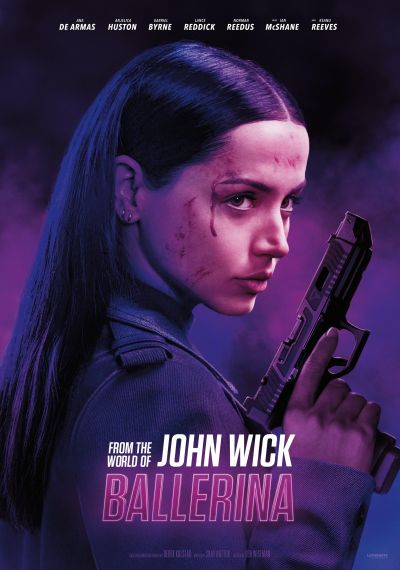 To be honest though, I really couldn’t tell based on the end product. I have read a lot of criticism suggesting, in brief, “Nobody asked for this.” While that’s dumb – nobody asked for John Wick either – there is an element of truth in it. If they wanted a spin-off, they might have been better using Sofia Al-Azwar, the existing character played by Halle Berry, who was key to one of the best scenes in John Wick: Chapter 3 – Parabellum. It’s worth noting, the script by Shay Hatten, written back in 2017, was not originally part of the Wick universe (although Hatten was inspired by the trailer for John Wick 2), and subsequently got tooled into it. But I wonder, how often are spin-off movies ever successful? Ok, except the Minions franchise.
  It’s borderline awesome, and on occasion, there’s no “borderline” about it. Let’s just say, I will now be looking into acquiring a flamethrower for home defense. Ok, I should explain. There’s a scene where Eve and one of the Cult members have a – bold font, capital letters, please – DUEL WITH FLAMETHROWERS. It’s every bit as epic and wonderful as that sounds, and it escapes me how they could possibly have achieved it, without reducing the entire stunt team to charcoal briquettes. That’s just the action highlight in a film which has a number of them. I was also impressed with the nightclub sequence – is this obligatory for every film in the Wick-iverse? – of Eve’s first mission, as much for the thumping techno tunes, as for the high-quality fisticuffs.
  “This book is equally for the diehard comic reader and someone who hasn’t read sequential art since Garfield,”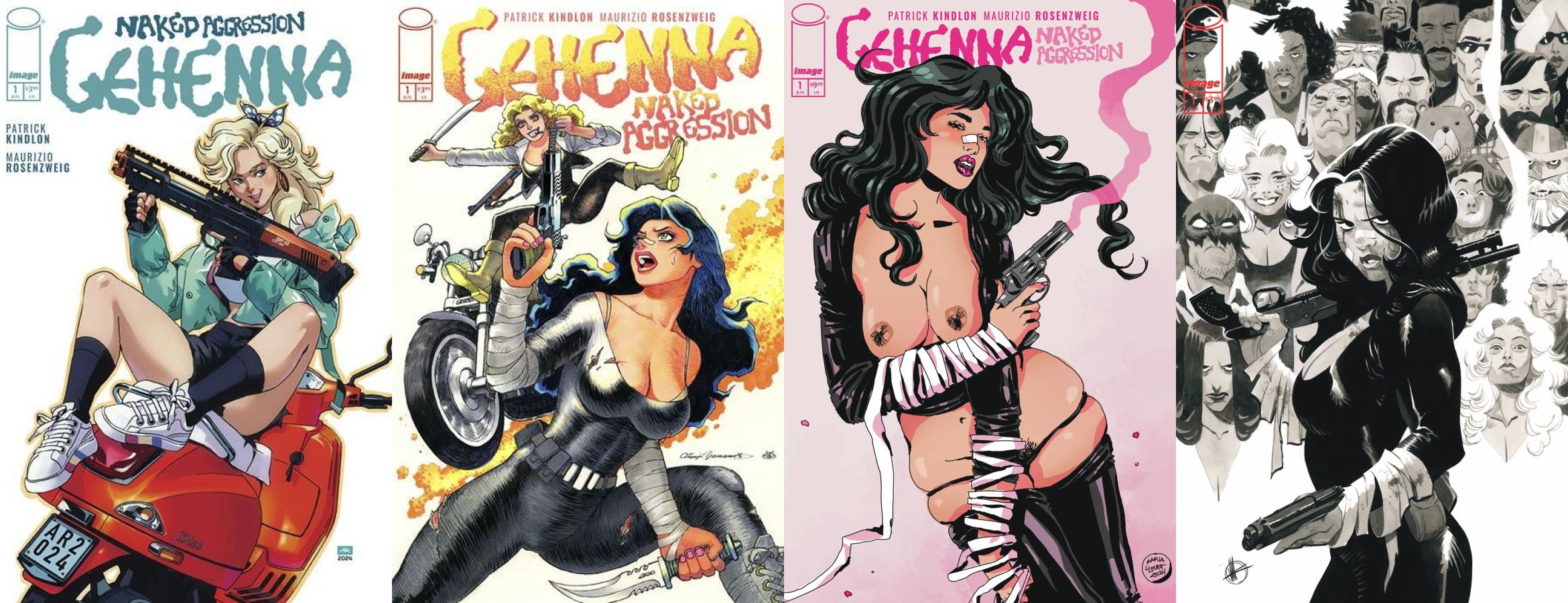
 ★★★★
★★★★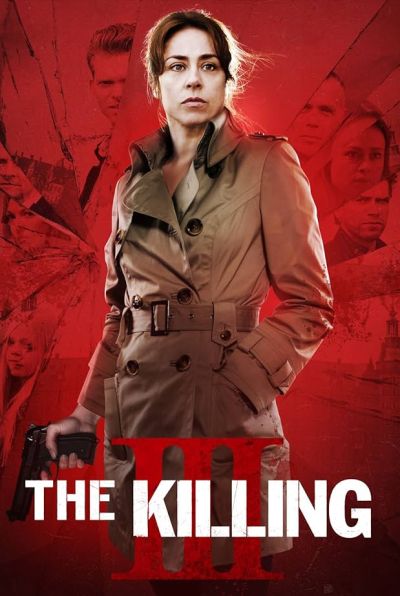 For perhaps the first occasion, the suffering of the family members left behind after a beloved person dies, is shown in what feels like almost real-time. That’s remarkable, as in almost any crime story I have ever seen, these feelings are usually only vocalized in one or two sentences. Just recently, I watched an old Italian giallo and it felt almost ridiculous how the main character seemed hardly moved at all, as her entire family was exterminated, one by one. Is such behavior normal? Normal people mourn their beloved ones. Maybe some do it more quietly than others, but most movies or series leave this, very important, aspect out, with it usually secondary to finding the perpetrator. The Killing takes that time, showing us the after-effects on a family barely able to go on, needing psychological help, and taking pointless, misguided revenge, with acts that can’t bring back what has been lost.
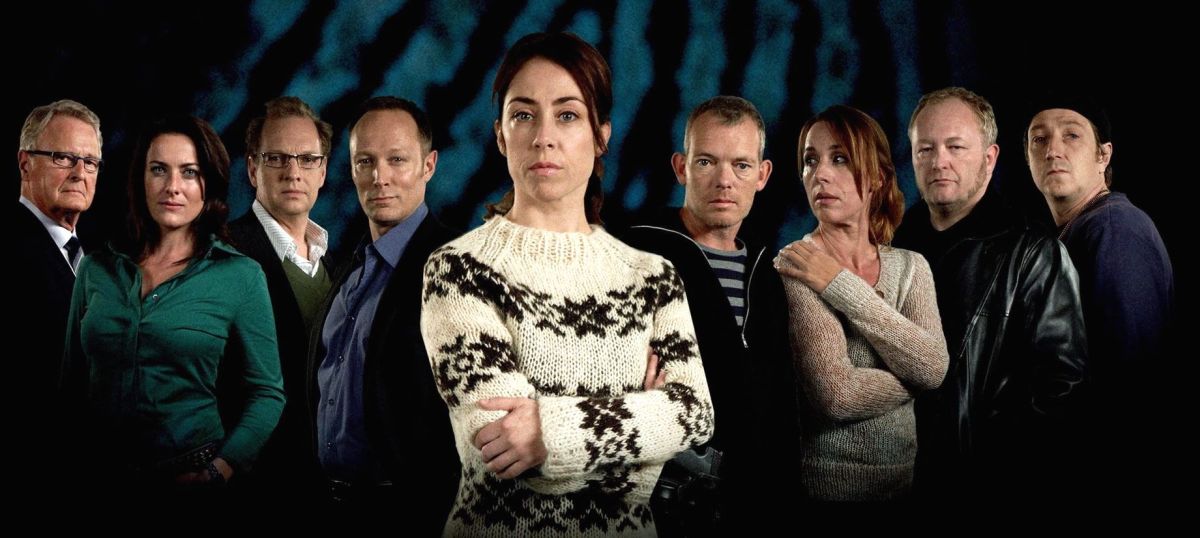 Season 1. The father of the murdered girl kills the murderer, and will most likely go into prison for that. Season 2. The minister of justice uncovers the corruption of the ruling government, but can’t do anything against it, as
  Remy eventually becomes part of the “team,” also including gay-for-pay Levi (Campbell), who service the truckers who pass through the high-altitude location – as well as local sheriff Rex (Baldwin). It’s a tough life, with violence a risk they face on an everyday basis, such as when a trucker shows up in a toilet stall with his throat slit, or someone decides Levi is a bit of rough. However, things escalate considerably, because the problem is: you can take the girl out of the cult, but you can’t take the cult out of the girl. After getting a visit from another member, Remy decides, as she puts it, “We must cleanse the world before we can cleanse ourselves of it.”
 It’s not long before someone tries to kill her in the psychiatric facility, but she’s able to escape (somewhat), with the help of struck-off former doctor, Nasipan (Tao). However, she is forced, with the aid of a nano-bomb injected into her bloodstream, to take a mission for Artest (Mak). There’s a war of succession going on in the country of “Libiwala”, with the prospect of drug production becoming legal in the country – to the joy of crime boss Roger (Lee). Artest requires Anna to liquidate all those in line for the leadership to prevent this. Or maybe encourage this. It’s all a bit murky, and the plot twists and turns until the very last scene, though never gets incoherent.