
Cutthroat Island, by John Gregory Betancourt

Literary rating: ★★½
Kick-butt quotient: ☆☆☆☆

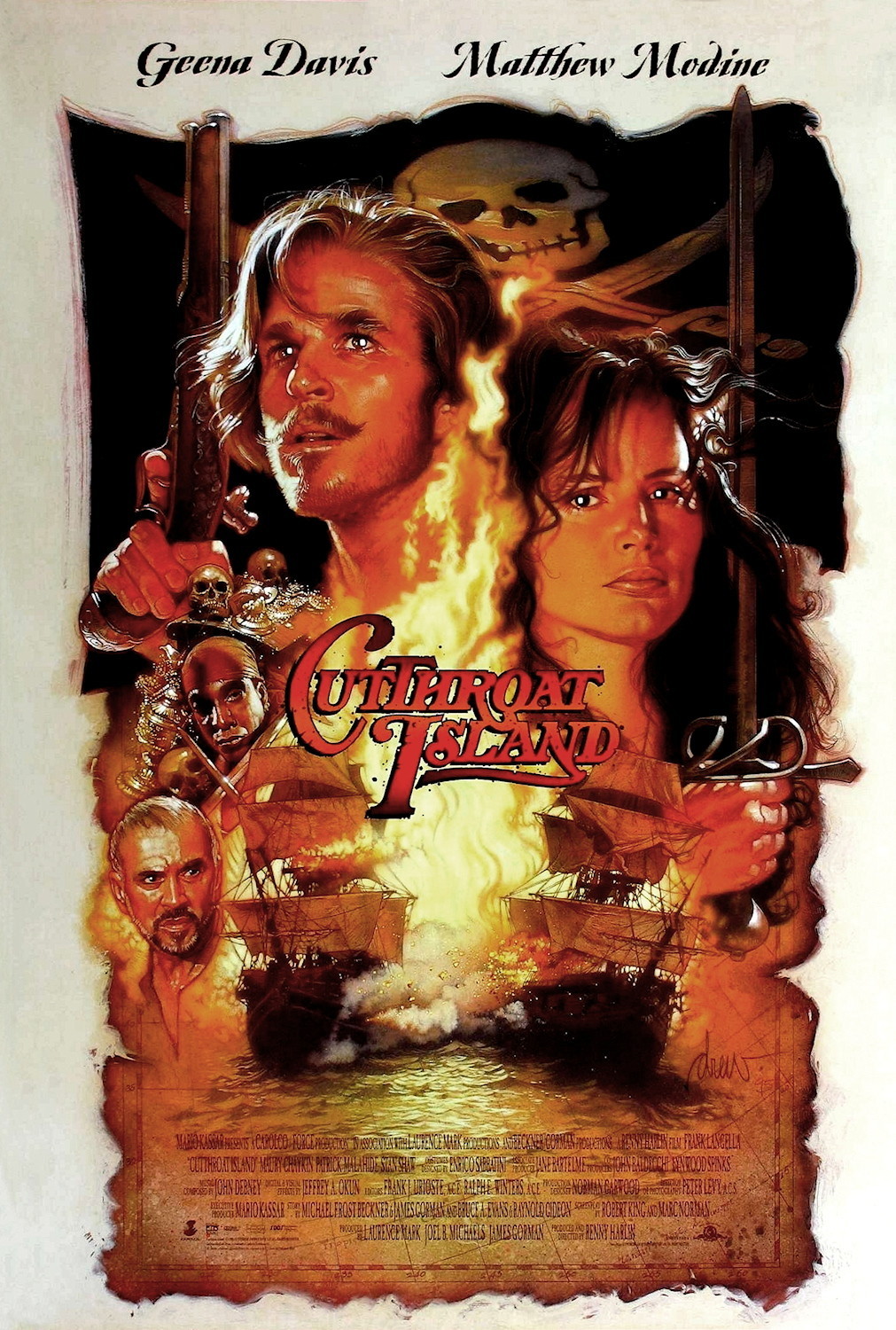
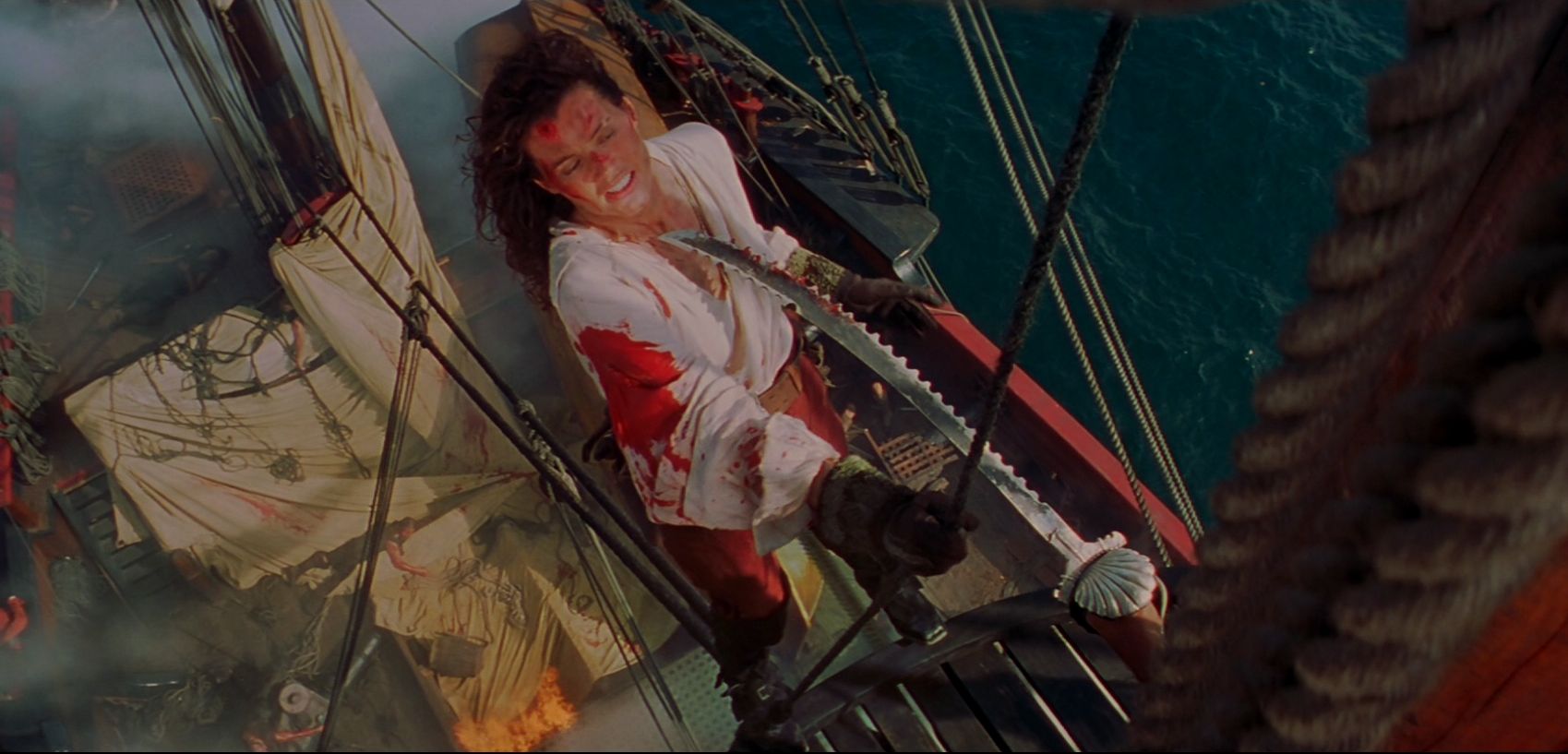
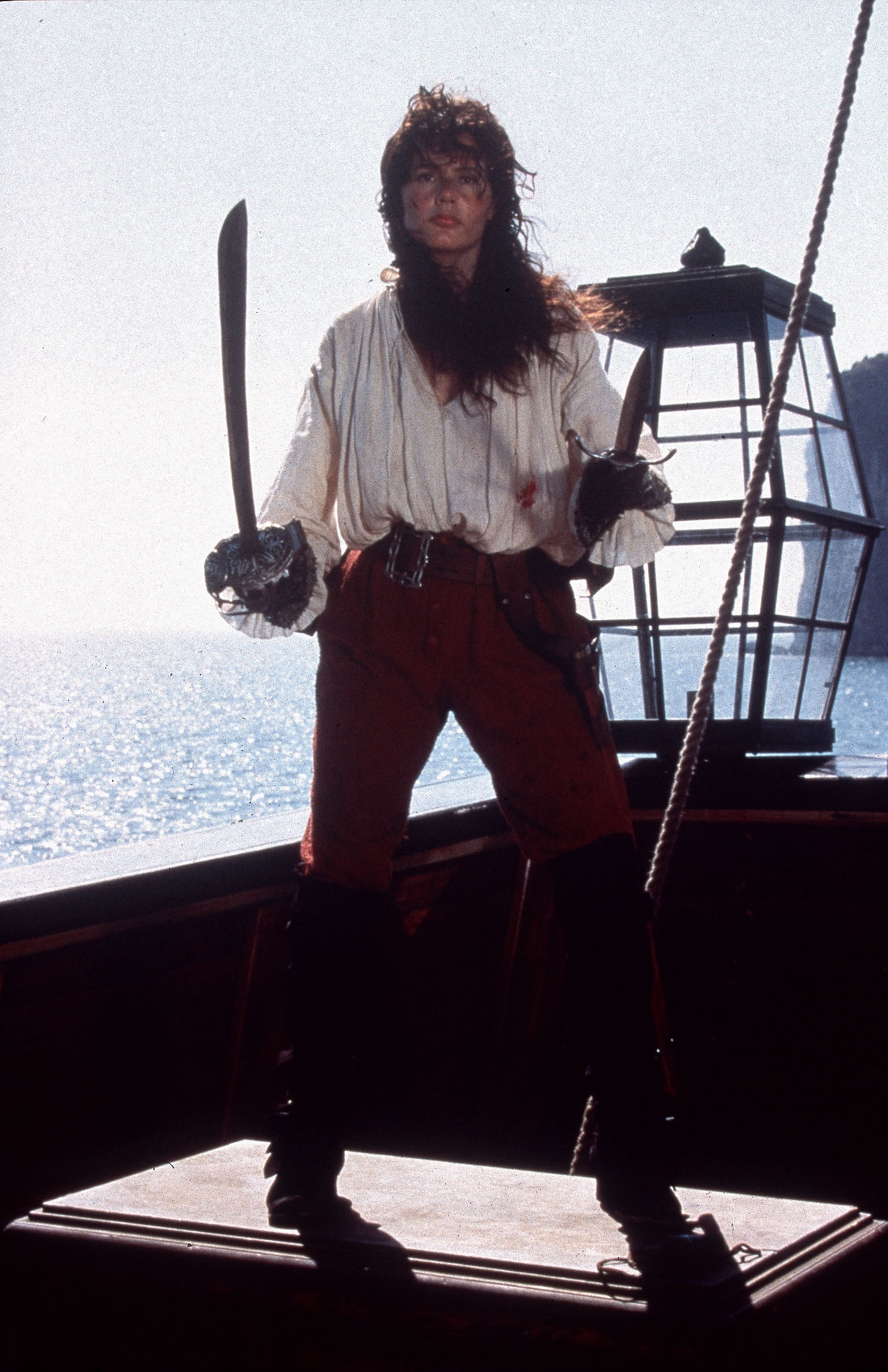
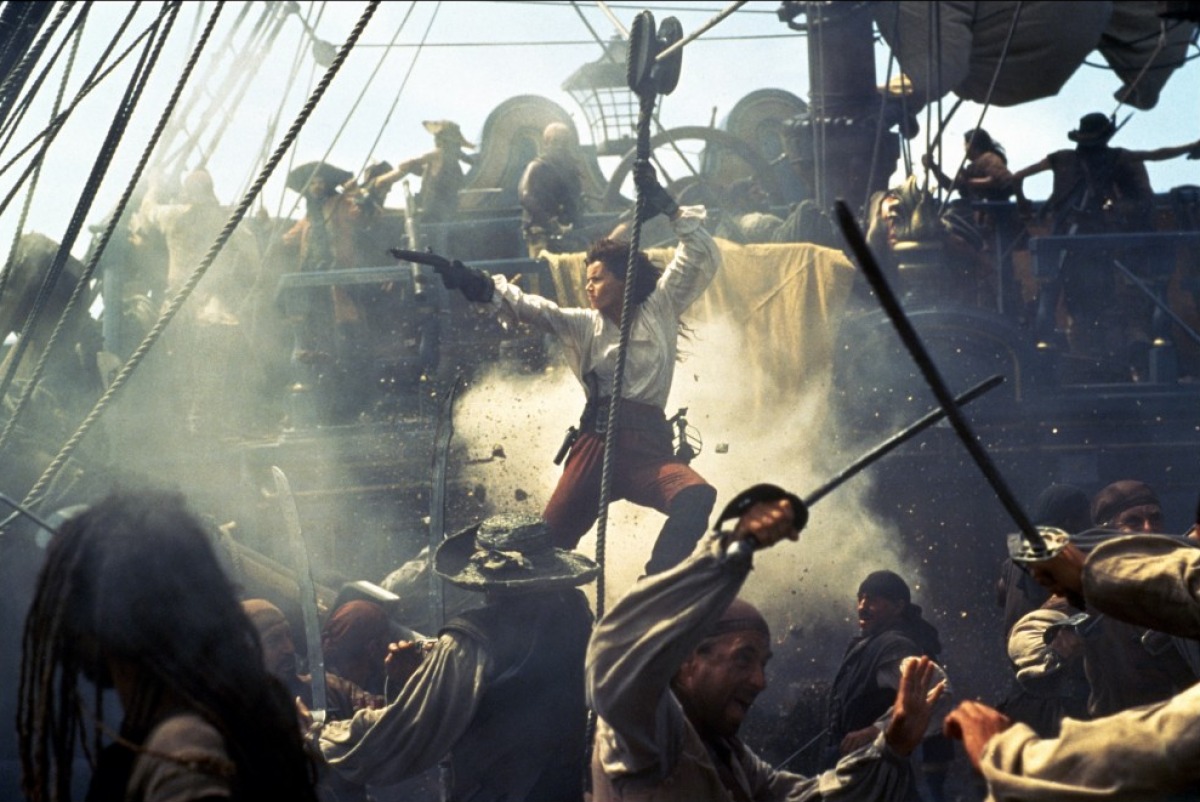
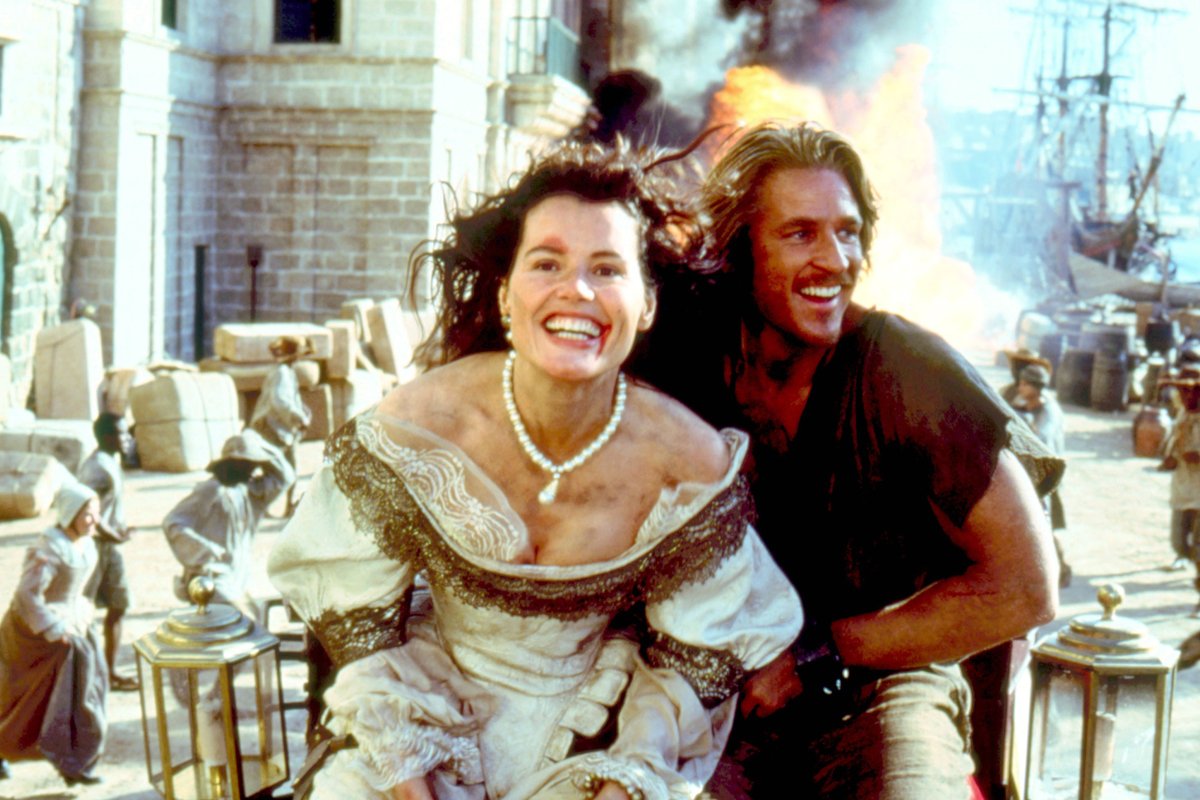
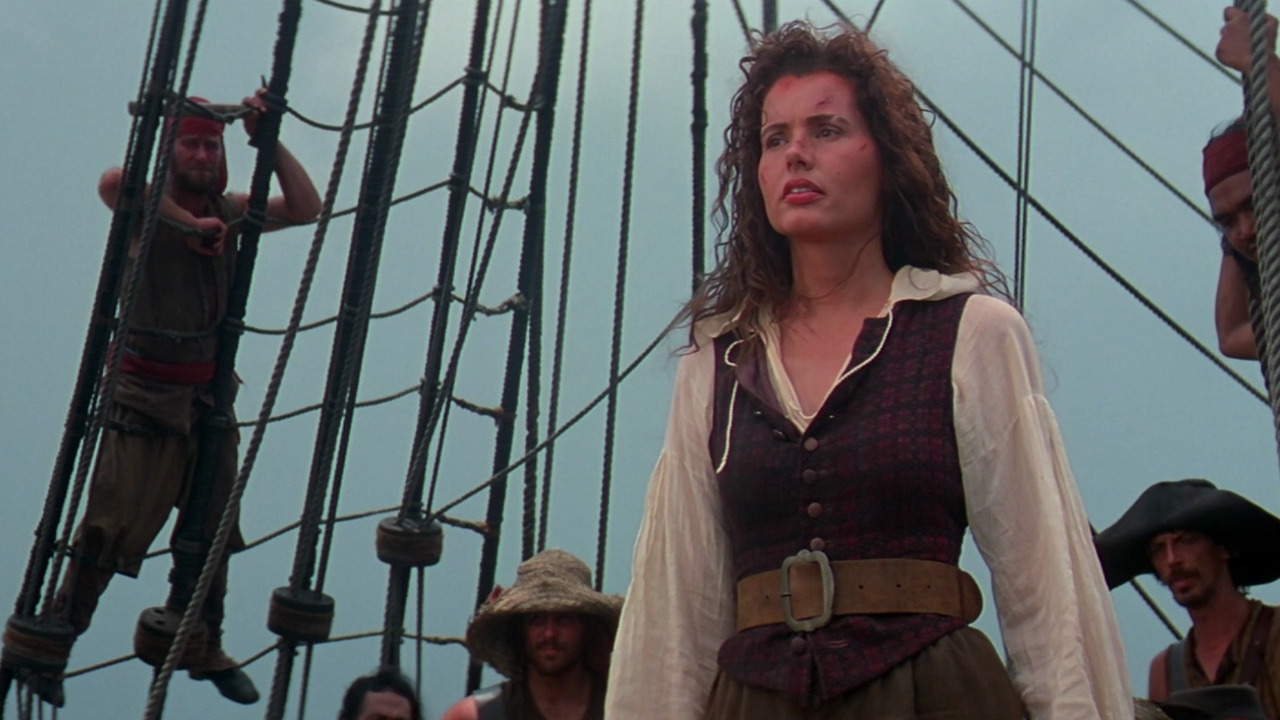
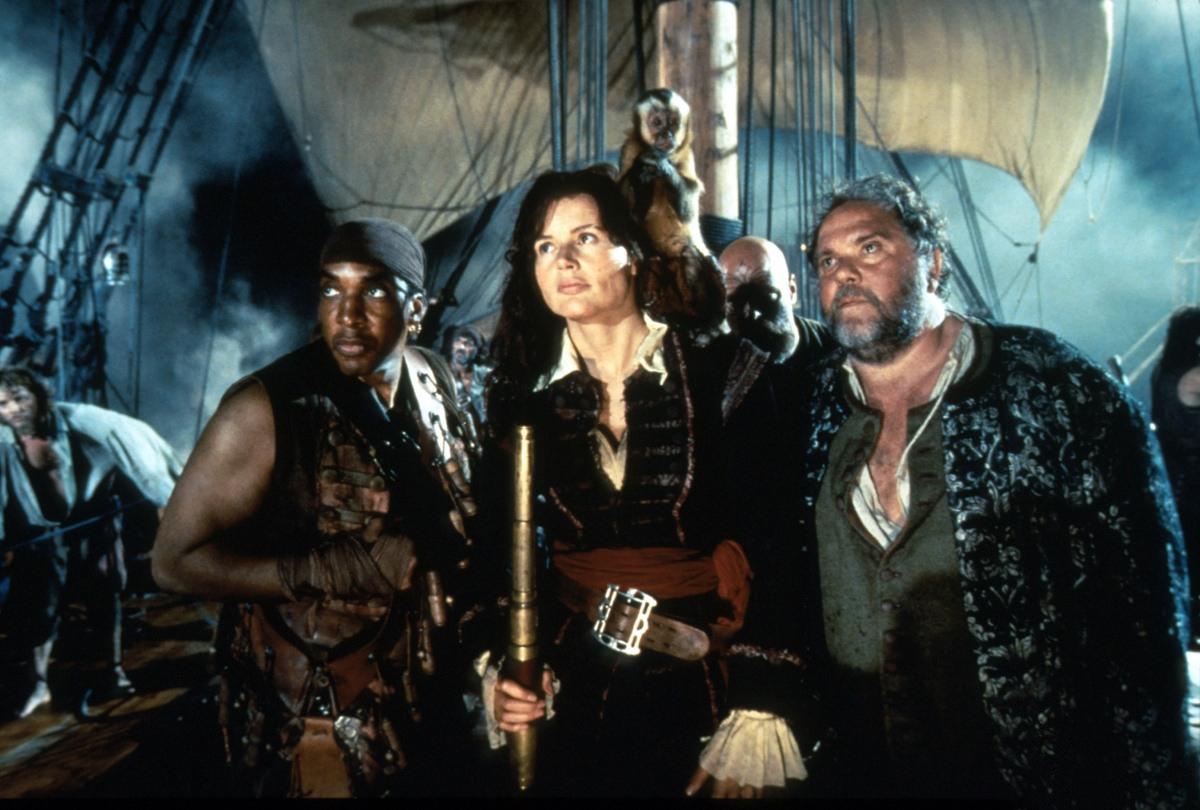
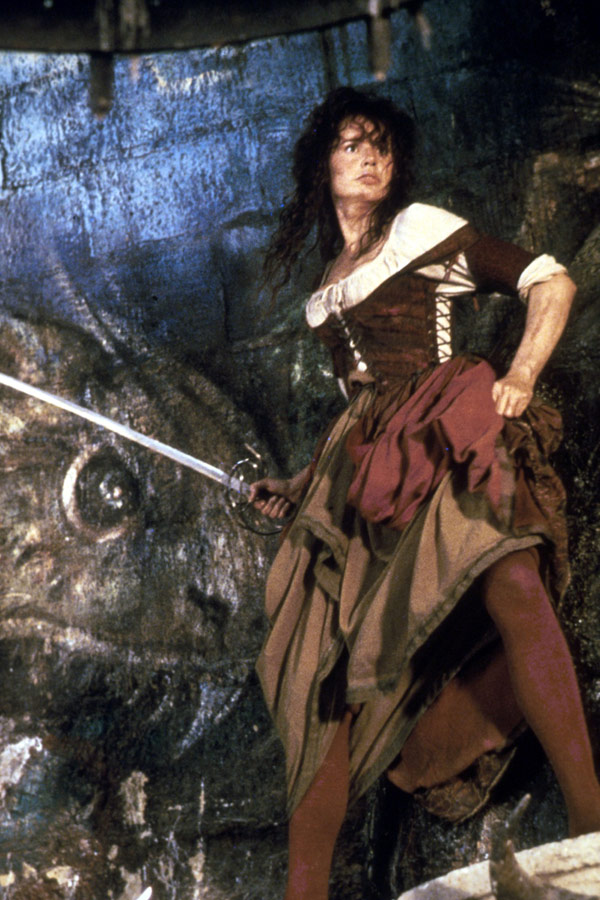
Made in 1995, Cutthroat Island was a pirate-themed historical action-adventure movie starring Geena Davis and Matthew Modine. (Before starting my read of this novelization of it, I’d never seen the movie, though I’d long been curious about it; but about 3/4 of the way through the book, after learning that the film could be watched for free on Tubi, I made time to view it so that I could compare it with the book.) The filmmakers didn’t strive for great cinematic art; they didn’t intend to offer anything but undemanding escapist entertainment. But even considering that fact, the widespread negative reaction by both fans and critics, which endures to this day, is remarkable (the film made it into the Guiness Book of World Records — as the worst box office flop in movie history!). I was aware of that going in, but was resolved to make my own assessment. As is sometimes the case, I landed in the minority; I like the movie well enough for what it is

Unlike some people, I don’t view movie novelization as inherently a trashy and illegitimate abuse of the fictional art. To my mind, it can be a perfectly legitimate artistic enterprise, adapting a story told in one medium to the possibilities afforded by a different one, with the intention of producing a retelling that offers genuine rewards to readers. Because it’s an adaptation, I think the adaptor should strive for as much fidelity to the original as possible, just as in the converse situation of novel to film. The novel format, however, offers the possibility of providing more explanation and clarification of areas that may be murky in the film because of the latter’s time (and other) constraints. Unfortunately, I’d have to say that Betancourt didn’t do as well as he could have on either of these points (and this novel generally suffers as a result). Some of its literary flaws and improbabilities, though, are already inherent in the original movie itself.
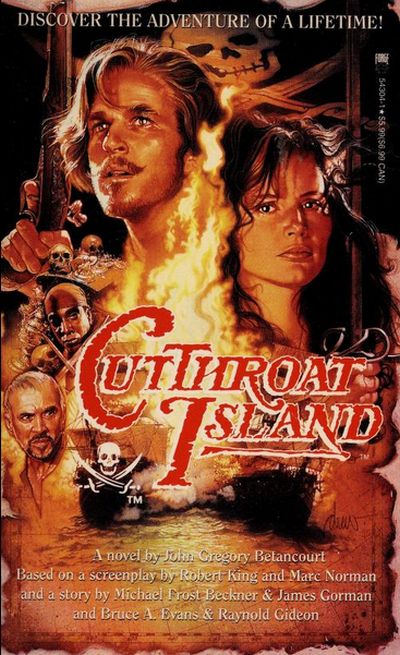
The tale opens in 1688. In the movie, the opening scenes are on, or just off, the coast of Jamaica; in the book, they’re moved inexplicably to Tortuga, off the northern coast of Haiti, and we then move to Jamaica in one day (which I doubt is actually possible for a wind-driven sailing ship). But we soon learn some crucial backstory. In 1619, a pirate captain named “Fingers” Adams captured a Spanish treasure ship loaded with “the richest cargo ever to leave the Americas;” but his ship was subsequently wrecked on the uncharted titular Cutthroat Island, with Adams as the lone survivor. He secreted the treasure there; but after returning to civilization, instead of mounting a retrieval expedition, he contented himself with making a map to the treasure’s location. (Apparently, pirates didn’t steal their booty to do anything like selfishly spend it; they just liked to leave it for posterity.) He divided the map into three parts, bequeathing one piece each to his three in-wedlock sons, all pirate captains in their own right. A fourth son, pirate captain Douglas Brown, nicknamed Dog or Mad Dog (Betancourt always affects the spelling “Dawg,” though that wouldn’t be pronounced any differently) was left out because he was born out of wedlock.

Brown didn’t appreciate this slight, so when our story begins, he’s embarked on a campaign of tracking down and murdering his half-brothers to get their pieces of the map. (This isn’t a close family.) Why he waited until 1688 is never explained. By now, he’s got one piece, and he’s making captured Adams sibling Black Harry “walk the plank” while simultaneously demanding that he reveal the location of the second piece. (Okay, nobody ever said Brown was intelligent.) But Harry’s 20-something daughter Morgan (her exact age is never given), herself raised as a member of his pirate crew, comes to his rescue amid a slew of murky unexplained details and convenient improbabilities, though he’s mortally wounded in the process. Before he dies, he reveals that he had a copy of his part of the map tattooed to his scalp (where he couldn’t possibly refer to it; so no, intelligence doesn’t run in this clan). Morgan’s mission (whether she chooses to accept it or not) is to get herself elected captain in his stead, join up with her surviving uncle, and beat Brown to the treasure, while staying alive in the process. Oh, and find somebody literate in Latin, since that’s the language used on the map. Swashbuckling action-adventure ensues.

There are some significant historical errors here, one already in the movie script itself: in the 17th century, in English law (which applied in Jamaica the same as in England), the punishment for any theft worth more than 12 pence wasn’t being sold into slavery; it was a mandatory sentence to death by hanging. (And it has to be said that main male character William Shaw’s idea of crashing the governor of Jamaica’s ball uninvited, claiming to be a physician when he’s not, swiping jewels off of his dance partners while they’re distracted by his flattery, and transparently lying about what ship brought him to the colony, while having no exit strategy except trying to casually walk out of the building, puts him in the running for the title of most stupid character here, though the competition is fierce.)

And governors of Jamaica did not serve without pay; they were actually paid quite handsomely by 17th-century standards (though the expenses of their station were also steep, and they generally did resort to wangling extra fees and cuts, and sometimes outright corruption). Betancourt also introduces significantly more bad language, nudity and sexual innuendo into this version; the original movie doesn’t have much of any of these, and no real nudity. (It also doesn’t have any reference to Brown having sexually molested Morgan when she was a child, though that claim is made here.) He drops a character arc for one character that’s in the movie, but rather improbable; but he invents two others that are just as improbable compared to their previous behavior.

On the more positive side, the author does develop Morgan’s character better than the filmmakers do, and shows a bit more growth on her part, and more believable development of romantic feelings on the part of the two main characters, than what’s brought out in the movie. He also inserts a short dialogue between Shaw and teenage pirate Bowen (who’s said here to be an orphan taken in by Harry after his parents died) that offers some explanation for how the pirates view their lifestyle; when Shaw points out that Bowen’s a criminal, the latter replies, “We don’t see it that way, since the whole world is crooked, and we’re making the best of it we can.” Morgan’s an interesting, nuanced character, a strong and athletic woman who’s been raised in a rough, kill-or-be-killed milieu (her mother’s never mentioned, in either the movie or the book), who has no qualms about taking human life in combat or in rescuing endangered shipmates, and doesn’t consider reforming and adopting a different career as an attractive possibility. But she’s also capable of kindness and a protective stance, and has a well-developed sense of duty, courage, loyalty, and fairness. (Unlike Brown, she’s not a murderous psychopath; and when she’s pitted against him, she’s not hard to root for.) This read has a lot of action, and there’s never a dull moment.

In terms of content issues, as noted above, there’s more occasional bad language here (in the form of profanity, cuss words and vulgarisms, though not obscenity) than in the movie, but probably far less than we’d have been apt to hear on an actual pirate ship. Violence is pervasive, and Brown is a sadist, but for the most part, neither the movie nor the book make it more graphic than it has to be. (The book is the more graphic of the two, but that’s mostly just in one place, and stops short of being “pornography of violence.”) No sex acts take place in the book itself, though it’s clear that one took place just before it begins. In order to rescue Harry, Morgan’s rousted out of a bed she’s been sharing with a French naval officer who was planning to arrest her after using her; but she’s way ahead of him, and his subsequent discomfiture doesn’t earn him much pity. (She also later poses briefly as a prostitute.) We can infer that she’s honestly been raised with no conception that sex is anything but casual recreation, and she acts accordingly; though there’s an indication at the end of the tale that she might be on the cusp of discovering what it’s actually intended for.)

I actually did like this yarn (though the enjoyment might be characterized as something of a guilty pleasure). It can be recommended to readers who like action-oriented historical adventure, especially with a pirate mystique, and who aren’t put off by the very real flaws noted above.

Author: John Gregory Betancourt
Publisher: Tor Forge; used copy available through Amazon, but only as a printed book. It is available to borrow through the Internet Archive. 
A version of this review previously appeared on Goodreads. 
The Bluff

★★★
“Back from Davy Jones’s locker.”

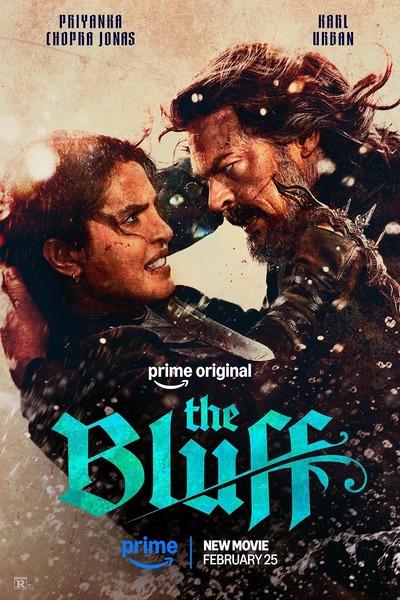
Are women pirates in vogue again? It’s safe to say that the startling failure of Cutthroat Island holed that subgenre of action heroine movies below the water. That was over thirty years ago now, and this may well be the first time Hollywood has returned to it since. [I found an indie film about Irish pirate Grainne Uaile which wrapped shooting in February 2014, and still hasn’t received a release] Though even here, there isn’t much high seas action here. Outside of the opening scene, where Captain Connor (Urban) boards a ship run by Captain Bodden (Córdova) and finds gold stamped with Connor’s hallmark, this takes place almost entirely on land, specifically the island of Cayman Brac.

Connor heads there, that being where Bodden’s ship came from, in search of the rest of the gold. This was taken from him years previously by then piratical associate Bloody Mary (Chopra Jonas) , who stabbed Connor in the chest and left him for dead. She is now Mrs. Ercell Bodden, having abandoned the nautical life, and started a family. The arrival of her ex-lover upends her domestic bliss, and forces her back into the violent way of life. It’s all kinda like The Long Kiss Goodnight, without the amnesia thing. She has to protect her crippled son Isaac and rather flighty sister-in-law Lizzie (Oakley-Green), while figuring out how to rescue her husband from Connor’s clutches.

The two leads are probably the best things about thus. Chopra Jonas has been ramping up her action chops since her co-starring role in Citadel – also an Amazon product – and does a good job throughout. Urban makes for a great villain, despite being solidly into his mid-fifties. He still commands a fine screen presence, almost thirty years after playing Julius Caesar on Xena. However, the other elements aren’t quite as impressive – or, at least, not consistently so. Flowers doesn’t have a lot of directorial experience, especially in the action genre, and sometimes that shows. There are some good sequences, such as where Ercell fends off buccaneers in her own home. But others, such as a battle in a cave complex, come over as dark and muddled.

The same lack of consistency hampers the rest of the film. For every cool moment – such as the discovery that there are caimans on Cayman Brac – there are elements that don’t work, like Ercell’s relationship with Lizzie. Another issue is that since the days of Cutthroat Island, the genre has been redefined by the Pirates of the Caribbean franchise. Any pirate movie will inevitably be compared to it, and any hero(ine) to Jack Sparrow. It’s an awkward situation, and it feels as if The Bluff is torn between pandering to this, and being its own thing. Whatever Cutthroat‘s issues – and they were numerous – that wasn’t one. But if this can prove the viability of female pirates again, it’ll have been worth the effort. 

Dir: Frank E. Flowers
Star: Priyanka Chopra Jonas, Karl Urban, Safia Oakley-Green, Ismael Cruz Córdova

Pirates! by Celia Rees

Literary rating: ★★★★★
Kick-butt quotient: ☆☆

Although I haven’t read much pirate-themed fiction, I find the premise interesting; so I’ve had my eye on this historical novel ever since the BC library (where I work) acquired it. It definitely didn’t disappoint! Set mostly in the early 1720s, with some stage-setting in the years leading up to those, this action-packed tale follows the life and adventures of first-person narrator Nancy Kington (b. ca. 1704), the daughter of a Bristol merchant, who finds herself packed off to the family’s plantation in Jamaica at the age of 15, and is subsequently led by circumstances to voluntarily sign articles on a pirate ship.
Pirates, of course, are sea-going robbers; by definition, they forcibly steal other people’s property for their own profit. Obviously, they’re off of the ethical strait-and-narrow path, and in shady moral territory. The piratical profession most naturally appeals to brutal and self-serving types who don’t have any particular moral sense or empathy with their fellow humans. (Some may be more brutal and selfish than others –and some spectacularly evil and sadistic types may find the pirate life an opportunity to gratify their propensities.) Like Robert Louis Stevenson before her, British writer Rees gives full recognition to that reality.

To a greater extent than Stevenson, though, she recognizes that there can be a range of nuanced moral qualities among pirates, with not all of them quite fitting that model –especially in a time and place where patriarchy and male chauvinism, legalized slavery, and institutionalized inequality and injustice greatly constrict many people’s lives and choices, and might render the right side of the law as morally dicey as life under the Jolly Roger. (That’s not unlike the situation in the Old West, or in medieval Europe, where “outlaws” might sometimes be decent people pushed outside the law by others using the system for their own gain.) Personally, I think that pirates who aren’t brutal and selfish as such, and who do have a strong moral sense and a concern for others, can be interesting characters in the ways they navigate the shades of grey that their position necessarily entails; and that’s true of our heroine here. (Yes, a lady who happens to be a pirate can be an honorable and admirable heroine!)

This is fiction in the Romantic tradition –that is, fiction that seeks primarily to evoke strong emotional responses from the reader, sometimes enhanced, as they are here, by extreme situations and exotic settings. The Romantic aim is fully fulfilled here; I was taken captive by this pirate right away, turned the pages as fast as I could at every opportunity, and experienced a wealth of complex emotions throughout the story. (It’s not, however, a “romance novel” in the Harlequin sense –though it has clean romance as one strand of the plot, which I appreciated– and it doesn’t “romanticize” things like piracy, slavery, and the grim realities of ocean-going life in the 18th century). It’s also fiction with serious food for thought, as well as rousing adventure, and a very moving portrait of cross-racial friendship. Like most modern Romantic fiction, though, it borrows Realist techniques, with a concern for verisimilitude and historical accuracy. (In common with some other authors, Rees used the contemporary nonfiction A General History of the Robberies and Murders of the Most Notorious Pyrates, which she and some others attribute to Daniel Defoe, as a key source.) Nancy’s narrative voice is engaging and quick-flowing, with a slightly archaic flavor in word choices and diction for realism, but is much easier to read than an actual 18th-century narrative would have been.

Born in 1949, former schoolteacher Rees is an accomplished novelist, the author of some 19 books, and a History major (she actually had a double major, but History was one). Her publishers market her books to the YA age group (and the BC library put this one in the Juvenile section on that account), in this case probably encouraged by the fact that Nancy and her friend and fellow pirate Miranda are in their teens. Bad language of the d-word sort is present but relatively restrained, rape or attempted rape and prostitution are part of their world but not portrayed in great detail, and while there are some very violent and grisly moments, Rees doesn’t wallow in them. The content here, IMO, wouldn’t be harmful to a healthy teen; and I could see plenty of teen readers of both sexes eating it up with a spoon and asking for more. But it could just as easily have been marketed as an adult novel; there isn’t anything stereotypically juvenile or “kiddish” about it. (Teens in Nancy and Miranda’s day were expected to grow up quickly, and our gals here definitely did –they have far more in common, in their capacities and general attitudes, with today’s adult women than they do with typical modern teens.)

This particular edition of the book has a moderately interesting interview with the author (originally published in a Michigan newspaper), and a few pages of discussion questions and activities, aimed at younger readers, that could be used for common reads in a book club or classroom. At the time it was published, the novel garnered a number of prestigious accolades from the likes of the American Library Assn., the International Reading Assn., etc. For once, I think it deserved every critical recognition it got (and I don’t often agree with the critical community!).

“You may wish me luck, or curse me for a damnable pirate,” Nancy writes near the close of her account. This reader opted for the first choice, without apology!

Author: Ceilia Rees
Publisher: Bloomsbury, available through Amazon, both as a paperback and an e-book

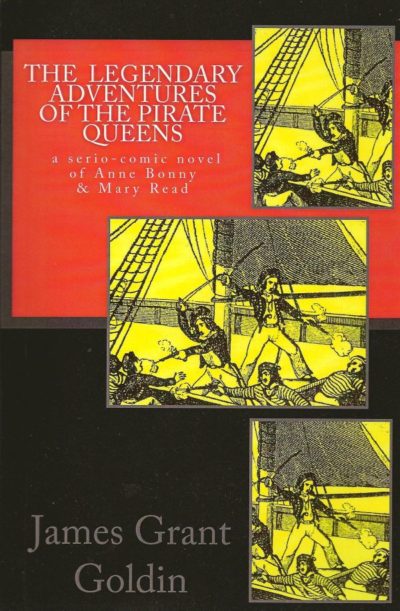
The Legendary Adventures of the Pirate Queens, by James Grant Goldin

Literary rating: ★★★★
Kick-butt quotient: ☆☆☆

“Two women with swords was a sight that none of Vane’s men had ever imagined. It was like seeing a two-headed snake; one such monster would be a freak of nature, while two would indicate a terrible new species.”
Readers of the site should already be aware of Anne Bonney and Mary Read, as we covered them in our piece about women pirates a while back. They’re a good candidate for a story, because the known facts about them are relatively scant, allowing lots of scope for an author to fill in the blanks, however they wish. Goldin has no qualms on this front, freely admitting in the prologue, “A lot has just been made up.” This isn’t a bad thing, providing you’re looking for the “serio-comic novel” this is, not a recounting of the historical record. While based on the facts, and including both persona who existed and events which took place, Goldin does a good job of weaving them into a more complete narrative which, if unprovable at best, could have been how things happened.

After spending time in the military, and also becoming a widow, Mary Read is masquerading as “Martin” on a Dutch ship in the Caribbean when it is is captured by Calico Jack Rackham and his pirates. S/he and another member of the crew, Peter Meredith, defect to Rackham’s crew, where Read meets Bonney, the Captain’ lover. Subsequent issues include an encounter with Bonney’s ex-husband; Read’s daring rescue of Rackham and Bonney from New Providence, where Governor Woodes Rogers is trying to rid the colony of pirates; and the return of Rackham’s former boss, Captain Charles Vane. It ends with a grandstand finale, in which Vane seeks to recapture New Providence, only to find his ship facing a rather better-armed Spanish ship with the same aim, as Read (by this point “outed” as a woman) and Bonney try to spike the fortress’s guns.

Indeed, about all there isn’t, is much in the way of actual piracy, though only after it was all over did I notice this omission. And it’s occasionally educational. I never realized pirates were so… democratic. For according to the articles the crew sign, “The Captain shall be chosen by majority vote of the Company, and shall have supreme power during a battle. But before and after, every man shall have an equal vote in affairs of moment.” Who knew? [I’m presuming this is accurate, anyway: googling “pirates majority vote” led me down a rabbit-hole involving the Pirate Party of Iceland…] It makes for a fast, light read, driven by a bunch of engaging central characters who sound like they would be fun to be around, with unconventional quirks that play against pirate stereotype, e.g. Rackham’s desire to be considered witty.

Perhaps they’re too engaging? For the book sometimes feels in need of a true antagonist to balance the scales, a really hissable villain, with Governor Rogers and Captain Vane both turning out to be not entirely bad after all. Meredith also comes over a bit underdeveloped, a milquetoast romantic interest for Mary; it occasionally seems as if he’s there mostly to defuse any potential lesbian subtext between her and Anne. On the other hand, the relationship between Jack and Anne is spot-on, a fiery combination of steel and gunpowder which can go from volcanic passion to equally fiery confrontation in the blink of an eye. The novel was based off a script Goldin wrote for a prospective TV series, which makes sense, as it come across as visual in style, with the battles unfolding easily in your mind’s eye. Shame it wasn’t picked up: he says, “I really think the story bothers producers on some level. I also do think that, even now, the shadow of Cutthroat Island is long and dark.”

Still, we will always have the novel, and it was refreshing to read something which, for once, worked perfectly as a standalone story, rather than dropping the reader off a cliff-hanger, with an exhortation to buy the next in the series. A sequel is planned down the road, but Goldin got distracted by another series, on the children of the Norse gods. That should hopefully be finished by the end of 2018, then he promises to work on the further adventures of Anne and Mary. I’m looking forward to that.

Author: James Grant Goldin
Publisher: Basilisk Books, available through Amazon as both an e-book and a paperback.
A free copy of the book was supplied to me, in exchange for an honest review.

The Muthers

★★½
“Jolly rogered.”

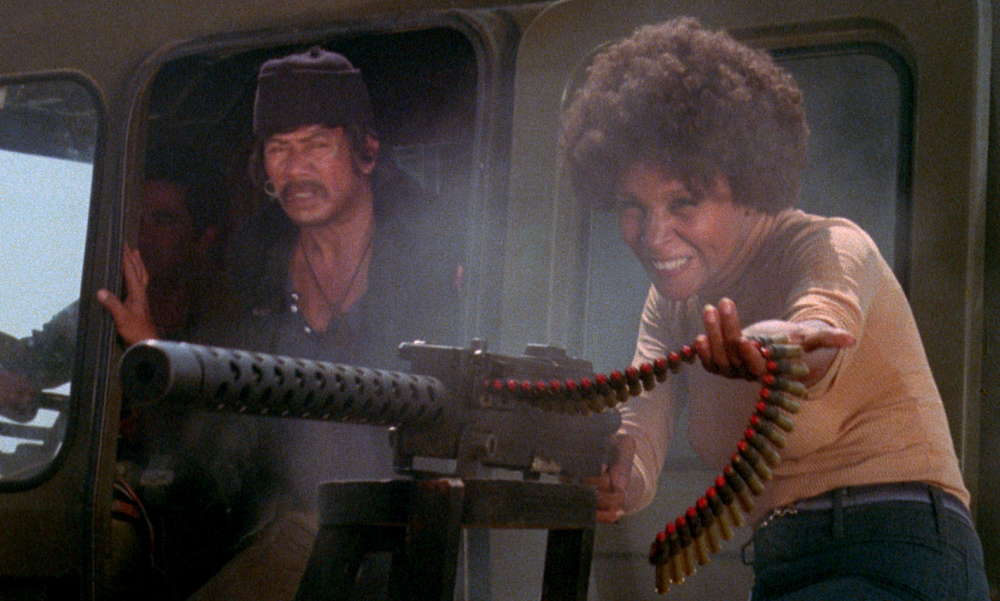
This is a strange cross-breed between a blaxploitation flick, a pirate movie and a women-in-prison film. Then again, a lot of the seventies films coming out of the Philippines tended to be at least somewhat bizarre, and this is likely no exception. The titular gang are pirates, led by Kelly (Bell) and Anggie (Katon), who roam what appears to be the Caribbean, going by the mention of Santo Domingo, but is actually in the Eastern hemisphere, boarding and robbing unsuspecting vessels, and fighting with a rival band of brigands using their kung-fu skills. However, Kelly’s sister goes missing, and is tracked down to a coffee farm belonging to the evil Monteiro (Carreon), which he runs in the manner of a pre-Civil War Southern plantation. Our heroines go undercover, only to discover getting out will be tougher than getting in.

It starts off in fine form, coming over as a modern, urban version of a sixties swashbuckler, and it’s a shame it didn’t stick to this premise, which would have offered something rather innovative. Instead, from the time Kelly and Anggie – yes, there is apparently an extra “g” in there – show up on the farm, it goes down too well-worn a path, with sadistic guards, fellow inmates who cozy up to their captors, and showers. Lots of showers. After the expected breakout attempts, recaptures and punishments, things eventually end in an equally expected riot, enlivened somewhat by the unexpected return appearance of the rival pirates, as allies of Monteiro,

muthersBoth Bell and Katon had worked with Santiago before, in T.N.T. Jackson and Ebony, Ivory & Jade respectively, and make a decent impression here. I’ve read a few other reviews that rip into this for poor-quality action, yet I can’t say I hated that aspect too much. Sure, there are times, particularly for any acrobatic moments, where the doubling is not exactly well-concealed. But there are other times where they’re putting in their fair share of effort, and should be appreciated for that. It is, if not quite tame, rather less sleazy than some on Santiago’s offerings. At first, I thought this was because I was watching it on Turner Classic Movies (yes, a refreshingly broad definition of “classic”!), but turns out to be fairly mild. Mind you, Bell’s ultra skin-tight top doesn’t exactly leave much to the imagination there!
On the whole though, I’d have preferred if it had stuck with the pirate theme present at the beginning, which was a good deal fresher than the rote WiP fodder served up in the middle. Maybe I’m just grumpy because I did lose a bet with the wife: on seeing a guard tower overlooking the workers’ huts, I predicted it would later explode in a giant fireball, as a guard falls from it. I am disappointed to report that this simple pleasure was with-held from me. Sheesh, what is the world coming to, when a film from the golden age of Phillsploitation can’t even deliver on this expectation?

Dir: Cirio H. Santiago
Star: Jeannie Bell, Rosanne Katon, Trina Parks, Jayne Kennedy

Cutthroat Island: 20 years on

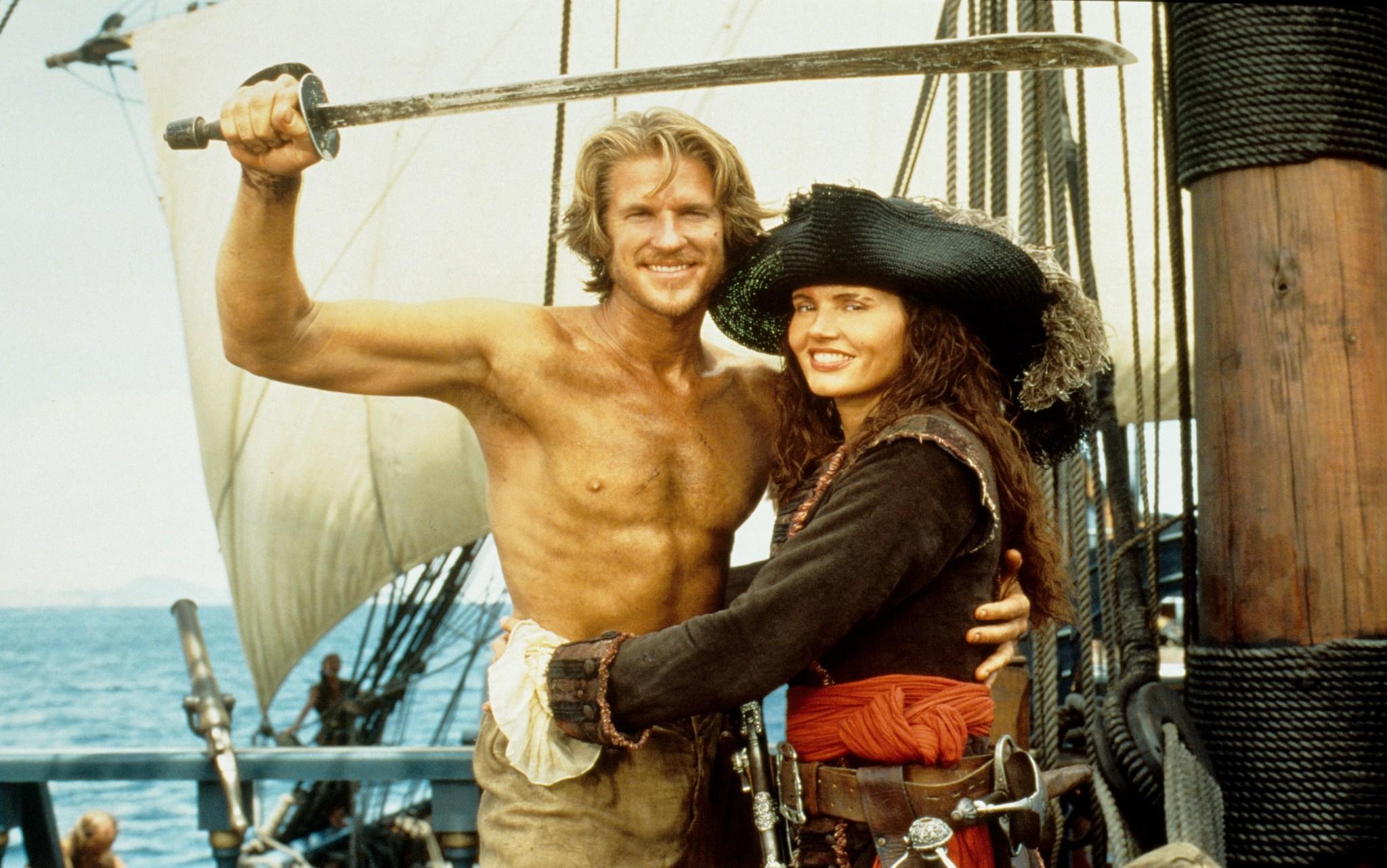
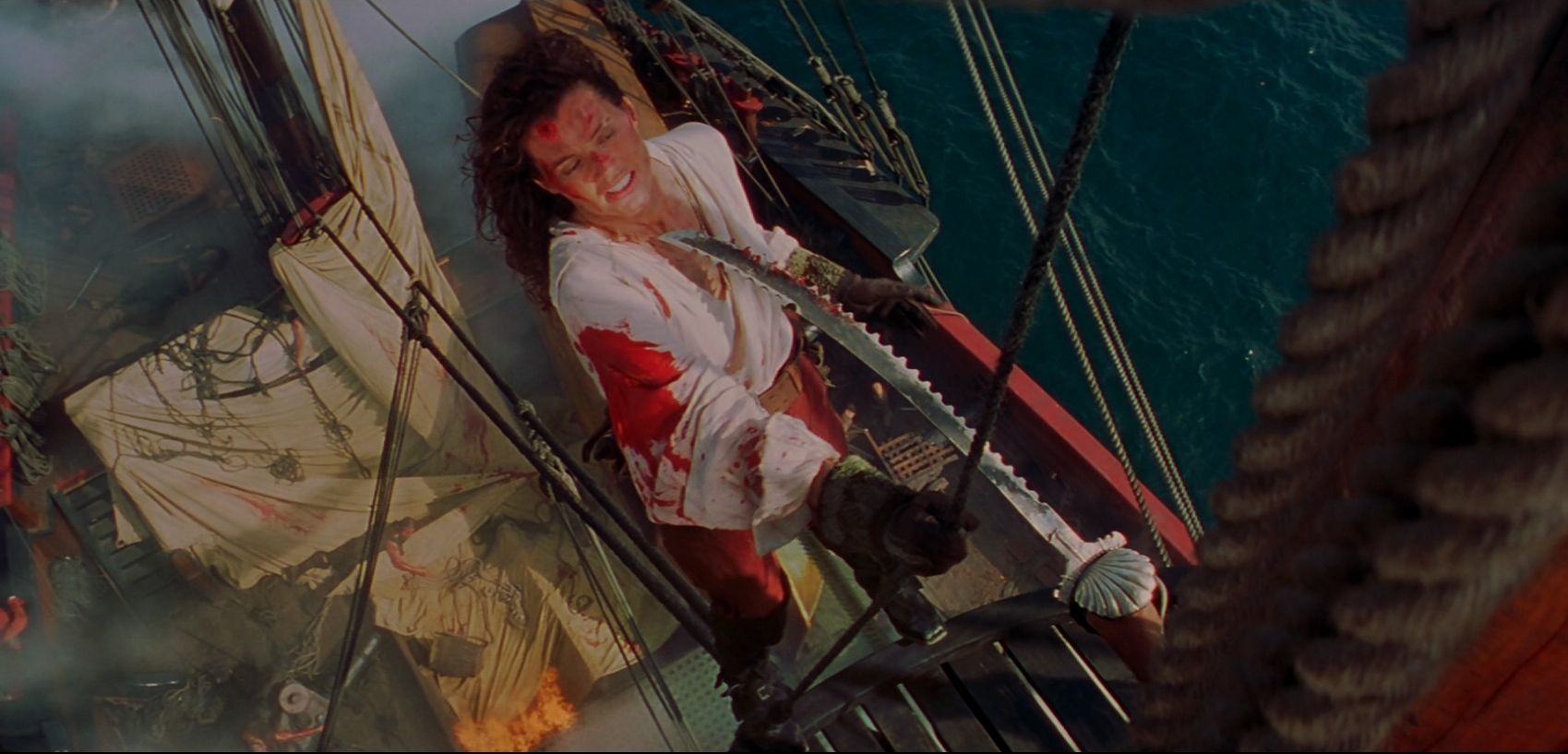
cutthroat05While there have been box-office bombs in the genre since – Tank Girl, Barb Wire, Catwoman – the epic scale of Cutthroat Island‘s failure surpasses them all. It cost $115 million to make, a sizable amount even now, yet didn’t even crack the top ten in the United States on its opening weekend, finishing behind Dracula: Dead and Loving It. The film barely grossed $10 million in North America, and still regularly appears on lists of the biggest cinematic financial flops, sometimes right at the top. With December marking the 20th anniversary of is release,  let’s take a look back at what is perhaps the most infamous action heroine film of all time.

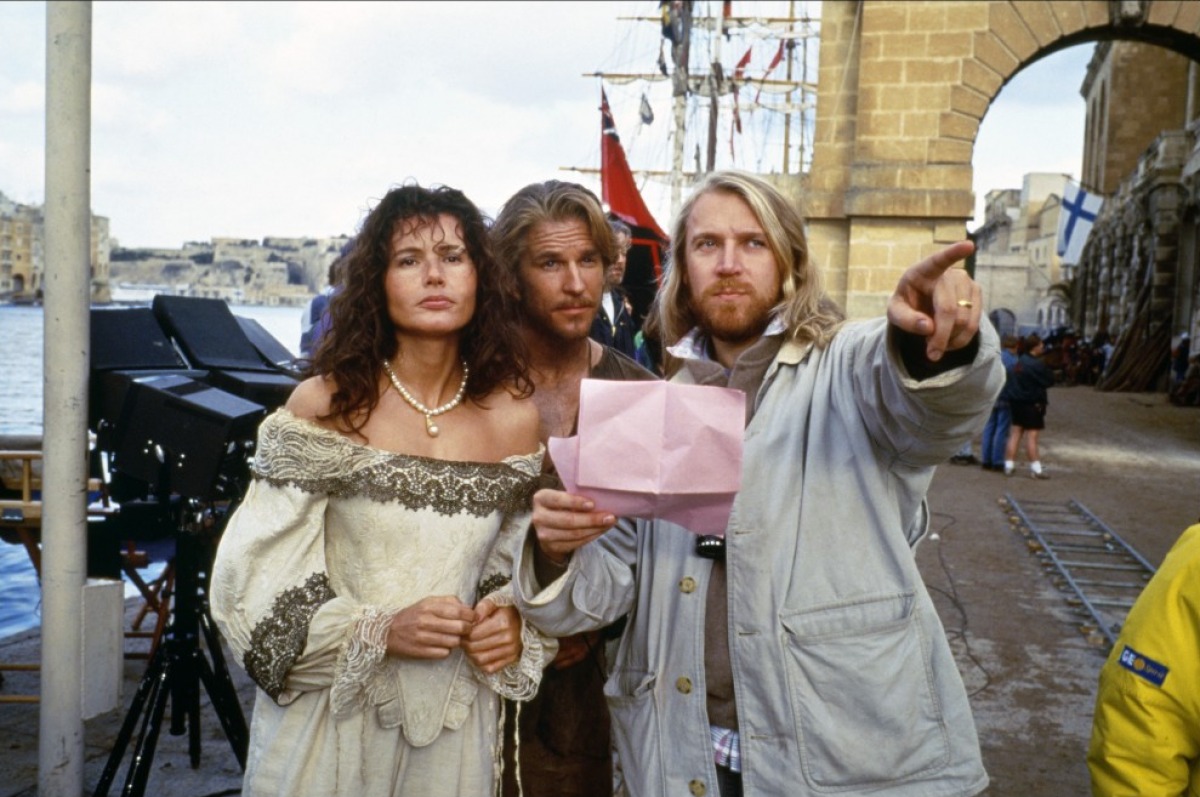
cutthroat02Its origins are tied to another ill-fated, woman pirate venture from around that time. Columbia’s equally big-budget saga, Mistress of the Seasm which foundered in the summer of 1993, after director Paul Verhoeven left the project. One of the reported replacements for Verhoeven was Finnish director Renny Harlin, although after he was dumped, and Verhoeven returned, the film’s intended star then jumped ship. That star was Harlin’s then fiancee, Geena Davis, apparently miffed at her other half being courted then rejected by the studio. A source said ”From what I understand, she’s decided she wants to make a movie with her future hubby.” Mario Kassar, the chief of rival studio Carolco, seized the chance to woo both Harlin and Davis for his rival project, which already had Michael Douglas signed on as the male lead and love interest. [Mistress never got made; in the light of subsequent events, that was likely a win for Columbia]

But Carolco were already in financial trouble, having fallen far from smash-hits such as Terminator 2 and Total Recall. They had restructured in 1992, and sold off shares in 1993, yet were still in such dire cash-flow straits that they could only afford one big-budget production. The studio decided to shelve another historical epic, Crusade, after its budget reached nine figures [this had been another Verhoeven project; he must really hate Harlin and Davis!], and concentrate purely on Island. This was, in effect, a last throw of the dice for the beleaguered company and they financed the production, with its expected $60 million budget, largely by pre-selling distribution rights to overseas investors.

However, trouble was brewing, as Harlin apparently kept beefing up Davis’s role, at the expense of Michael Douglas’s. Said the actor, “I just was not comfortable with the part. The combination of not seeing it on the page and not knowing where it would go. I was feeling uncomfortable, and I wanted out… Ultimately, comes one day, and the director says, ‘I’m happy with the direction the script is going.’ And I said: ‘God bless you. I’m not.’ ” No-one at Carolco either saw fit or was able to override Harlin, so Douglas left the project. Both Harlin and Davis expected it to fold entirely due to his departure, but Carolco  had no way back from the financial abyss into which they had flung themselves, and had to go forward, holding both director and star to their contracts.

Harlin later recounted: “At that point I was left there with my then-wife, Geena Davis and myself, and a company that was already belly-up. We begged to be let go. We begged that we didn’t have to make this movie. We begged that we not be put in this position.” Davis concurs: “I, of course, assumed the whole project would be canceled. It was all based on Michael Douglas’s being in it. To my horror, I learned not only would they not cancel, but that I had a legal obligation to go ahead, unlike Michael. I tried desperately to get out of this movie.”  Instead, Douglas was replaced by the considerably lower profile (and far cheaper) Matthew Modine. Yet even he was unhappy, complaining, “They didn’t give me the [new] script. They gave me the script that Michael had said yes to… It was about a guy and a girl, but when I arrived in Malta, it [had become] about a girl and her journey.”

Ah, yes. Malta. The film was to be shot there and in Thailand, and pre-production had to go on, despite no leading man, and with the script a work in progress. But why let that interfere? In a memo, Harlin wrote, “When the casting concerns have been resolved and I arrive in Malta, I want to see the most spectacular and eye-popping sets, the most interesting and unusual props, and especially weapons and special effects that leave the audience gasping in awe and stunts that no one thought possible before. No sequence or setting that you’ve seen in movies before is good enough. Any idea that has been previously used has to be reinvented and cranked up 10 times.” Seems a strange kind of message from someone  supposedly desperate to get off the project, unless he was trying to push costs to a level where even Carolco would have to cry “Enough!” This theory might help explain stories like Harlin allegedly spending $15,000 to expedite getting his dog through Maltese quarantine.

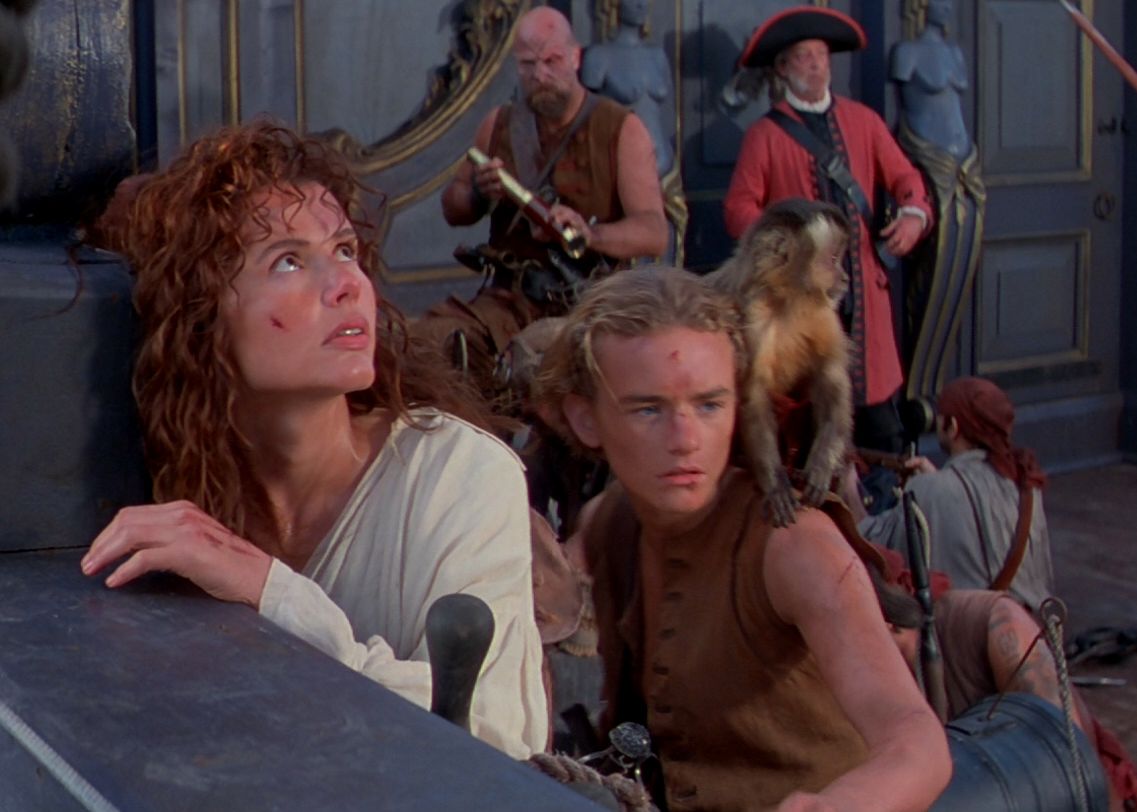
cutthroat13There, the design team had to build its sets on spec, only to incur the extra costs of rebuilding them after Harlin finally arrived in Malta. Chief camera operator Nicola Pecorini quit, and two dozen crew members left in sympathy. A director of photography broke his leg in an accident. Raw sewage leaked into one of the tanks where actors were supposed to swim. While no-one questions the efforts of either Harlin or Davis, costs continued to escalate as the shoot moved to the Far East, where an inexperienced team struggled with the logistics of filming a largely water-bound production. The total cost of producing, distributing and marketing the film ended up at $121 million. Considering only four films released in 1995 took even $110 million at the US box-office, the chances of Island saving Carolco’s bacon were slim indeed. Indeed, it was already too late. If triggering a financial meltdown was Harlin’s aim, he succeeded; the company didn’t survive long enough to see Island in cinemas, declaring bankruptcy six weeks before its release in December 1995.

The film, to be honest, never really had a chance. Originally intended as a summer release, the production problems led to it being pushed back, and for some inexplicable reason it was sent to cinemas the weekend before Christmas, which was then hardly a tent-pole date for action blockbusters. Critical reaction was mixed, though hardly disastrous: it’s rated 37% fresh on RottenTomatoes.com, but Roger Ebert gave it three stars out of four, saying, “Cutthroat Island is everything a movie named Cutthroat Island should be, and no more.” The audience, however, ignored it entirely. It opened at #11, taking in less than $2.4 million its opening weekend, and finishing below the likes of other openers such as Jean-Claude Van Damme’s Sudden Death or entirely forgotten family adventure Tom and Huck.

cutthroat15Those involved generally seem to look back on the results with fondness, though Modine expressed some bitterness at the time: “It’s the first movie I’ve worked on where the director never really spoke to me. It was frustrating and Renny spent a lot of his time just finding new ways to blow things up. He likes to blow things up.” His opinion seems to have mellowed, and he now says, “I’m still very pleased with the movie. I think that the movie was terribly harshly criticized. It’s a pirate movie! And it was attacked as though we tried to remake Gone With the Wind or something. It’s a really fun movie.” Davis agrees, saying, “The fact is, Renny and I are really proud of the movie,” and Harlin thinks, “It’s not Pirates of the Caribbean, but I think it’s a totally fine sort of family and young people’s pirate adventure. And I think that people just ganged [up] against it because it failed at the box office.”

Are people right to do so? Well, I’ll largely refer you over to our original review, though I did watch it again for the purposes of this piece. This time around, it seemed a film which should be more entertaining than it is, despite Harlin’s fondness for explosions – Modine was dead right there, with the director apparently oblivious to the fact that cannonballs were not rocket-propelled grenades that create giant fireballs on impact. Plausibility is utterly out the window, from the giant island with its sea-cliffs, hundreds of feet high, inexplicably missing from maps, through to the multiple zip-lines with which pirate vessels were apparently equipped. The dialogue certainly feels like it was made up on the fly, from virtually the heroine’s first line (“I took your balls”) to her last (“Bad Dawg!”). However, it doesn’t drag, and the main cast go at the material with sufficient energy to make for an entertaining two hours. I’ve seen far worse, much more successful films – hello, National Treasure.

One final, semi-ironic point. At the time, it was considered possible Hollywood would rein in the excess. as a result of the film’s failure. The following April, Daniel Jeffreys of The Independent wrote, “The films that have topped the box office list in the US since Cutthroat Island sank have had budgets well below $50m. Movies like Dead Man Walking, The Birdcage, Sense and Sensibility, 12 Monkeys and Mr Holland’s Opus have all cleared their modest costs with ease making three times as much money between them as Cutthroat Island lost. Next time Hollywood goes looking for buried treasure it might remember that and leave the lavish special effects at home.” But 20 years later, the top hits this year are Jurassic World, Avengers: Age of Ultron, Inside Out and Furious 7, whose production budgets alone – without distribution or marketing costs – average north of $190 million, making Island look positively restrained by comparison. Perhaps Renny and Geena were just ahead of their time, after all.

Tiger of the Seven Seas

★★★
“Good, for the (Spanish) Main part”

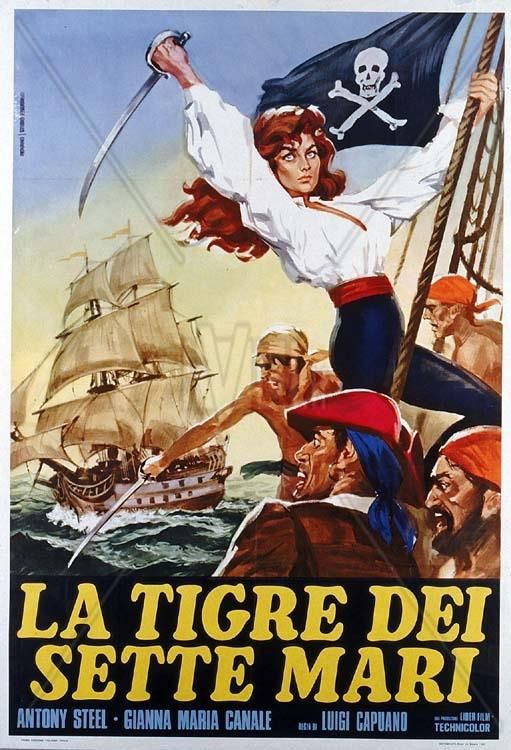
tigerofthesevenseasAnother in the flurry of Italian female pirate flicks of the sixties, this stars Canale as Consuelo, the daughter of a pirate captain. After he retires from the buccaneering business, she defeats her lover, William (Steel) in a duel to decide who takes command. Her father is killed with William’s knife a short while after, but they are attacked by the Spanish forces of Governor Inigo de Cordoba (Calindri) before her boyfriend can be hung for the crime. In the ensuing confusion, William escapes, and makes off with the ship. Consuelo and her followers, hijack another vessel and give chase. But is William the real culprit, or is this part of a plan cooked up by the Governor’s scheming wife, Anna (Spina), who seeks to get her hands on the horde of treasure which was buried in a secret location by Consuelo’s father, before his death?

The action is a bit disappointing here, with most of the sword-fights consisting of not much more than the two participants standing at arm’s-length from each other, waving their weapons. The story is also rather predictable, with few if any of the developments being unexpected. We just know William is going to be proven innocent, even if he looks like a young, piratical version of Lou Reed. ]Maybe that’s just me?] What do work, are the characters, who are an enjoyable bunch to spend time with – even the villainous Anna, who is clearly the brains of the marriage. She’s an excellent foil for Consuelo, who is equally smart and brave; she certainly makes a strong first impression, hurling a knife at William, and embedding it in the trunk of a tree by his face.

The spectacle side of things is well-integrated, though I have an idea some of the footage may have been lifted from other pirate pictures, as it doesn’t quite seem to match; it was certainly not Capuano’s sole foray into the genre. Everything builds nicely to the standard adventure film cliche, #37: the masked ball, which Consuelo infiltrates in the cunning guise of…a pirate, to rescue William, after he made an ill-advised attempt to storm the fortress and abduct the traitor. This leads to an all-out battle, perhaps most remarkable for the “raining cannons” sequence, but despite what I said about the plot having no twists, I must admit, the final conclusion is not one I saw coming, with the villainess getting off surprisingly easily, compared to other potential fates. She actually gets the treasure, though at the cost of letting Consuelo and William go. I like to imagine the sequel has them heading back to reclaim her father’s loot, and I certainly wouldn’t have minded seeing more of their adventures, and it’s a shame no such follow-up ever emerged.

Dir: Luigi Capuano
Star: Gianna Maria Canale, Anthony Steel, Maria Grazia Spina, Ernesto Calindri

The Pirate Vortex, by Deborah Cannon

Literary rating: ★★★½
Kick-butt quotient: ☆

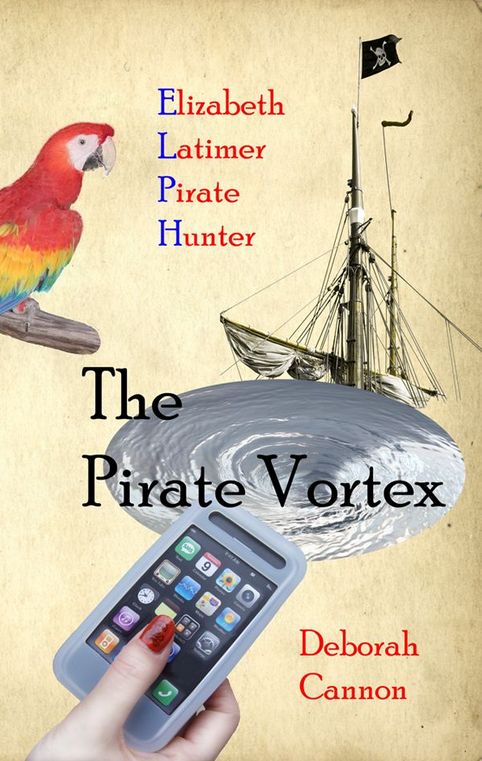
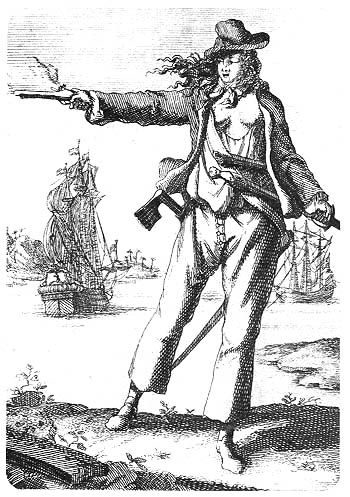
pirate vortex“Calico Jack” Rackham, a Caribbean pirate hanged soon after his capture in 1720, his lover and fellow pirate Anne Bonny (b. ca. 1700) and a few other characters in this series-opening novel were real-life people, who left behind an historical record in A General History of the Robberies and Murders of the Most Notorious Pyrates (1724), by one Capt. Charles Johnson. (Johnson is otherwise unknown; many scholars surmise, as Cannon assumes in her novel, that this was a pen name used by Daniel Defoe.) That book forms our main historical source for piracy in that era, and Cannon’s portrayal here seems to be basically very faithful to the historical data as far as it goes, including the fact that we know nothing of Bonny’s ultimate fate (so we’re free to speculate about any descendants she may have had…) –but that data is very embellished here, with time-traveling SF elements.

The author and I are Goodreads friends, but I checked a copy of the book out from the library where I work (so, it wasn’t a review copy). My rating correctly indicates that I liked the read. For me personally, a few factors kept it from a higher rating; but it’s quite possible that other readers wouldn’t weigh those as much, and would rate it higher. (In fact, several already have!)

Our heroine, Elizabeth Latimer, is an 18-year-old college student at the Univ. of Victoria near Vancouver in British Columbia, Cannon’s own stamping grounds. We’re not told her exact age until a few chapters in, and many American readers wouldn’t know there’s a Victoria, Canada; I confused it with the Australian state of Victoria for the first couple of chapters. Liz’s mom, Tess Rackham kept her maiden name and formerly taught an Archaeology of Piracy class at the university; but when her husband John Latimer was lost at sea in a sailing accident four years earlier, she quit that job and went into marine salvage with her business partner, Cal Sorensen. Though her dad taught her to sail proficiently, Liz hasn’t since that day.

She has some issues from her dad’s death and her mother’s not very hands-on parenting of herself and her 14-year-old sister, and mixed feelings about her parents’ obsession with pirate history: she aspires to go into business and make a prosaic career on dry land –but she’s the self-styled “queen” of her school’s competitive fencing program, and taking the same class her mother once taught. Then on a spring morning, two things happen: she meets mystery youth Daniel Corker, and learns that her mom is presumed lost at sea, in the Bermuda Triangle area. This sets us up for a time-traveling adventure.

Cannon handles language capably, without the poor grammar and diction that bedevil so many self-published authors; she’s also written novels before, so this is no freshman effort. Her prose style isn’t of a sort that calls attention to itself; it’s straightforward, with a focus on the story. The pace is fast, and the plot exciting and eventful, with an emphasis on events, action, and snappy dialogue. Young Adult readers affluent enough to be tech-savvy are the main target audience, and there’s a fair amount of tech-talk, texting jargon, and pop culture references that this group would be more at home with than some other demographics; but older readers wouldn’t be lost with these either, since the context usually furnishes clues for any meaning that’s essential to get, and the same goes for nautical terms, though there’s aren’t a lot of those.

Bonney,_Anne_(1697-1720)Liz herself is a well-drawn, likeable but not perfect character, with some depth and complexity to her. As an action heroine, her fencing skills don’t match those of seasoned pirates, she’s not a good shot, and she’s an inexperienced horsewoman; and more often than not, she needs male rescue when in jeopardy. (Considering the situations here, the violence in the book is restrained, and almost never lethal.) Given her background and situation, though, this is only realistic. She’s also got enough guts to fight when necessary, thinks quickly and resourcefully, and is a strong swimmer. Other characters, like Lu, Stevie, Cal and Jerrit Wang, are also quite lifelike.

Time-travel writers divide over the question of how they handle time paradoxes. Some take the position that you can’t change the past – whatever you did there, you’ve already done. Cannon and others treat the past as malleable – you can change it, and you’d better not, or you might erase yourself and your whole bloodline! Personally, I prefer the former approach; but it wasn’t a problem to accept the latter as a literary conceit. I did have some issues with the plotting. In several cases, IMO, characters make decisions that aren’t well explained, or that it doesn’t seem like they would have made in real life, although they’re necessary to move the plot the way the author wants; and some difficult operations/problems are solved too easily or coincidentally. At one point, we’re apparently barely off shore from Nassau, traveling by sail –but are in very short order in swimming distance of Jamaica on the far side of Cuba, a journey that would take days at least.

Liz has unexplained telepathic connections with animals, and sometimes with people: we’re told at one point that she can tell if someone is lying, and Tess can psychically tell if Liz is in danger. In a plot that already demands some suspension of disbelief, this for me was an element that stretched credibility a bit too much. And while CJ the parrot is cute, he and the horse Fancy display a lot more intelligence than parrots and horses really have. (Parrots imitate the sounds of human speech, but in real life they don’t know what they’re saying.)

Romance isn’t really a stressed theme; Liz has always been too focused on her studies and her fencing to have much time for boys and dating (her sister Lu, at 14, is the more boy-crazy of the two). That said, she is a healthy 18-year old who’s aware of attractive unattached males and appreciates their awareness of her, and who wants to someday be married. There’s a triangle of speculative interest here, and there will be a kiss before the book ends; so very romance-phobic readers will want to avoid it. This novel completes its story arc, but it leaves a lot of unanswered questions for the sequel(s). Readers who liked this first book will probably want to continue the series; and I definitely plan to set sail with The Jade Pirate myself sometime!

Note: There are a couple of instances of implied sex here, but nothing explicit. There’s some use of d- and h-word language and vulgarisms, but no obscenity and little profanity.

Author: Deborah Cannon
Publisher: Self-published, available through Amazon, both for Kindle and as a printed book.

A version of this review previously appeared on Goodreads.

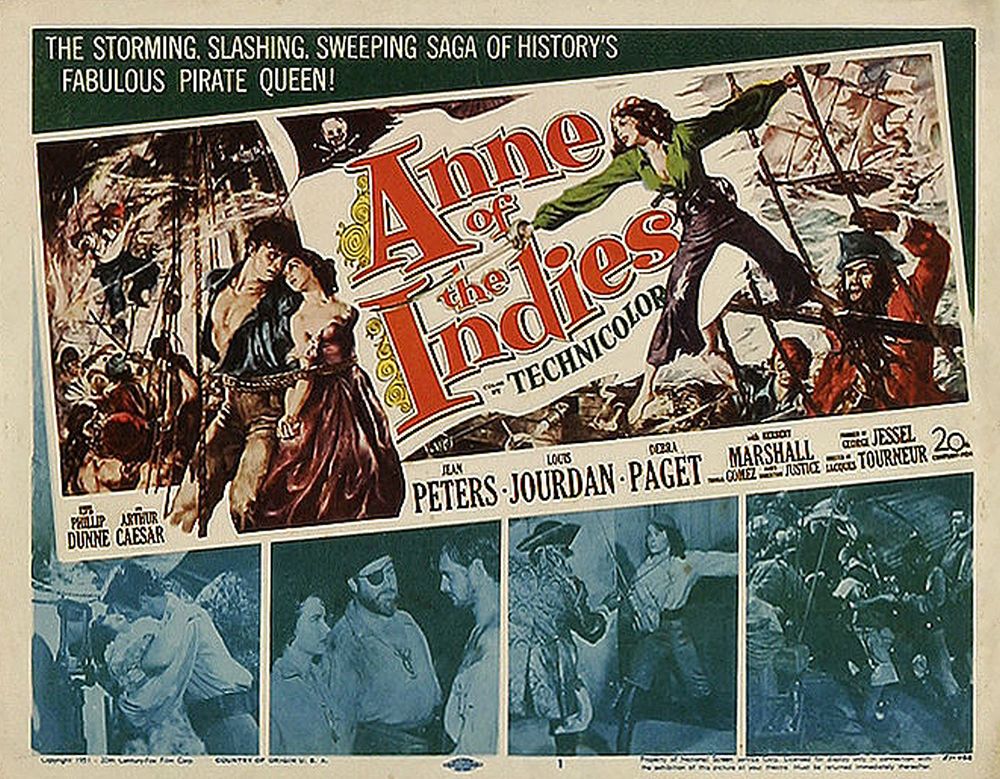
Anne of the Indies

★★★★
“Timbers well and truly shivered.”

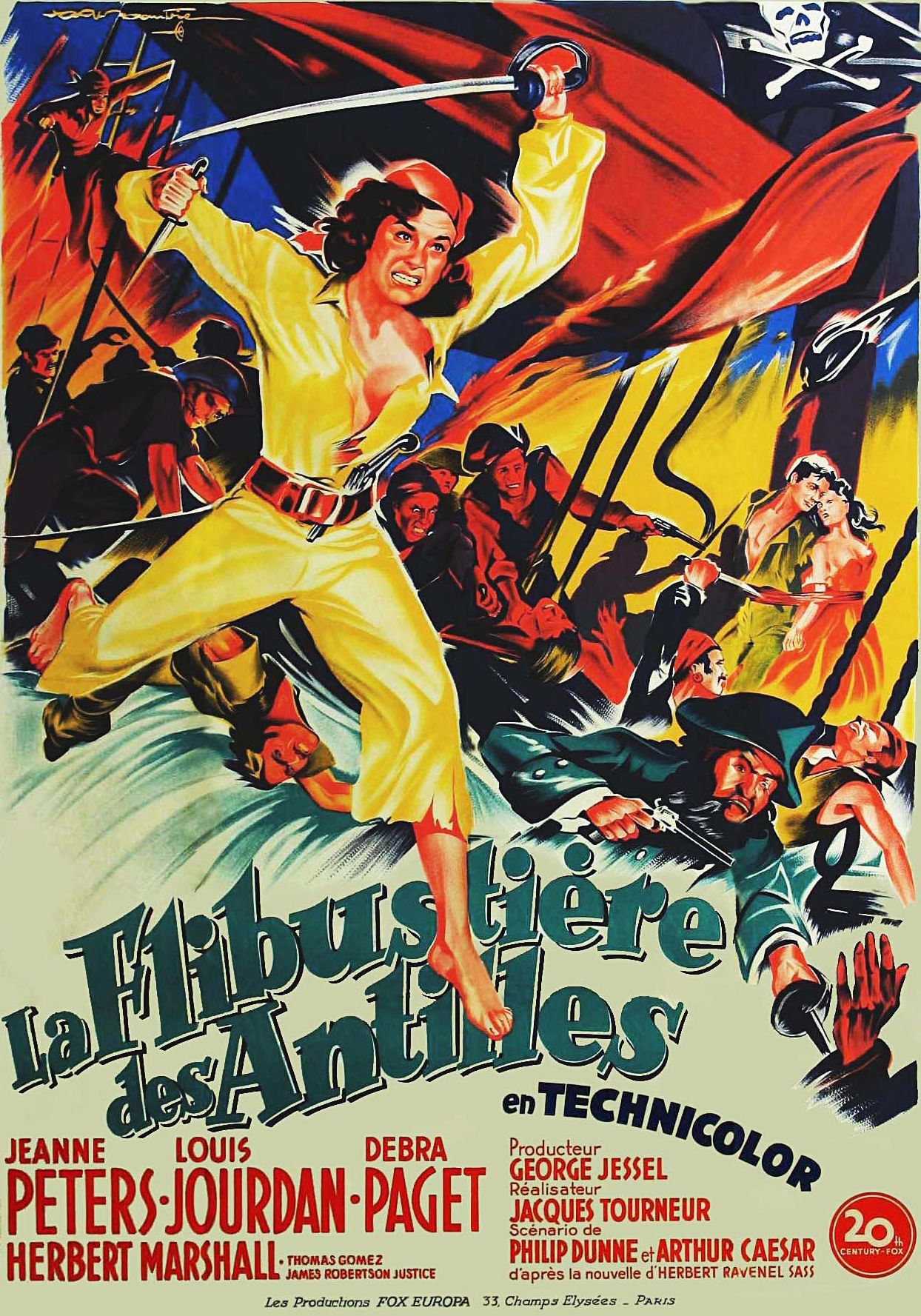
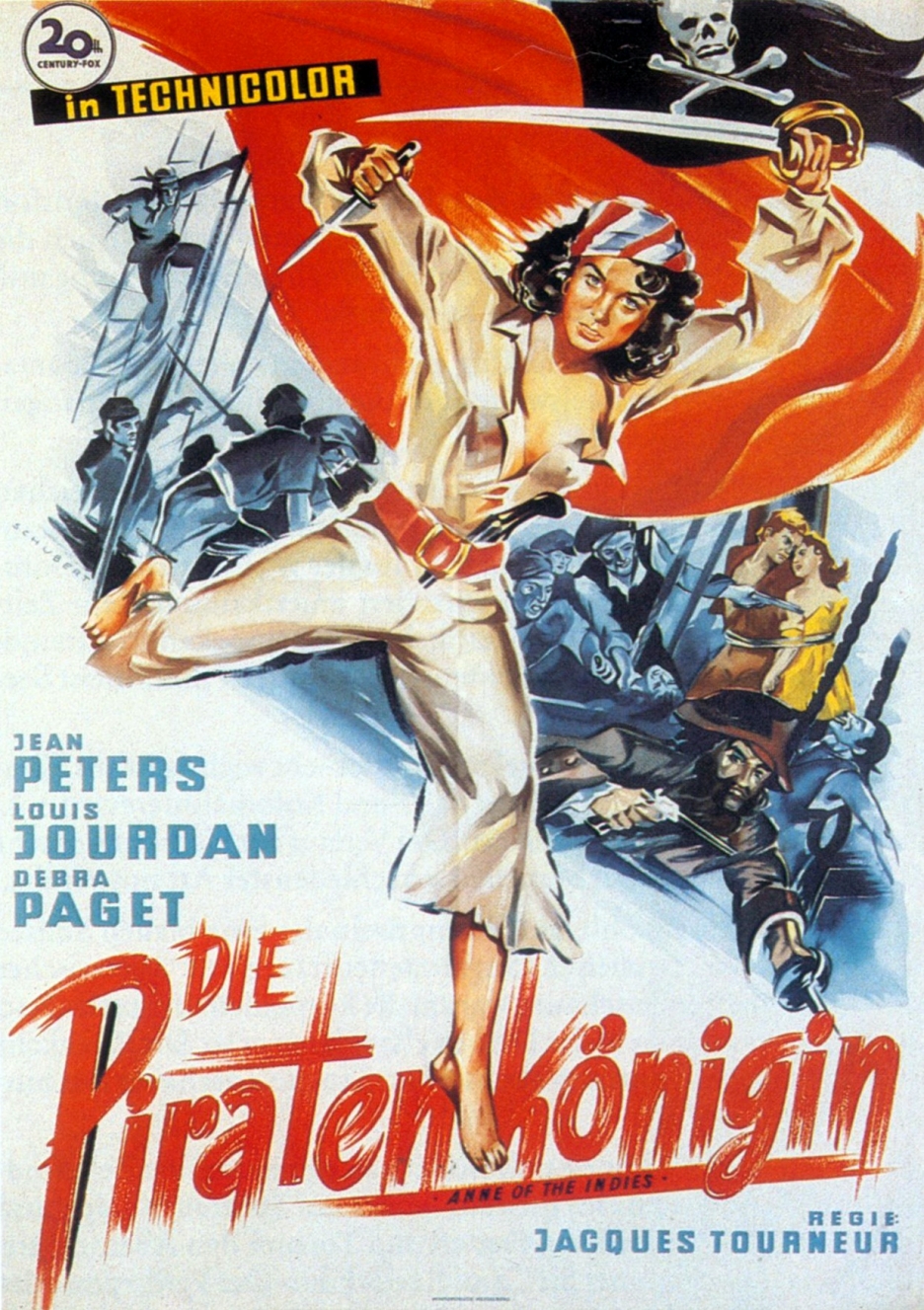
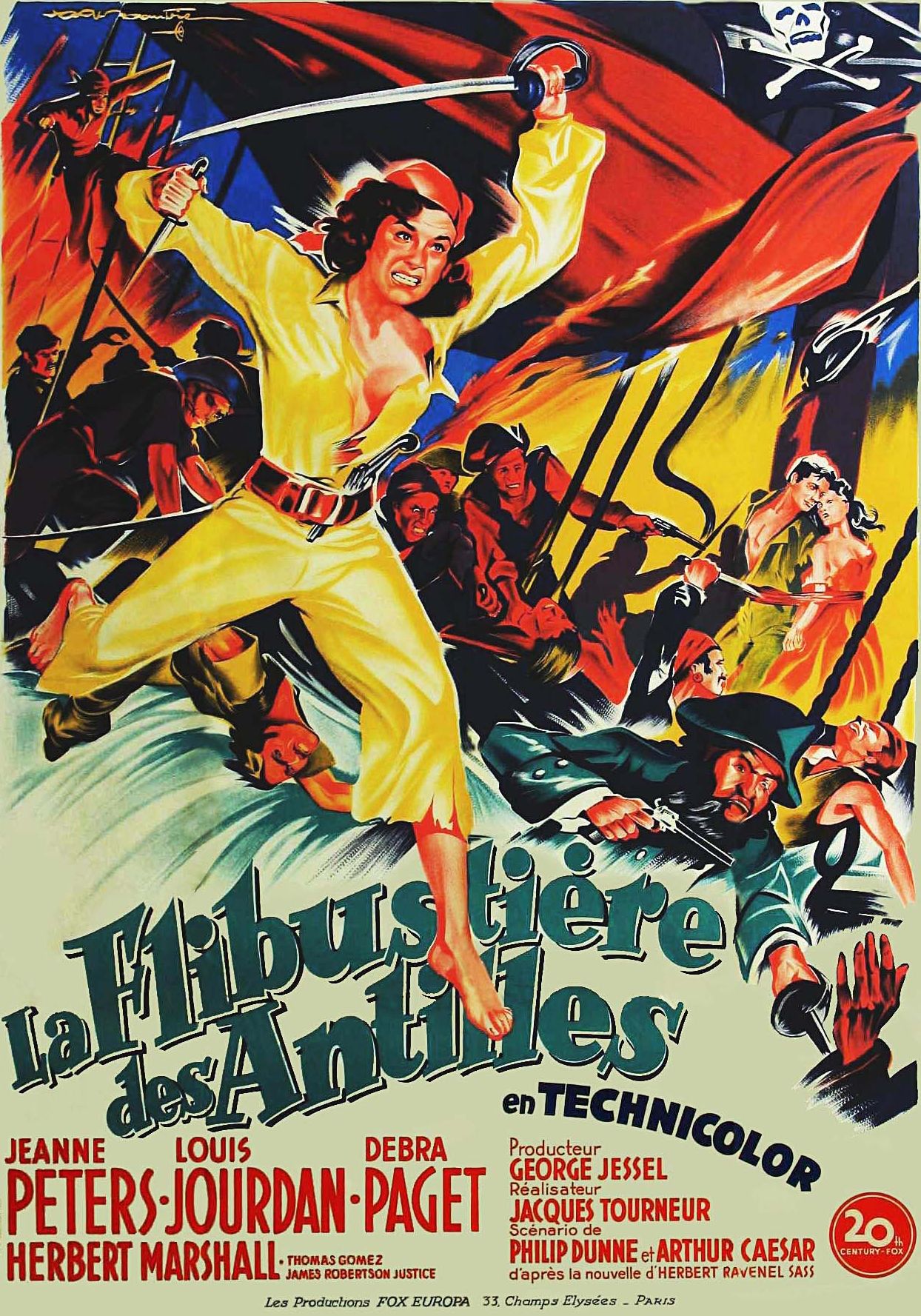
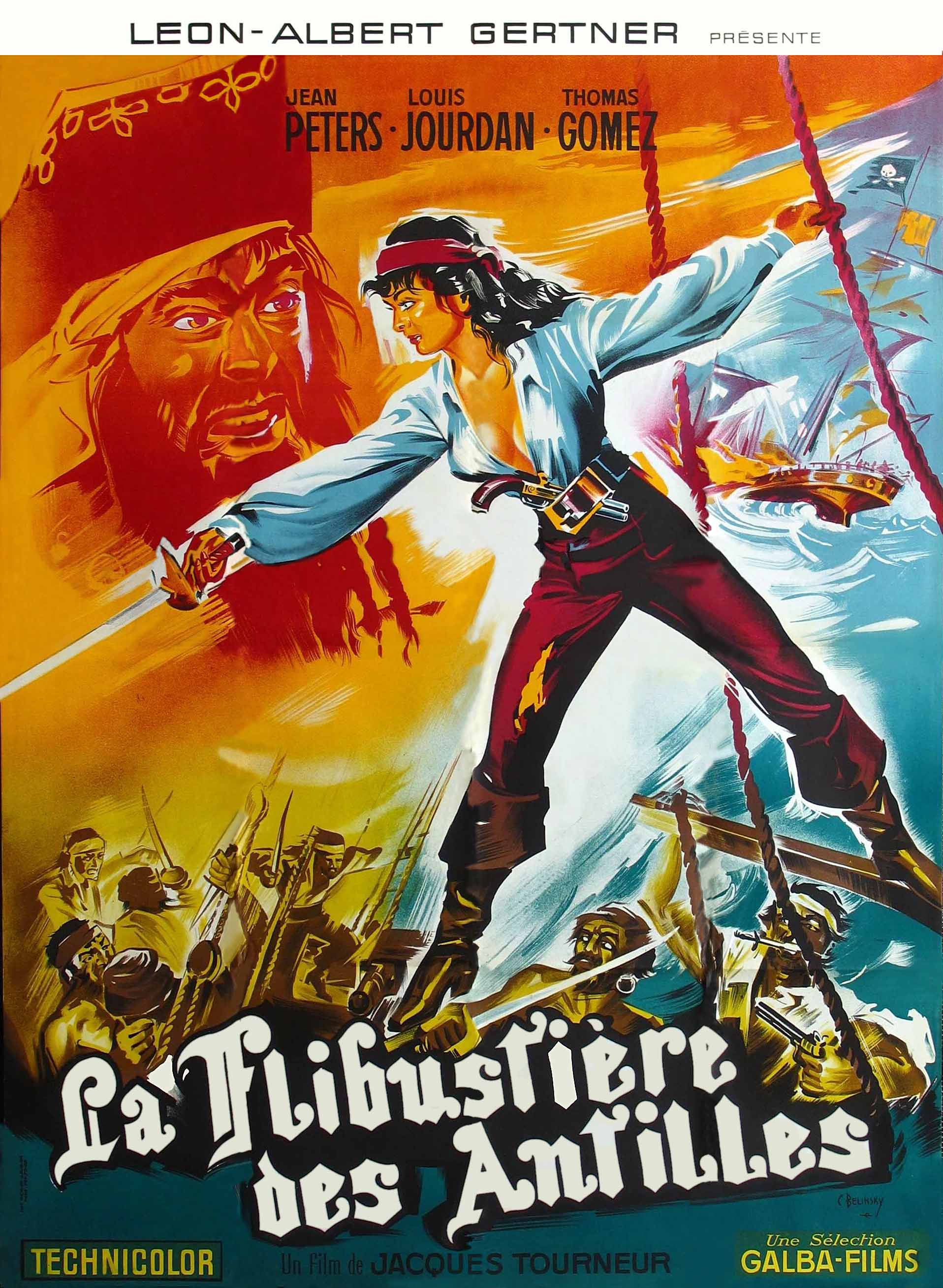
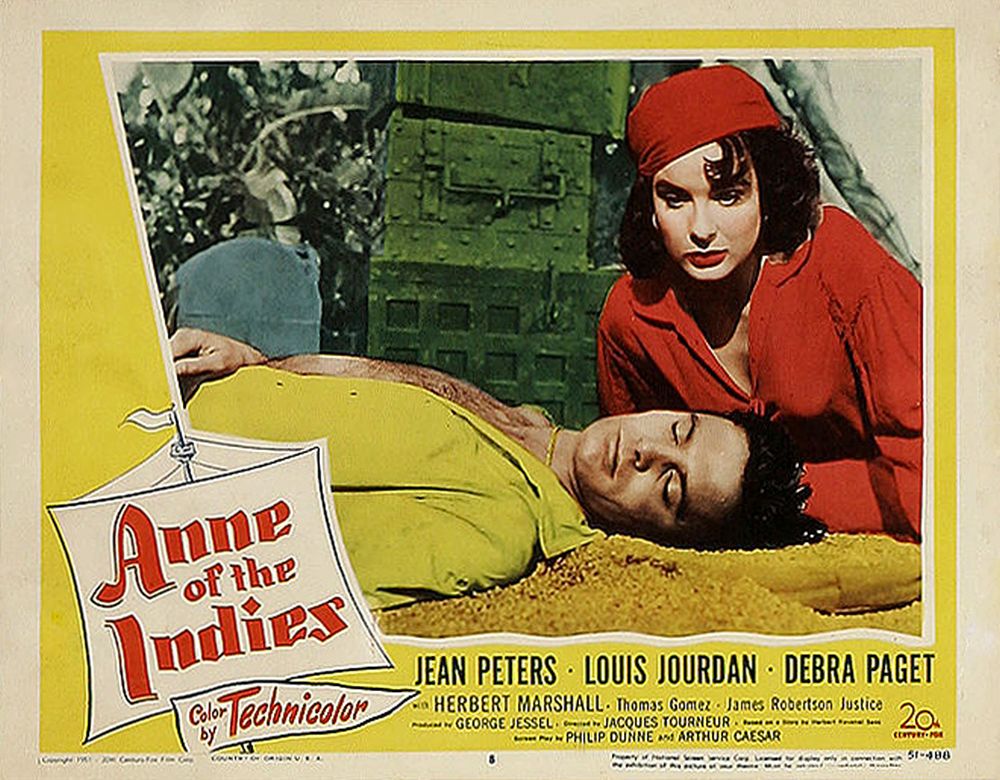
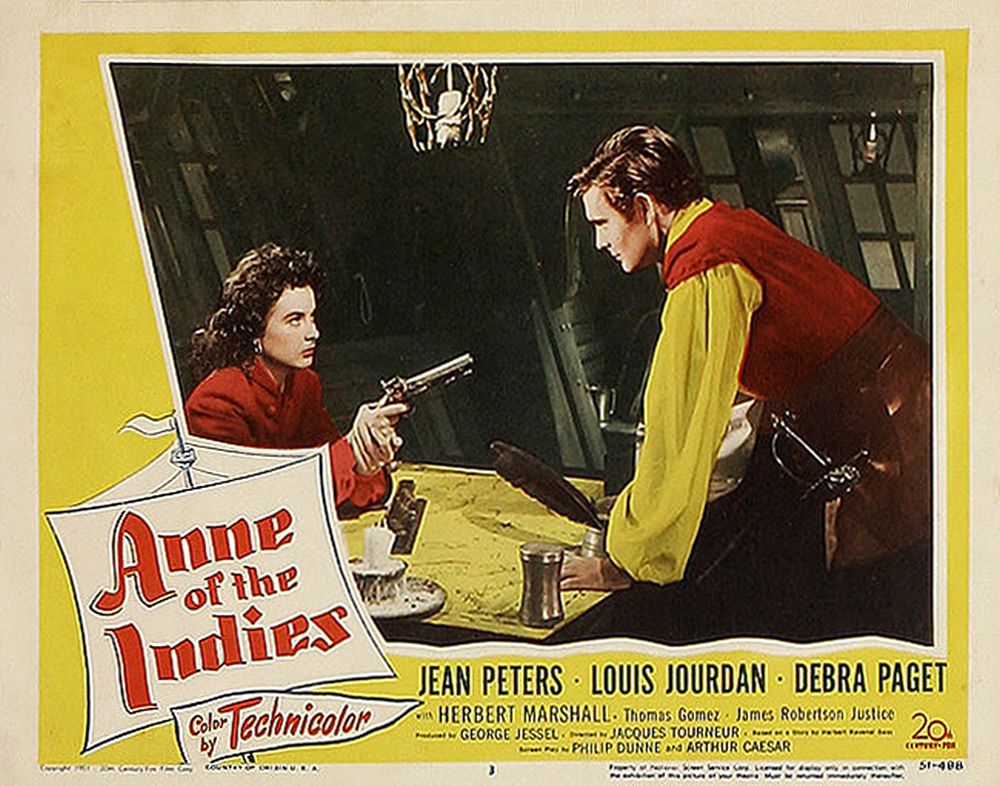
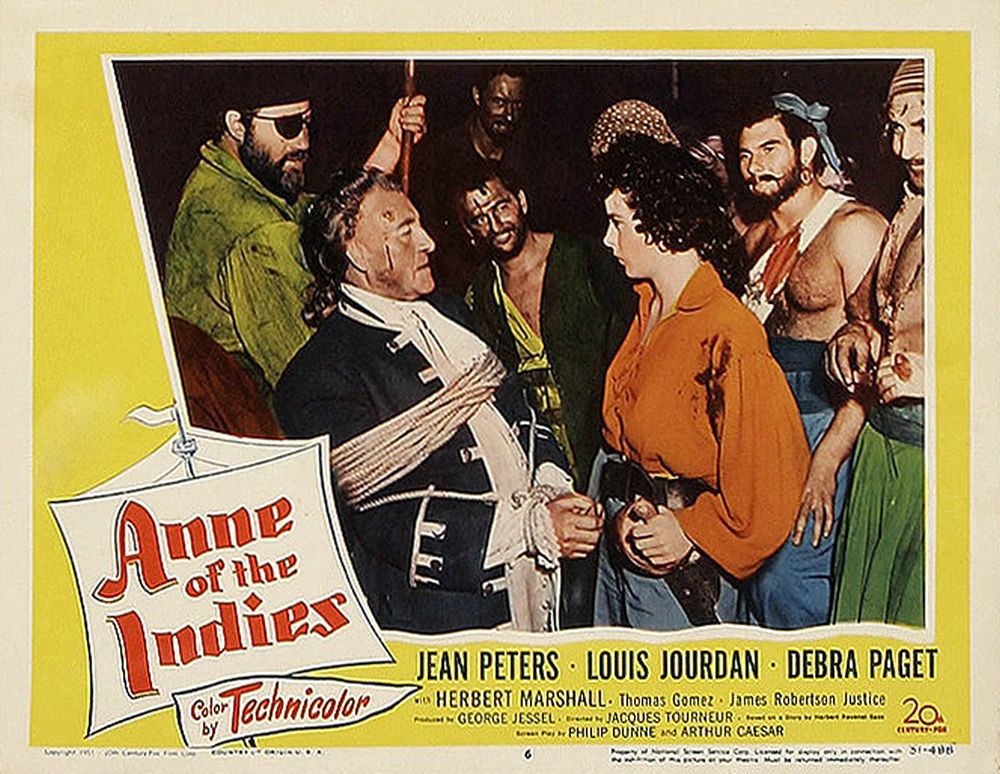
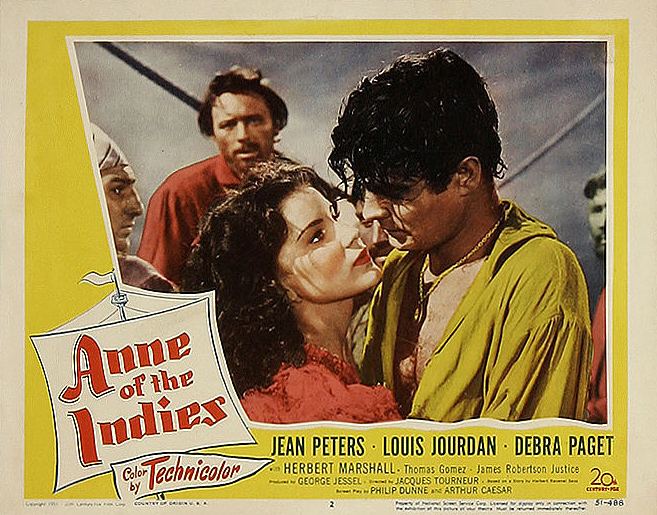
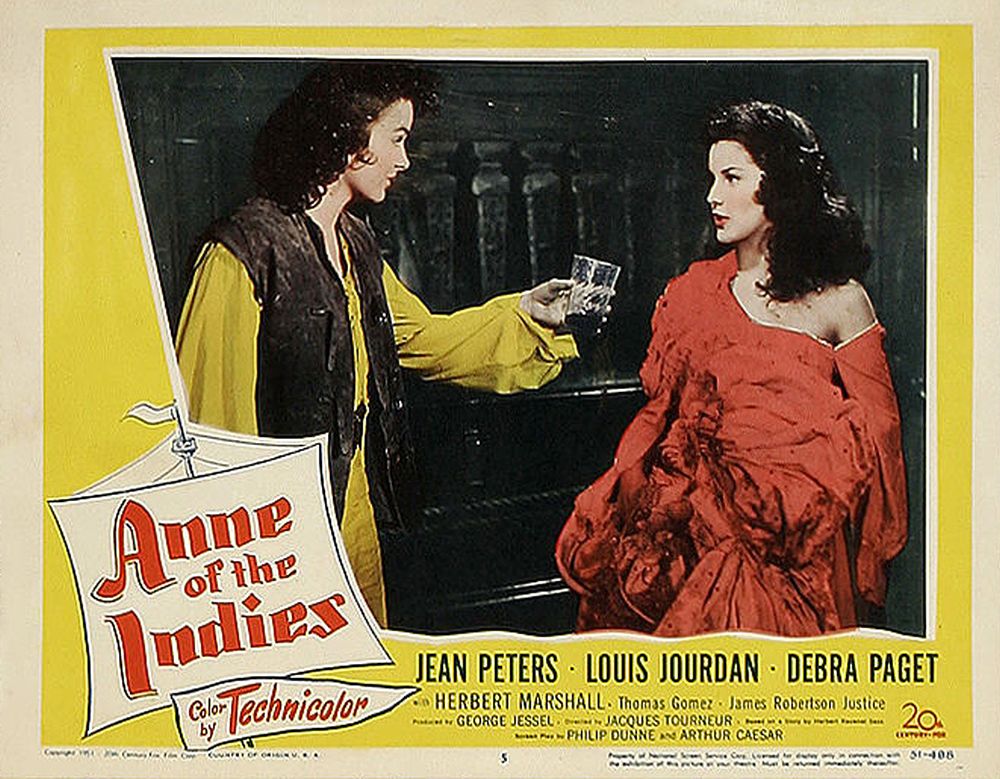
anne of the indiesStrikingly ahead of its time, this 1951 film looks for a while like it will meander down a well-trod path – woman pirate falls for handsome hero – but ends up going in a completely different direction, and is all the better for it. Captain Providence is the scourge of the seas, the most notorious pirate out there, infamous for a ruthless approach to any British captives. While the latest batch of victims are being made to walk the plank, Frenchman Pierre François La Rochelle (Jourdan), found in chains below decks is spared: he’s startled to discover Providence is actually a woman, Anne (Peters), and accepts her offer to join the crew. He tells her of buried treasure, pointing to which he has half a map; the other half is owned by a resident in the British stronghold of Port Royal, and he’s set ashore to go negotiate for it, while Anne’s ship, Sheba Queen, waits off-shore. Except, it has all been a massive ruse, with La Rochelle actually working for the British, after they captured his vessel. Hell hath no fury like a woman pirate scorned: Anne kidnaps Pierre’s wife, with the intent of selling her into white slavery. Can he get her back?

What’s particularly effective here is the second part of the film, after Anne realizes she has been duped. Conventional plotting would have her abandoning her own career and continuing to chase after Pierre. Not here: her response is basically, “No, fuck you“, doubling down with the intent of extracting personal vengeance, by kidnapping his wife and selling her into slavery. Though as one review points out, “The fact that there were not many – indeed, probably not any – Arabs wandering around what is now Venezuela in the 1710s trading in fallen European women isn’t allowed to get in the way of this storyline.” This Anne, who lets her quest for revenge consume her over the latter half, is a fascinating character, even if, naturally, morality has to win out in the end. Her conscience, personified throughout by the ship’s doctor (Marshall), must awaken, allowing for a finale offering redemption through heroic sacrifice. But considering when this was made, it’s arguably even more transgressive for its time than the ending of Thelma & Louise.

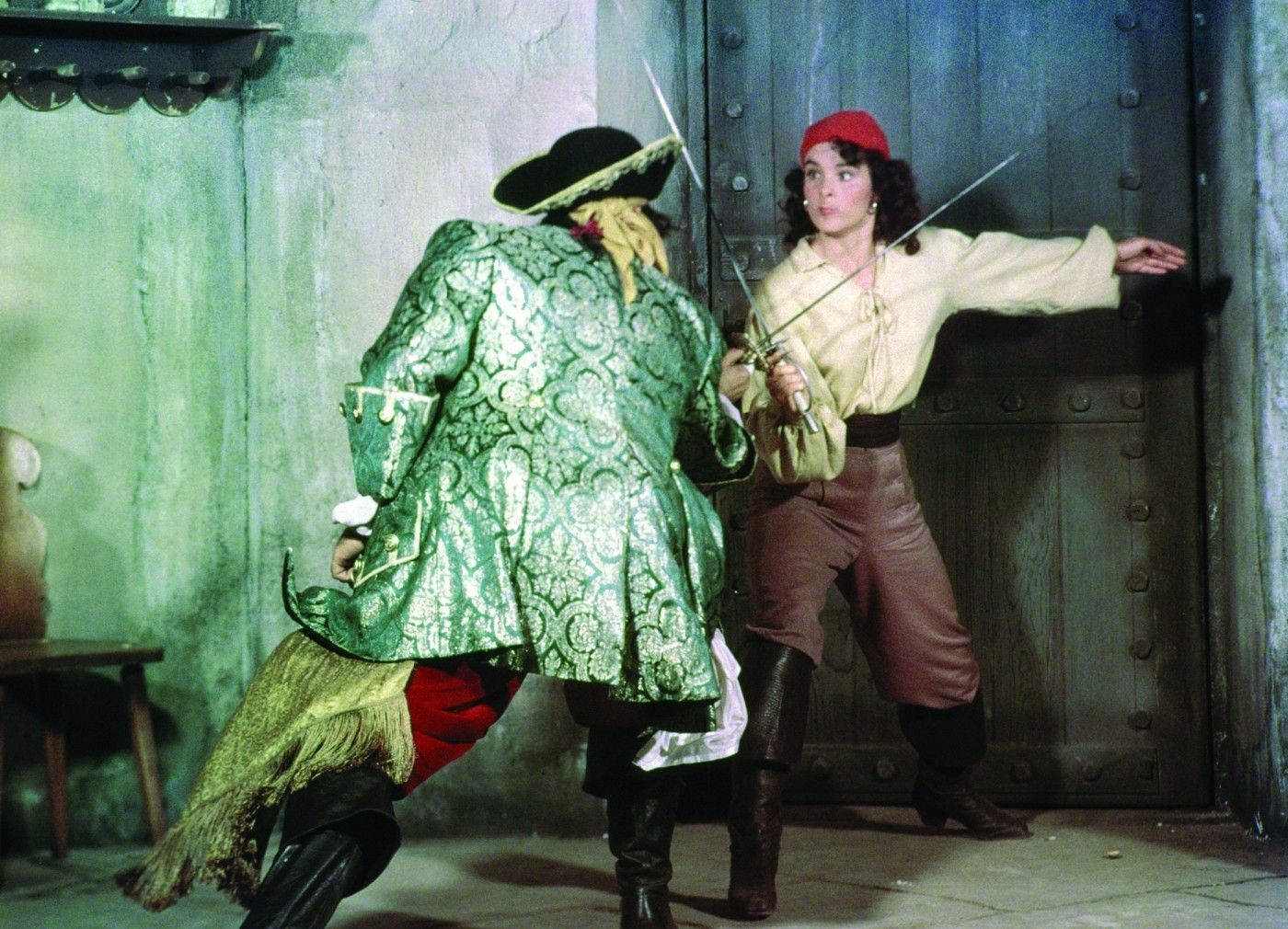
The other outstanding feature is Peters, who handles herself particularly well, giving the impression of knowing what she’s doing. This is particularly the case in a (semi-)friendly bit of swordplay between Anne and her piratical mentor, Blackbeard (Gomez). You’re not expecting much, since the former is a heroine in a 1950’s movie and the latter looks to have the range and mobility of a sofa. But it’s really good: it might have been undercranked, but it still looks lightning-fast and genuinely skilled, doing a good job of establishing Anne’s credentials as someone to be feared and respected. Director Tourneur is best know for his classic RKO horrors, such as the original Cat People and I Walked With a Zombie, but shows that his talents were not limited to black and white chills, and work just as well on these wide open, Technicolor seascapes. The quality here is virtually across the board, with the exception of James Robertson Justice’s highly-dubious Scottish accent, and has certainly stood the test of time.

Dir: Jacques Tourneur
Star: Jean Peters, Louis Jourdan, Herbert Marshall, Thomas Gomez

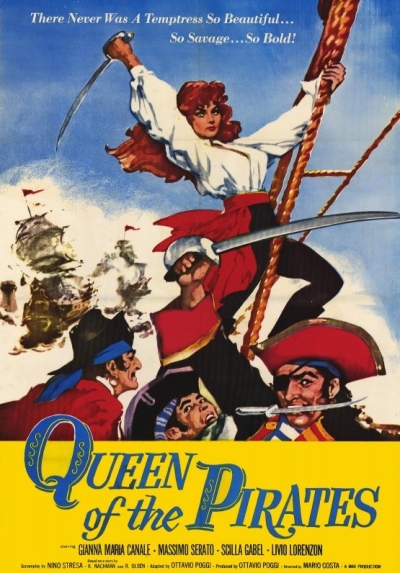
The Queen of the Pirates

★★½
“Court in the act.”

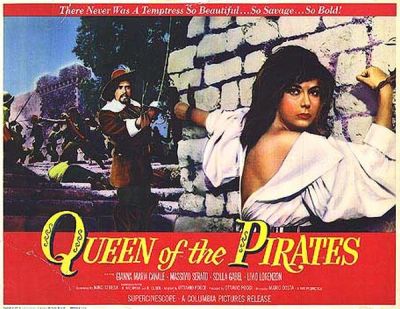
queenofthepiratesSandra (Canale)  and her father fall foul of the local tyrannical Duke (Muller) after they refuse to pay his excise duty. Arrested, the arrival of the poor but noble Count of Santa Croce, Cesare (Serato), saves them from death – or a fate worse than in Sandra’s case, as the Duke has a profitable sideline, shipping local girls off to the Middle East. After escaping, they join up with a local pirate band, who agree to help target the Duke after Sandra bests their leader in sword-play. To gain the hand of the duke’s daughter, Isabella (Gabel), Cesare agrees to hunt down the “Queen of the Pirates” who has brought trade to a standstill, not knowing that his target is the same woman he helped save, and since then has had a secret longing.

Its storyline is more than slightly similar to the other Italian piratess movie we also covered here, Queen of the Seas, from the following year. This is slightly weaker, mostly because Sandra ends up taking a back seat to the heroic Cesare in the second half, though it benefits from a solid supporting performance by Gabel, who brings a genuine nastiness to her role as the spoiled heiress, who is perfectly happy to endorse Daddy’s white slavery operation, as long as it keeps her in jewels and pretty dresses. The shift in focus from Sandra is disappointing, not least because she can handle a sword pretty well – that’s clear right from the fight against the Duke’s excise-men, and reached its peak during the friendly duel against the pirate king. Really, given the era (1960) and Canale’s provenance as a former runner-up in Miss Italy, it’s genuinely impressive.

queenofthepirates2

From about the midpoint on, it is entirely predictable, and becomes much less interesting as a result, despite some efforts to suggest that Cesare might not really be smitten by the heroine – just pretending to be, in order to lure her in. There’s also some desperately unfunny attempts at comedy, courtesy of his squire, and the English dub appears to have been written by someone practicing for International Talk Like a Pirate Day, spattering every other sentence with gratuitous nautical vernacular. I can’t call it disastrous, and at 75 minutes, doesn’t outstay its welcome; there’s just too much queening and not enough pirating in this for me.
Dir: Mario Costa
Star: Gianna Maria Canale, Massimo Serato, Paul Muller, Scilla Gabel
a.k.a. La Venere dei Pirati