




★★★½
“Faster pussycats who kill, kill.”
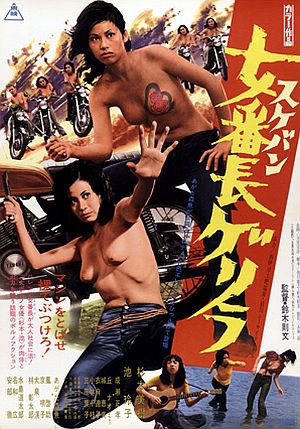 After my disappointing first foray, this is more like it, right from the moment Sachiko (Sugimoto) rips open her top, revealing a heavily-tattooed breast, before she and her Red Helmet Gang of biker chicks kick the asses of another, male gang who are hassling them. It’s clear that Sachiko deserves the title far more that the ‘Delinquent Girl Boss’. She and her crew from Tokyo head off to Kyoto, where they face off against, and end up taking control of, the local girl gang – some of whom are none to happy by this invasion [Kyoto being the former capital, its residents seems to hold a grudge against those from Tokyo]. Sachiko ends up on the wrong side of the local Yakuza, one of whom has a sister, Nami (Ike), who is an independent free-agent girl gangster, affiliated with none, but kinda over-seeing all. Sachiko meets and falls for a boxer, Ichiro (Mizushimi), after he helps her girls out of a tough spot with the Yakuza, and follows him to a seaside resort where he is training. Needless to say, love does not quite conquer all.
I really like the two heroines here, who are just about everything I expected from the genre, combining toughness and beauty, savagery and tenderness. Both actresses are excellent, fleshing out (pun not intended…) what could easily have been no more than shallow stereotypes. What doesn’t sit so well is the strange lurches in tone. Oh, look: here’s a (supposedly) hilarious sequence where one of the girls catches VD from a priest, then deliberately passes it on to the Yakuza! Oh, hold my aching sides… Then, there’s a bit of unintentional hilarity where a Japanese hippie sings a mournful lament to a dead friend, accompanied by his guitar – but the soundtrack is very clearly a piano. Barely have you finished rolling around the floor laughing hysterically at that, then there’s a genuinely nasty torture sequence involving rather a lot of topless whipping, which appears to have strayed in from a very different movie entirely.
This inconsistency of approach makes for a rather jarring experience, as it switches gears like a badly-maintained Model T, and seems at odds with the female empowerment present in much of the film. However, this still remains a pleasing slab of exploitation for the not-easily offended. Below, you’ll find what Youtube calls a ‘trailer’ but is really more a random selection of clippage; however, it’ll still give you an idea of what to expect.
Dir: Norifumi Suzuki
Star: Miki Sugimoto, Reiko Ike, Michitaro Mizushimi
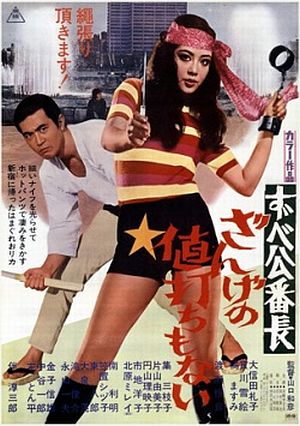 When Rika (Oshida) gets out of reform school, she goes to visit her friend Midori (Katayama), and gets a job working in the garage belonging to Midori’s father Muraki (Ban), even though Midori is estranged from him – except when she needs money to pay off her boyfriend’s gambling debts to the local Yakuza under Boss Ohya (Nobuo Kaneko). Another friend of Rika’s is working in an “art studio”, doing nude modelling to support her sick husband, and still others are hostesses at the Ginza Girls cabaret, a dance-hall which Ohya’s gang are also extorting for protection money. After Muraki has to take a loan using the garage as collateral to pay Ohya, Rika tries to offer herself as an alternative to the boss. This goes about as well as you’d expect, though there’s a genuinely cool twist in which we find someone isn’t quite who we seem. There’s a tragic fatality, which sets the scene for all the girls to get together and take on Ohya’s gang.
 After the abomination that was Part 2, I’d filed the third entry under ‘watch whenever I have time’, until a spirited debate on its merits (or otherwise) broke out on over oun our
 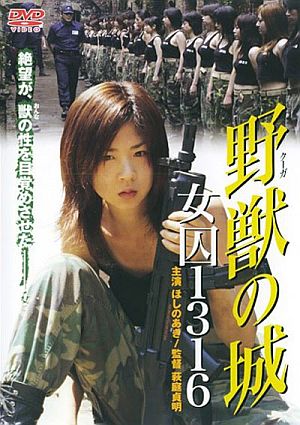 Misaki (Hoshino) is in prison for stabbing a policeman to death, but is taken from her jail to a remote island. There, she joins the rest of the hand-picked prisoners, who are there to be trained by a mysterious government organization, and moulded into operatives who can be used to protect national security. Most of the inmates just want to make things easy, sleeping with the guards in exchange for privileges, but Misaki is made of tougher stuff, and won’t buckle down to the authorities. While she begins plotting how to escape the island, she needs to overcome a number of problems, not least having no idea about where it is, and whether the small boat they stumble across will be capable of getting them to any other land.
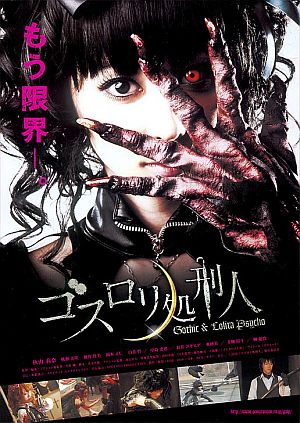 First of all, “Gothic Lolita” is a Japanese style term; Lolita fashion is based on clothing from the Victorian era, and the Gothic sub-genre is…well, suitable for a Victorian funeral, basically. Quite why heroine Yuki (Akiyama) decides to dress like this, after her mother is murdered by a group of five thugs, is never satisfactorily explained. Actually, it’s never even mentioned, putting it alongside the issue of why her father (Yanagi) is apparently a Christian priest, now confined to a wheelchair as a result of the attack. Or where Yuki is now a skilled fighter, armed with a bulletproof, lethal umbrella that can kill you in a variety of ways. Where does she get those wonderful toys, to borrow a phrase.
 S’funny what you stumble across on Netflix, at the end of a long chain of “See also…” recommendations came this, which according to the
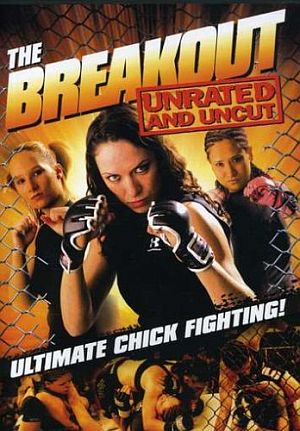
  The shortest match of the night – lasting exactly one minute – was a bit unfortunate, as Shayna Baszler actually broke the arm of her opponent, Samantha Anderson. She was applying a submission hold on the arm, but it seemed that Baszler fell forward, resulting in the pressure being made much worse, and resulting in a clean break of her humerus. Ouch. The opening contest [on the DVD – there was an amateur fight not included for some reason] was the only one that lasted longer than one five minute round, with Marissa Inhofer beating Kirsty Bushnell. As well as being the brother of another MMA figher [Nick Inhofer was on The Ultimate Fighter 3] Inhofer was a roller-derby girl, and seemed to have brought a large contingent of her team-mates with her.
 If you’re going to use a cover like this, you’d better live up to it, even if we can forgive the heels as artistic license. And while not a complete lie, this takes far too long to deliver, and comes up short of expectations. Holly (Kosaka) is a nightclub singer, separated from her husband, who got custody of their daughter due to a DUI Holly got, with the daughter in the car. On arrival at his house to pick up their child for a scheduled visit, she finds him missing – and a gun in the basement, along with a case of drugs. She calls the police, but ends up getting arrested after the police find her husband’s body, and her fingers on the murder weapon, which has mysteriously moved from the basement to the scene of the crime. The drugs have also vanished; while held in jail over the weekend, Holly gets a visit from their owner, who busts her out and insists she return with him and his thugs to the house to show her where they are. Can she escape their grasp, rescue her daughter and find out who the real murderer was?
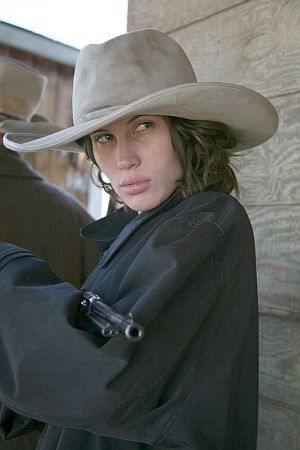 The Asylum studio are infamous for producing ‘mockbusters’ – straight to DVD look-alikes of big-budget movies, designed to benefit from their publicity budgets. These have included their own versions of Sherlock Holmes and War of the Worlds, but they do make their own original works, including cheesy delights such as Mega Python vs. Gatoroid, starring 80’s popsters Tiffany and Debbie Gibson. They come in for a lot of flak as a result – some justified, some not, for this is neither mockbuster nor cheesy, and is surprisingly solid, if you want a straightforward Western tale of revenge. Selina Stevens (Mears) has to watch as her husband and two young sons are killed by Lee Horn (Mead) and his gang; she is brutally raped and left for dead, beginning a decline into alcoholic despair. Having reached bottom, she meets bounty-hunter Frank Allison (Van Dyke), and asks him to teach her how to shoot – conveniently, just as Horn’s crew start to make their way back to town. The townsfolk’s repeated affirmations that they feel safer with Frank around, might have been a bit premature.
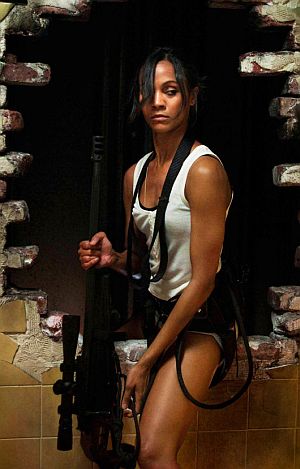 There are moments where this seems to have the potential to break out beyond its story, but once you get past the strong central core, the script has very little to offer. Cataleya (Saldana) narrowly escapes death when her parents are killed on the orders of their gangster employer, Don Luis. She flees from Colombia to Chicago and is raised by a family friend, but never forgets where she came from, and has revenge on her mind. Grown-up, she becomes a hit-woman, but has a side-project of payback. She has an occasional boyfriend (Vartan) who knows little about her, and a dogged FBI agent (James), intent on tracking down the mysterious, elusive killer. Y’know: all the usual baggage that goes along with being an assassin.
 After she gets word, back in their native Russia, that her sister has been killed in Toronto, Karma (Bechard) vows revenge on those responsible. This pulls her in to a seedy, dangerous world of sex trafficking, with women being lured from Eastern Europe to the West, with the promise of legitimate jobs, only to forced on arrival into working as strippers or worse, by the criminal elements who organize and run the business, with a fist of iron. As Karma stabs, shoots and bludgeons her way up the chain of command, those at the top grow increasingly restless. Initially, they think a rival gang is responsible, but the evidence eventually convinces them Karma is, indeed, a bitch,