
A Resistance

★★★
“Not your usual women-in-prison film…”
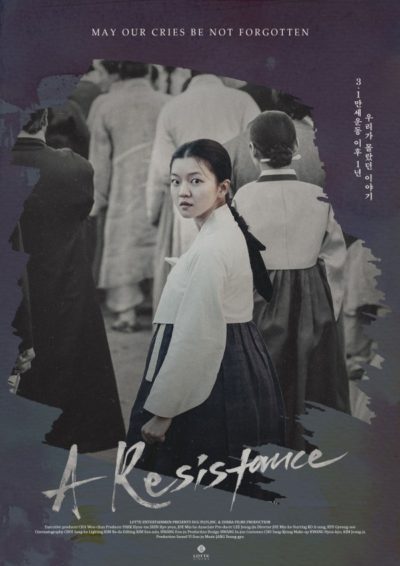
This takes place in 1919-20, when Korea was under occupation by the Japanese [there seems to be quite a lot of this about; I’ve seen a bunch of Chinese movies set when that country was occupied by Japan as well]. Even demonstrating against the Japanese, or in favour of Korean independence, was sternly forbidden, with those taking part likely to be arrested and thrown in prison for months. If they were lucky, that is: an opening caption tells us 7,500 were killed in the protests or died in jail subsequently. Even for those merely arrested, this was not a “nice” prison, to put it mildly, with horrendously over-crowded conditions (24 to a cell!), freezing temperatures and meagre rations.

Once such prisoner was Yu Gwan Sun (Go), 16 years old at the time of her imprisonment: her sentence was three years, due to contempt of court being added on to the normal charge. However, she would not be cowed by the punishment, and refused to bow to the will of her captors – for example, refusing to speak to them in Japanese, even though she could. Such disrespect, and her “defiant face”, inevitably brought Yu into conflict with the authorities, including the warden, and Korean collaborator Jung Chun-young, who acts as a translator. They try to break her will, but her refusal to accept even her status as a prisoner, never mind their authority, remains defiant.

The historical Yu does seem to have been an unrepentant, patriotic bad-ass, sometimes referred to as Korea’s Joan of Arc, and with at least half a dozen films based on her life story. While in prison, she wrote: “Even if my fingernails are torn out, my nose and ears are ripped apart, and my legs and arms are crushed, this physical pain does not compare to the pain of losing my nation… My only remorse is not being able to do more than dedicating my life to my country.” Joe films almost the whole movie in stark black-and-white, save for occasional coloured flashbacks, and music is also used sparingly. This certainly gives a realism to proceedings, though I did feel the portrayal here was a bit too good to be true – putting the “Saint” in “Saint Joan”, if you wish.

It may also be a little restrained, with the tortures inflicted on her coming across as little more than an inconvenience. Perhaps the little things here are most effective, such as the prisoners sharing body warmth, to try and protect a new-born baby. It builds to Yu’s carefully crafted act of defiance, leading a cheer for Korean independence which flows through the prison and to the outside world, triggering further anti-Japanese protests. Even after her fellow inmates are released, she is kept in jail: the final lines of dialogue are an exchange that sums up her obstinate refusal to give up. Asked “Why must you do this?,” Yu almost shrugs: “Then who will?” [She died at age 17, still in jail, a few days before her scheduled release date.] This shines a light onto an area of history I knew nothing about, though I’m hard pushed to say it illuminated much more than the heroine.

Dir: Joe Min-ho
Star: Go Ah-sung, Ryu Kyung-soo, Kim Sae-byuk, Kim Ye-eun
Whore and Policewoman

★★★
“We prefer the term ‘sex worker’ these days…”

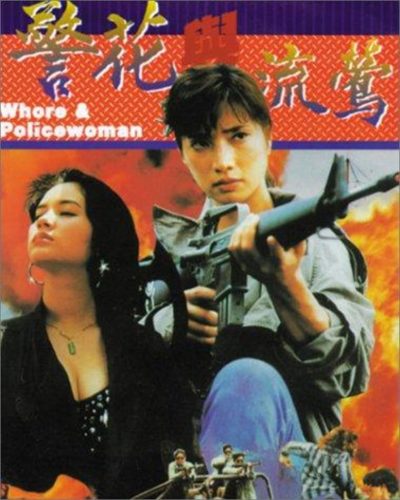
If the title is more than a bit blunt, it’s certainly accurate. May Lin (Cheng) is a brash hooker, who runs a sideline in blackmail videos with her flatmate, Nana. But one night she comes home to find Nana near death, the victim of a brutal client. She tells the police about the video, but before she can give it to them, the perpetrator – rich and influential politician, Kao Tien Chin (Cho) – sends an army of beige trenchcoat wearing killers to take care of both Nana and May. The former succumbs, but the latter escapes and goes on the run. With the police force apparently leaking like a sieve and the case being shut down from on high, prosecutor Yin Li Shan sends his niece, Nancy Cheng (Mishiwaki), to link up with May and bring her in. But they’ll have to get past the trenchcoat mafia, among other threats, for there to be any hope of justice.
This is relatively late in the Hong Kong GWG cycle, and is rougher than most, in more ways than one. There is a nice character arc for May, who initially seems intensely dislikeable, but ends up fiercely loyal to her protector, after realizing the extent to which Nancy will go – literally taking a bullet for the prostitute. This is harshly demonstrated when May lets herself be gang-raped, to save the injured Nancy from that fate. While not in any way explicit, it’s a tough sequence to watch, May mouthing “Go away” to Nancy. Of course, there’s the usual bonding in the middle between the mismatched pair, as they realize neither deserves the scorn with which they view each other.

The plot is more than a little flimsy, with any number of points at which things could easily have been resolved. There are some remarkable moments of coincidence too. For instance, after escaping the trenchcoaters (in a rather risky-looking stunt, involving a plummeting jeep and a giant fireball), seconds later in screen time, May and Nancy bump into them again at a train station. Similarly, the rapists are coincidentally re-encountered, giving our heroines the opportunity for revenge. However, in both cases, the results are a solid bit of one versus many action, in the interesting environments of a train carriage and a food court respectively, so we’ll let it slip.

I do wonder if Nishiwaki was injured during shooting. Because when it comes to the final confrontation, at a party in Chin’s offices, Nancy is replaced by another character for the last battle, without explanation. It’s not a stand-in, it’s a completely different actress in a separate, unnamed role. Very bizarre. This may also have been the final movie of Nishiwaki’s Hong Kong career, which would lend support to the “major injury” theory. All told, this is decent enough. Not all of it works (though the crappy English sub job doesn’t help), yet a sufficient quantity does, and with acceptable pacing to ensure the viewer is never bored, at least for too long.

Dir: Kuo-Chu Huang
Star: Yim Lai Cheng, Michiko Nishiwaki, Hoi-San Kwan, Charlie Cho

Lady of the Law

★★★
“I am the law…”

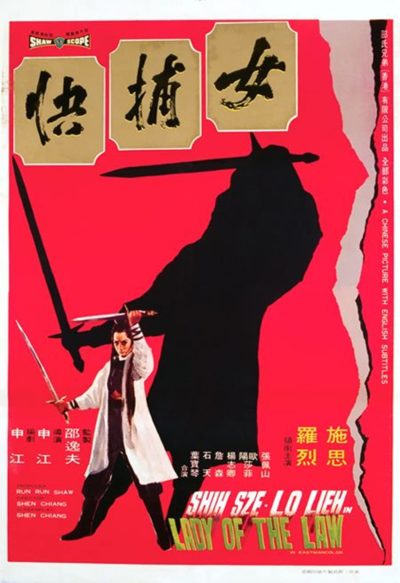
I kept moving between 2½ and 3 stars for this. It is pretty chatty, and the focus is not as much on the title character as I might have hoped. But there’s no denying that Leng (Shi) is a very solid character, and when she gets her chances to shine, does so in a memorable fashion. This is nowhere better illustrated than her final battle, where she takes on an enemy – who just tried to molest Leng, believing her drugged – while they both balance on a tight-rope. There’s no particular reason for the fight to take place in such an environment. The ground would have been perfectly fine. But it adds an extra dimension, and the way it’s filmed makes it feel surprisingly possible that they were wobbling about up there.
To get there is, however, quite a process. There’s a rapist going about China, but when he eventually escalates to murdering the concubine of a high official, something must be done. That something is Leng, a smart and persistent officer of the law. However, the real rapist, Chen (Shek), and his rich father frame Jiao (Lo) for the crime; he flees, with Leng in pursuit. The Chens seek to make sure Jiao can’t testify. They also seek to sideline and silence an incriminating witness – a blind man who can identify the rapist by his voice. As a result, he could both exonerate Jiao and pin blame on the real culprit.

Once this gets going, it is, however, mostly a pursuit, with Leng tracking Jiao across the countryside. The best sequence likely has him hiding out in a palace whose owner has a massive harem of Warrior concubines. They’re… quite pleased by Jiao’s arrival, but their owner refuses to help Leng in her quest, unless she can defeat the entire harem. It’s a nicely staged sequence, which must have required Shaw Brothers to hire just about every woman at the time in Hong Kong, who knew how to operate the business end of a sword. On the other hand, Lo is top-billed for a reason, and definitely gets a good slab of screen time, despite the title of the movie. 

There’s even a prologue where we discover the same men who framed him was responsible for the death of his father, and the child Jiao was only saved by the intervention of the child Leng. This doesn’t add much to proceedings, and can safely be ignored. The same goes for Jiao’s secret mastery of the Flaming Daggers technique: demonstrated, the completely forgotten. I’d rather have seen the time used to develop Leng’s story, such as the intriguing relationship with her white eyebrowed, Taoist mother. Shih apparently took over at Shaw Brothers as their star, after Cheng Pei Pei moved to California in the early seventies. This, which I’ve read sat on the shelf for several years, is the first film of hers I’ve seen (outside of bizarre Shaw/Hammer co-production, The Legend of the 7 Golden Vampires). However, there was enough here to make me interested in finding some of her other work.

Dir: Siu Wing
Star: Shih Szu, Lo Lieh, Chang Pei-Shan, Dean Shek

Kung Fu Girl Fighter

★★½
“Could have been a contender.”

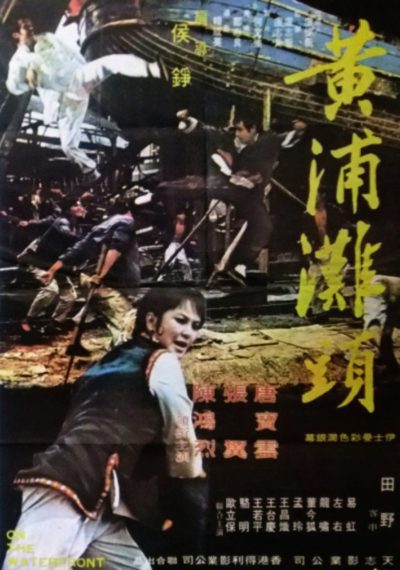
Yeah, I think if I’d seen this under the alternate title of On the Waterfront, I might well have passed it by. Though that is probably a slightly more accurate description of the contents here, even allowing for the complete absence of Marlon Brando. [At least we didn’t have to deal with the expectations set by the Italian title, which translates as “The merciless hand of Bruce Lee strikes again”!] It takes place around the Whampoa wharves in Shanghai, where various crime families are jostling for position and control, with varying degrees of morality e.g. whether or not they approve of drugs and/or sex trafficking as a means to make money. Particularly of note here are Red Rose (Tang) and Zhou (Chang), who eventually end up allies against their common enemy (Chen).

Key word: eventually, as we take a meandering route to that final 15-20 minutes, where things seriously kick off. Up until then, it has been fairly low-impact. During the first half, there’s only about one good fight, Rose (or Red? I’m not sure what to call her) fending off a slew of attackers seeking to return Zhou’s gambling winnings to the casino. At the half-way point, there’s also a restaging of a scene from the same year’s Fist of Fury, where Bruce took exception to a “No Chinese or dogs” sign in a park. Rose goes berserk on seeing park guards beating up Chinese kids. Otherwise though, it’s mostly plot-based shenanigans, before the admittedly somewhat impressive finale.

However, the print circling YouTube, Tubi and Amazon Prime is flat out wretched. While it’s okay in terms of cropping, it’s so badly faded that it looks more like a pastel watercolour than a portrait of a vibrant port. There are also appears to have been some censorship issues in this English dubbed version. Another review refers to “a superbly sensual bath-house murder scene,” which is entirely missing. The last fight may also have suffered, the villain’s dozen or so henchmen apparently evaporating into bodies on the dockside without any visible action from Rose and Zhou. I suspect a decent, uncut (and, ideally, subtitled) edition might well get at least a half-star more.

Tang’s approach is relatively static in comparison to her co-star. She seems to have been more a dramatic actress, who while still a teenager, won the Best Supporting Actress award at the first ever Golden Horse awards, Taiwan’s top film honour. This straightforward plateful of chop-socky would therefore appear a bit of an aberration, yet Hou shoots her moves well enough they pass muster. It may also explain why the dramatic elements are perhaps a little better than normal for the “straightforward chop-socky” genre, though of course are also impacted by the dubbing. Still, her passionate rage during the park scene does still come through, and it’s a bit of a shame she apparently did not pursue further endeavours in the same line as this.

Dir: Cheng Hou
Star: Bao-Yun Tang, Yi Chang, Hung-Lieh Chen, Tien Yueh
a.k.a. On the Waterfront

Prey

★★★
“Prey to win.”

The latest entry in the Predator franchise has resulted in sharply divided opinions, partly for reasons that I’m not even going to get into. And, for roughly the 11th millionth time, the reality lies somewhere in the middle. It is probably the best entry in the franchise since Predator 2. However, let’s be clear: Sharktopus vs. Whalewolf would also satisfy that criteria. So, let’s dig in. The year is 1719, and the Northern Plains see a new arrival, in the form of an extraterrestrial visitor, looking to test its mettle against any species unlucky enough to cross its path. They could be animal, or human – the latter include both French trappers and the local Comanches.
The heroine is Naru (Midthunder), a young woman who wants to join her brother, Taabe (Beavers), on the tribe’s hunting parties. He and the rest of the tribe are reluctant to let her, preferring to make use of her skills as a healer. However, after they encounter the Predator while hunting a mountain-lion, Naru sneaks off to hunt it on her own, seeking to prove her skills. It’s not long before it becomes clear she has her hands full, simply trying to survive in the treacherous wilderness, and avoid the trappers. Never mind taking on a vicious creature from another planet, in possession of technology far in advance of what’s available to Earthlings, and with a fondness for ripping spines clean out of their owners’ backs.

It’s certainly a fresh and original setting,  especially for a SF/action movie, and I’d say the makers deserve credit for using native actors across the board. I will admit to rolling my eyes at some of the early attempts to position Naru as a rebel, which felt severely like the imposition of modern traits onto a historical setting. “Why do you like to hunt?” “Because they think I can’t!” Yeah, you almost get killed. Twice. They have a point. However, once she leaves the camp and sets out on her own journey, the movie hits its stride. By the time the trappers find they are no longer the hunters, but the hunted, it’s clear Naru will need to think outside the box of standard tactics in order to win. You’ll probably have figured out the key, as soon as she mentions that a certain medicinal herb “cools the blood”…

I can kinda see why it went direct to streaming, since some of the CGI effects are of the low-rent variety, and I suspect it was a lot cheaper than the $88 million cost of its predecessor, The Predator. On the other hand, it doesn’t skimp on the old ultraviolence, and that’s the way a Predator movie needs to be. It has to be said, this seems a particularly dumb example of the alien species – fortunately for Naru. It never seems to see her as a threat until it’s too late, clearly being sexist as well as extraterrestrial. Maybe a future installment could feature a female Predator… With all of history now officially in play, the possibilities are almost endless. While still imperfect, credit is due to the makers, for taking a franchise that seemed potentially on its last legs, and giving it new life. 

Dir: Dan Trachtenberg
Star: Amber Midthunder, Dakota Beavers, Michelle Thrush, Stormee Kipp

7 Women From Hell

★★½
“Circling hell”

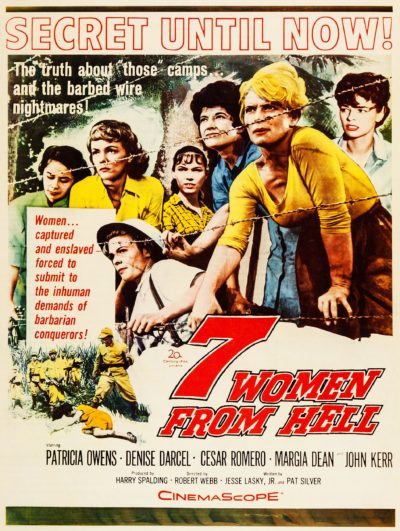
About the only review online I found for this, said it “may be the worst movie released in 1961.” I can only presume the writer of that statement has never seen The Beast of Yucca Flats. Even if I admit its weaknesses, Seven is nowhere near the same league of badness. Indeed, it starts off well, depicting the sudden invasion of Papua New Guinea by Japanese forces in 1942, with “enemy” civilians being herded into interment camps. The ones on the women’s side are a multi-national bunch, including Australian Grace Ingram (Owens), several Americans including Janet Cook (Craig), a German widow Ann Van Laer (Sylvia Daneel), Frenchwoman Claire Oudry (Darcel), and mixed-race nurse Mai-Lu Ferguson (Pilar Seurat). 
Initially, life is just about tolerable, with the camp commandant being mostly reasonable. But after he is killed in a bombing raid, his sadistic deputy takes over. When one of them knocks out a guard who tried to rape her, the women escape with the help of the camp doctor. But life on the outside is little better, especially with the Japanese in pursuit. Let’s just say, it doesn’t stay at seven women for very long. Without a compass, their odds of finding their way to safety are slim. Fortunately, they come across a downed American airman who has one. The bad news: he tells them their intended destination has already been abandoned. Then they meet the estate of German-Argentinean farmer Luis Hullman (Cesar Romero). Though is he as friendly as he initially appears to be?

It is important to realize this is very much a product of its era, when Hollywood was supremely disinterested in action heroines. We were still several years before even the arrival of Honey West on televisions, and there were few cases at the time where a female-led story-line would not be driven primarily by romance. It’s on that basis that the rating above has to be seen, cutting it some slack for the time in which it was made. By modern standards, sure, it’s fairly weak sauce. But the climax, where the women discover the truth about Luis and take action, feels progressive for the time. These women are – again, for the era – remarkably independent. They don’t need to be rescued by men: indeed, they’re the ones doing the rescuing of the airman.

The weakness is mostly on the character front, as outside of their nationalities, the protagonists are not given anything like an adequate amount of depth. The script doesn’t seem to know what to do with them once they are outside the confines of the prison camp either, at one point resorting to a bathing scene which had me rolling my eyes at the indignity of it all. Credit for not making the Japanese irredeemably villainous, though I’m not convinced the shooting location of Hawaii is an adequate stand-in for Papua New Guinea. Definitely not the worst movie released in 1961, by quite a considerable margin.

Dir: Robert D. Webb
Star: Patricia Owens, Denise Darcel, Margia Dean, Yvonne Craig

The Woman Who Robbed the Stagecoach

★★½
“A tale of daylight robbery.”

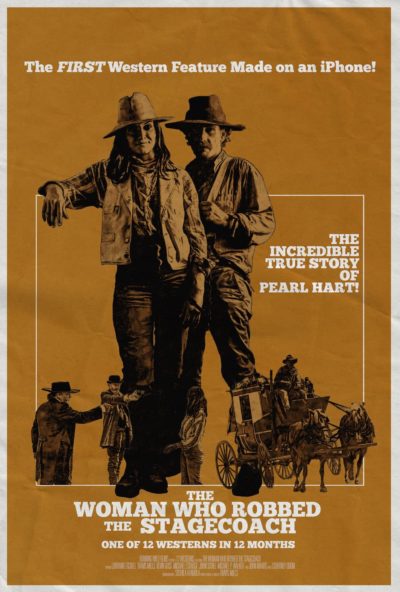
There are a couple of points to note going in. This was one of “12 Westerns in 12 months”, a project run by the director during 2020. It also proudly pronounces itself as the first ever Western feature to be shot entirely on an iPhone. Both of these do lead to limitations. The sheer speed involved obvious has an impact, and I can’t help wondering if a more measured approach would have been better for the end product. As for the iPhone… Well, on the plus side it looked perfectly watchable on my 49″ television, especially the outdoor scenes. However, the indoor sequences seemed almost too crisp. Especially for a historical production like this, I felt I was expecting a softer look, and I found that a bit of a distraction throughout.
It’s the story of Pearl Hart, a genuine figure from Arizona history, who achieved notoriety by being involved in one of the last stagecoach robberies, at the very end of the nineteenth century (May 30, 1899, to be precise). The movie covers both her life leading up to that point, and the subsequent arrest, trial, acquittal, re-arrest, conviction, escape, recapture, eventual release – according to some, because she managed to get pregnant in jail – and final disappearance into obscurity. Actually, the script basically feels like they took Pearl’s Wikipedia page, and used that as a synopsis. You can virtually tick off the incidents mentioned in it, as they happen during the film. With the character such a blank slate, and so little verifiable information, I’d like to have seen Mills give us something not taken from the first page of Google results.

The positives are mostly from the performances. Mills pulls double-duty as Hart’s accomplice, “Joe Boot”, about whom next to nothing is known. That does allow some freedom, and Root is made into a European miner, who is largely obsessed with Pearl and prepared to take the fall for the robbery on her behalf. I did like Etchell’s portrayal of Pearl, a woman who has been fighting an uphill battle almost her entire life, and tries to make the best of her situation – often by morally questionable means, albeit out of necessity. The film also shot in a lot of the locations around where events took place, such as in Globe, with the Yuma Territorial Prison standing in for Tucson’s jail.

It’s unfortunate that the limited time and budget are often all too apparent. In particular, there’s next to no scope here, with Mills largely forced to keep the camera in close, to try and disguise the paucity of sets, or things like a lack of extras. It really doesn’t work, although it remains a story that should be told, and I’m glad to have heard it. But the almost throwaway nature of the production, combined with the rote nature of the script, does the larger than life character of Pearl Hart a disservice. They should have chosen to print the legend instead.

Dir: Travis Mills
Star: Lorraine Etchell, Travis Mills, Kevin Goss, Michael Estridge

Hell Hath No Fury

★★★½
“Grave consequences.”

I’m quite familiar with the work of director Jesse Johnson, mostly through his collaborations with Scott Adkins, who is probably the best action star you’ve never heard of. Some of their movies together have been top-tier, in particular Avengement, so I was very curious to see what he’d do with a film which – according to the cover – has a female lead. Well, that is slightly misleading in that the heroine does take a back-seat as far the action goes. But there’s still easily enough to qualify here, and she’s definitely not your typical character in a war-time setting like this.

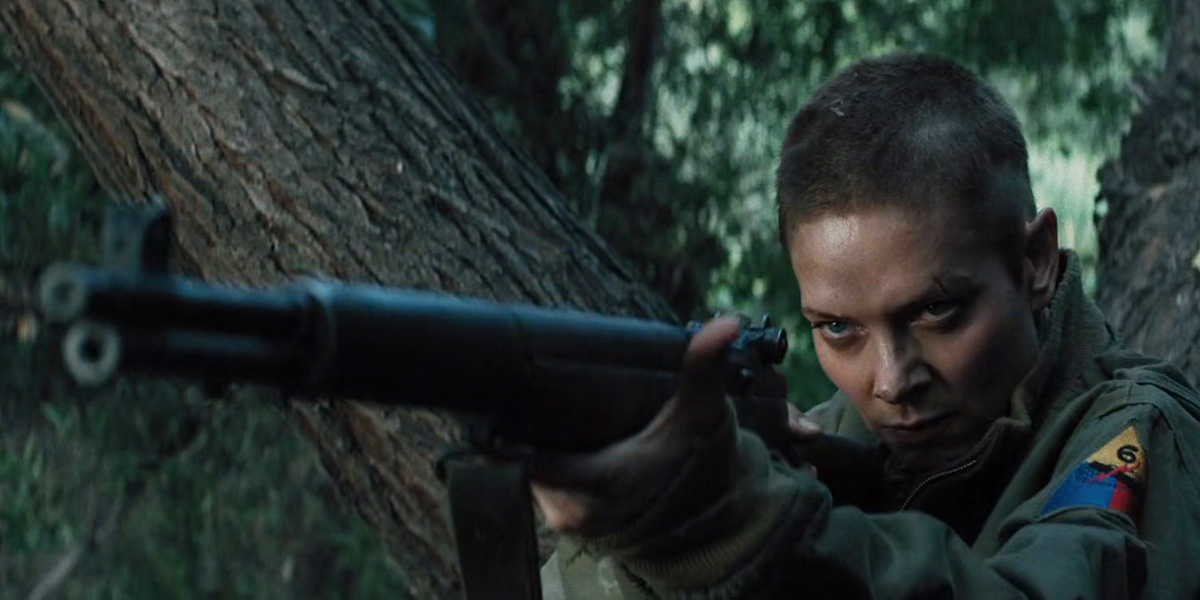
To be blunt: Marie is a collaborator with the Nazis who occupied France. In particular, she was the mistress of S.S. officer Von Bruckner (Bernhardt), until their relationship goes pear-shaped (to put it mildly), and she’s shipped off to Ravensbruck concentration camp. Three years later, with the Allies sweeping through France, she is released and returns to her home-town. They haven’t forgotten her collaboration, so she has her head shaved and a swastika painted on her forehead. Marie is rescued from further indignity by Major Maitland (Mandylor) after playing her trump card, telling him she knows the location of a cache of gold in a local cemetery. However, on arrival there, it’s quickly clear they’re not the only ones after it. The gravedigger wants in, and Von Bruckner is also on his way back, hoping to collect the stash on his way out of the country.

There’s something quite Sergio Leone about this. The cemetery treasure idea is clearly taken from The Good, the Bad and the Ugly, along with the three-way stand-off at the end, and the way Marie tries to play the two sides against each other reminded me of A Fistful of Dollars. This isn’t as stylized, the cinematography is nowhere near as sublime, and it’s largely restricted to the single location of the cemetery. Yet it’s solid enough, and the lack of traditional “good guys” (or girls!) – another similarly to the spaghetti Western genre – is quite refreshing in the context. Everyone here is driven strictly by one imperative: getting the gold for themselves, by any means necessary: no-one is the slightest bit interested in returning it to its rightful owners.

Alliances are formed and dissolved as the Americans, French, Germans and Marie all look to come out on top, though there are nasty surprises for everyone as things unfold, and the Nazi forces arrive on the scene. This leads to an extended gun-battle around the tombstones, and eventually, the stand-off mentioned. I can’t say I felt the ending was entirely satisfying: it didn’t make sense, considering all that had gone before. Giving Marie more to do, rather than simply manipulating her way towards the gold, would have been nice. However, the journey to get there was briskly entertaining, and the freshness of the characters in this particular scenario, also helped sustain my interest with relative ease to the end credits.

Dir: Jesse V. Johnson
Star: Nina Bergman, Louis Mandylor, Daniel Bernhardt, Timothy V. Murphy
a.k.a. Ave Marie

Betsy

★★
“Dog People”

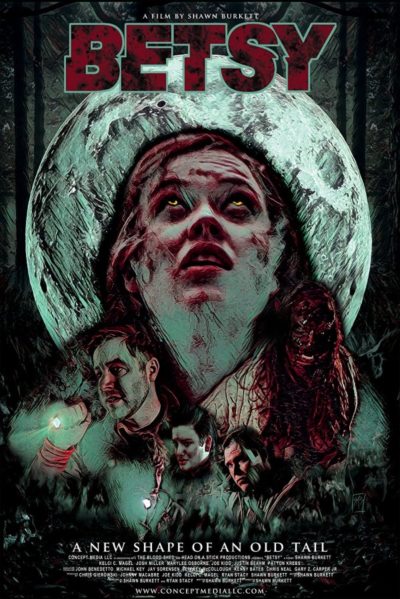
On her way home one night, Betsy (Ryan) is attacked by a mystery assailant and badly injured. While she recovers, she’s traumatized by the events, with nightmares that even her attendance at a support group can’t help. She is also increasingly plagued by violent outbursts against her supportive but increasingly concerned roommate Kayte (Osborne), and physical changes. If you are at all familiar with horror movies, you’ll know the symptoms: Betsy’s attacker was a werewolf, and she’s now in the process of becoming one. This throws a spanner in her growing relationship with Sam (Miller), made worse because he’s a policeman, investigating the recent spate of “animal attack” murders around town.

There’s seems to be a strong inspiration from Paul Schrader’s remake of Cat People here, not least in that it’s sexual activity which seems to bring out the beast in Betsy, rather than the phase of the moon. Her first transformation occurs after a sexual assault, and another after a session of love-making with Sam. It’s never quite clear whether she needs, as in Cat People, to kill in order to regain her human form: there’s no-one here who can tell her the rules by which she is now operating. Indeed, nor is it clear what happened to her original attacker, who seems to infect her, then leaves the film entirely. But this will suffer in any comparison with Cat People. With all respect to Ryan, she’s no Nastassja Kinski, and its transformations are far superior. Sure, that had a much bigger budget: it also predates this by 35 years.

This isn’t entirely without merit, though it is definitely in the slow-burn category – we’re about half-way through before the heroine’s feral instincts properly kick in. In fact, the best thing about this might be the scene tucked away in the (lengthy – after all, there are 28 producers of one kind or another to thank!) closing credits, in which we discover that Betsy is no longer alone. I definitely wanted to see where it might have gone from there. Trimming minutes from her early group therapy sessions, etc. would have offered scope to develop that, and helped this feel more like its own beast, if you see what I mean.

However, I’ve definitely seen far worse low-budget horror. Director Burkett also wrote and edited this, and seems to know where to point the camera and how to capture audible sound. These are skills not to be pooh-poohed in the field, and it’s also to his credit that the film usually is aware of its limits, and doesn’t over-stretch itself. An interesting twist is using a different actress to play Betsy, post-transformation. perhaps making this also influenced by another horror classic, Dr. Jekyll. While the flaws here are too hard to ignore, there are quite a few positives as well, and I’m interested in seeing what Burkett could do with a larger budget, and perhaps a more original idea.

Dir: Shawn Burkett
Star: Erin R. Ryan, Josh Miller, Marylee Osborne, Justin Beahm

Crimson, by Arthur Slade

Literary rating: ★★★★
Kick-butt quotient: ☆☆½

The world of Illium has enjoyed a millennium of peace under its powerful queen Servilia. Though “enjoyed” might be the wrong word, since it has come at the cost of freedom, and harsh justice. A victim of the latter is 15-year old Fen, who four years previously, had her hand lopped off for stealing a trinket from a merchant’s stall. Worse follows, as she wakes up to find her hair has turned red, the sign of a “wildmage” – someone who has magical powers, an ability Servilia seeks to extinguish before it can pose a threat to her rule.

Fen is forced to leave her family, and seek sanctuary in the forest of Helwood which provides the only area outside the queen’s control. She meets another wildmage, Ithak, with the talent of invisibility, who brings her to the legendary Mansren, who lives in the centre of Helwood. History had told her he was evil incarnate, overthrown by the queen after a violent war, a thousand years earlier. But how accurate is that version? For he offers to help Fen free her sister from Servilia’s dungeon, if she helps him become whole again. But is the reward worth the cost – both personally to Fen, and for Illium?

This is a well-written page-turner, which I found myself looking forward to reading each night. It poses some interesting more dilemmas, without ever getting bogged down in them, such as the limits of personal responsibility, the veracity of the past (as Ithak says, “Those who win wars write the histories”) and the balancing of evils against each other. Fen is initially prepared to do anything to rescue her sibling; however, she gradually realizes that by doing so, she may have unleashed a more destructive force on the entire world. For Mansren’s mind has been imprisoned by Servilia in the middle of a lava lake for centuries, which hasn’t exactly improved his state of sanity, charming and eloquent as he may be.

I will say that the means by which the dilemma is resolved is perhaps a little bit of a stretch. Perhaps a greater emphasis on the powers locked within Helwood, and how Fen taps into them, might have been better. The setting also appears to be Chinese, though I’m not sure why; I was quite surprised when this suddenly cropped up. I certainly wouldn’t have guessed this from the cover, and it’s little more than window-dressing. However, the story does a lot of things right, bringing us along with Fen on her heroic arc, as she grows into her powers and learns that everything she has been told may not necessarily be the truth. Though she’s “just” a teenager, there are few of the obvious trappings of YA fiction, and it’s the better for it.

It is a little restrained on the action front, with Fen largely refusing to use her abilities against others, and in the final act, being more an observer up until the very end. However, these moral restraints help her character from becoming over-powering, and on several occasions, there’s a genuine sense of threat. With this being a stand-alone book, it is entirely possible it could end in her being forced to make a heroic sacrifice, and Slade handles that aspect particularly well. I was actually quite sad there are no further volumes, but it’s also nice to have a story which is entirely wrapped up in a fully satisfactory way. I’ll have to make do with perhaps checking out some of Slade’s other works.

Author: Arthur Slade
Publisher: Dava Enterprises, available through Amazon, both as a paperback and an e-book