
★★
“Cover not necessarily representative.”
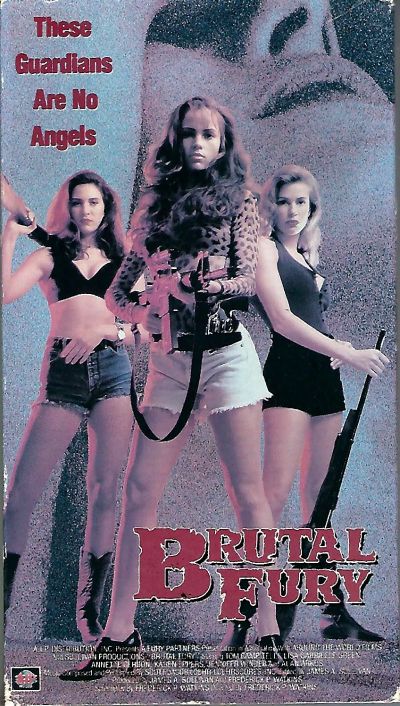 While technically a 1993 release, the copyright date on this is five years earlier. That seems about right, because a more eighties movie, you would be hard pushed to find. The hair! The synth score! The fashions! But, to be fair, this makes it ahead of its time in some ways. It definitely predates Heathers, with which it shares a number of elements in common. It takes place in small-town Texas, where Lincoln High School is home to a group of female vigilantes called The Sisterhood. They take it upon themselves to act as moral enforcers, punishing with violence those who sleep around, take drugs, etc. Their latest recruit is Misty (Greene), recently arrived in town.
However, Misty is barking mad, the result of a lifetime of indoctrination by her evangelical and fundamentalist minister father. While The Sisterhood go no further than beating up those they find guilty, Misty is… more enthusiastic. The predatory lesbian gym teacher? Stabbed and pushed off a roof. The rapist football player? Suffocated and left dangling from the goal-posts. Detective Bill Griffin (Campitelli) doesn’t know what to make of it. Not least because his wife, Molly (Gebron), is currently undercover at the school, trying to bust open a drug ring. You’d think that might have merited attention from The Sisterhood, but apparently not. I guess they are too busy holding quasi-Satanic initiation ceremonies, which look they might have strayed in from the director’s cut of Spinal Tap.
Molly isn’t exactly convincing as a teenager, despite dressing from the “Sexy Punk Rocker” aisle at Party City. But that’s alright, because the pupils at the school also look closer to their mid-life crises. Naturally, she ends up becoming one of the targets for Misty’s big finish, after she gets kicked out of The Sisterhood for being too extreme. There is certainly a lot to unpack here, and it definitely feels like there are a plot or two in excess of what the director could handle. In more skilled hands, this would definitely have had potential as a cult classic, mixing religion, morality and violence. But this was apparently Watkins’s debut, and little of the potential is realized.
He doesn’t even have the decency to deliver gratuitous nudity. I mean, staging a meet for the drugs outside of a topless bar? Sheesh. That’s your B-movie license revoked, right there. Greene is likely the best thing here, selling both of her personalities effectively: shame this was her only film. The rest of the cast vary from competent enough to “Was there really nobody else available for the role?” It is just in desperate need of executing its ideas with considerably more energy than Watkins can bring. Lean into the insanity more, play up the exploitation elements (for despite the title, it is neither brutal nor furious) and this would have the potential to become one of Quentin Tarantino’s favourite movies. Someone needs to remake it along those lines.
Dir: Fred P. Watkins
Star: Lisa-Gabrielle Greene, Tom Campitelli, Annette Gebron, Karen Eppers
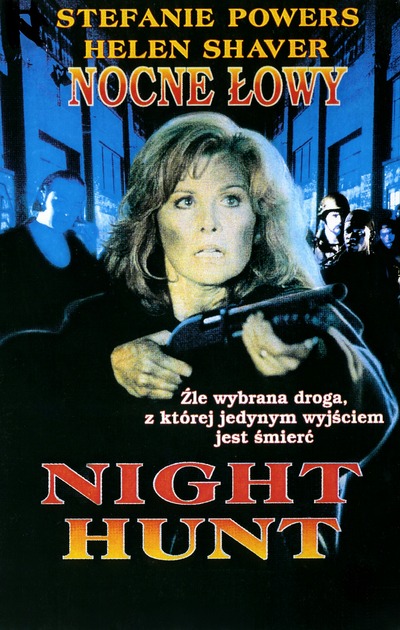 There’s a strong parallel between this TV movie and Judgment Night, a theatrical feature, also from 1993, starring Emilio Estevez and Cuba Gooding Jr. Both involve a group stranded in an urban war-zone who incur the enmity of a local gang, and consequently have to fight to eescape. The difference with this – and why it’s here – is the victims are three women: psychiatrist Victoria (Powers), her daughter Julie (Robertson) and sister Stacey (Helen Shaver). They are on their way home after a family Thanksgiving dinner, when a quest for fuel leaves them stranded in the South Bronx. That is just start of their problems, courtesy of Ice (Graham) and his vicious gang of thugs.
 For the first hour and forty minutes, you may well be wondering why this is here. You will need to be patient: it gets there… eventually. However, to start with, it’s the story of the battle between crime boss Nikka Shaitan (Grover) and dogged cop Inspector Sidhu (Kumar). After members of the former’s gang are caught attempting a bullion robbery, Sidhu seeks to leverage them to reach their boss. But Shaitan uses all the power – both legal and illegal – at his disposal, to avoid justice. Initially, a state of martial law (the title translates as “emergency”) gives the cops the edge, but after that is declared over, the balance shifts, culminating in Shaitan’s gang invading Sidhu’s wedding and gunning everybody down.
 The traditional rule of thumb is, Cynthia Rothrock’s Hong Kong movies are good, but her American ones are bad. The question is, what category should this one be placed? On the one hand, it’s a Hong Kong production. On the other, it’s filmed in America, with an American cast. On the third hand, it’s directed by notorious schlockmeister Ho, as “Godfrey Hall”. I’m painfully aware how much his work can vary in quality, though I’ll confess, I am generally adequately amused. The results here are a real grab-bad of the good, the bad and the laughable. Put it this way: Cynthia is probably close to the best actor. That’s not something you’ll hear often.
 By that, I am referring to the unnamed heroine of this film, because she doesn’t have to leave the house. She works as a hitwoman for Yakuza boss Yasuhiro Kokubu (Katô), and he delivers the targets to the front-door of her rural home, on the pretext of her being their entertainment. She then gives them the Black Widow treatment, having sex with them, before a couple of post-coital shots. She barely has to get out of bed, literally. In some way this makes sense, since she’s blind – I guess it’s nice to see the disabled being given equal opportunities in the assassin field. But she’s not exactly happy with her lot; her cleaner and handler Masahiko Yoshizawa (Murai) is concerned about her spiralling into alcoholism.
 Yeah, if the above line of subtitled dialogue makes sense, this film then ups the ante, with white subs on a frequently white background, and which frequently appear to be making a bid to escape from the bottom of the picture. It’s safe to say that a decent presentation of this, perhaps with a print which doesn’t look like it was left in someone’s pocket when their suit went to the cleaners, might merit a half-star more. A few more fight sequences would help too: the ones there are, don’t lack in quality. There’s just a bit too much farcical comedy for my taste.
 If the title is more than a bit blunt, it’s certainly accurate. May Lin (Cheng) is a brash hooker, who runs a sideline in blackmail videos with her flatmate, Nana. But one night she comes home to find Nana near death, the victim of a brutal client. She tells the police about the video, but before she can give it to them, the perpetrator – rich and influential politician, Kao Tien Chin (Cho) – sends an army of beige trenchcoat wearing killers to take care of both Nana and May. The former succumbs, but the latter escapes and goes on the run. With the police force apparently leaking like a sieve and the case being shut down from on high, prosecutor Yin Li Shan sends his niece, Nancy Cheng (Mishiwaki), to link up with May and bring her in. But they’ll have to get past the trenchcoat mafia, among other threats, for there to be any hope of justice.
 Former WWF star Lesseos, where she was known as the Fabulous Mimi, carved out a small career for herself in low-budget action films, mostly in the mid-nineties. Though the ones we’ve covered before, such as
  Watching this after having read the manga version, it feels like the anime version can do little more than scratch the surface of the world of Tiphares, in the barely fifty minutes it has to work with across its two OVA (Original Video Animation) volumes. The stories here, originally released in 1993, cover the first two section of the manga, and it looks like much of what we see here will also be included in the live-action film next February. Slightly confusing matters, is the way this uses the original Japanese names. So Tiphares becomes Zalem here, and Hugo is Yugo. Most oddly, the heroine is not called Alita – hence the absence of her name from the title – but Gally. To avoid further confusion, I’m going to be consistent with our other articles on the topic, and stick to the translated ones for what follows.