“Get your yi-yi’s out.”
 I used to be a Xena fan; for the first couple of series, I was a die-hard, never missed an episode, bought the merchandise, went to the gatherings, etc. I loved (with one exception) the supporting cast – Joxer, Ares, Autolycus – and still reckon Callisto remains one of the great TV villainesses of all time.
But the dynamic of the series slowly changed; Xena’s irritating sidekick, Gabrielle, started getting more screen time, and it became more of a relationship-based show than the action/humour cross which I knew and loved. Finally, around the end of Series 3, I gave up (I think the musical episode was a watershed – as with Buffy); not even the news that the series was ending could lure me back, and the finale in Summer 2001 passed me by. It even took me a month to decide to pick up the DVD, and then it was only ‘cos I had a Best Buy gift card burning a hole in my pocket. But I’m glad I did, as it’s an ending fit for a warrior princess.
Warning: the following, of necessity, contains extreme spoilers for the show’s end. Readers are advised not to proceed if they wish to avoid such knowledge.
Let’s get the spoiler out of the way first: the original title for this review was, Oh My God – They Killed Xena! You Bastards!, but wiser counsel prevailed. To screams of fury from the Hard Core Nut Balls (as Lawless herself once described the more extreme fans), Xena died. And this time, it was permanent – something of a change for a show in which fatality was previously only a minor inconvenience. Indeed, one of the problems was there was no longer any tension, characters having come back from the grave so many times, even death no longer had a sting. The reason for the reaction, it seems, was less the actual death, than the separation of Xena and Gabrielle. For a small but extremely vociferous part of fandom invested the relationship between those two with far more than the actresses (and most of the creators) intended. These “subtexters” wanted to see the two walk off into the sunset, hand-in-hand – probably sporting crew cuts and Birkenstocks too, if you catch my drift. The makers sometimes jokily acknowledged these obsessives, which was perhaps like trying to put a fire out by throwing petrol on it.
The things which made them dislike the finale were, perhaps, the ones why I enjoyed it. I was never bothered by the concept of a Xena being a lesbian, it was just the idea that whiny waste of space Gabrielle was her partner which I found inconceivable: sidekick, yes; love interest, no. The finale largely downplayed Gabrielle’s role: she was entirely absent from the half told in flashback, concerning a previous adventure back when Xena was, shall we say, “morally independent”. This created the drive for the film. The incident in question saw Xena ransoming a Japanese girl – forming a bond with her which certainly has subtextual elements of its own. But it all went horribly wrong, and Xena caused – albeit inadvertently – the deaths of 40,000 people. Now, the only way for her to find redemption is to kill the demon which consumed their souls…but the only way to do that is to become a ghost herself. While there’s the usual escape clause, at the end we discover that any return to life would condemn the souls forever; Xena is not prepared to do this, and so remains dead into eternity.
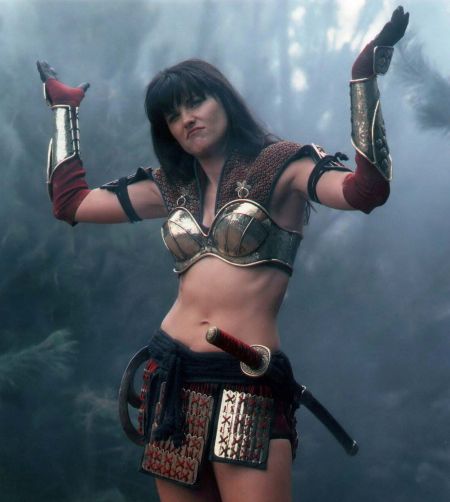 Like the series itself, the finale veered wildly between the fabulous and the questionable, vacuuming up influences like Tarantino on speed. From Japan: Kwaidan, Shogun Assassin and Akira Kurosawa. From Hong Kong: A Chinese Ghost Story, Once Upon a Time in China, Swordsman. From the West: The Evil Dead and Sergio Leone – the former makes sense, since director Tapert produced that classic slice of low-budget horror. Fortunately, it has a lot of its own to admire, rather than being a series of homages; the story is great, and the acting largely excellent.
The highlight is probably Xena’s death, a five-minute sequence of harrowing intensity featuring a never-ending hail of arrows, into which our heroine struggles, intent on finding a warrior’s death. It’s a fabulous combination of effects and acting, which would be worthy of any movie – at the end, there’s a mass exhalation of breath, as you realise that those who live by the sharp, pointy object, die by the sharp, pointy object. It’s entirely fitting, and if the show had ended there, I’d have had no complaints. The actual climax is clunky and contrived in comparison, though the shock value present remains huge, since you confidently expect the revival of Xena, right up until the credits roll.
On the downside are various, jarring inaccuracies: Xena’s ghost hugs Gabrielle but is incapable of holding her chakram (the “round killing thing”, if you didn’t know); some of the “samurai” possess blatant New Zealand accents; a giant explosion implies the medieval Japanese possessed nuclear weapons (given the location, this is in somewhat dubious taste). If Xena really cared for Gabrielle, why send her on a wild-goose chase of resurrection, when Xena knew it wouldn’t happen? Why did Gabrielle pause to get a full-back tattoo first, before going off on this, presumably somewhat urgent, quest? These are clumsy and obvious flaws which could/should have been corrected.
It still remains a brave and uncompromising finale, in an era when “final” is usually about the last word you’d use to describe them. While the door is not completely closed – not in a milieu where humans can become immortal and then get killed anyway – in all likelihood it is the end of Xena, and marks the close of her chapter. From a beginning as a minor character on another show, she became a cultural icon; whatever you may think of the series, its important place in female action heroine history cannot be denied.
Dir: Rob Tapert
Stars: Lucy Lawless, Renee O’Connor




 Not the Billy Bob Thornton/Bruce Willis vehicle of the same name, this German film is several years older. Four girls, in the titular prison band, seize the chance to escape when playing at a police function. With freedom comes unexpected fame, thanks to a tape sent to an unscrupulous record company executive. There is plenty of potential for a Natural Born Killers-style hack at the media, manafactured celebrity: the Bandits could go after the exec for exploiting them, he could encourage the cops to shoot the fugitives and increase sales, etc. Von Garnier largely avoids this, in favour of unsuccessful chick-flick emoting, and a slightly surreal approach, like a long-format pop video. Add an irrelevant subplot in which the Bandits take a hostage, play with him for a bit, then dump him, and it’s clear the script is embarrassingly weak.
 Though I hope 80’s hair
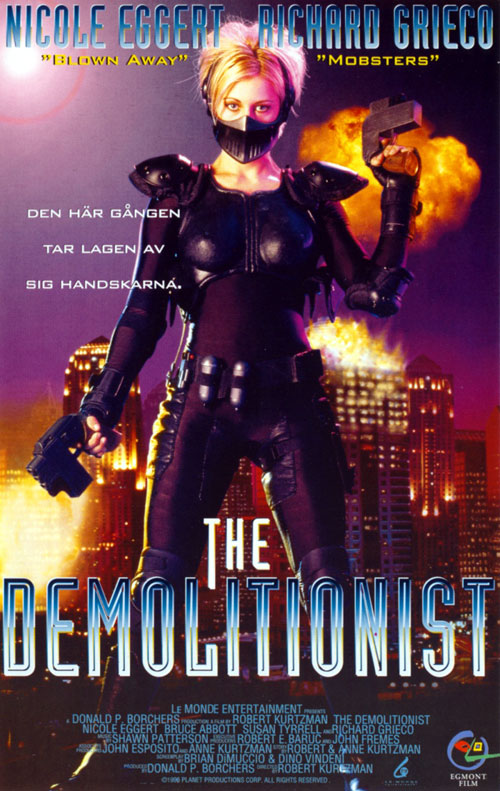
  Half a point added for the lurid sleeve, an absolute classic of exploitation, that certainly lurid-ed us (“us?” says Chris – okay, me…) into purchasing, even as I knew it would disappoint. And I was not, er, disappointed in my disappointment. There’s a slight hint of Alias about the plot, in which an agent (Ager) with a penchant for wigs, discovers her father (Estevez) is in the same organization, and that she might not have been working on the side of the angels. It diverges sharply when she is ordered to kill him, along with a training camp for assassins that badly overstays its welcome. [Though it has a decent start, where the would-be hitmen have to cut the patriotic bull and admit they just like killing people.]
 Despite its title, Prisoner Maria: The Movie has a different set of influences altogether. First up heroine Maria is only a prisoner for a few minutes; the most obvious reference point is Nikita, and it’s not alone.
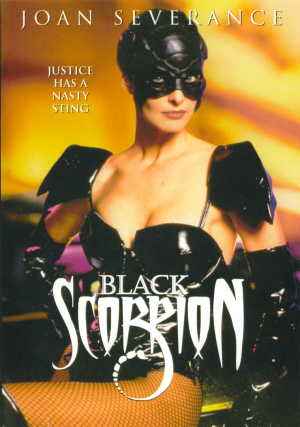
  Based on a manga by Shigeru Tsuchiyama and Shintaro Iba, this is cheerfully shallow stuff, although the occasional sequences of abuse may have more liberal viewers twitching — the depiction of the serial killer at work is unlikely to survive any British release. Aota wears a selection of tight dresses and short skirts, and performs her action scenes creditably enough, though the likes of Michelle Yeoh will not be losing any sleep. In addition, some thought has clearly gone into the story, which is perhaps where it wins out most convincingly over Scorpion’s Revenge.
 Roger Corman is a man without shame – and that’s in no way intended as an insult. He simply utilises any resource to the best of its ability, as is shown by the
 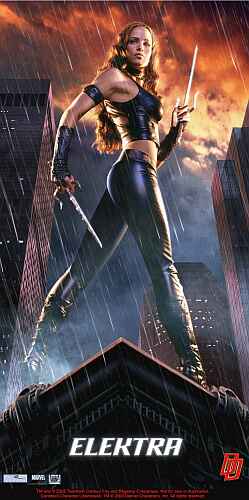 While 2003 has been touted as the Year of the Comic-book Movie, those centred around heroines have been notable by their absence. Sure, X-Men 2, League of Extraordinary Gentlemen and Daredevil have then in supporting roles, but going by the example of the last-named, anyone expecting much is likely to be sorely disappointed. Elektra, one of the toughest, deepest, most twisted characters in comics history – at least in the Bill Sienkiewicz/Frank Miller incarnation – was reduced to little more than a simplistic sidebar of little relevance. Credit to Jennifer Garner for doing what she could, but it’s safe to say that we’re not awaiting the touted Elektra spinoff with anything more than a “that’s nice” level of anticipation.
 I usually start watching this in a sense of disbelief, since it’s certainly not the most immediately convincing of movies. However, there’s a point near the middle which has in quick succession an amazing action sequence and two revelations, one touching, one tragic, and I realise that I am, yet again, utterly buying into the characters, storyline and setting. Disbelief simply ceases to be an option, and by the end, I know why this is among my all-time favourites, not just in the action heroine genre, but among all cinema.
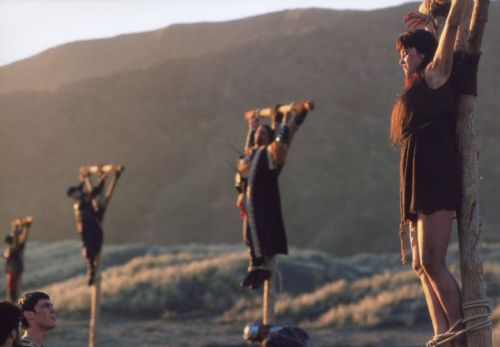 The defining moment of Xena’s sophomore season didn’t take place in any episode. In fact, it didn’t even take place in New Zealand, but thousands of miles away, During a rehearsal for an appearance on The Tonight show with Jay Leno, Lucy Lawless was thrown off a horse after it lost its footing, and broke her pelvis. It’s interesting to compare the reaction of the producers to what the Tapert/Raimi team did when the star of Spartacus, Andy Whitfield, was similarly a victim of severe misfortune, more than a decade later. There, they put the show entirely on hold and opted instead to film a prequel without him.
 In terms of style and approach, the show covers even more ground here than the first time, from absolutely froth to grim darkness. Xena even gets crucified by Julius Caesar in one episode [confusingly, the actor responsible also crops up later, playing Cupid, complete with fluffy wings…]. I’m sure I’m not the only one who found themselves whistling Always Look on the Bright Side of Life, during the scene shown above right. Another unwitting Python reference is the wretched Here She Comss, Miss Amphipolis, a dreadful tale of drag-queen empowerment, featuring perhaps the least convincing female impersonator since John Cleese put on a dress – as on the left, watch that Adam’s apple
 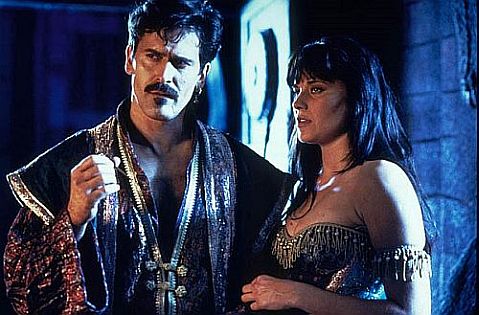 It’s assumed viewers are at least somewhat familiar with Xena’s background, as she is first seen burying her armour in an effort to bury her past. Of course, this is about as successful as it usually is in fiction, and it’s not long before she’s saving villagers, including Gabrielle, from slavery. That includes an aerial battle atop platforms, which is the first sign of the show’s strong influence from Hong Kong action films; it was using wirework, in a way that predated its popular arrival in Hollywood. Similarly, the stunning New Zealand locations foreshadow Lord of the Rings, to the extent that I kept expecting to see hobbits gamboling along in Xena’s wake.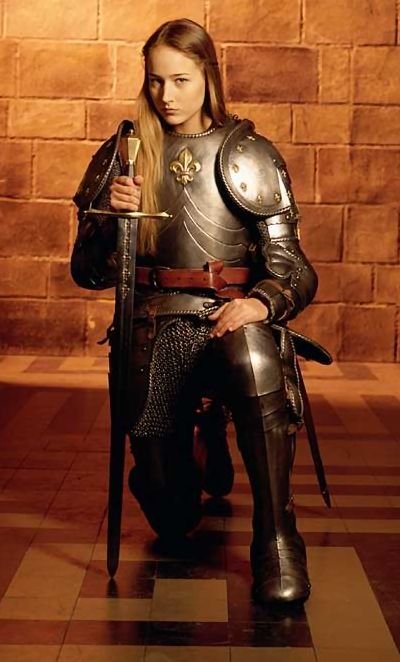
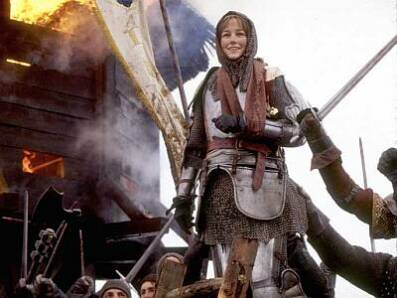 However, the main difference between this and The Messenger is that Joan of Arc is convincing. Perhaps with the advantage of having extra time (the DVD of the miniseries runs 189 minutes), they make the effort to show her interacting with other characters, and Sobieski’s calm, complete assurance is a striking contrast to Jovovich. The viewer can see why people would believe her, and it naturally follows they will too – Sobieski’s Emmy nomination was entirely well-deserved. Despite playing fast and loose with the facts (another example: Joan’s brother was not killed in battle, but lived to see her trial verdict overturned), this strong central performance holds the film together and, with the aid of the other fine actors, makes it eminently watchable. It may not be historically accurate, but it does a fine job of explaining why her myth is still honoured in the third millennium, without coming down in one camp or the other regarding the source of her visions. There are few TV miniseries worth watching, and fewer still worth owning, but this one comes highly recommended.