
Buffalo Girls

★★★½
“Certainly no calamity.”
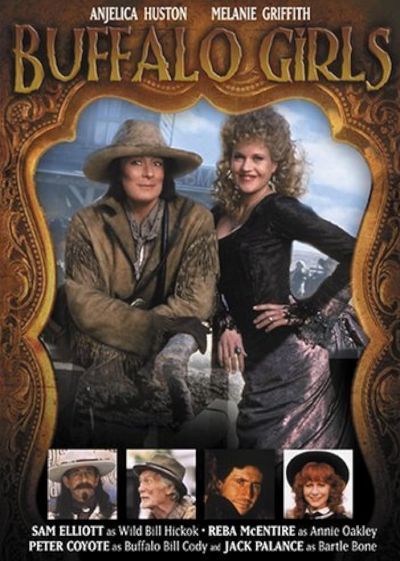
Calamity Jane is one of the larger-than-life figures who populated the Wild West in its later days, as it was gradually becoming civilized. The truth about who she was is hard to determine, with verifiable facts hard to come by. But like Robin Hood, this just makes her raw clay, to be moulded into whatever shape writers and film-makers want. In Jane’s case this means her over the decades being played by anyone from Jane Russell through Doris Day to, here, Anjelica Huston. This version of her story, originally a TV miniseries in two parts from 1995, is based on a book by Larry McMurtry. I’ve not read it, but by most accounts, it’s mostly an elegy to the death of the old West and its people.

This doesn’t feel quite as depressing, though certainly nods to the end of the frontier ways. Jane here is a down-to-earth figure, whom we first see working with the forces of General Custer. Fortunately, she avoids meeting the same fate, though tragedy hits in a different way, with the murder of Wild Bill Hickok (Sam Elliott, basically re-running his Tombstone character). Jane had long held a candle for him, but never managed quite to tell him. However, their relationship leaves her with a child, which she gives up for adoption to a rich family. Years later, she discovers her daughter is back in England, and joins the circus of Buffalo Bill (Coyote), to travel across the ocean in the hope of being reunited.

This thread is fine, with a tremendous cast doing good work, also including Jack Palance, an early role for Liev Schreiber, and Reba McEntire as sharp-shooter Annie Oakley [in my head canon, she’s playing the great-grandmother of her character in Tremors] I doubt how historically accurate it is: while Buffalo Bill’s show did play in London, I’ve not found anything to indicate Jane was with them (Oakley, however, was part of the show), and certainly not shooting up an English pub! But the old saw, “Print the legend” is likely applicable here, and I’m always willing to cut cinematic biography some factual slack, in the interests of making its story-telling more effective.

Less successful is the secondary plot, involving brothel madam Dora DuFran (Griffith), who again did exist, and her true love Ted Blue (Byrne), who did not. I was particularly annoyed how Dora repeatedly refused Ted’s proposals of marriage, preferring to retain her freedom… then got very upset after he married someone else, and even got hitched to someone herself (the short-term spouse being played by Schreiber). Either be with someone or not. They’re not a puppy on a leash for you to jerk around, and your history is not their problem. Every scene with the pair was a waste of time, and I was left wondering if I could create a ninety-minute supercut of the film, which removes them from the film as far as possible. I suspect it would be an improvement.

Dir: Rod Hardy
Star: Anjelica Huston, Melanie Griffith, Gabriel Byrne, Peter Coyote 
Knockout Blessing

★★★
“Punches above its weight.”

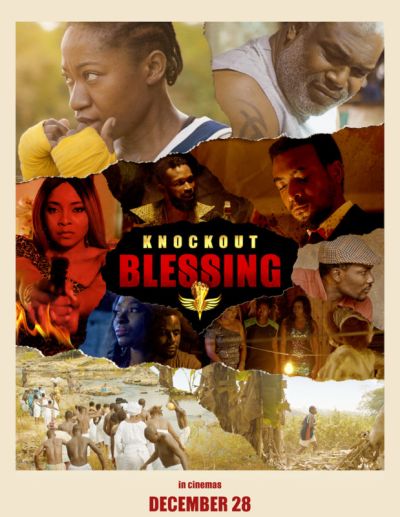
Always a pleasure to cross another country off the map, and this is the first movie we have ever reviewed here from Nigeria. Indeed, entries from anywhere in Africa have been very limited, and in general, I found this a pleasant surprise. In some countries, film-makers appear to be trying simply to imitate Hollywood. That’s not the case here: this feels Nigerian, and is all the more entertaining as a result. What it may lack in hardcore action, was made up for me by the glimpse it provided into local culture. The differences are what gave this flavour – though as we’ll see, it appears we are united by a general disdain for politicians and their behaviour!

It begins in a small village where Blessing (Laoye) is the grand-daughter of a boxer, who has brought her up and certainly passed on his skills, leaving Blessing fully deserving of her titular nickname. However, after she punches out the son of a rich local, who was attempting to force himself on her, and he dies as a result, her father is killed by a mob, and she is forced to flee to the city. There, she falls in with a group of hookers, including Hannah (Meg Otanwa) and Oby (Ejiofor). They end up working for low-level gangster Dagogo (Franklin), honey-trapping men whom Blessing then knocks unconscious so they can be robbed. Her goal is to raise funds which Dagogo says he will use to get her a passport to America.

When this shows little signs of happening, Blessing grows reluctant, so Dagogo says he needs just one last job. It’s a high-risk, high-reward job, to steal some diamonds from the notorious Gowon (Adedoyin). Naturally, as “one last jobs” do, it goes wrong. While they get the case, it instead contains a hard drive, with a very incriminating video, depicting the President of Nigeria… Well, let’s just say, there’s a goat involved. [Told you there’s no love lost for politicians] Needless to say, both Gowon and the President are extremely keen to get the drive back, and will stop at nothing to do so. This leaves Blessing and her pals trying to get it to a friendly journalist and online, before the loose ends they represent are tidied up.

This was consistently entertaining. My (admittedly limited) experience of Nollywood left my expectations low, and this surpassed them on most levels: the script, performances and direction are all fine. Credit Adedoyin in particular, whose suit-wearing Gowon becomes a very convincing and menacing villain. It’s never dull, and no special knowledge of Nigerian life and culture is needed here. I did wish more use had been made of Blessing’s pugilistic talents. There’s a significant chunk in the middle, where it feels like the movie forgets about its heroine. Blessing did enough in the early going to win our affections, and she deserves better than to be sidelined. I was still left with an interest in seeing more Nigerian cinema, and that’s not what I expected on the way in.

Dir: Dare Olaitan
Star: Ade Laoye, Bucci Franklin, Ademola Adedoyin, Linda Ejiofor

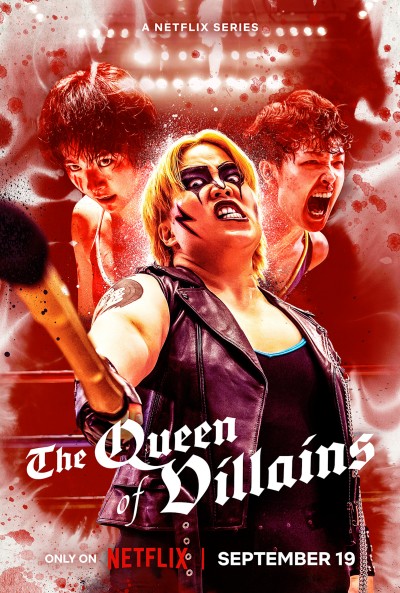
The Queen of Villains

★★★★½
“Hard-hitting, and hitting hard.”

Not long ago, I tagged Black Doves as the best television of 2024. If I’d seen this before December 31, it would have beaten it out. It’s a top-tier depiction of the world of Japanese women’s professional wrestling in the eighties, weaving truth, fiction and legend together in a way that’s highly effective – probably even if you’re not a particular fan of sports entertainment.  It’s the story of Kaoru Matsumoto (Retriever), who escaped a dysfunctional family to join All Japan Women’s Pro Wrestling (AJW). Initially struggling to achieve success, she found her niche as nightmare villain Dump Matsumoto, feuding with former friend Chigusa Nagoya (Grace), until the pair faced off in a legendary, brutal battle, destined to lead to public humiliation for one of them.

We all know professional wrestling is staged, with the outcomes predetermined, right? [Do not used the word “fake”: I will cut you!] Here, things are… murkier. This treads a delicate line between that and kayfabe, the wrestling term for promoting it as reality, and genuine competition. The stance here is interesting, suggesting that while those in charge, like promoter Toshikuni Matsunaga (Saitoh), can have a result in mind, that relies on those in the ring agreeing to it. This isn’t always the case [one wrestling show I remember attending definitely had a genuine fight, for backstage reasons], and here, Matsumoto is a loose cannon, prepared to go to any lengths to put herself over. Or her character: the lines are certainly blurred here, to the point of near invisibility.
What matters, is that the audience believed it was real, to the point that Matsumoto received death threats as the feud intensified. It’s perhaps hard to understand just how popular AJW was, but their TV shows were getting considerably bigger ratings in Japan at its peak, than WWE or WCW were during the Monday Night Wars. It was a true cultural phenomenon – oddly, with teenage girls at the front of fandom. Nagayo and tag partner Lioness Asuka (Goriki), known as the Crush Gals, were basically Taylor Swift: they actually had a successful music career. Below, you can see the video of the real match mentioned, between Nagayo and Matsumoto. I defy you to find any wrestling bout, anywhere, where the crowd were so utterly into it.

The show does a fabulous job of capturing this, and the bouts as well are very well-staged – the real Nagayo worked as a technical advisor. Wrestling at the time was very different from what it is now, especially for women, and Matsumoto’s brutal style was unprecedented. She could chew up and spit out current WWE champion Rhea Ripley, using her as a tooth-pick. Indeed, it feels as if the final match is the dramatic pinnacle, and should end the fifth and final episode. It doesn’t and it feels like it’s heading for an anti-climax thereafter, until recovering [while not mentioned, it’s caused by AJW’s rule that wrestlers had to retire at age twenty-six!] But the drama behind it also has a great deal of nuance, depicting her troubled family life, and willingness to do whatever was necessary for her career.

This came at personal cost – not least her friendship with Nagayo. But it also affected her relationship with her family, in particular her mother and sister. Matsumoto initially wanted to become a wrestler, so she could protect them from her abusive and alcoholic father, but in the end, even her family were not safe from the ripples of her in-ring “villainy”. It all works on multiple levels, and provoked genuine emotions in me, to a degree rarely managed by any TV show, least of all one based on (lightly fictionalized) reality. Towards the end, the promoter lets a young girl in to see the show, and I was left wondering whether this was perhaps intended to be someone like Manami Toyoya, the greatest woman wrestler of all-time.

Another series, perhaps The Queen of Heroines? We can but hope. 

Creator: Osamu Suzuki
Star: Yuriyan Retriever, Victoria Grace, Takumi Saitoh, Ayame Goriki

Kill Craft

★★
“More kill than craft.”

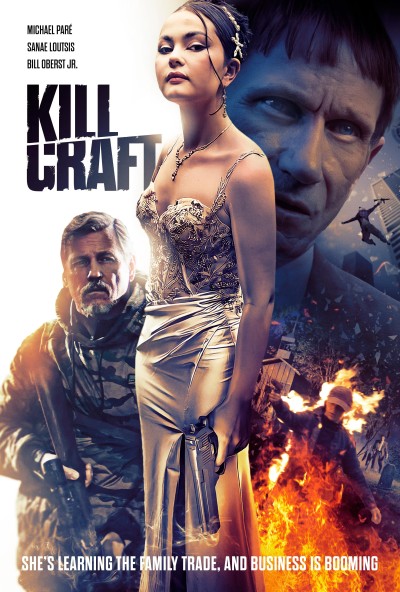
There is potential in the idea here. It’s a shame it ends up feeling like two separate movies, both of which come out feeling under-cooked. The main focus is on Marina Delon (Loutsis), a teenage girl with the typical teenage girl problems, e.g. bickering parents, generally sullen demeanour, etc. Except, her dad Thomas (Paré) is actually an assassin, working for the very strange Poe (Oberst). This has contributed to the marital strife, because his work is why mom is in a wheel-chair – and is not happy about it, to put it mildly. However, things are up-ended after Thomas is killed on a job, and Marina decides to take over the family business.
Thee are a few interesting directions this could perhaps have gone. Unfortunately, it doesn’t take any of them. Instead, things rumble vaguely on, with Marina doing not very exciting murders for hire, sometimes with the help of her Gother than thou BFF Freya (Eggleston), and to varying success. Such as trying to kill the estranged wife of a gangster, which only results in a bit of flirty chit-chat with the target’s son. Communication with Poe is entirely through dead-drops, so he has no idea his assassin is now a teen girl, until his boss informs him descriptions of the killer no longer resemble Michael Paré. Poe decides to tidy up the loose ends, by terminating what remains of the family.

Why it feels like two films, is mostly because the director can’t seem to commit to whether it should be Marina’s story or Poe’s. It could have been both, adopting a Leon-esque approach of Poe taking her under his wing. However, the two barely share a few seconds of screen-time before the final shootout. Instead, we get unconvincing family drama, e.g. Marina being upset her father isn’t attending the recital at which she is unconvincingly playing the violin, or even weirder stuff such as Poe digging up the grave of his dead mother. I’d actually have been fine with more of the latter – few do unrepentantly weird better than Oberst [he has done a one-man stage show adapting Edgar Allen Poe stories, incidentally, giving resonance to his character name here], and he’s much better an actor than Loutsis.

For whatever reason, I kept expecting some dramatic twist, such as Freya being a figment of Marina’s imagination. I mean, we first meet the pair digging animal graves behind her house, which sets an odd tone for the film from the beginning. The fact Marina and Poe both… have issues, is another way this could have developed. But once we’ve established Marina is taking over – and with remarkable vagueness on the details there – the film more or less grinds to a halt, dramatically and thematically. With action sequences which are no more than competent, despite some gore which is occasionally amusingly excessive, this is one you can afford to miss, despite Oberst’s best efforts.

Dir: Mark Savage
Star: Sanae Loutsis, Isis Eggleston, Michael Paré, Bill Oberst Jr.

Hacked Into The Game, by Saul Tanpepper

Literary rating: ★★½
Kick-butt quotient: ☆½

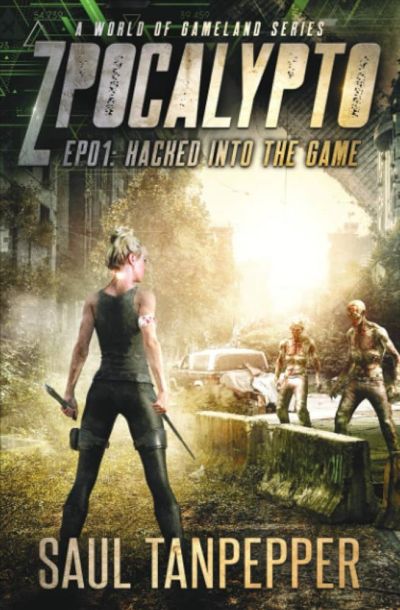
The literary rating is mostly down to the sluggish way in which this gets going. Though having subsequently discovered this is the first in a fourteen volume series, it’s perhaps understandable if the author decided to slow-play things in the early stages. Still, as a standalone read, it definitely takes a while to get to the good stuff. By which I mean, human vs. zombie action. This takes place well after the zombie apocalypse, with the epidemic having been contained, and indeed, commodified, Zombies are kept in a formerly infected area of Long Island, now cordoned off to the public, where a company called Arc Entertainment allows the very rich to control them through implants, and fight to the (un)death.
There are other elements too, though these don’t have a significant role in this volume. For instance, everyone is mandated to have a “kill switch” fitted in their head, for use by the government if there were to be another outbreak. Or, after death, you can be resurrected as a zombie and conscripted into the military, or other public service. I presume these will come into play in later volumes. Here, it’s the story of Jessie Daniels and her friends, moderately disaffected young people who decide to break into the restricted zone on Long Island, for a variety of reasons, from boredom to a desire to hack the game from the inside. Needless to say, the expedition does not go smoothly.

As noted, it takes a while to get there. In fact, they don’t even reach Long Island before the 62% mark (all hail Kindle readers!), with much of the opening two-thirds taken up with interpersonal relationship, prep work for the expedition, or world building. It’s not dull, but for a franchise called Zpocalypto, I was expecting rather more… well, pocalypto, I guess. Or, indeed, more Z, with the first one we encounter in real-time, again, not showing up until they’re swimming through the tunnel to Long Island. To be frank, I was seriously wondering if this would qualify for inclusion here to the eighty percent (hail Kindle!) point, hence the low K-BQ.

However, it then goes from 0-60 in about two pages, and basically doesn’t let up thereafter. Jessie and her expedition “buddy” Jake find themselves cornered in a gas station, from which they first have to extricate themselves, reunite with the rest of their party, and head back to the mainland. None of which is easy. Fortunately, she had received some weapons training from her grandfather when Jessie was young, and that certainly comes in handy against the hordes of undead who have suddenly popped up. That in itself poses questions, which I imagine are answered… at some point over the thirteen subsequent volumes. Yeah. While I get the need for an author to pace themselves, Tanpepper (a fabulous pseudonym, incidentally) needs to do a better job of grabbing the audience’s attention out of the gates.

Author: Saul Tanpepper
Publisher: Independently published, available through Amazon, both as a paperback and an e-book
Book 1 of 14 in the Zpocalypto series.

Azrael

★★★★
“Hell on Earth.”

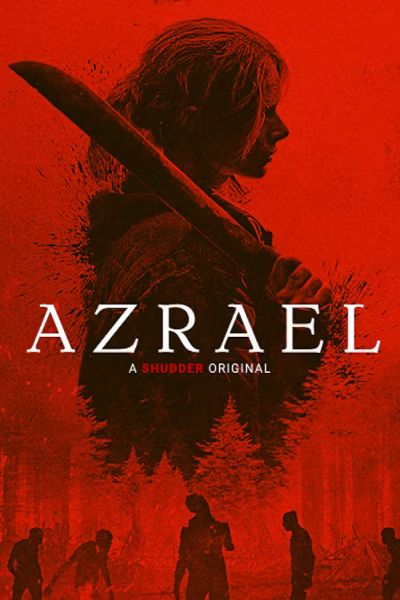
If I see a more relentless and brutal film in 2025, I’m going to be quite surprised. This doesn’t let up, with people being eaten alive, impaled, decapitated and slitting their own throats when they realize the horror of… Well, let’s leave that to the film to divulge, shall we? I must say, you should probably read the first sentence of the Wikipedia synopsis, because there is a lot there, which the film does not explain. Admittedly, this is in part because it contains almost no dialogue, and there are a number of elements which feel near impossible to show, rather than tell. You don’t need to know them to enjoy this. But they will certainly answer some questions. 

What the film has is a mute woman, Azrael (Weaving) and her boyfriend,  Kenan (Stewart-Jarrett), getting captured by an equally silent cult in a forest. The time and era is uncertain, but they do have working cars, so it seems fairly contemporary. They want to sacrifice her to dark, humanoid creatures which inhabits the woods, but she is able to escape back into the wilderness. She attempts to return, so she can rescue her boyfriend, and encounters the group’s spiritual leader, the pregnant Miriam (Sonne). After failing to save Kenan, and narrowly escaping from the dark creatures more than once, as well as getting buried alive, Azrael vows to take bloody and fiery revenge on the cult, and also discovers the true nature of Miriam’s pregnancy. 

I don’t want to send Eva Green or Milla Jovovich out to the Sunnyside Retirement Home quite yet. But when they do decide go to the farm upstate, Samara Weaving might be best-placed to replace them. In Guns Akimbo, Ready or Not and now this, she has shown the ability to compel the viewer’s attention, even if the film might not be the greatest. She does it again here, despite doing the acting equivalent of having one hand tied behind her back, robbed of emoting with her voice. I can’t think of many current actresses who could pull such a trick off with such apparent ease, and help make what is admittedly a gimmick, feel surprisingly like a natural scenario.

She becomes quite the bad-ass over the course of proceedings as well. It’s not clear whether she was initially, since we get no real information regarding her previous history. But she needs to be, in order to survive against the monsters in the woods, who are among the creepiest things I’ve seen in a while. By the end, she’s enthusiastically hacking her way through what appear to be her former allies, although the ending is… ambivalent. I suspect there’s a lot of religious back-story here – Azrael is the angel of death in Islam [It’s also the name of Gargamel’s cat in The Smurfs, but that’s probably less relevant!] There’s scope here for an entire feature before this, plus likely one after, and I’d watch both. Just a shame it got buried on a second-tier streaming service like Shudder.

Dir: E.L. Katz
Star: Samara Weaving, Vic Carmen Sonne, Nathan Stewart-Jarrett, Katariina Unt


Star Trek: Section 31

★★½
“Yeoh, thanks – but no thanks”

While I have seen all the movies, I’ve never particularly been a fan of the Star Trek universe. I leave that largely to Chris, who has been watching the show since the original series. That includes Star Trek: Discovery, the series from which this spun off, and I was… in the room when it was on. But I have been a fan of Michelle Yeoh since Yes, Madam – sorry, make that Oscar-winner Michelle Yeoh, and did enjoy her evil turn as Philippa Georgiou, head of the Terran Empire in a parallel universe, who relocates to our universe. As this begins, she has taken refuge, out beyond the reach of the Federation, in a club apparently having a Fifth Element theme night.
Naturally, the Federation needs her help – in particular its shady operations department, Section 31. There’s a powerful artifact from her universe which could cause major problems in the wrong hands, and must be recovered before that happens. She teams up with a diverse group of misfit Section 31ers, including Quasi the Chameloid (Richardson) and Alok Zahar (Hardwick), to recover the device. If this all sounds rather like “Mission: Impossible meets Guardians of the Galaxy,” that is exactly how Yeoh described it. It’s about how Chris described it as well, after all was said and done. Originally intended as a series, the impact first of COVID then Yeoh’s rise to fame, led it to be compacted into a movie – the first in the Trek-verse not to be released theatrically.

Good thing too. For if I had seen it there, rather than at home, without specifically paying for it, I would have been more disappointed. It’s not bad, just painfully ordinary. The moral limitations of Trek may prevent it from truly being able to explore the darkness of Georgiou. Outside of an opening sequence, where we learn what she did to become Empress, and discovering she likes eyeballs in her martini like chewy olives, it feels more like Yeoh is cosplaying evil, rather than being it. Which is still fun to watch, although the shaky camerawork is clearly there to try and hide the fact that Yeoh is now in her sixties. Oh, she can still move. Just do not expect Crouching Tiger

Once you get pass her, the drop-off is steep. Contrast Guardians, which had a slew of memorable characters, all the way down to a walking tree with a three-word vocabulary. Section 31 has… a Vulcan with an Oirish accent. There is a reason for this, which does not make it any less irritating. I can’t really speak to how this all ranks as Trek, but going by what Chris said, she was not especially impressed. I can say that as an action, sci-fi, caper film, there’s not particularly much that I will remember a week from now. Not even the spectacularly stunt cameo at the end with an Everything Everywhere connection. The “straight to streaming” label is, sadly, entirely appropriate.

Dir: Olatunde Osunsanmi
Star: Michelle Yeoh, Omari Hardwick, Sam Richardson, Robert Kazinsky

Lady Outlaw

★★★
“I’ve seen crazy before… And trouble always follows crazy.”

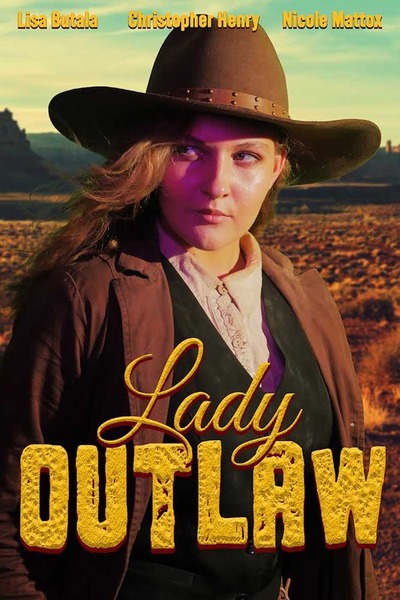
This low-budget Western does a lot of things right, but is not able to tie up all the loose ends in the final act. Most of which are ends that never needed to be loose in the first place. It takes place in 1890’s Oklahoma, when the gang of George ‘Bittercreek’ Newcomb (Henry) is trying to head back home. The gang includes a female outlaw, Rose Dunn (Butala), who is perhaps a little more moral than some members of the gang e.g. Tom, played by veteran villain Michael Ochotorena, this time covering up his impressive face tattoos. The situation comes to a head after Rose rescues a saloon girl, Ellie (Mattox), who just shot a man dead.
This won’t be the last woman Rose ends up saving, much to the chagrin of George. For they have enough trouble as is, being hunted by the dogged Marshal Hixon (Gillum). In an effort to shake the pursuers off, George and Rose head into Apache country, meaning they now also must deal with both no water and bad water. This seems a sequel of sorts to Mauser’s earlier Lady Lawman, which I haven’t seen – its protagonist seems to show up in an end-credit sequence. On the evidence here, I might have to check it out, because this is a decent character-driven piece. Although certainly chatty rather than shooty, it is largely interesting, especially courtesy of Ellie. She brings every scene she’s in to life, dragging the rest of the cast with her, if necessary. 

In particular, it’s as a result of her efforts that Dunn herself comes to life, after initially seeming like a bit of a stilted character. This may be intentional, a necessary survival technique in the otherwise all-male gang. Ellie brings Rose out of her shell, and by the ninety minute mark, we’d had a good arc for her, creating a fully rounded heroine, and a decent story. The problem is, the film runs 110 minutes. After forgetting about him in the middle, the film suddenly remembers Hixon, having to wrap up his story-line in a sequence which feels like an afterthought. There’s then an extended ending, and it seems equally tacked-on and unnecessary. This is definitely a case where less would have been more. 

There are a few gunfights, which provide the bulk of the action. These are marginally competent, and rather static, consisting mostly of people standing around while popping off shots at each other. The best sequence, for me, was the battle between Tom and Rose, a nasty bit of ground and pound, where both participants know only one is going to survive. The limitations on this front didn’t impact my interest, and until the final section, the performances and well-written dialogue held my attention effectively. There’s a lesson to be learned here for other low-budget filmmakers. If your foundation is solid, audiences will be willing to forgive the limited resources. 

Dir: Brett William Mauser
Star: Stars: Lisa Butala, Christopher Henry, Nicole Mattox, Wes Gillum

On the Run

★★½
“Sisters, doing it for themselves.”

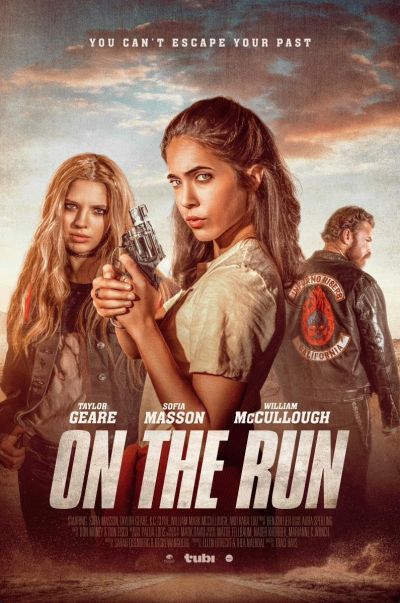
I guess it’s equality at work. This film, written by, starring and directed by women, proves that they are every bit as capable as men… Of knocking out vaguely competent, forgettable, low-to-mid tier action films, anyway. #GirlBoss This is another in the ongoing series of Tubi Originals I’ve reviewed here, including Calamity Jane, Kiss of Death, and The Vigilante. There’s definitely a “Tubi type” at play, with content which tends largely to go down tried and trusted routes, rather than pushing boundaries. It’s likely somewhat unfair – though only somewhat – to describe them as tending to be slightly more edgy versions of Lifetime content, but… hey, at least I’m not comparing them to Hallmark movies.
This is another which offers passable entertainment, yet contains little that would ever merit a rewatch. It begins with a falling out between biker friends Vince (McCullough) and Rick (Clyde) over a scheme to steal drugs from a rival gang. Fifteen years later, Vince gets out of jail, and makes a beeline for revenge. For Rick testified against him, entered witness protection, abandoned his road life, and is happily married to Laurie, with two teenage daughters, of sharply differing personalities. “I’m gonna be a teacher like mom,” proclaims good girl Kayla (Masson), while bad girl Paige (Geare) is doing an unconvincing impression of playing guitar in her room, and wants to run off from Utah to New York to be in a band.

Such things take a back seat after Vince shows up and kills mom. Rick takes his daughters on the road, but the pursuit is inexorable: the tracking software her parents installed on Paige’s phone backfires there. We then discover that Vince’s goals are not limited strictly to payback, because – and this is so obvious it’s not really a spoiler – Paige is his daughter, and he wants a family re-union. Fortunately, “Aunt Steph” (Pamela Rose Rodriguez) is also on the case. For she is actually the US Marshal assigned to the family by the witness protection program, and likely represents the best chance at stopping Vince before he is able to split up the sisters and spirit Paige out of the country. Frankly, it’s as generic as the title, and only qualifies for inclusion here due to a somewhat rousing final twenty minutes.

The script is the main problem. I’m far from convinced the writers know how witness protection works, or law enforcement in general, e.g. Steph taking Kayla along with her to rescue Paige. The explanation for why she doesn’t call for backup is… unconvincing, and that’s being charitable. Similarly, Vince growls at Rick, “No one breaks the code,” but the ease with which Steph gets his location out of another biker would, um, suggest otherwise. There’s also gratuitous terminal illness, so maybe the Hallmark comparison wasn’t so far off. Fortunately, the performances aren’t bad. Masson and Geare are credible as siblings, and that goes a significant way to keep this just about watchable.

Dir: Traci Hays
Star: Sofia Masson, Taylor Geare, William Mark McCullough, K.C. Clyde

American Samurai

★½
“Dollar-store samurai.”

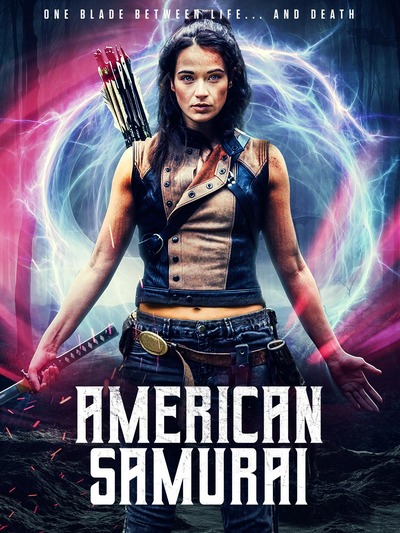
If I’d realized earlier this was by the director of the underwhelming, non-GWG film, Once Upon a Time in the Apocalypse, I would likely have set my expectations considerably lower. This has much the same “running around the woods after civilization has collapsed” vibe, though I did see Willard has added some digital effects to enhance the post-apocalyptic atmosphere. It is likely an improvement technically, but there just isn’t enough going on here to sustain interest. In this version, the rich have abandoned the failing civilization on Earth and decamped in self-sustaining spaceships. Everyone else has been left to fend for themselves, and this includes the community here, who keep themselves to themselves, deep in the Oregon woods.

In charge of its security are Larkin (Hastings) and her acolyte, Alyssa (Fortuna). They go on regular patrols around the area, or when they get word of strangers who might pose a threat. On one such excursion, they meet Ryan (Pelfrey) who begs for their help, offering them tickets to space if they help him reach the take-off point. Alyssa wants to take him up on the offer, but Larkin over-rules her. However, they come across a couple of the elites, who have returned to Earth on a “hunting expedition”, and the encounter turns lethal. This puts them in the crosshairs of the accompanying, ‘enhanced’ bodyguard (Mann). It poses a dilemma, because the last thing Larkin wants is to bring the pursuer back to their settlement. 

The idea isn’t terrible. Unfortunately, the execution largely is, in a variety of ways. The most obvious one is the action. Using the S-word (incidentally, there is zero connection to the 1992 film of the same name, starring Mark Dacascos) sets… certain expectations in regard to your fight scenes, which Fortuny and Hastings are in no position to meet. Slowly and carefully waving swords about is not an acceptable answer, despite guns and bullets apparently (though not consistently) being in short supply. Too many plot threads never go anywhere of significance. These include both Ryan and his space tickets, as well as little girl Mary, back in the settlement, who is supposed to be in dire need of a doctor – though she looks pretty healthy to me.

Fortuny and Hastings aren’t terrible; the latter grew on me after a shaky start to her performance. Their two characters form a decent contrast, the cautious Larkin with the impetuous and more emotionally driven Alyssa. The individual scenes where they are talking with each other are okay. It’s just there are far too damn many of them, each bringing the film to a halt. Then, when we finally see the settlement, it looks like a well-maintained holiday camp, where a hippie festival is happening (fire dancers!). It’s salutary to contrast this with another recently reviewed low-budget slice of post-apocalyptic cheese, in Ride Hard: Live Free, which did a far better job of working round its limited resources, and retained my interest considerably better. Guess they don’t make apocalypses like they used to.

Dir: Nathan Willard
Star: Rosa Fortuny, Larkin Hastings, Rob Pelfrey, Mikel Mann