



★★½
“A blonde, not having more fun.”
 I am reluctant to be overly harsh on this one, because I suspect I didn’t get to see this in its best format. The fact it feels very choppy and disjointed could potentially be a result of the IMDb giving this a running time of 136 minutes, but the only print available ran a good half-hour less. It was also dubbed from Greek into English and pan-and-scanned. Pretty much the holy trinity of cinematic suckage, right there. It’s the story of Natassa Arseni (Vougiouklaki), who lives in Greece when the Nazis invade during World War II. She’s initially largely unconcerned, but gradually becomes involved in the local resistance.
There are two men in her life. A former college friend, Max (Karras), followed his father’s German heritage, and is now a member of the occupying forces, who has feelings for Natassa. Her affections are elsewhere, haven fallen in love at first sight with Orestis (Papamichael), a partisan dedicated to ridding his home country of the occupying forces. She marries him and throws her lot in with the resistance, but is captured by the Nazis, and tortured for information. Except, this was a cold-blooded decision to sacrifice them, in order to provide false information to Germany about the location of a future Allied invasion. Orestis escapes capture, and hatches a daring plan to disguise himself and his men as the Nazi firing squad sent to execute Natassa. Fate, however, has other plans.
There are some good ideas here. The character of Max, with a foot in both camps is an interesting one, and I liked how there are biggest issues at play, requiring sacrifices – unwittingly, admittedly – from those on the front lines. Some scenes are very effective. The wedding of Orestis and Natassa, where they are ambushed on the way to the church, and she pushes through with the ceremony despite being shot, would be one. Then again, I’m a sucker for a bloodstained wedding dress. Vougiouklaki is strikingly blonde, and rather unGreek. However – again, perhaps due to the editing down to the most dramatic scenes, or maybe the dubbing – it feels as if she has her acting permanently set at a level of “11”, occasionally toppling over into overacting.
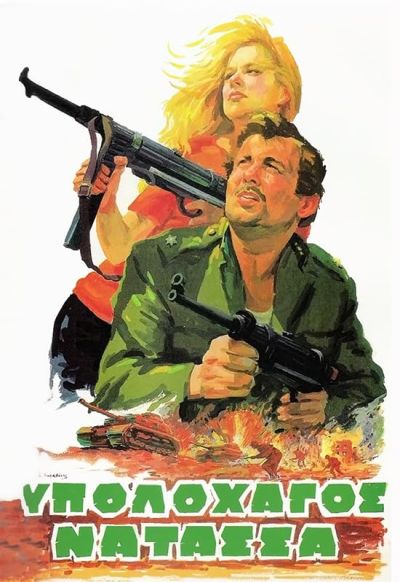
There are points where this is justified: I mean, you’re being interrogated and tortured (even if Max points out, “I’m not in the Gestapo, I’m in the SS” – not sure that makes much difference…), a little hysteria would seem fair enough. But when it seems most scenes are played out like that, it reduces the impact when it’s needed most. There are also moments which dangle awkwardly, such as the opening, where a post-war Natassa visits Dachau, or when she’s a singer, bursting into(presumably patriotic?) song when the Nazis show up. That feels like a knock-off of the Marseillaise bit from Casablanca. I don’t recall the heroine wielding an automatic weapon at any point, as the poster suggests, either. I’ve read that this was the biggest-grossing local movie in Greece for years after its release. Needs a remake, I’d say.
Dir: Nikos Foskolos
Star: Aliki Vougiouklaki, Dimitris Papamichael, Kostas Karras, Kakia Panagiotou
a.k.a. Lieutenant Natassja or Battlefield Constantinople