



★★★
“Innocence behind bars.”
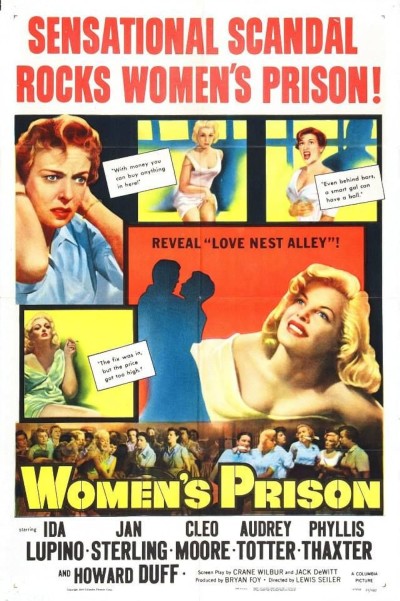 It’s always interesting to watch these early entries in the women-in-prison genre, and see the elements which are still staples of the genre, close to seventy years later. Well, some of the elements anyway: this dates from 1955, so is obviously tamer than a kitten on Valium in terms of sexual content. No strip searches. No prison showers. And when it’s revealed that one of the inmates is pregnant, it’s almost as much of a surprise to the audience as it is to the authorities. But it’s still recognizable as an ancestor, thanks to things like the sympathetic prison doctor, new inmate who shouldn’t be there, and the sadistic warden who rules things with an iron fist.
It is an ensemble piece, whose focus shifts throughout. Initially, it seems likely to be the story of “fresh meat” Helene Jensen (Thaxter), who is doing time for vehicular manslaughter, and has a tough time adjusting to life inside. Then it shifts to Joan Burton (Totter), an accomplice to her robber husband, Glen, who is doing time in the men’s prison next door. He has something vital to tell her, and makes repeated attempts to sneak across the border to visit Joan. On the other side of the bars is the power struggle between the warden, Amelia van Zandt (Lupino) and jail physician Dr. Crane (Duff). Her methods are anathema to Crane, who flat-out calls van Zandt a psychopath. He may have a point.
Despite the lack of salacious elements, this is still entertaining fodder. There are a lot of amusing characters among the inmates, from cheerful fraudster Brenda Martin through to black inmate Polyclinic Jones – named after the hospital where she was born! She’s played by Juanita Jones, who’d be Oscar nominated a few years later. Interestingly, despite this being years before the Civil Rights era, the prison is not segregated: the black inmates have their own cell, but otherwise mix freely with the white prisoners. Race is never even mentioned here. There’s an impressively meta moment too, when two guards are discussing a cinema trip. “They never get things right in prison pictures,” muses one, and is told, “I know, but I like to pick out the flaws.”
This happens just before another familiar element: the prisoners riot and take over, after being pushed too far. In this case, it’s van Zandt’s brutal interrogation of Burton which proves the tipping point. Or at least, “brutal” by fifties standards; it’s not much more than a bit of light slapping around. The rebellion leads to tear-gassing and hostage taking, as the women seek to make van Zandt pay, plus Glen roaming around with a pistol. Really, the men’s side need to look into their security protocols, I reckon. For all its innocence in many ways, bordering on naivety, there are still moments which have an emotional impact; I found the death of one inmate surprisingly affecting. Released in Germany as Revolte im Frauenzuchthaus, which I only mention, as “frauenzuchthaus” may be my new favourite German word.
Dir: Lewis Seiler
Star: Ida Lupino, Howard Duff. Audrey Totter, Phyllis Thaxter
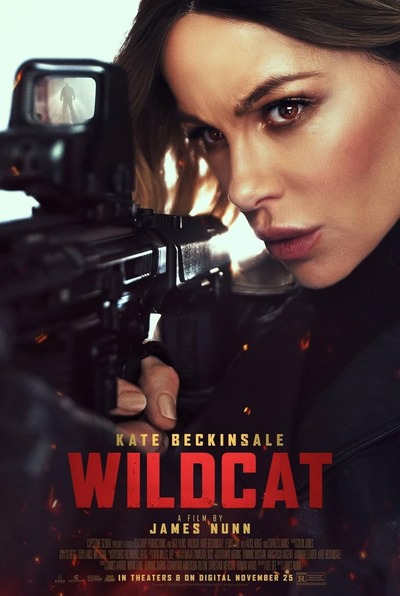 I was quite startled to read some of the scathing reviews this received. For I genuinely enjoyed it, to the point it likely came one element (which I’ll get to) from a seal of approval. Sure, it’s nothing particularly new overall. However, I found it consistently enjoyable, to the level I felt no desire to look at my phone at any point. These days, that’s high praise indeed. It takes place in a slightly alternate London, where gang bosses Frasier Mahoney (Charles Dance) and Mrs. Christina Vine (Krige) are on the edge of a war for control of the city. There’s also a rogue element, in the Mushka Gang, who have turned an East End estate into a no-go area.
 This was a real and pleasant surprise. I wasn’t even sure if this would qualify for the site, or if it would end simply being too gentle. Whole it’s not going to get any awards for hard-core action, it does fit in here. More impressively, it managed to make my empathize with someone whose views are ones I’d generally disagree with. It takes place in Iceland, where Halla (Geirharðsdóttir) is a middle-aged, single woman, waging a near one-person campaign of sabotage against heavy industry, mostly by disabling the power-lines which supply electricity to it, disfiguring the landscape and exacerbating climate change. It’s a game of cat and mouse, with the authorities keen to stop the eco-terrorist from dissuading foreign investors.
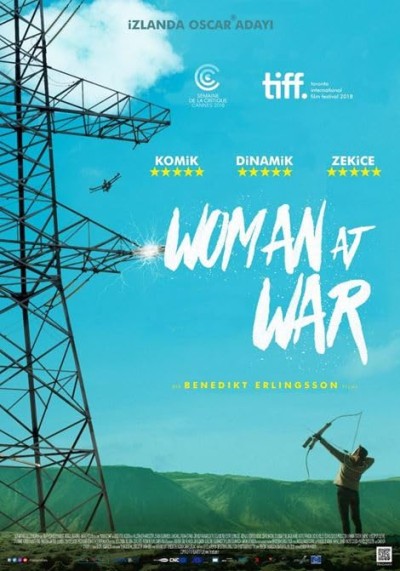 However, Halla has issues of her own, beyond the net closing in on her property destruction. A long-dormant adoption request is suddenly approved, and she can’t risk further criminal acts, as a conviction would bar her from proceeding. She intends to go out with a declaration of her manifesto, literally flung from the Reykjavik roof-tops, and a final act, stealing Semtex to blow up a key electricity pylon. Her accomplice, government employee Baldvin (Ragnarsson) is increasingly concerned about the “one last job” trope, and twin sister Ása (also Geirharðsdóttir), a yoga teacher, threatens to put a spoke in the adoption process too, by vanishing off to India for two years to live with her guru.
 I would have sworn I had seen every example of Hong Kong girls-with-guns movies from the eighties. But this one had managed to escape my attention completely for 35 years, until accidentally stumbling across it on YouTube. It’s perhaps partly because it never seems to have received any kind of post-VHS release, being unavailable on DVD or streaming sites. Which is a little surprising since it combines two genres that have been quite popular in the West: not just GWG, but also hopping vampires, as in the Mr. Vampire franchise. It’s a rather awkward combo, and there’s definitely significant potential wasted. Yet I’m fairly certain it’s going to be unlike anything you’ve seen before.
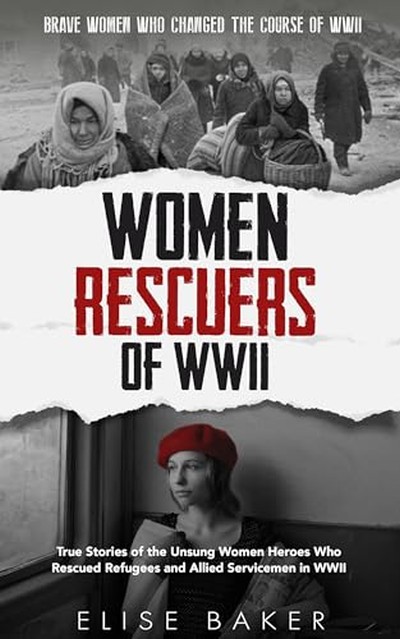 With the somewhat accurate and rather clunky sub-title of “True stories of the unsung women heroes who rescued refugees and Allied servicemen in WWII”, this is a book whose idea I liked rather more than the execution. The core is six chapters, each devoted to a woman or pair of women, who operated before and around World War II, mostly helping refugees to escape the Nazi regime as it swept across Europe. Every chapter has the same structure. Each begins with ‘The Threshold’, describing how they came to take on that role; then ‘The Move’, covering their heroic activities; and finally, ‘The Close’, detailing what happened to them afterward.
 It generally makes sense for a film to escalate over its duration. The problem here is, what escalated was my annoyance. It began as irritation, but by the end I was deeply peeved, because the stupidity is strong in this one. It begins with two different strands. In one, former desperado Lee Hughes is visited in his mountain resort by ex-colleague Jimmy Montague (Fafard) and his minions. They want to know the location of two million in proceeds from a previous crime Lee and Jimmy pulled. In the other, lesbian couple Lane (Newton) and Megan (McClay) are busy being lesbionic with each other, because they’re lesbians. Did I mention they are a same-sex couple?
 There are reviews which are easy to write, because – good or bad – the subject generates a lot to talk about. This is not one of those. It’s a bland slice of semi-urban fantasy, which just… sits there, the literary equivalent of a bowl of vanilla pudding. It’s not good, nor is it bad enough to be memorable. It merely exists, remarkable mostly in how unremarkable it is. Put it this way, I finished it less than 24 hours ago, and I can’t even remember the heroine’s name, so little impression was made. Instead of writing, I find myself almost preferring the Star Trek musical episode Chris is watching next to me. And I don’t really like Star Trek. Or musical episodes.
  To be frank, I was expecting rather more action given the title here. Almost all of it, however, takes place “off-screen”, as it were, being described second-hand, rather than experienced. It makes sense in the context of the book, and it’s not badly written. But when you use the word “warrior” or derivations thereof, not once but twice in your title, it would seem fair to expect a higher quotient of… warrioring. I tagged this as fantasy, mostly because it clearly takes place elsewhere and/or elsewhen. It is fairly grounded e.g. no dragons or vampires, but certainly contains elements I would call mystical.
 I think it has been a long time since a film has so completely yanked the carpet out from under me. We might have to go back all the way to David Lynch’s Lost Highway, and that was 1997. So it has been a while. I’m not sure if it works here. It did in Highway; I’m just uncertain whether Khalili is as good a film-maker as Lynch. It’d likely require a second viewing to decide, and I wasn’t that impressed elsewhere to justify a repeat. I will remember it though, and that’s more than can be said for many of the films I review here. So it was not a complete waste of time.
 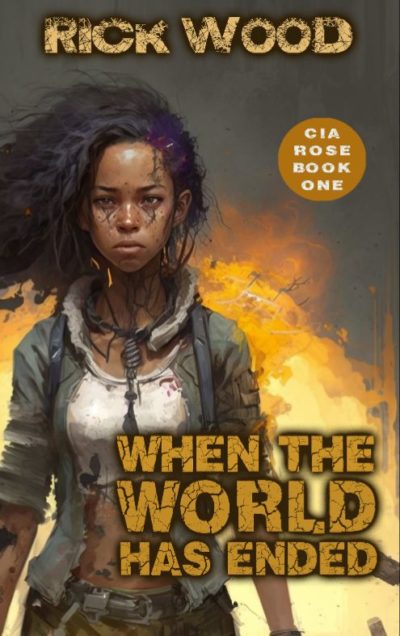 “It just seemed as if Hell opened up one day and that was that. Instant carnage, liberated monsters, death for all. They rose from somewhere beneath the ground, attacking for no clear reason and killing until God knows when.” That’s how this starts, so there’s no hanging around. Cia Rose is one of the few survivors, for whom every day survival is a perilous endeavour. She’s seventeen, and the daughter of a scientist. When the monsterpocalypse took place, the rich, influential and powerful – who, it appears, knew this was coming – headed for their shelters. Her father was allowed in, to research the invaders. Cia was not.