



★★
“Pap fiction.”
I am not a fan of Quentin Tarantino, outside of Kill Bill. Even as early as Reservoir Dogs, I found his style to be self-indulgent, and could never hear his characters speaking in their own voices, only QT’s. He seems to be capable only of cobbling together elements and influences from obscure, yet generally superior movies, and sprinkling them with pop-culture riffs and dialogue that’s so fake-sounding and artificial, it needs a warning label. So, while I appreciate the irony of someone ripping off the master of rip-off cinema, as Morgan does here, it’s not a world into which I willingly travel.
The influence here is palpable from the opening scene, when bar owner Jo Lee-Haywood (Price) is interrogating a thug she has captured and, it turns out, is tied up in a backroom of the bar she runs. Jo ends up talking about motivational speaker Tony Robbins, and how everyone is motivated by pleasure or fear, in a speech which couldn’t be more Quentin Tarantino, if it were licking the heroine’s bare feet. More or less from then on, it seemed painfully apparent this was the kind of film I was going to have to endure, rather than enjoy. And that was largely correct.
Jo, it turns out, is in debt to some rather nasty people, in particular a gangster named Sam “Hollywood” Barone (Urbas). He sends his henchmen to make Jo and her daughter, Scarlet (Vincent), an offer they can’t refuse, involving handing over the bar. Only, Jo is all, “Nah, we’re good, thanks,” and is having none of it. For she is not exactly the innocent bar-owner she seems, but came to the small Michigan town in order to escape a particularly brutal past. This isn’t her first time at the crime rodeo, shall we say – as we find out via another Tarantino-esque device, the needlessly convoluted time-line.
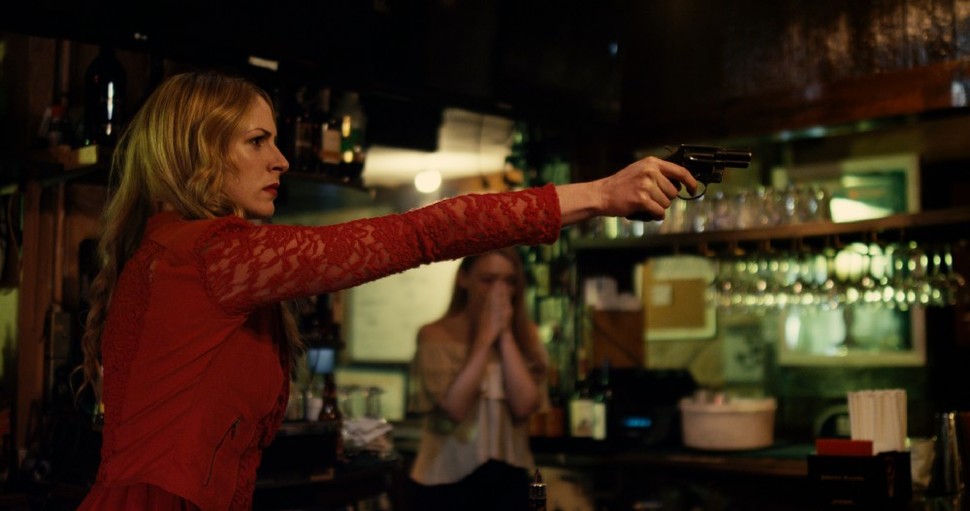
Morgan also appears to be a fan of Sin City, throwing in stylistic flourishes such as switching to rotoscoped animation at random. Most of these are more aggrandisements than art, save for Hollywood always being depicted in black-and-white. That’s a great way of indicating his status as a character straight out of film noir. The rest, though? Style for the sake of it, down to the cribbing of musical cues lifted from Morricone scored spaghetti Westerns, and a character who seems to have wandered straight off those same dusty streets.
And it’s a shame, as in Jo, the film has a character which could have been a classic – even if the whole “left in a coma” thing is also cribbed from a certain QT film you’ve probably seen. Price plays her character like a velvet glove cast in iron (that’s one cult film not referenced!), and it soon becomes apparent that, when it comes to protecting Scarlet, Jo has no limits. Exploring this aspect, rather than making both story-line and players subservient to the movie’s look and feel, would have helped avoid this coming over like a fan submission to TarantinoCon 2018.
Dir: Usher Morgan
Star: Elyse Price, Yaron Urbas, Katie Vincent, Joe Trombino
 Despite a startling cover, this isn’t as sleazy as it seems. Indeed, even the title appears to be erring on the side of restraint, having apparently avoided the more obvious (and arguably, accurate) one of Killer Pussy. While the heroine certainly has an… interesting choice of costume, that’s as far as the film wants to go. It’s an odd approach: a sleeve like that sets up certain sets of expectations, which the movie has no apparent interest in matching. It’s not as if anyone of a sensitive nature is going to have got past the cover, so it seems odd to exercise such self-discipline when it comes to the content.
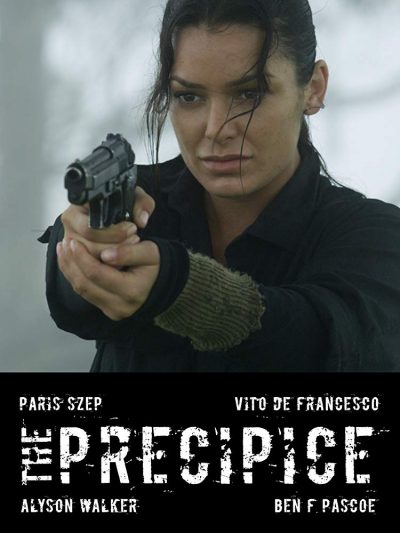 There’s nothing wrong, as such, with a film playing its hand close to its chest. However, you’ve got to give the audience enough information to keep them interested, and wanting to find out more. It’s here that this movie fails entirely, doggedly remaining so reluctant to tell you anything, I wanted to strap it down in a chair and start waterboarding. We don’t even get names for anyone involved, it’s that willfully unforthcoming. This begins in the aftermath of a shoot-out at a wind-farm, from which there are apparently only two survivors: a woman (Szep) and her captive (de Francesco). They head across the rural terrain towards a rendezvous with her allies, pursued not only by the captive’s allies, but also other interested parties.
 Origin stories are all the rage, it appears. Though it’s probably just coincidence we watched this prequel to
  Coming in on a wave of hype, e.g. “The Best Indie Science Fiction Movie Since Moon“, I guess I should have listened – because I didn’t think Moon was
  To some extent, this was the film which “broke” Miyazaki in the West, being his first feature to receive an unedited theatrical release in America. It wasn’t a huge commercial success, taking only about $2.4 million in North America. But it was very well-received, Roger Ebert listing it among his top ten films of 1999. It likely opened the door for the success of Spirited Away, which would win Miyazaki the Oscar for Best Animated Feature at the 75th Academy Awards. But if I’m being honest, I don’t like it as much as many of his movies. While there’s no denying the imagination and enormous technical skill here, it doesn’t resonate emotionally with me in the same way. I think it’s probably the central character, who is relatively bland and uninteresting, even compared to other characters in the movie.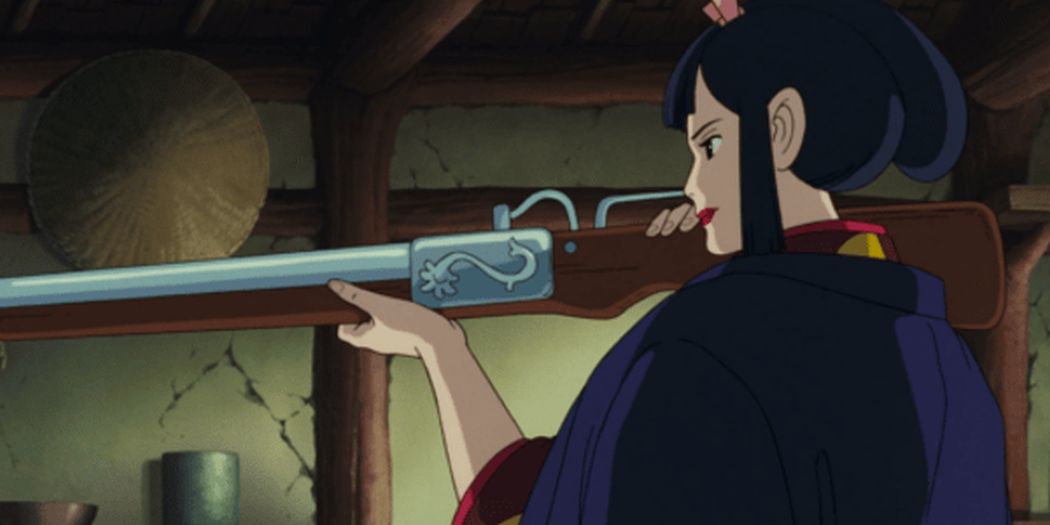
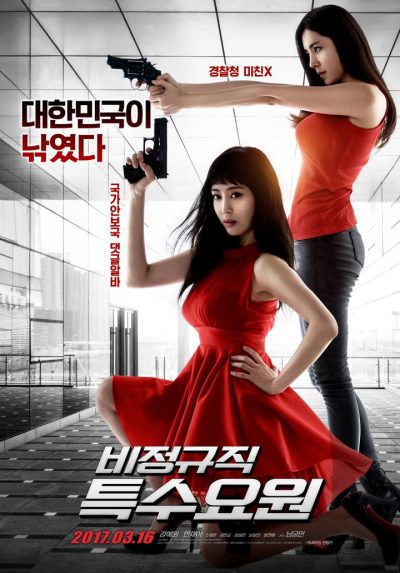 An amiable piece of light fluff from Korea, while this probably doesn’t need to be 117 minutes long, the time passed comfortably enough. After many years of failing the civil service entrance exam, Jang Young-shil (Kang) finally succeeds and is rewarded with a contract job in the national security agency. However, she’s still mediocre, and is laid off. Fortunately, she overhears her boss (Jo) having been phone-phished out of $500,000 of departmental funds, and is the only agent available to go undercover in the ‘boiler room’ carrying out these scams. There, she recognizes another employee, Na Jung-an (Han) – having seen her take out a pickpocket on the subway, she knows Na is an undercover cop. The two women, of sharply disparate backgrounds and skill-sets, form an uneasy alliance, seeking to take down the charismatic boss of the con company, Min Seok (Namkoong).
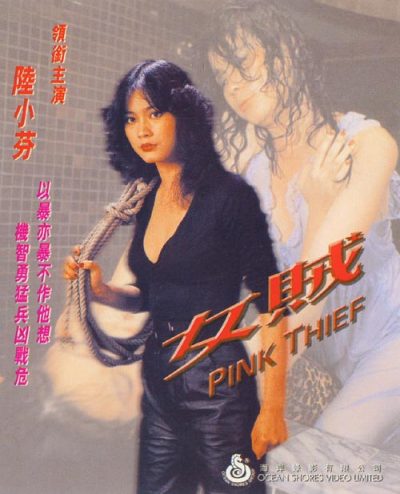 Lan Hsiao-Tieh (Lu) is one of four illegal immigrants to Hong Kong, who manage to escape from the human traffickers bringing them to the colony – albeit after Lan has been raped by one. She and her friends just about manage to eke out a living on the edge of society, which treats them very unkindly in comparison to legal residents: for example, working as a coolie, they get only a fraction of the wages. As a result, they’re forced into criminal activity. One of the victims of the resultant pick-pocketing is the feared Chief Detective Lu (Lui), who tracks down the gang and makes them an offer: go undercover and help in his investigation of a Triad gang called the Eagles, in exchange for legal status. Lan is doubtful – until she realizes that one of the targets is the man who raped her. With the assistance of training from a retired thief, Lan is inserted as the moll of the gang’s leader, Hao (Tien Feng).
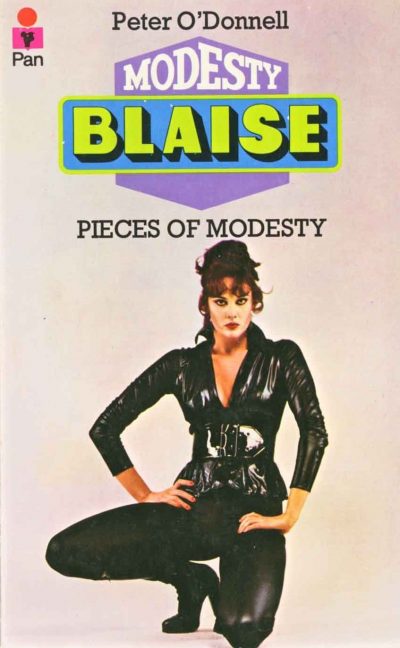 While this is the sixth installment of the series, because the stories are strictly episodic and not connected to each other, and are set at various times in the 60s, they don’t really have to be read after the first five novels to be understood and appreciated. (It would probably be best to read the first novel first, just to provide a foundation.) In a couple of stories, references are made to events, and characters reappear, which are probably drawn from the novels; but any information about past events that we need to know is supplied. Five of them are written in third person; “I Had a Date with Lady Janet” is unique in that Willie narrates it in first person, which helps to develop his character more deeply. The settings are mostly British or continental European, with one tale taking place in South America. All six adventures involve Modesty in a wide variety of situations, which illustrate various aspects of her personality and abilities; that may explain the collection’s odd title. (Don’t worry –Modesty is not dismembered!)
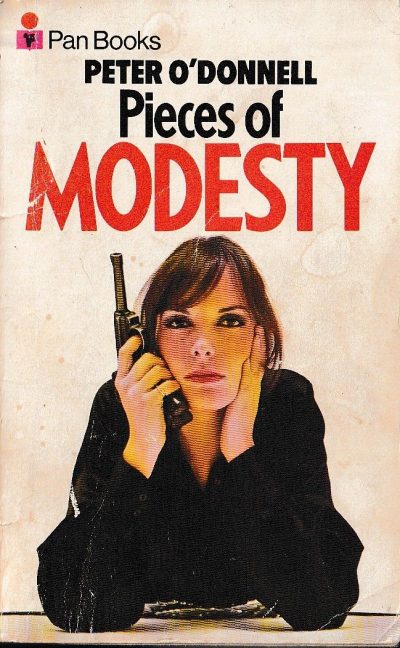 “Salamander Four” is the only selection here that indicates Modesty’s openness, on occasion, to uncommitted sex (although there’s no explicit sexual content there, or in any of the stories), but the psychology of it is understandable and she comes across to me as misguided rather than callous and selfish –it’s clear that her intention isn’t knowingly to be hurtful or exploitative. Finally, “The Soo Girl Charity” is the most disturbing of the stories, in that (though without being graphic) it provides a look into the dark reality of the exploitation of women by sexual sadists, and into the even darker reality of what pounded-in cultural brainwashing of females to accept patriarchy and male domination actually does to their psyches. (I didn’t feel that the victim here being Asian indicates racism or cultural stereotyping; I think that simply reflects a reality that, at least in the 60s, traditional rural Asian cultures still tended to promote that kind of brainwashing to a greater degree than Occidental ones –even though the sexism of our culture is bad enough.)
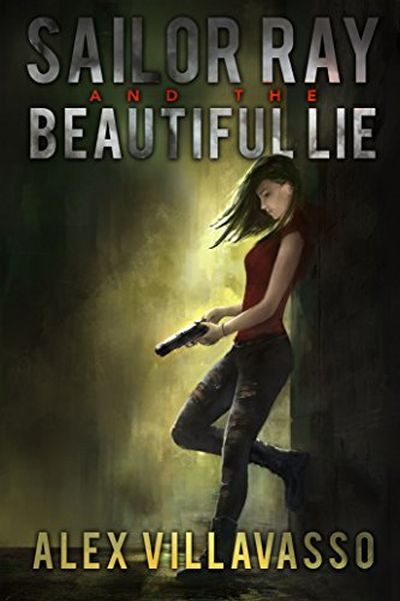 This got off to a frankly rocky start, to the point that a few pages in, this felt like it might become a very rare DNF (Did Not Finish) book. It’s an incredibly clumsy and stilted opening, depicting the internal conversation between Sailor Ray and the demon who inhabits her. Literally, “Why am I reading this?” bad. Still, I persisted: and in the end, the story redeemed itself, though the final third was considerably weaker overall.