
★★★½
“Patience is a virtue.”
 If you came into this with absolutely no previous knowledge (including the poster on the right!), you’d be forgiven if you spent the first forty minutes thinking this was an independent drama about the perils of professional dating life in the big city. Then, suddenly, it’s very not. But initially, it’s about Nicole (Shannon), who while she may be a little strange and anti-social, doesn’t seem all that far outside the bounds of normal behaviour. Well, I guess her carting a bottle of hard liquor to work, for drinking sessions in the bathroom, is somewhat problematic. Maybe her imagining dinner with her parents could be a bit of a red flag. [The film makes nice use of switching between b&w and colour, to separate reality from flashbacks and fantasy] But, all told, she’s fairly high-functioning.
That all changes when she goes out on a rare date with John (Green), whom she met through an online app. She’s simultaneously fending off advances from a co-worker (Busey) and neighbour (Lockhart) – it must be said, all the men here fall somewhere on the creepy/predatory spectrum. What we know, but Nicole initially does not, is that John is well toward the latter, with a fondness for date rape and every intention of adding Nicole to his list of dubious conquests. However, her day drinking has given her a remarkable tolerance for alcohol, so when he makes his move, she’s not as drunk as she should be, and fights back, with no shortage of vigour. As well as a knife. That’s where the tone of the film changes drastically. We’re not in Sex and the City any more, Toto.
The rest is considerably closer to pitch-black humour, as Nicole has to come to terms with the consequences of her actions. Realizing what John was intending, she decides simply to dispose of his body. This requires a late-night trip to the hardware store, where the Goth assistant nods approvingly at her selection of tools. Then there’s the actual dismemberment, not helped by John’s corpse continuing to talk to her throughout the process. For example, he requests a refill on his wine, only to realize it’s hard to drink since she’s removed his hands.
This disposal reminded me a little of A Good Woman is Hard to Find, though that was thoroughly serious. There are also elements of Ms. 45. in a blurring of the lines between reality and delusion, which are deftly handled. Regular readers won’t be surprised to learn I preferred this second half of the film. I was actually a bit disappointed things ended when they did, more or less with Nicole’s return to work, and in a maybe or maybe not more well-adjusted state. It felt there was mileage left on the table, with her further adventures as an IT worker, moonlighting as a killer of sexual predators. We can only hope for Nicole 2: Ax Me Anything at some point down the road.
Dir: James Schroeder
Star: Tamika Shannon, Stephen Green, Ke’Shawn Bussey, Tre Lockhart

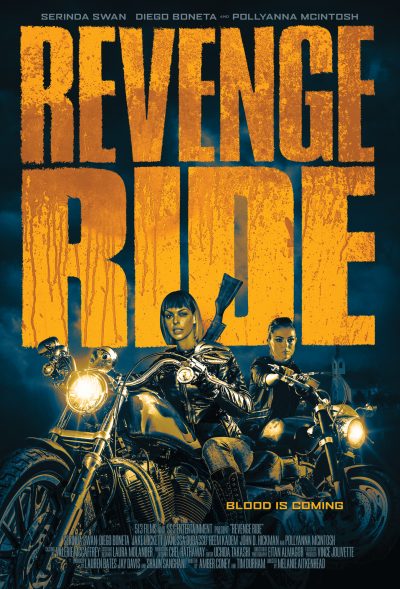 Mary (Dubasso) is drugged and raped by three members of the football team at a college party. Believing neither the college authorities nor the police will do anything, she turns to cousin Maggie (Swan) for help, because her relative is a member of the all-female Dark Moon motorcycle gang (eloquent slogan: “Eat my pussy”). Run by Trygga (McIntosh), they take revenge on the rapists, branding their catchphrase on the perpetrator’s asses, and leaving them in full view on the college campus. The fraternity boys don’t take this kindly, and strike back, causing things to escalate towards an all-out war. Complicating matters are Maggie’s increasing feelings for Brian (Boneta), one of the team, though uninvolved in the rape.
 Halle Berry was born the same year I was. There is, however, just one of us that is capable of convincingly playing the role of a mixed martial artist. To give you another yardstick, the lead in this was originally going to go to Mrs. Ryan Reynolds, Blake Lively (

 Whenever the Olympics are on, we love watching the weird sports that never get covered the rest of the time. That means things like handball, archery and fencing, so I was particularly interested by this Russian film, based around the quest for gold in the women’s sabre event. While it does struggle to move past the usual cliches of sports films, it’s done with enough energy to work. The two protagonists are Aleksandra Pokrovskaya (Khodchenkova), a veteran coming to the end of a long, successful career, and Kira Egorova (Miloslavskaya), a brash teenager who arrives on the scene with a blast, and whose unconventional style causes fits among other fencers. Aleksandra has one final crack at the prize which has eluded her – an Olympic gold – but Kira poses an unprecedented threat to that ambition.
  Which brings us to CCW’s Goddess of Gore 2, held at American Legion Post #335 in South Gate, California, on October 3rd, before a crowd of… dozens. Okay, that is a bit snarky. We have worked for and patronize a lot of independent federations locally, and the crowd for them is typically along similar lines, between one and two hundred. That is a bit sad, because given what the participants go through, they deserve more. Then again, tickets for this show started at forty bucks, which is easily twice the price of what we’d pay here in Arizona. Maybe, like petrol, professional wrestling just costs more in California.
 I’ve never played League of Legends, but the good news is, you don’t need to, in order to enjoy Arcane. While that may provide some extra depth, it works perfectly well on its own. There is a degree of over-familiarity with the high-level scenario, which is Generic Fantasy Plot #3. Per Wikipedia’s premise, “Amidst the escalating unrest between the advanced, utopian city of Piltover and the squalid, repressed undercity of Zaun…” Yeah, it’s class war time again, cut from the same basic stamp as