★★★
“Edgar Wallace meets Russ Meyer”
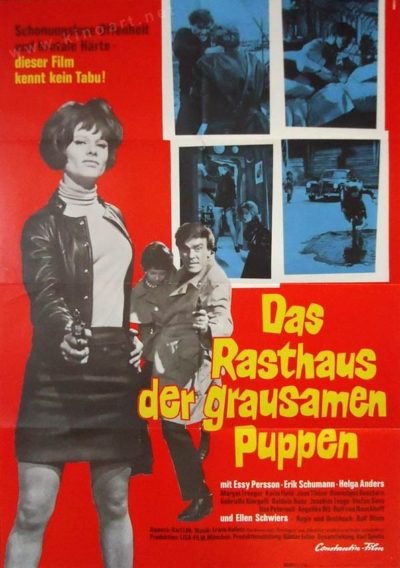 I’m usually not a too big fan of trash movies, because a lot of them are not so much trashy, as they are boring. Nevertheless, I’m always in for a good, entertaining bit of trash, as long as I don’t find it too excessive. There is no doubt that German movie history is full of it: just think of all those Schoolgirl- and Housewife-Report films of the 1970’s. Though most of these movies can be ignored, since very often, they are just no fun at all.
Not so this jewel, stumbled upon when going through the extensive selection of German Amazon Prime. Made during a time when German movie entertainment found itself at a crossroads, with “Papas Kino” (Dad’s cinema) still running in cinemas, but the new German cinema not having arrived yet, some strange movies found their way on the big screen. 1967 was a year when German Edgar Wallace movies (having been made in colour for about two years) were still finding audiences before the students’ revolts, yet movies in general outside the countrt, became kind of “wilder”. A little bit more erotic titillation found its way in, but the wave of German softcore comedies hadn’t started yet. This movie therefore falls in this very narrow time frame between “older” and “newer” German film styles, which makes it very difficult to define. Though, let me have a try!
The story: Bob (Schumann) and Betty (Persson) try to break into a jewelry store. Unfortunately, the robbery goes wrong, and when trying to escape, Bob kills a policeman with his car. He escapes, leaving the unconscious Betty to pay the price, and she is sent to prison. There, terrible conditions rule. Girls are mistreated in order to keep them in line. Some girls have turned – you’ll be shocked! – to lesbianism. And the female chief warden, with the remarkable name of Francis Nipple (!!), wants to force Betty to have sex with her. Betty instead takes her chance, killing Nipple and breaking out with 4 other girls.
They flee into the Scottish Highlands (though this was filmed in Trieste, Italy), where Bob now works as a waiter in an inn. Betty’s idea is to kidnap the psychologically deranged wife (Trooger) of rich factory owner Oland, blackmail him, get to the coast with the money, and head abroad for a happy life with Bob. Unfortunately, Bob has a taste for one of Betty’s pals. Meanwhile, the factory owner has an affair with his female assistant and is already figuring out how to get rid of his wife. You can probably imagine, things don’t go as planned and… well, go a bit haywire!
Inn is one of the weirdest and trashiest movies from Germany I’ve seen in some time. Part of the fun is, you see a movie that basically comes across as the mad love-child offspring of a typical black and white, Edgar Wallace “krimi“, and something close to Russ Meyer’s Faster, Pussycat! Kill! Kill! – what a crazy genre mix! The weirdest thing is: it is wholeheartedly entertaining, though you can never take it seriously for a single moment. It comes off as wanting to be cool but not really being able to. This is in contrast to Faster, Pussycat!, which is very cool and embraces its trashiness. This constantly tries, but cannot escape that it is, in the end, a German movie. When local film makers tried to “rebuild” successful foreign recipes such as spaghetti Westerns or the Hammer Horror movies, the results always left an impression of amateur dabbling.
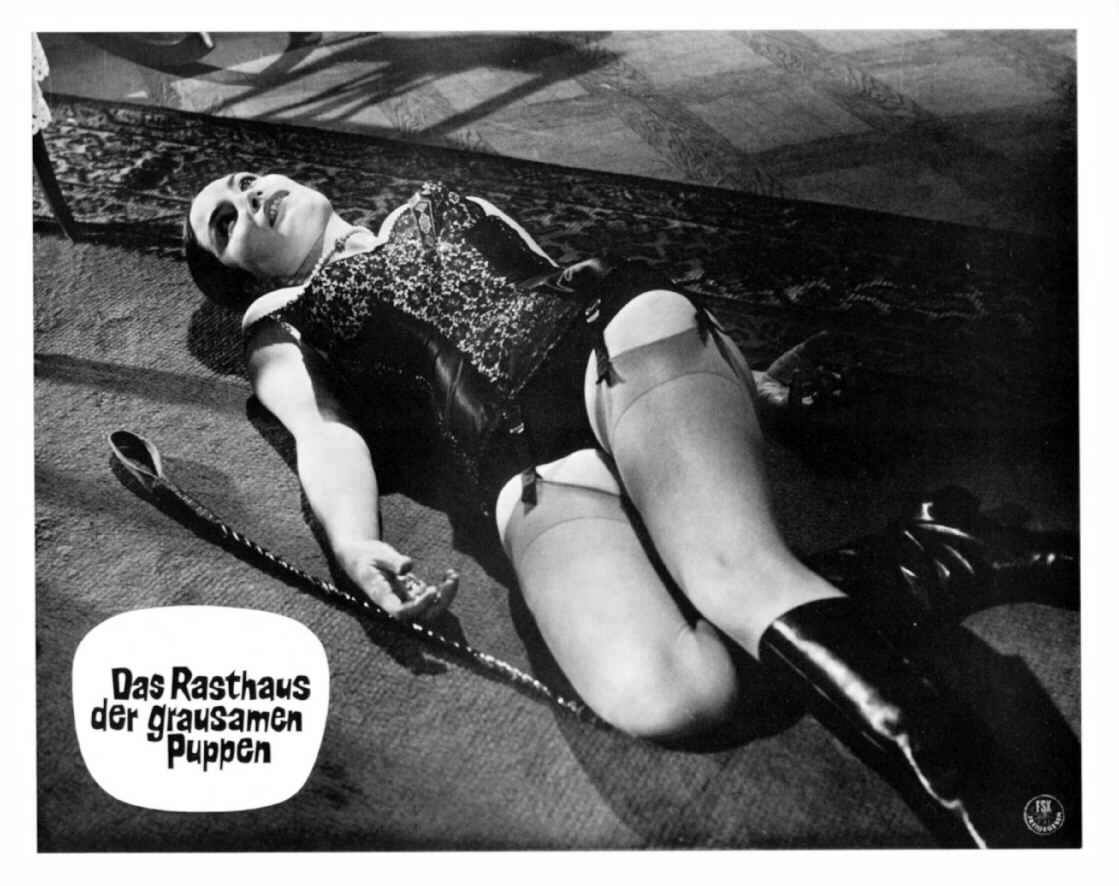
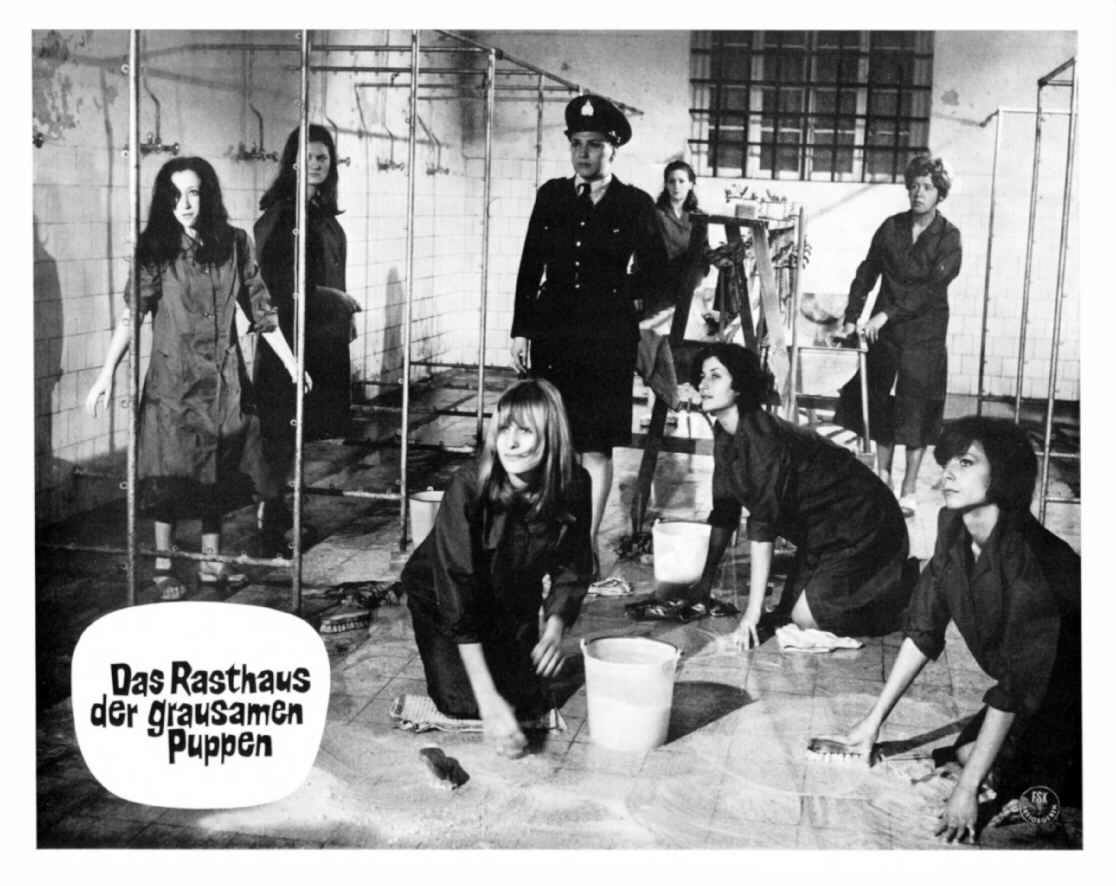 The setting and style – production design, costumes, cars – reminded me strongly of the Edgar Wallace movies. At the same time, you see women appearing as erotically as they could without ever being nude. Add to that the typical wooden acting of an Edgar Wallace movie, and you have an involuntary comedy of the highest order. I was screaming my head off because I found it hilariously stupid, especially when some of the actors tried to be “very emotional” and over-acted, without being able to be convincing. Also, I had to laugh at Betty killing off nearly everyone who has the misfortune to be in her line of fire. She is very trigger-happy and has a tendency to shoot first and ask questions… never.
Moments where Betty or other girls seemed to question their acts occasionally made me wonder. Was this movie meant at some point to be a serious crime drama about how social circumstances ruin young women’s lives? But then another nonsensical scene shows up. For example, an innocent witness discovering the dead inn-keeper, running up the stairs, screaming for help (as in an Edgar Wallace movie), screaming more when she met another of the girls, then while shouting “Don’t kill me! I want to live!”, falling out of a window. As they say, “Hilarity ensues…”
You won’t find great German “stars” in this movie. Erik Schumann (Bob) mainly reached my attention by being the German voice of Hollywood star Louis Jourdan, and Margot Trooger was better known for roles in … Edgar Wallace movies, as well as Pippi Longstocking and other Astrid Lindgren series/movies. I don’t know any of the other actors in this German-Italian co-production. The director Rolf Olsen was a very busy Austrian director who seemed to have directed everything that came his way, although not often with well-known German stars.
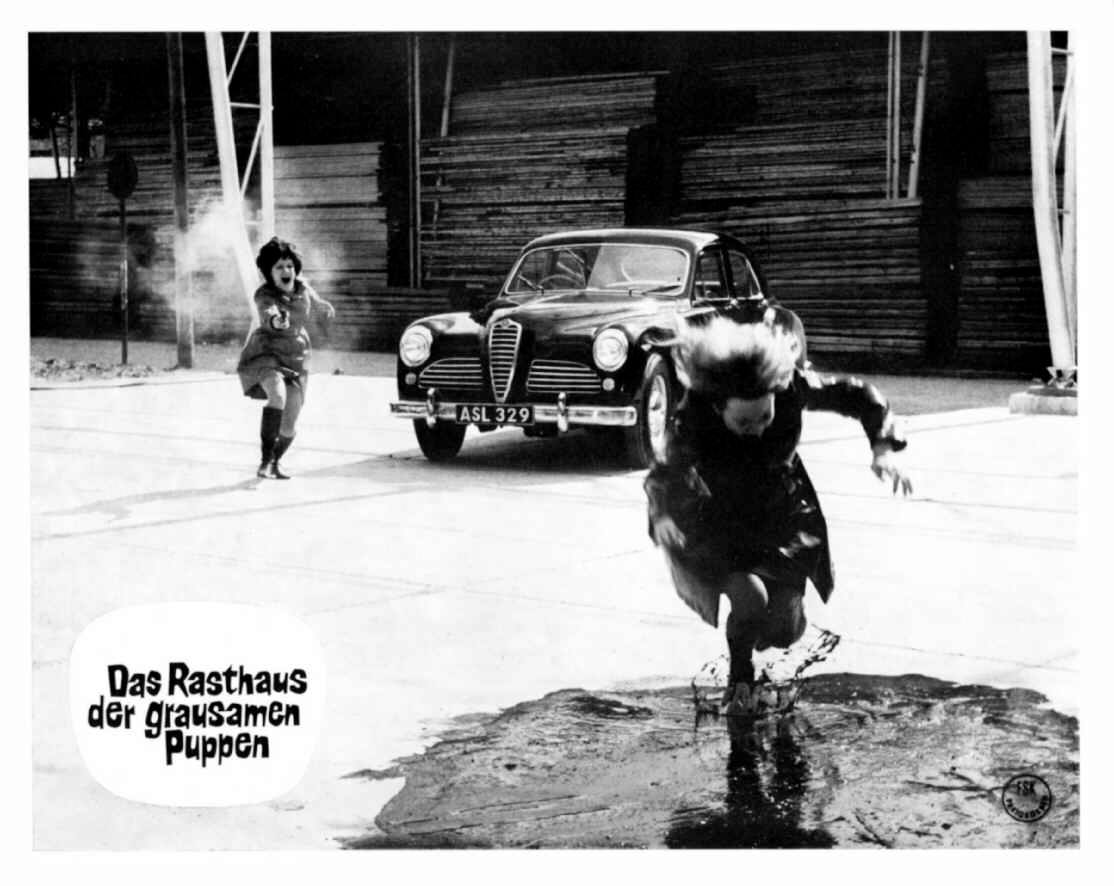 No, this is to be taken as seriously as long-running German TV series Hinter Gittern (Behind Bars), about a women prison. Which means: not at all! I always thought this genre came into existence in America in the 70s, having seen movies such as Black Mama, White Mama. Jonathan Demme, who would later direct Silence of the Lambs, also contributed to it with Caged Heat. It obviously is older than I imagined, but then I’m no expert on this subgenre! [Jim adds: The women-in-prison film as we know it goes back to 1950 with Caged, starring Eleanor Parker and Agnes Moorehead. I think the earliest we’ve reviewed here was 1955’s Betrayed Women.]
It seems the movie may have originally been longer. The version available today has a running time of 85 minutes, but the original cut is said to have had a running time of 96 minutes. It seems that the German film censorship organization, FSK (Freiwillige Selbstkontrolle = Voluntary Self Control) must have cut the movie extensively at the time. The trailer indicates that a water torture scene in the prison, the attempt by the female prison warden to force herself on Betty and the death of the inn-keeper have been cut. There is also a short clip in the trailer, which seems to indicate some of the five girls meet a bloody end in the inn; again, this is not shown in the version I saw. Instead, that seems to indicate two of them got away, as they never appeared in the movie again.
It’s a strange movie, attempting to marry the old with the new. But while I wonder if director Rolf Olsen might have seen and been inspired by Meyer’s Pussycat, I’m quite sure that this movie was seen by and inspired some Edgar Wallace directors. For the role of the sadistic prison warden would appear again in – you guessed it! – a 1968 Edgar Wallace movie, Der Gorilla von Soho (US title: “Gorilla Gang”),taking care of girls in a prison! Finally, the German title of this 1967 movie is Das Rasthaus der grausamen Puppen. “Rasthaus” being the German word for what the translation program tells me in English is “roadhouse; highway restaurant (am.)”. So I’m not quite sure “inn” is the right word for “Rasthaus”. The title for the dubbed American version was The Devil’s Girls, by the way.
Dir: Rolf Olsen
Star: Essy Persson, Helga Anders, Erik Schumann, Margot Trooger
a.k.a. Das Rasthaus der grausamen Puppen




 At least a star of the above rating is purely for the concept, which is one just brimming with potential. The problem here is entirely down to execution that isn’t just lacklustre, it’s entirely devoid of all lustre. First and foremost, there is absolutely no reason for this to have a running time of 122 minutes, especially when the first half makes its point inside about ten, and then sits there, as if waiting for a bus. It’s a particular issue, because it’s only the second half where things get adequately interesting. You will need a great deal of patience – or, probably more likely, some household chores to take care of – in order to reach that point.
 Although I first experienced this series through the two sequel novellas, this second installment of Armstrong’s Nadia Stafford trilogy would be best read after the series opener, Exit Strategy. References are made to events in the first book, and to parts of Nadia’s backstory which are detailed there, and these are much more meaningful if you’ve read the first installment. Even more importantly, Armstrong really introduces Nadia’s complex character and current circumstances in depth in the first book; the development she undergoes here presupposes that foundation. (That’s also true for other characters from that book who continue to play roles here; you need the full-orbed picture to understand them.)
 Even with her off-the-books side income, Nadia can’t afford to pay more than a tiny staff at her guest lodge; but out of kindness, she’s given a job as assistant housekeeper to a 17-year-old girl from the nearby small town of White Rock, Sammi Ernst. Sammi’s foul-mouthed, barely literate, and has a chip on her shoulder; the latter isn’t surprising, given her life situation. She’s the out-of-wedlock daughter of Janie Ernst. Both women are widely looked down on in the community –Janie because she’s a drunken, mean-tempered, self-centered deadbeat, and Sammi mainly because she has Janie for an (abusive) mother. Also a single mom herself, Sammi’s not promiscuous like Janie (she had a single affair, with a visiting rich college kid who wasn’t interested in marriage or fatherhood, and left her to bear his unacknowledged daughter alone); and also unlike her own mom, she genuinely loves baby Destiny, and wants to work to support her, rather than making a dead-end career out of welfare dependency as Janie has.
 This gets off to an impressive and intriguing start. Cora Fisher (Pribilski) has a perfectly normal life. Then, she’s involved in a car crash. The next thing she knows, she wakes up in a hospital bed. Oh, to which she is handcuffed. Before she can come to terms with that, she is informed that ten years have passed. And completing the triple-whammy, Texas Ranger Jim Krueger (Llorens) enters, and tells Cora he’s going to make sure she gets the death penalty for the murders she committed. It’s safe to say, the movie has successfully gained my attention by this point. Guided by mysterious cellphone texts, Cora escapes the hotel and goes on the run, seeking to find out the truth about what happened.
  I will say, I did actually enjoy this rather more than the rating above indicates. For pure entertainment value, it’s a 3 to 3½-star entity, when watched as a brutal parody of new feminism. The problem is, I don’t think those involved with it were making a parody. As a serious statement about gender, it’s almost impossible to take seriously. Alexandra Nelson (Cotter) is at the end of her tether, when she gets a call that her long-estranged mother is dying. Driving home to pick up the body, she finds it being hustled out the back of the crematorium. Turns out to be part of an organ harvesting scheme, run by the local crime bosses. This gives Alex something to live for, and she begins a one-woman campaign to take down the perpetrators. But that’s a mission which will drag in her estranged sister, bikini barista Jenny (Gately), into peril as Alex’s targets respond to her actions.
 I went into this preparing to hate it. There had been red flags all over the place, such as star and producer Chastain coming out with comments about her movie like, “It’s very important for society. We’ve moved against the status quo, and we’re creating our own narrative for it. The film is, in some sense, a political act.” Uh-oh. No film is
  I guess this shows that the concept of the “mockbuster” is not something invented by The Asylum. This came out in 1978, the year after
 There’s a decent idea here, and an attempt to add some new wrinkles to that old reliable, the rape-revenge genre. Unfortunately, there are too many problems and missteps to make this a worthwhile entry. Violet (Winkler) is an aspiring actress, whose dreams are shattered when she falls for a fake audition. She is lured into a basement, raped, and the resulting footage posted on a highly-dubious website. She’s clearly broken by the trauma, to the increasing worry of her mother (Burns). But hope is present in her growing relationship with Josh (Crowe), a young man she met at the lake where Violet likes to sit, trying to find some measure of peace. However, how will he react when he finds out about her other life, in which she is making those responsible for the assault, pay.