




★★★
“Raiders of the Lost Monte Cristo Ark”
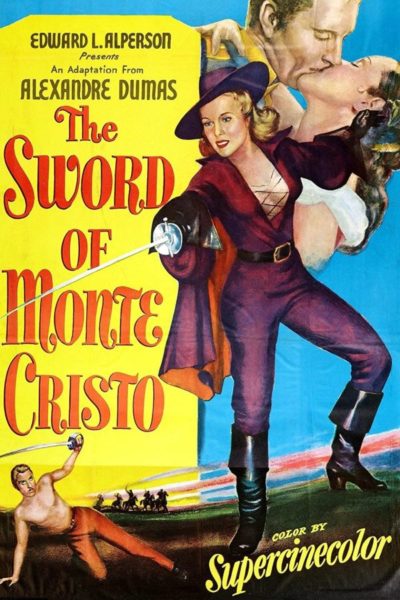 This 1951 movie is a bit clichéd. But then one has to consider that a lot of these weren’t clichés at the time the movie was made. That said, you will find everything here that you might expect from such a movie: A good king, his evil scheming brother who wants his throne, a dashing captain who has his way with the ladies, revolting citizens, a hidden treasure and a beautiful lady.
Though, and this is where the film diverts from the usual formula, said lady is actually the hero. Countess Christianne (Corday) is supporting the oppressed farmers and citizens against the dictatorship of King Louis Napoléon (the II. or the III.? I don’t know.) in 1858. But truth is Louis (David Bond) is not the real villain here, he was placed in the position of the king due to his brother, Charles LaRoche (Kroeger), because only someone named Napoleon was entitled to become king. LaRoche is the one who’s actual actions terrorize the people.
In secret, LaRoche is planning to overthrow Louis’ government and replace his ministers with people who serve and obey him. Lady Christianne wants to use the famous treasure of the Count of Monte Cristo (who was a friend of her late father) to finance the revolution, since the citizens and farmers have no means to buy weapons. When LaRoche finds out about that treasure, he imprisons Christianne’s uncle and tries to find out the secret code (embedded in Monte Cristo’s famous sword) that will lead him to the treasure.
Well, this is definitely not an adaptation of the Count of Monte Cristo novel by Alexandre Dumas as the title claims. As a matter of fact, it just uses the famous name, probably hoping to dupe audiences into believing they would see something based on the literary source. Casual name dropping is so much fun (e. g. Lady Christianne has a very big dog that she calls “Richelieu”!). It’s of course a typical product of its time, somewhere between the pirate movies, that were already on their way out of Hollywood, and before the glut of biblical epics that would soon invade the silver screens.
In Germany we call that genre “coat and sword“, I think in English it’s being called “cloak and dagger“? [Jim: I think those are more like spy movies: these would be… swashbucklers?] At that time these kind of historical adventure movies were very much en vogue. In 1948 The Three Musketeers with Gene Kelly had come out, and in 1952 Stewart Granger cemented his star status with Scaramouche. What makes this film stand out (and qualifies it for inclusion on this site) is the already mentioned fact that “Countess Christianne“ is the main hero here. In dark garb, she rides through the night, persuading the citizens who have almost given up on their revolt to continue the good fight, and appears with her large black hat and mask like a female version of Zorro.
Yes, the movie can’t entirely escape the attitudes of its time: There is the dashing charming Captain Renault (Montgomery) who, in a running gag, can’t for the life of him remember the name of the bar maid, with whom he obviously once had an affair. He seemed to have had quite a number of them. And of course, he’s attracted to Lady Christianne.
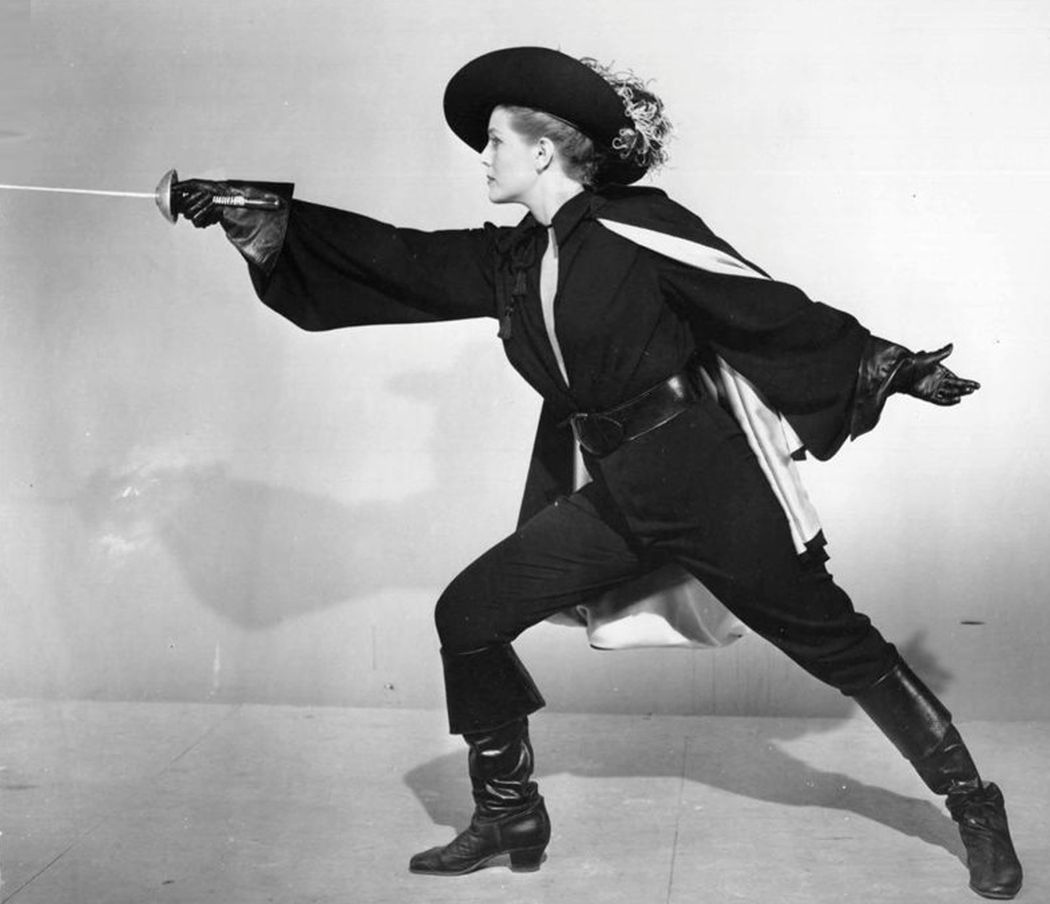 When he enters her private rooms, after she has just redressed as her normal self again, he takes – unasked – a seat and puts his shoes on the table. He also forces a kiss on Lady Christianne. When she snaps, “You don’t behave like a gentlemen should!“ he answers, “Well, you don’t behave like a woman should!“ You are left a bit baffled wondering how women in 1951 were supposed to behave when being kissed involuntarily, by an unknown stranger, who just entered your home through the window? But then even her nanny seems to agree (“A young lady shouldn’t run away from a man, she should catch one!”). How things have changed since that time!
Though, the Captain (to whom Lady Christianne is of course attracted to) is not really on the side of evil LaRoche. He is just bound by duty and will, in the end fight, and kill LaRoche as you expect from a man in love with the beautiful lady. So there is hope for this guy! The movie’s budget and time must have been very limited. Essentially, the feeling is you have just 4-6 locations, with one being the local pub, another the home of Christianne and her uncle, and one some grass fields with a bit of woods between those. But the movie never gets boring. Though it’s from 1951 it has enough movement, dynamic and intrigue to keep your interest through its short 76-minute run time.
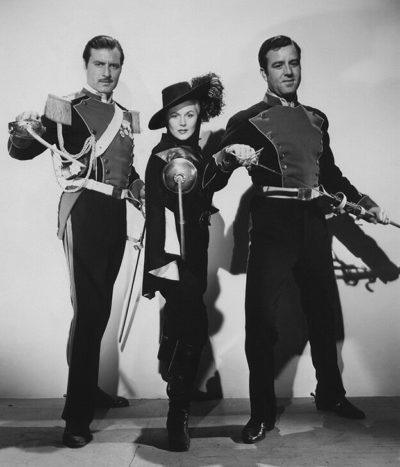 Countess Christianne does enough riding, fencing and chandelier-swinging to be rightfully included in the genre of female action heroines. Yes, she is not alone: Captain Renault comes across like a second-class Errol Flynn, supporting her and hinting as to her “true motives“ for cross-dressing and fighting (“You don’t fight against the king! I think, you are fighting against your female nature!“). Though Renault kills the big bad, she still has a mind of her own, riding with the Royal dragoons and killing off LaRoche’s right-hand man, Major Nicolet (Conrad).
I don’t know any of the actors in this historical adventure movie: Rita Corday was only in movies for a short time, from 1943–1954. On the other hand, Montgomery (of whom I’ve also never heard) had a very long movie career from the early 30’s to somewhere in the 80s. The only actor I recognize is William Conrad (playing the supporting role of Major Nicolet) who would later become a well-known TV-star thanks to his many series (Cannon, Nero Wolfe, Jake & McCabe). Here he is quite young but appears in good form when fencing.
Overall, Sword of Monte Cristo is a nice little classic movie that doesn’t hurt, yet isn’t a “must-see“. But considering the era it was produced in, it’s noteworthy: how many genre films do you know from this time where a female would be the main character? Though, it’s still no match for Anne of the Indies, which came out the same year.
Dir: Maurice Geraghty
Star: Rita Corday, George Montgomery, Berry Kroeger, William Conrad
 There is a good concept here. Unfortunately, rarely have I seen an idea so conspicuously derailed by dreadful execution. Let’s not get ahead of ourselves though, and begin by focusing on the positives here. Dawn (Morgan) is a truck driver who is on a cross-country route, and pulls off the road into a remote, wooded location for an obligatory rest stop. Barely has she come to a halt, when a terrified young woman, Phoebe (Gobin), shows up outside her cab, demanding help. She claims to have been abducted, and been held nearby. But she managed to escape from her kidnapper, who is now hot on her heels, with evil intentions. However, is the new arrival speaking the truth or is she dangerously deranged?
 This was a very pleasant surprise. I wasn’t expecting much from this, especially after seeing Wynorski’s name – let’s be honest, he is best known for bargain basement soft-port. That said, he does occasionally hit one out of the park, such as the sublime Deathstalker II. This is definitely one of his better entries, even if it is, by and large, a low-budget version of Assault on Precinct 13.
 This probably falls into the category of lightly amusing, rather than anything more. But I can’t say I was ever bored, and it’s assembled well enough technically that I can’t complain. The heroine is Mi-Young (Uhm), a former North Korean agent, who defected, changed her looks through plastic surgery, and now lives a quiet existence, with a part-time job selling pastries in the local market. She’s married to Seok-Hwan (Park), a computer repairman, and their life is frugal as far as wealth goes. Seok-Hwan, however, is wins a promotion run by a soft-drink company, getting them and their young daughter a trip to Hawaii.
 Rapace seems to be turning into a female version of Ryan Reynolds. By which I mean, it seems that hardly a month goes past without a new Netflix Original coming out starring her. Ryan had 6 Underground, Red Notice and The Adam Project. Noomi has given us
  I must confess I have not seen Confessions of a Homicidal Prostitute, to which this is a sequel. It’s marginally possible, I suppose, that the character development, story and nuance were present there, and explain why these are all but entirely absent in its successor. I would not, however, be prepared to bet on it. I suspect the original was every bit as mean-spirited as this: and “suspect” is all I’ll ever do, because I won’t be making any effort to track it down. In fact, I probably wouldn’t watch it if my aged mother begged me to on her death-bed. Too harsh? Perhaps. Yet I don’t think I’ve ever seen a flat-out
  This one is slightly unusual among action-heroine films, in that it was both written and directed by women: Kirsten Elms and Kari Skogland respectively. Unfortunately, it’s not exactly an advert for their gender; after a brisk start, it falls apart, and becomes a ridiculously implausible movie, in a completely different genre from where it started. That’s a real pity, because where it started, had a lot more potential than where it ends up. It begins with Sage Rion (Manning), a young but highly-talented thief, taking a bet with her partner, as to who can boost a classic car quickest. She picks a 1966 Dodge Challenger, but inadvertently leaves her ID at the scene of the crime.
 This is certainly an odd animal. It takes place in and around a Thailand hospital, where one of the physicians, Dr. Tar (Jarujinda), has a lucrative side-scam in selling bodies to… well, if it’s not clear who, there appears to be sufficient demand for them. He is in cahoots with a group of seven nurses, but one of them, his girlfriend Tahwaan (Wachananont), finds out he is having an affair with her sister, Nook (Rujiphan). After she threatens to go to the police, Dr. Tar and the other six nurses kidnap and kill Tahwaan. However, her spirit comes back from the grave, to take brutal vengeance on those responsible for her death. Naturally, the peeved ghost starts with the characters who bore relatively minor culpability, working her way up to Nook and the not-so-good doctor.
 That’s what happened here, about a month ago,with Quinn wanting to move in the direction of engagement and marriage and Nadia not willing to, leading to a messy breakup that left him very hurt and her “feeling like [vulgarism deleted].” :-( On top of that stress, when this book opens, she’s in rural Michigan on a job (of the kind that she doesn’t advertise). That quickly results, though through no fault of her own, in a traumatic event which has her on the point of meltdown. But before long, she’s in for a moral and emotional ordeal which will make her present distresses look relatively mild.