




★★★
“Live to fight another day?”
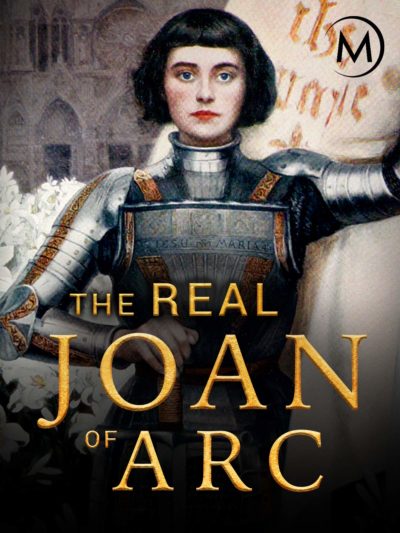 Pun mot intended, but the reality is, we know very little for sure about Joan of Arc. Not even what she looked like in detail, for there are no surviving portraits of her, dating from when she was alive. The facts about her life are equally as uncertain, because everything about Joan was subject to spin, depending on who was talking, when they were saying it, and what agenda they sought to achieve. Because everybody involved had an agenda of one kind or another: either elevating Joan up to the level of literal sainthood (finally achieved in 1920, almost half a millennium after her death), or tearing her down, as a tool of the Devil. Even basic facts – was Joan a shepherd when she was young? – are uncertain, with contradictory testimony.
It’s really in that light you need to view all this documentary shows. Indeed it largely opens by admitting to the above. This opens the door to questioning the standard narrative, in which Joan is a humble farm-girl, who heard divine voices and was inspired to lead France to fight back against the English invaders. However, I was also left with as much doubt about the alternative suggestions the film provides, because the evidence for them is little if any less sketchy. These theories are certainly interesting – and from a secular viewpoint, elements are perhaps no less plausible than the “voices of God” explanation. On other hand, it feels as if they raise as many questions as they answer.
The first is the suggestion that Joan was actually of noble birth, perhaps an illegitimate child. This could explain things like her reported ability to ride and wield a lance, and speak “proper” French, rather than the coarse dialect of her village. She was, in effect, created for the specific purpose of becoming a figurehead. It’s an intriguing idea – though given events unfolded over a period of several years after she came to public attention, whoever was responsible clearly had to be playing a remarkably long game. It is, though, small beer beside the theory which occupies the second half: Joan was not burned at the stake, but survived, resurfacing a few years later as Jeanne des Armoises, getting married and living a whole second life.
Yeah, big if true. The evidence for this begins with alleged oddities around her death. Joan’s head being covered on her way to the stake; an unusually high pyre; hundreds of English soldiers keeping the locals at bay. Yet there were a lot of people who were present, and subsequently provided, albeit years later, sworn testimony as to her fate. It would have been a remarkable cover-up, to put it mildly. I’m more convinced by the second element: someone, representing herself as Joan, did resurface a few years later, even getting as far as the royal court and meeting Charles VII of France. However, most accounts agree that de Armoises ended up admitting to the fraud, being unable to tell the King information Joan would have known.
I still enjoyed watching this, and the intellectual exercise it provided. It’s always good to keep an open mind about history, and contemplate alternative scenarios, whether they pan out or not. Though some of the recreations leave a little to be desired, this is a decent, well-assembled piece, with good “talking heads”. It did give me pause for thought, and no documentary which does so can be considered a failure.
Dir: Martin Meissonnier
Star: Marcel Gay, Francoise Michaud Frejaville, Colette Beaune, Philippe Contanime
a.k.a. Vraie Jeanne, fausse Jeanne
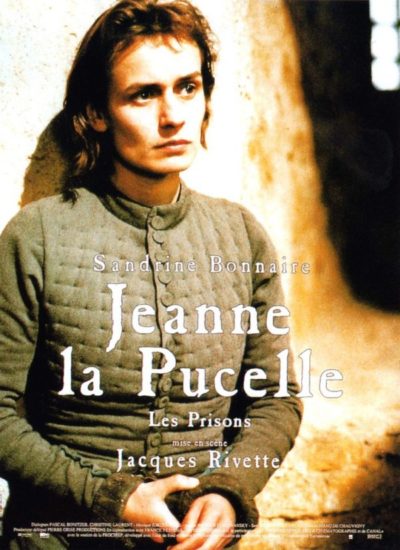 Just as part 1,
 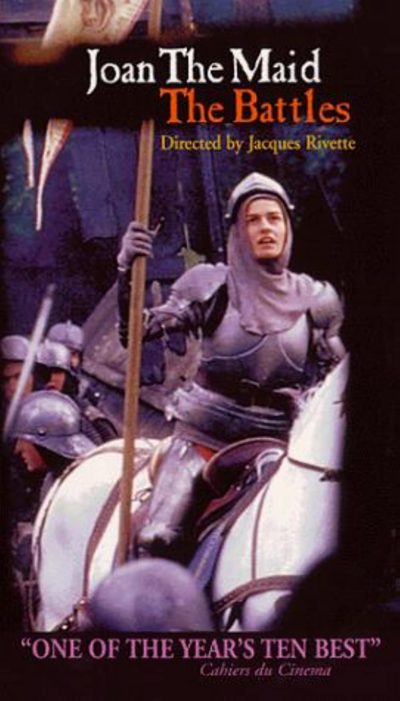 The above refers to the title, and in particular “The Battles”. It is a solid two hours before anything more than handfuls of English and French troops lobbing rocks at each other show up. So if you are here for large-scale spectacle, keep on walking. You will be disappointed. I had a certain idea of what to expect, having seen Rivette’s immediately preceding film La Belle Noiseuse. Admittedly, I saw it largely because I had the hots for Emmanuelle Beart at the time. Otherwise, a four-hour movie, containing lengthy sequences of real-time painting would probably not have been on my radar. But I kinda liked its languid pace (the copious Beart nudity didn’t hurt, let’s be honest!), and so was prepared for things in this to unfold at a similarly leisurely pace.
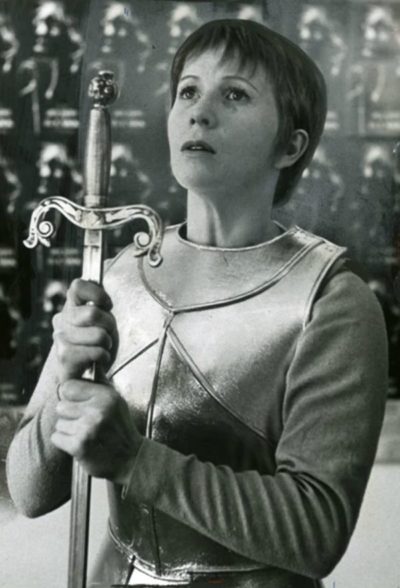 This was originally a French play, L’Alouette, written by Jean Anouilh in 1952. Three years later, a translated version was brought to Broadway, where it ran for 226 performances from November 1955 until June 1956. Julie Harris played Joan, and there was quite a star-studded cast behind her, including Boris Karloff as Bishop Cauchon, Christopher Plummer and Theodore Bikel. It was critically acclaimed, Harris winning that year’s Tony Award as Best Leading Actress, and Karloff being nominated as Best Leading Actor. The following February, a TV adaptation was screened in the United, though wasn’t the first or the last such. In November 1956, the BBC screened their version, with Hazel Penwarden as Joan, and a supporting cast including Michael Caine. Additionally, 1958 saw an Australian version, though it seems notable only for having Olivia Newton-John’s father in the cast.
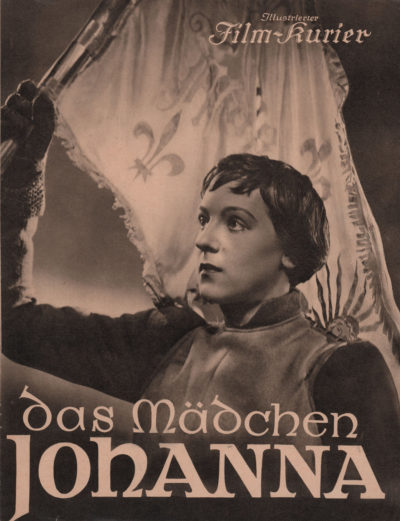 It’s basically impossible to separate this from the time and place in which it was made: that being Nazi Germany, just a few years before the outbreak of World War II. The portrayal of, not only Johanna/Joan of Arc, but the rest of the participants, has to be read in this light. It certainly explains why neither the English nor the French sides exactly come over as covered in glory. From the former camp, we have Lord Talbot, who is cruel to an almost cartoonish degree. On the latter we have King Charles VII (Gründgens), who is cynical to a fault, and has no qualms at all about using Joan when convenient, then discarding her when she isn’t.
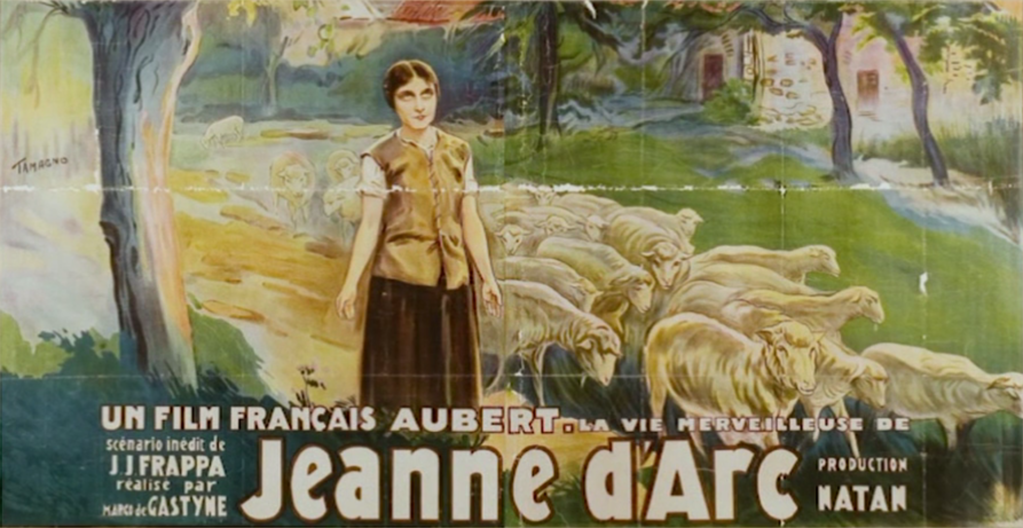 ★★★★
★★★★ I generally make it a rule not to review foreign movies without subtitles, simply because it’s difficult to judge them reasonably if you can’t understand them. I made an exception for this 1929 French film for a couple of reasons. Firstly, it’s silent, so comprehension is limited only to the intertitles: I can read the language better than I can understand it spoken. Also, it was approximately the eleven millionth version of the Joan of Arc story I’d seen in the past month: I think I had a pretty good handle on the plot by this point. Boy, am I glad I did, because it’s the best silent film I’ve seen, albeit in my quite limited experience of them.
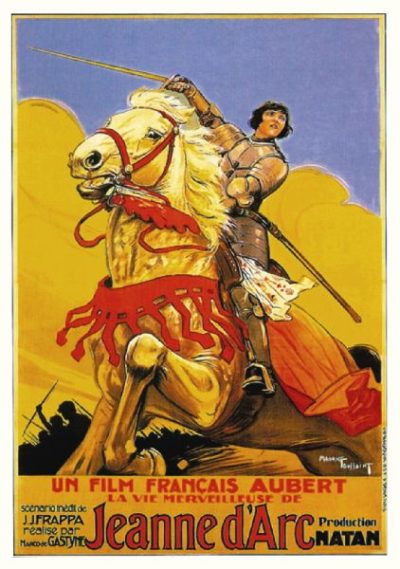 History has largely forgotten this version, in favour of Carl Theodor Dreyer’s La Passion de Jeanne d’Arc. Both movies were produced concurrently, interest in the topic apparently having been spurred by the canonization of Joan at the start of the twenties, and the approaching 500th anniversary of the events in her life. However, delays during filming meant this adaptation was beaten to the cinema by Dreyer’s. It perhaps was also impacted commercially by the arrival of the new-fangled “talkies”, leaving silent movies like this looking old-fashioned. Half a century later, the film was eventually restored, and can be found on YouTube as well as
 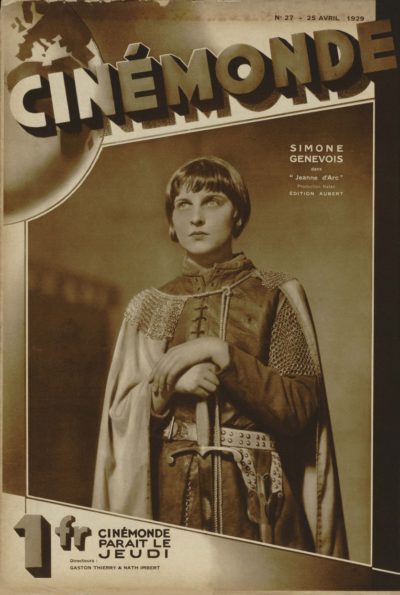 Then there’s the burning at the stake, another scene which came uncomfortably close to historical accuracy for Genevois. “The moment the wood caught fire I yelled ‘It burns!’ [The director] Marco was so sure I was afraid, that he did nothing at all. All of a sudden the cameraman, Gaston Brun, shouted ‘She’s burning!’ and everyone ran towards me, because I was tied up and couldn’t budge. I was very frightened.” Even putting that aside, there’s no denying the emotional wallop it packs, particularly in the extended shot of Joan walking towards her death: Simone’s face, again, sells this in a way which left me genuinely distraught. This doesn’t happen often, and never before while watching any silent movie.
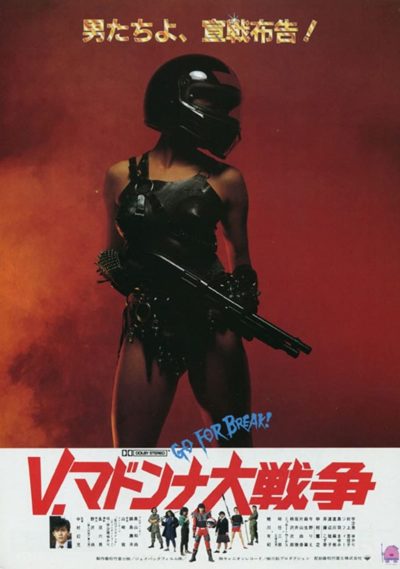 I have so many questions about the Japanese education system after watching this. It takes place in a high school whose student council is repeatedly being squeezed for extortion money by the Yagyu, a local biker gang. They ride up to the place, beating up and terrorizing the students, and generally making a nuisance of themselves. Where, exactly, is the principal when all this is going on? Teachers? Concerned parents? There is a throwaway line about how reporting things to the police would only make the gang attack harder. But you’d think
 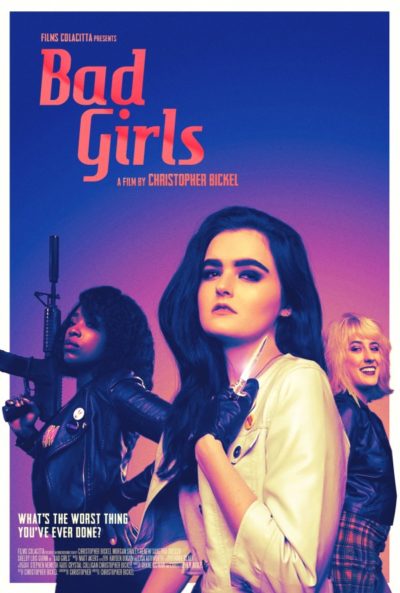 I didn’t realize until this started, it was by the director of the (non-GWG)
 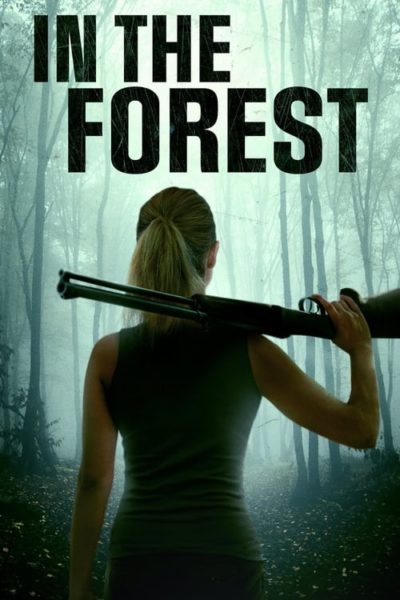 Three generations of a family take a trip into the woods in their mobile home. There’s grandfather Stan (Ward), his somewhat neurotic daughter Helen (Ayer), whose life has been falling apart around her, and Helen’s teenage daughter, Emily (Spruell), for whom a weekend in a forest with old people is
 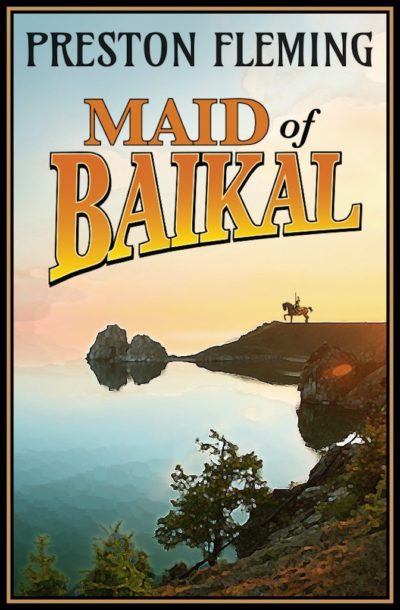 I have always been intrigued by alternate histories. These are bits of speculative fiction, which are based on a “What if…?” premise. For example, what if Napoleon had won the Battle of Waterloo? Or what if John F. Kennedy’s assassination had failed? Creators speculate on the way the world might have changed, in ways big and small. I find such creations endlessly fascinating, giving me a strong suspicion that, at certain points, history teeters on a razor’s edge, where a seemingly insignificant event can have an impact far beyond its scale. Here, it’s a single person who changes the course of history. For what might have happened, had Joan of Arc turned up, not in medieval France, but in Russia, during the aftermath of the 1917 revolution?