




 ★★★
★★★
“Third time’s the charm?”
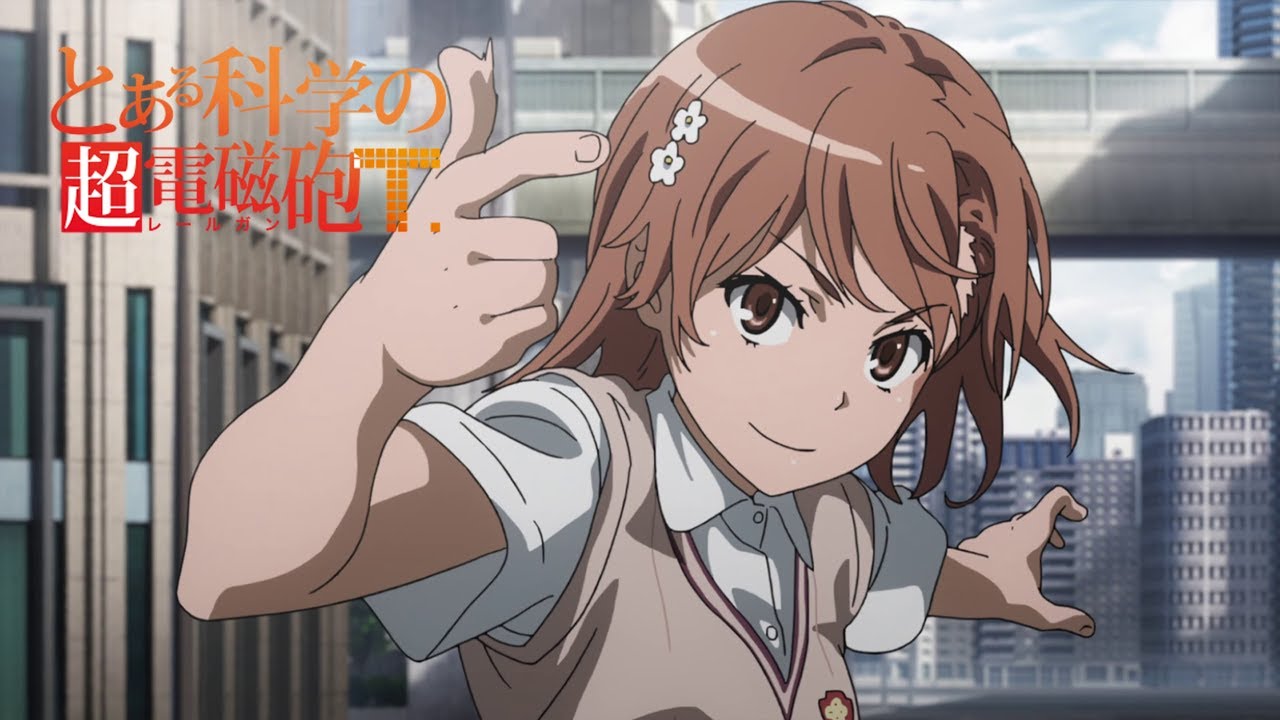
A lot has happened in the Certain Scientific universe since the second season of Railgun. There had been an OVA movie, which I won’t review here; it is less a Mikoto Misaka story, than a team effort across the different shows, with Index, Railgun and Accelerator working together to solve a case that was too big for any one of them alone. Mother show Index had a third season, whose story played in Russia, introduced an evil Misaka clone called “Misaka Worst” and dealt with the prevention of World War III. The villain of Railgun‘s second season, Accelerator, had become an unlikely anti-hero, now working on the side of the angels – though still nasty in his usual way. He had gained a sidekick, in the form of an underage Misaka Mikoto clone. Finally, our heroines also got a third season.
All of this, except the OVA, happened within one year! Obviously, this big universe – dare I compare it now to the size of the Star Trek universe? – had attracted more and more interest and fans over the years, so creating studio J.C. Staff decided to come back and produce more. After all, the anime business is exactly that, a business, and like any other depends on its sales. With Kazuma Kamachi, the series creator, constantly tossing out new volumes there was no lack of new material. And after watching the new seasons, including the third season of Railgun, I can come to two main conclusions.
Firstly, I love this universe. I got so accustomed to it, its characters, their behaviour, the story-lines and so on, that I will always be here when new animated content for them comes out. Though I must confess, I have only made it through the end of the 7th volume of the Railgun manga. I haven’t much time on my hands, sorry! Secondly, while I love the anime series (and will always recommend the other shows to those who liked this), probably nothing will ever beat the “sisters arc” of Railgun – S. I’m sorry, but all the other story-arcs, as good as they may be, never come close to the emotional impact this specific story-line had on me.
That said, season T is still very good, manages to raise the stakes and is recommended entertainment, if you like this kind of anime show. Once again, new characters are being introduced, though quite a number of episodes were, to me, wasted on a story-arc that was not that interesting. It was a similar feeling I had when watching the “Febri story arc” of Railgun – S. In the end A Certain Scientific Railgun stays a mixed bag – although I would also say that about many shows, e. g. The X-Files. Naturally, your mileage may vary: you may like or love some aspects or episodes of a show and not be so interested in others, then someone else may see it totally differently. That said, let’s go in media res, shall we?
 The first new arc deals with the “Daihasei” festival in Academy City – essentially a sports event, where the different schools compete with each other. Nice to look at, also very funny, but hardly life-threatening. Or so you may think in the beginning: these stories have a tendency to develop from harmless to world-endangering. For the kidnapping of one of the Misaka clones, as well as Saten investigating an urban legend, as she did in previous seasons, lead to something much bigger than anyone could have predicted. Newcomers to the series, include Shokuhou Misaki, another of those rare level 5-espers, who can control people and read their minds with the help of something that looks like a TV set. She seems to have a personal beef with Mikoto. Also new is Sogiita Gunha, whose special power is that “he has guts”; this may not sound much, yet he does some impressive things with it.
In the background, people are pulling strings, since obviously this event serves as a showcase for espers. The powers that be have realized, given the events of the previous two seasons, that espers aren’t as easily controlled and exploited as they hoped. As we know, Academy City is kind of a proving ground for these dark scientific forces. This all turns out to be a trap for our favourite railgun by evil scientist Gensei Kihara. This unscrupulous scientist seems to have been heavily involved in – or maybe even the catalyst for – the experiments that endangered the students of Academy City and our heroes in season one and two. But this is the first time he appears in person. With all his knowledge and abilities accumulated from his “test subjects” he is indeed a formidable threat.
His actions are directed against Mikoto, forcing her to become a “level 6”, something only one level 5-esper – presumably Accelerator – would be able to maintain in stable form. It would cause the person that Misaka Mikoto is, to dissolve and vanish – but not before blowing Academy City to kingdom come. Our heroine finds herself helpless, and in order to be saved needs all her friends. That’s one of the things I love about the show: it’s generally a team effort. Even when you have a story arc like Railgun S, when Mikoto thought she had to do it all alone, she realizes it is good to have a little help. Everybody contributes according to his or her abilities to the bigger whole. Okay, Accelerator is absent, but he was probably too busy starring in his own spin-off series, A Certain Scientific Accelerator. And they are all so damn noble:
- Touma, who never hesitates to put his life on the line for everyone, but especially for Mikoto,
- Kuroko, who comes out of her wheelchair to fight a dangerous hench-girl
- Mitori Kouzaku, who can create some kind of “evil clay doll” versions of herself and works for Gensei Kihara
- Kongou, who ends up in hospital for helping Mikoto, and has become a cool, noble character compared to the arrogant school princess who arrived in season one
- Shohuko Misuki, who almost loses her life – though less for Mikoto than saving the entire city.
- Sogiita, who is such a cool, sympathetic hero, giving all he can. If he starts to bleed… well, he realizes he “just has to put some more guts into it”!
What results is a “three-front war” with all those different protagonists fighting to prevent the Gensei Kihara’s mad-cap evil plan. Saving the world – and Misaka – is not a simple thing, and as seems to have become a tradition for the series, after such an almost “overkill” arc, the next story it delivers is inevitably less interesting. It can’t hope to compete with what has happened before, though I personally have made my peace with this. After all the excitement, you can use something to calm you down. Unfortunately, those episodes feel like a chore for me as they come across like lacklustre time fillers. Again: I guess you have to eat the vegetables, too, after you had your T-bone steak!
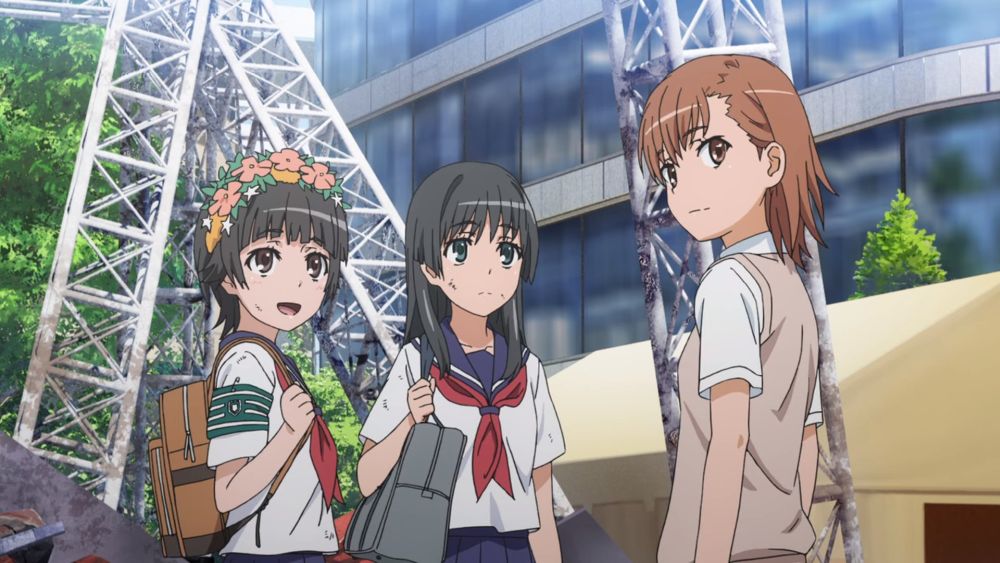 Time is spent on the “Dreamranker” Indian Poker game cards arc. When put on your forehead, these can make you relive the dream whoever made the card has dreamed before. While the concept itself is interesting, not enough is done with it. After having saved Mikoto from becoming a level 6, this is just “nice”, and a little bland. For example, an entire episode is wasted on Mikoto and another girl seeking a card that is said to be “the bust-upper” – that is supposed to do what the name suggests. Though, the story takes a curve (as it were!) with a mysterious girl Kuriby Ryouko making a human-looking machine to help her sick mother. It results in a clash not only between the girl and her machine, who wants to take over her life, but also Mikoto and a girl-gang called “Scavenger”. In the end it’s up for our favourite railgun again, to battle against the over-powerful android that threatens to destroy Academy City.
While the finale is again visually fulfilling and full of action, it can’t quite match up to the first story-arc. But then, Mikoto was more the victim of circumstances there, who had to be saved by her friends. In the second, it’s her fighting her own battles again. The last episode feels again like treading water after the big battle. So we get the usual “girly stuff” like villainesses undressing each other (face it, the show is not above the usual titillation!), girls lying in hospital, and the usual confusion with Kongou meeting one of the Misaka clones.
Overall, you leave the third season with a satisfied feeling of having had another good meal. You know what you came for, and you got it. I can’t watch the ending without being slightly touched, and feeling it was already a small miracle the show would come back after all those years. Now it’s over – or at least, in another hiatus until the powers that be decide the time is right for a fourth season. Until then, I agree with Mikoto and her friends, when the show’s catchphrase is delivered: “There never is a dull moment in this city!” And they’re right; there certainly never is!
Dir: Tatsuyuki Nagai and others
Star (voice): Rina Satō, Satomi Arai, Aki Toyosaki, Kanae Itō
 ★★★★
★★★★ Have you ever had this experience? There is a series you see and the series is fine, okay, solid. But without you noticing, you connect with these characters subconsciously, on an emotional level. As you watch them regularly, you get accustomed to them (though they are totally fictional) and don’t realize it until something happens, and you suddenly feel how much you have gotten attached to them. It’s not a new experience for me. It happens from time to time, but not often enough I would call it a rule, every time I watch a new TV show. Usually, I just passively experience the respective episodes and don’t waste much thought on it, least of all any kind of emotional investment.
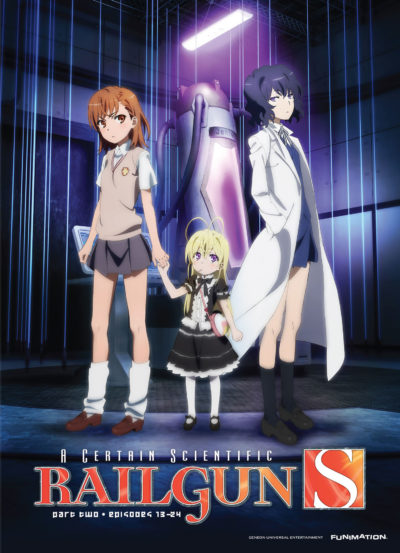 Another strange thing occurs. Somebody is leaving envelopes containing money in small, dark side-streets, leading to people going on their own treasure hunt, and Mikoto & Co. try to find out who’s doing that and why. The story constantly builds and you slowly realize that you are paying much more attention to the show then you ever did before. When Mikoto finally meets her doppleganger, it’s initially almost a shock. It leads to questions: who is the girl, why is she behaving so strangely, and where does she come from? Mikoto indeed has “sisters”. Actually, a lot of them. And these girls are part of an unethical and inhuman experiment.
 After this very well-built, suspenseful story arc, running from episode 2 until episode 16, I can understand why some felt the remainder of this season was a bit of a letdown. While we get another arc, the new one can’t quite compete with what happened before, though is decent on its own merits. For a while, we go back to small stories of the girls getting together and the usual jokes like e. Saten pulling up Uiharu’s skirt to embarrass her. Yes, that’s a thing. It’s alright by me. After you have clashed with the Big Bad, it’s
 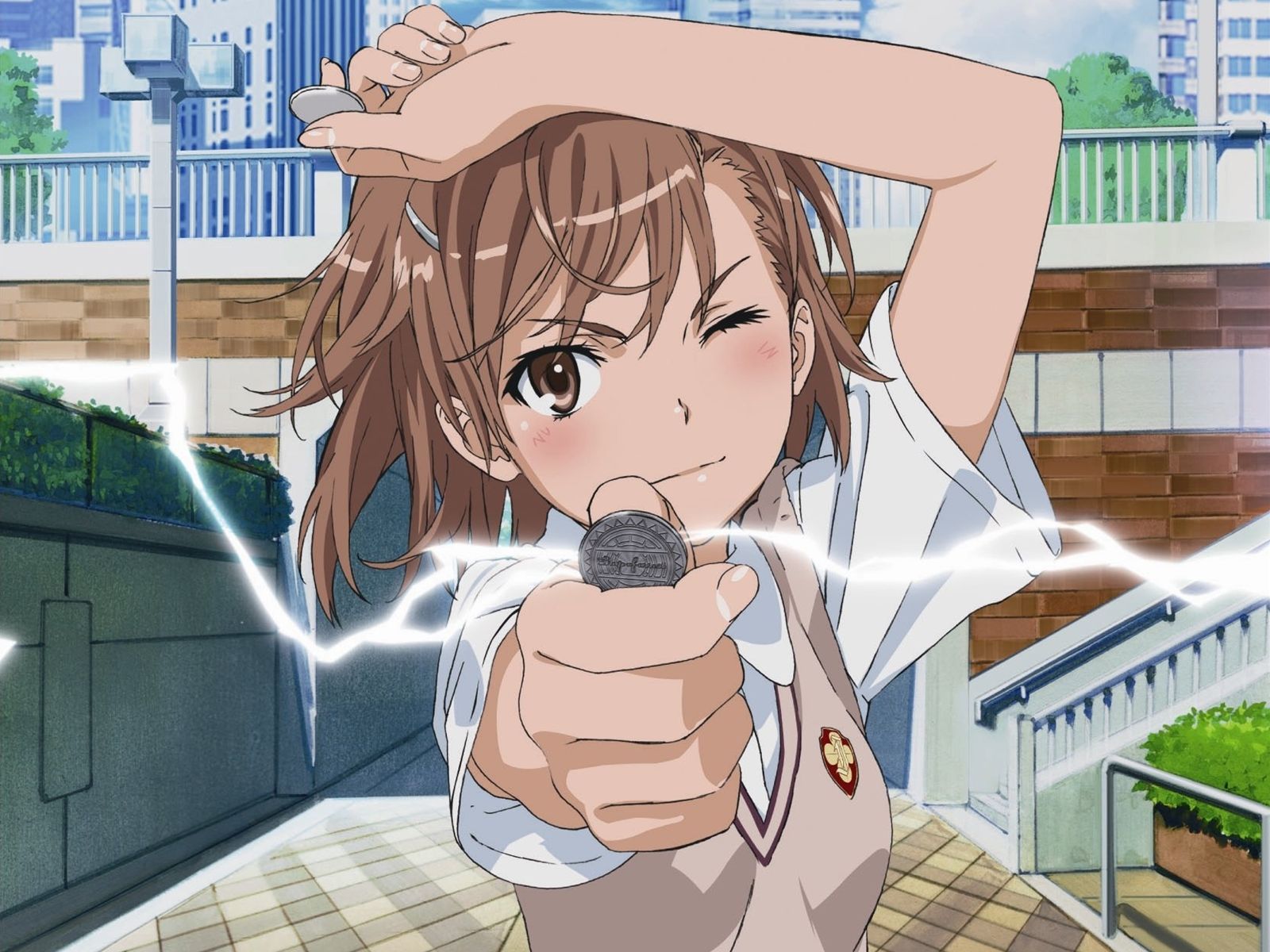 ★★★
★★★ Misaka is an esper of the highest degree, level 5. And while she is one of only seven level-5 espers in Academy City, this is not as unusual as it may sound at first. For the whole city is filled with students that Charles Xavier would probably have called “extraordinarily gifted”! They are all learning to develop and use their abilities at school, though for what purpose I still have not found out; is there a job market for those kind of abilities? Still, given their powers it’s a very sensible thing to do, since otherwise the students might easily misuse their powers.
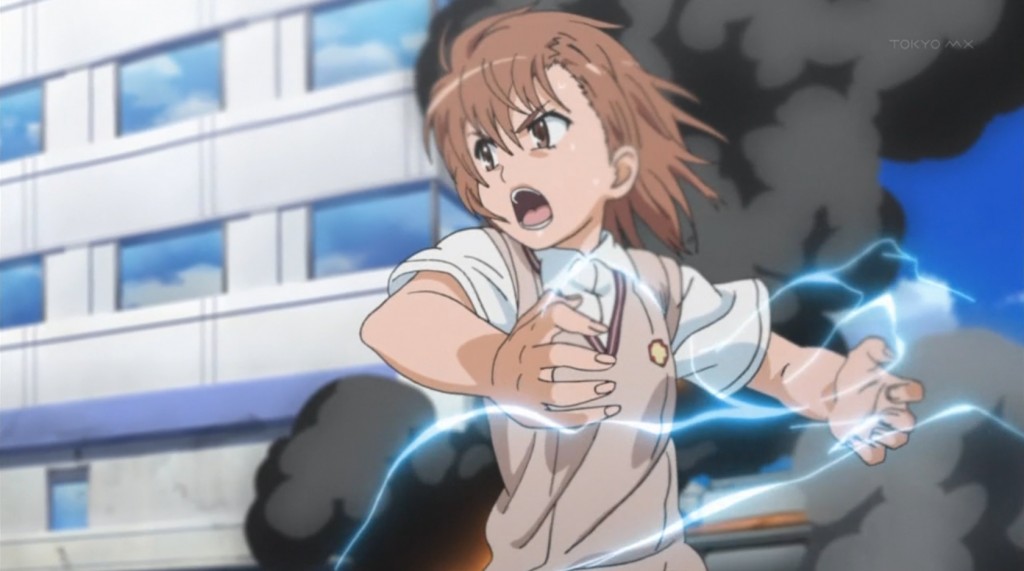 These powers are what gave her in the previous Index show the name of “Railgun”- in her words, “because even objects of a minor size can generate an enormous power when thrown with enough energy in one’s direction”. She also comes across Touma, the main character of Index, who embarrasses her when he tries to rescue her from the company of some teenage boys. Unfortunately for him, she takes his well-meant help as a personal insult, which leads her to constantly challenge him to a fight. Unfortunately for
  The structure here is kinda odd. While each of the three volumes included in this omnibus are effectively standalone stories, they each feel so slight as almost not to be worth bothering with. In particular, there seems to be a
  Mary (Kessell) has a grudge, and probably with good reason, I’d say. Because the serial killer known as Diablo killed her daughter, Kelly, in a particularly brutal manner – finishing his victim off by burning her alive. With the help of information provided by FBI Agent Selena Wall (Adedeji), Mary puts the pieces of the case together, and eventually lures Diablo (Howard) into attacking her, then brings him back to her house. This has been turned into a hi-tech, maze-like warren designed to force Diablo to confront all his crimes, and in particular his murder of Kelly. Naturally, things don’t quite go as intended. Expecting rational, predictable behaviour from a serial killer was probably a mistake by Mary, despite her technological advantages.
 There’s an old joke about bad movies: “This film wasn’t released, it escaped.” It seems disturbingly appropriate here, however, considering the shooting of this finished in October 2021, and it has been part of our annual previews for 2022, 2023 and 2024. Quite why Netflix sat on the end product close to three years, I don’t know. But having watched it, I can confidently say: it wasn’t long enough. This is the kind of movie that left me feeling actively more stupid by the end of it. Alba plays Parker, a soldier who returns to her hometown in rural New Mexico after her father is killed in a mile accident. Only, of course [and that whirring sound is my eyes rolling], it turns out not to be an accident.
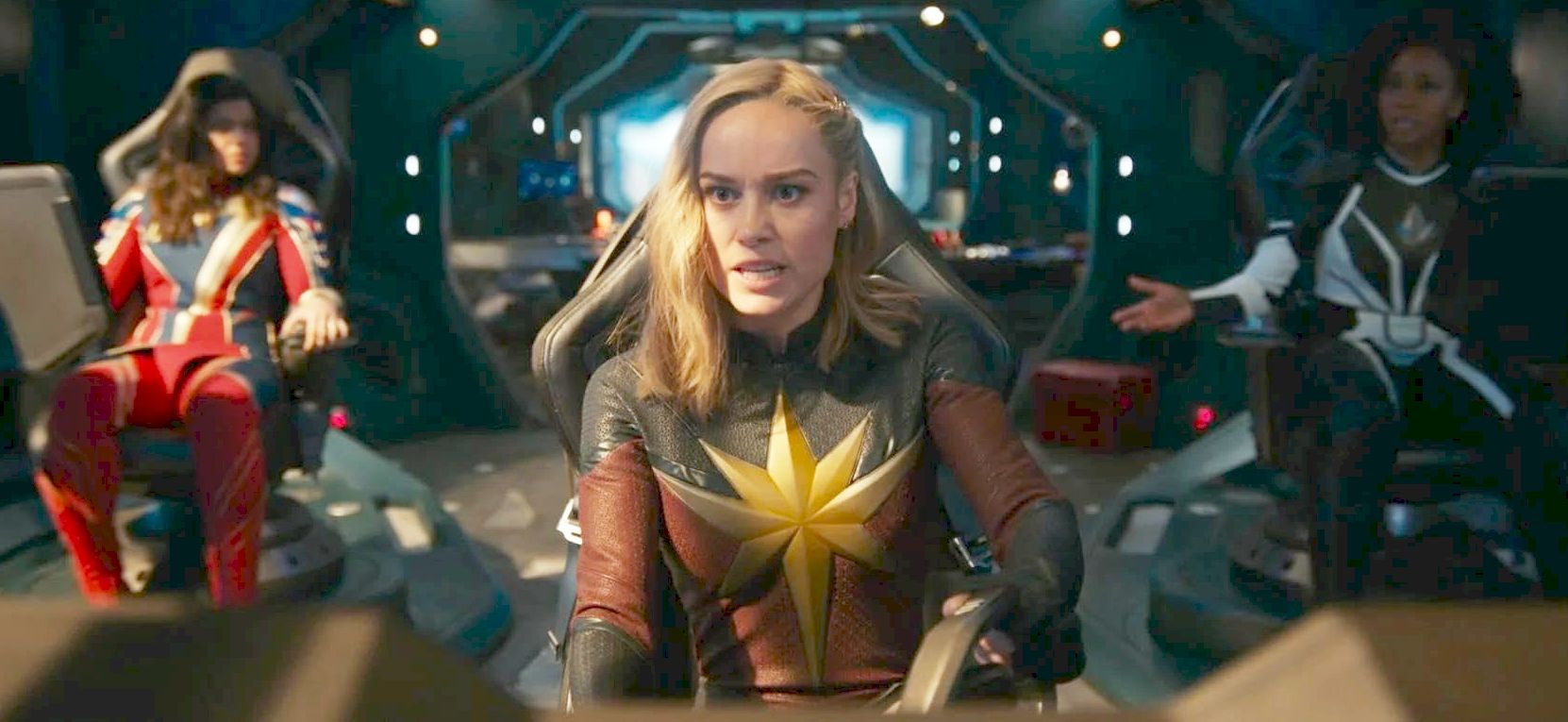 ★★
★★ It’s worth mentioning a couple of reasons I don’t think had much impact. Some suggest the actors’ strike handcuffed the film, preventing the stars from doing publicity for it. Others blame a backlash against women-led movies. But neither of these seem to have affected other entries. For instance, you might have heard of this little woman-led film called Barbie? It did okay, or so I’ve heard. You don’t need to invoke conspiracy theories to explain The Marvels‘ failure. The fact it’s taken me, a devoted fan of action heroine movies, more than seven months to get round to watching it, probably tells you all you need to know.
 This starts off strong, with an attention grabbing scene where a woman gets a visit from a plumber. She offers him a glass of water, and… Things do not go as expected. For the woman is Jessie (Shay), a psychiatrist on a mission. She has made it her purpose in life to punish paedophiles whom she feels have been too lightly punished by the law. The man is one such, and it does not end well for him. Specifically, he is stabbed, and buried in a shallow grave, deep in the Australian outback. Safe to say the film has got my attention. Unfortunately, it’s more or less downhill all the way from here.
 This ended up turning into an Internet investigation. The title above is the one by which it appeared on Tubi. But it’s clearly pasted onto the opening credits, and I ended up having to go through the IMDb credits for the one identifiable actress to find it there – where it appears under another title, with some promo materials giving it a third name. The end credits are entirely in Chinese, and provide absolutely no information as to who is playing who. So that also had to be pieced together. But least helpful of all, were subtitles that may be generated by a drunk AI, operated by a seven-year-old
 However, there are definite flaws in Brandvold’s craftsmanship here, starting with chronology. John Bass served in the Mexican War, after which he married and settled in Kansas. The Bass family graveyard on the homestead is said to hold the remains of an infant sibling who died over 20 years before 1865 –in other words, before 1845, and the Bass twins would have been born ca. 1849. But the Mexican War was fought from 1846-1848. There isn’t time between Feb. 1848 and the end of 1849 to fit in John Bass’ post-war activity, subsequent courtship and marriage, the couple’s move to Kansas, and four pregnancies prior to Reno and Sara. (And Kansas was not even opened for settlement until 1854.) If his general knowledge of U.S. history didn’t furnish red flags here, very basic research would have precluded these kinds of mistakes.